Research, or the Lure of the Rabbit Hole

by Janis Patterson

There’s nothing more frustrating than a novel which mangles history. Unless, of course, it is alternative history (at best a bastard genre) and clearly labeled as such. What raises my ire is when someone writes what is purported to be historical fiction but has such factual clangers in it as to stop the reader cold. My favorite example of this is from a contest I judged when a Regency hero – handsome, wealthy, arrogant as all of them are – pulls a fountain pen from his pocket to sign some important document.


Really? A fountain pen?


The bladder fountain pen that we all know wasn’t invented for at least fifty years after the Regency. Even the steel-tipped dip pen wasn’t invented until after the end of the Regency. Before that, writing was done with feather quills, usually goose.


Of course I dinged the writer severely for not doing proper research, and sent a rather kindly note of explanation of her low score, hoping to raise her consciousness about the necessity of research. Instead she attacked me viciously, not only in a private letter but on social media, ranting that it was an old-fashioned pen and who would know the difference anyway.


And there is the crux of the matter. Far too many people get their ideas of history from novels (and movies, and TV) and therefore as writers we owe them the honesty of real facts.


Such a high-minded ideal is not without its dangers to us, though. I was working on a fairly early Victorian Gothic where my librarian heroine had to make some ink. Now I knew she couldn’t just pop off to the allsorts shop in the village for a bottle, so I went online and looked up how to make ink.


Who knew there were so many ways to make ink? And there are so many people making it today? Well, it was a plethora of information and I started reading happily. Only thing was, I realized that some of the recipes used items to which my early-Victorian-working-in-remote-Scotland heroine would have no access. But I had to make sure of what was available, which took me to botanical sites and shopping sites and each of them led to other sites, most of which had little to nothing to do with Scotland, libraries or ink, and before I knew it hours later I was deep into the intricacies of making Scottish country cheese. Still don’t know quite how I got there, but it was fascinating.


Now I don’t know if I’ll ever need any minutiae about the making of country cheese in Victorian Scotland, but it did give me a deeper insight into the Scottish rural people of the time, their lives, their chores, their way of living. Besides, I believe that everything is useful in some way, some time, some how. Who knows when some snippet of rural Victorian Scottish life/mores/cheesemaking – or something influenced by them – will show up in a totally unrelated story? It’s one of the dangers and the magic of writing!


Doubtless by now you have figured out that I like research. And, having an inquiring (some say nosy) mind, I must admit I do. It’s one of the most fascinating things in the world. And one of the most dangerous. It can take hold of a story, turn it every way from up, then hand it back to you in a form totally different from the way you originally envisioned it. Or, if you are strongminded enough to corral your story to its original form, those little snippets of research are still there, adding depth and shading – and an occasional surprise – to your story.


A prime rule of good writing is Do Your Research. Another rule of good writing is Do Not Let Your Research Take Over. Usually I manage both, but it’s most definitely a delicate balancing act.

Guest Blogger ~ Claudia Riess

Choosing to write an art history mystery series came relatively late in my career, but the seed was planted very early in childhood, and was as much a part of the natural course of events as learning to read and being read to—Winnie the Pooh, Mary Poppins, Alice in Wonderland—and being told laugh-out-loud stories, ad-libbed by my father, about a little girl named Jeanie, clearly my alias, and her adventures with her anonymous daddy, clearly my own.  And like bedtime stories, my introduction to art—my association with art—was, and is, bound up with family, adventure, safe harbor. 

It began with outings to museums.  We lived in Brooklyn, and a couple of the great ones were a short subway ride away.  The Metropolitan, the Museum of Modern Art, the Frick, the Brooklyn Museum.  Typically, these outings were followed by take-out Chinese food and talks around the kitchen table about what we had seen that day.  We talked about the different ways painters saw the world; debated about which perspective better described the real world—and what the real world really was.  Color and light?  Shape and dimension?  And what about imagination? Created imagery.  Distorted reality.  Ideas about the relative nature of beauty and truth were woven into these conversations, and all the while we were savoring our chicken chow mein and fried rice with lobster sauce.

It stands to reason that my idea of the art world was a romanticized one, but by the time I’d written a few rom-com-like novels and murder mysteries and was considering writing an art suspense novel, I’d learned a lot more about its seamier side.  How the price of art is virtually uncontrolled, dependent on the whims of collectors and dealers and the transient tastes and fads of the times.  How art is ransomed, forged, used to launder money, stolen then sold on the black market.  In short, that the art world is where the most sublime of human instincts collide with its basest.  What a great amalgam for fiction!

I pitched the idea of my writing an art suspense novel to my brother, Jonathan, an art history professor at the University of Cincinnati, and he off-handedly suggested, “What about finding a lost study of Michelangelo’s Battle of Cascina?”  As he enlarged on the subject, a conversation I’d had years ago popped into mind.  It was my first week at Vassar College, and I was out of my social depth, trying to hold my own with one of my classmates, a seasoned debutant.  I suppose the incident remained etched in memory because our life experiences were so disparate.  Especially vivid was the story of how her father’s sugar plantation in Cuba had been confiscated by Fidel Castro’s government.  It was this historical nugget that instantly dovetailed with my brother’s suggestion.  In that moment, the American sugar plantation owner became an art collector, and as he and a freshly materialized plantation manager and a lovely cook’s assistant hid out in a basement storeroom, the art collection was being hauled off by a band of wannabe Castro rebels looking to raise money to buy arms.

The imagekicked off the prologue to Stolen Light, Book 1 of my art history mystery series.  I’m a stickler for historical accuracy, and as a rule I take off from it, filling the gap with events that conform to its character, and therefore might have been.  Then, in a butterfly-effect maneuver, I fast-forward to the present and drop a pair of resourceful lovers into the challenging set of circumstances that has developed—multiple murders included—and see if the sleuthing duo can sort it out. 

For example, the impetus for Knight Light, Book 3 in the series, came from two quotes.  From the painter Marcel Duchamp: “Not all artists are chess players, but all chess players are artists.”  From World Chess Champion, Alexander Alekhine: “Chess for me is not a game, but an art.”  From there, I discovered that the two had actually been team-mates on the French chess team in the 1933 Chess Olympiad.  And that furthermore, Alekhine’s death in 1946 has been considered a cold case to this day.  My fiction, integrated with the facts, took off from there.

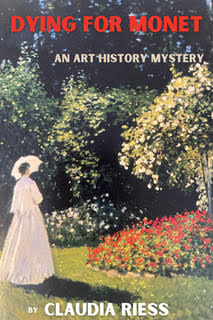
Dying for Monet, Book 5 and the most recent in the series, is structured with the same criteria, except this time a crucial plot-twisting component hog-ties me to a bare-boned blurb.  I’ve never felt more in danger of giving away the spoiler.  I’m okay discussing Claude Monet and the Impressionists; Paul Ruand-Durell, the renowned art dealer based in Paris, carrying on in London during the Franco-Prussian War; the art museums in London; the disappearance of a still life painting; a brutal murder.  Even the End Notes, where I mention books that were part of the research phase, omits a critical one whose title would blow it.  Luckily, I’ve got my two sleuthing protagonists, Erika and Harrison, about whose ever-evolving love story I could go on forever.

Book 6, the last in the series, is in the works.  Its plot is powered by the subject of artificial intelligence, boon and curse of the art world, depending on your definition of art or stake in its profits.  My fascination was doubly sparked by an episode of CNN’s “The Whole Story with Anderson Cooper,” which focused on the Dead End Gallery in Amsterdam, the world’s first art gallery dealing solely in art generated by AI, and the Whitney Museum’s exhibition of Harold Cohen’s AARON, the world’s first AI program for art-making. These experiences raised questions regarding the genesis of inspiration, the act of creation, and the boundaries of ownership, all of which are potential harbingers of conflict, including the most deadly.

Dying for Monet

A gala evening auction at Laszlo’s, an upstart auction house in New York City, is in progress.  Without notice, a much sought-after Impressionist painting is withdrawn from the block.  Moments later, its broker is found dead at the foot of an imposing statue in Laszlo’s courtyard.

Amateur sleuths Erika Shawn, art magazine editor, and Harrison Wheatley, art history professor, are once again drawn into an investigation involving an art-related homicide, this time sharing an unnerving coincidence with violent crimes occurring abroad.

As Harrison searches for clues in the archives at the Ashmolean Museum in Oxford, Erika is on a stakeout in Brooklyn Heights gathering information on the owner of the hijacked still life.  After Harrison experiences a disastrous encounter in London, he returns home, where he and Erika, along with a few of their usual cohorts, find themselves ever more deeply at odds with the movers and shakers on the dark side of fine arts commerce.

https://www.amazon.com/Dying-Monet-Art-History-Mystery/dp/1685126545

Claudia Riess is an award-winning author who has worked in the editorial departments of The New Yorker and Holt, Rinehart and Winston, and has edited several art history monographs.  Stolen Light, the first book in her art history mystery series, was chosen by Vassar’s Latin American history professor for distribution to the college’s people-to-people trips to Cuba.  To Kingdom Come, the fourth, will be added to the syllabus of a survey course on West and Central African Art at a prominent Midwestern university.  Claudia has written articles for Mystery Readers Journal, Women’s National Book Association, the Sisters in Crime Bloodletter, and Mystery Scene magazine.  She has been featured on a variety of podcasts, blogs and Zoom events.

claudiariessbooks.com.

https://www.facebook.com/ClaudiaRiessBooks

Guest Blogger ~ June Trop

Meet Miriam bat Isaac

            I’ve modeled my heroine, Miriam bat Isaac, on the woman known as Maria Hebrea, who probably lived in Roman-occupied Alexandria (Egypt) during the first century CE. I encountered her work when taking a course on the Historical Development of Concepts in Chemistry.

Ordinarily chemistry is taught from the perspective of what we know now without delving into how the concepts evolved over the millennia. So, when the professor assigned a paper on a historically significant concept, I had no idea of a topic. That is, until in desperation, I went to the university library to roam the stacks.

I don’t remember exactly how it happened—did I bump into a bookcase while looking to the heavens for inspiration?—but a moment later, a weighty tome fell on my toe and opened to a page about Maria Hebrea. And so, I began to wonder how a Jewish woman from Ancient Alexandria became the legendary founder of Western alchemy and held her place for 1500 years as the most celebrated woman of the Western World.

Sixteenth Century Depiction of Maria Hebrea

 In the alchemical literature, Maria Hebrea is also referred to as Mary the Jewess or Miriam the Prophetess, sister of Moses. Like her, all alchemists wrote under the name of a deity, prophet, or philosopher from an earlier time to enhance the authenticity of their claims or shield themselves from persecution. Although the tradition among all the crafts and mystical cults was to guard the secrecy of their work, persecution was a real risk for alchemists, who could be accused of and summarily executed for conspiring to debase the emperor’s currency.

Accordingly, Maria Hebrea worked anonymously. Hundreds of years later, however, another alchemist, Zozimos of Panopolis, celebrated her contributions. And so, with just a little tweaking, I had enough information to resurrect the once famous Maria Hebrea and create Miriam bat Isaac, my sleuth extraordinaire.

Miriam bat Isaac’s Adventures

Published in paperback and e-book by Level Best Books in February 2024

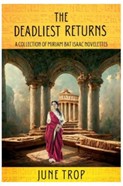
Miriam bat Isaac has recorded her nail-biting adventures in novels, novelettes, and short stories. Her most recent volume, The Deadliest Returns, is a book of three novelettes about returning, whether it means going back or giving back. In the first, “The Bodyguard”, Miriam’s brother, a renowned gladiator, returns from the dead to serve as a bodyguard back home when his employer retires Alexandria.

In the second, “The Beggar”, an old man disguised as a matronly beggar, returns to Alexandria to learn the fate of the lovechild he was forced to leave behind to escape the wrath of Roman law. And in the third, “The Black Pearl,” Miriam, having come into possession of the cache of jewels heisted from the Temple of Artemis, sails to Ephesus to return the treasure. The prized gem, however, a uniquely lustrous black pearl, disappears. With the power to heal the brokenhearted and restore the health of the one possessing it, could the pearl’s mystical properties be the motive for murder?

If, like Miriam, you thrive on uncovering the guilty longings, secrets, lies, and evil deeds of others, then as Miriam’s deputy, you will have ample opportunity to indulge your fancies. So, escape the monotony of everyday life and plunge into that rousing world of adventure in three of her most daring exploits.

To purchase The Deadliest Returns from Amazon

For the e-book, click here: https://www.amazon.com/dp/B0CV4TTX3T

For the paperback, click here: https://www.amazon.com/Deadliest-Returns-Collection-Miriam-Novelettes/dp/1685125859

As an award-winning middle school science teacher, June used storytelling to capture her students’ imagination and interest in scientific concepts. Years later as a professor of teacher education, she focused her research on the practical knowledge teachers construct and communicate through storytelling. Her first book, From Lesson Plans to Power Struggles (Corwin Press, 2009), is based on new teachers’ stories about their first classroom experiences. 

Now associate professor emerita at the State University of New York, June devotes her time to writing The Miriam bat Isaac Mystery Series. Consisting of short stories, novelettes, and several books, some have won modest recognition, such as being named a finalist for the Killer Nashville Silver Falchion Award. ​

June, an active member of the Mystery Writers of America, lives with her husband Paul Zuckerman, where she is breathlessly recording her plucky heroine’s next life-or-death exploit. She’d love a visit at www.JuneTrop.com or on her Facebook page, June Trop Author, https://www.facebook.com/profile.php?id=100044318365389, where she publishes a blog every Tuesday afternoon about writing, the history of science, or life in Roman Alexandria.

The Snake in the Grass

The leaves on the oak outside my window have yellowed and are heavy with rain. Wonderful rain. No more threat of fire, though we do seem to have a wee firebug in our area happily lighting small blazes that keep our CalFire folks busy. No need to ask why. Power is almost always the answer.

The desire for it, the need for it, and the loss of it. As strong a motive for murder or mayhem as any. Perhaps greater than jealousy, love, and hate all combined. But not money because money is part of the power paradigm, a weapon that can be unleashed against others to keep them at heel.

The scariest purveyors of power are those in sheep’s clothing. As I write that, I am thinking of Rev. Francis Davey, Vicar of Altarnun, in Daphne DuMaurier’s Jamaica Inn. As foul a human as one could imagine, one who envisions himself as a wolf in front of his unsuspecting flock of sheep. A villain’s shuddery villain, without a name until the reveal, the puppet master. Oh, there are others, but this was my first and yes, a chill ran up my spine when Mary Yellen found the Vicar’s drawing.

Power. Control. The conceit of holding it close, knowing you alone are aware of the power you wield. Oh my. But how to write such a character, so subtle, so hidden, yet the master of your story? There are types. The helper, the one who is always there, gently steering the protagonists toward doom. The gay, happy, rich, swoon-worthy antagonist who attracts the innocent and then uses them. The antagonist, so subtle so in need of winning, that they move through the plot like a water moccasin through a swollen river.

These aren’t the people you are consciously watching as you read; they are the ones that niggle at the corners of your mind. Why was he in the room? Why did so and so seek out our hero? Why are they everywhere? What is their purpose in the tale? They couldn’t have been the killer. Or could they, or is something more nefarious their goal? Like their purpose in the book, they bring power and control to the narrative. A drive that bubbles below the surface until it boils.

I love ‘em, I do. And I admit to weaving them into the occasional book. The purposeful manipulators. The ones with so much to lose that they are blinded by the need. The ones who will do anything to win. Lie, cheat, steal, kill – take over the world.

Books are rife with the bombastic variety, but it is the snake in the grass I love. They are a shoot of wheat rattling in a nonexistent breeze that catches your eye and sends a frisson up your back.

I know this as a writer.  It takes great discipline and tedious planning to develop such a character, keeping the behavior consistent and weaving the foreshadowing to sustain the mystery. Because the one thing readers will never forgive you for is throwing in a surprise killer or manipulator. If you’ve done well, the reader will relish rewinding the book for clues that implicate the character. If you’ve done it wrong, they’ll close the book and perhaps never read a book of yours again. And that, my friend, is a scary proposition.

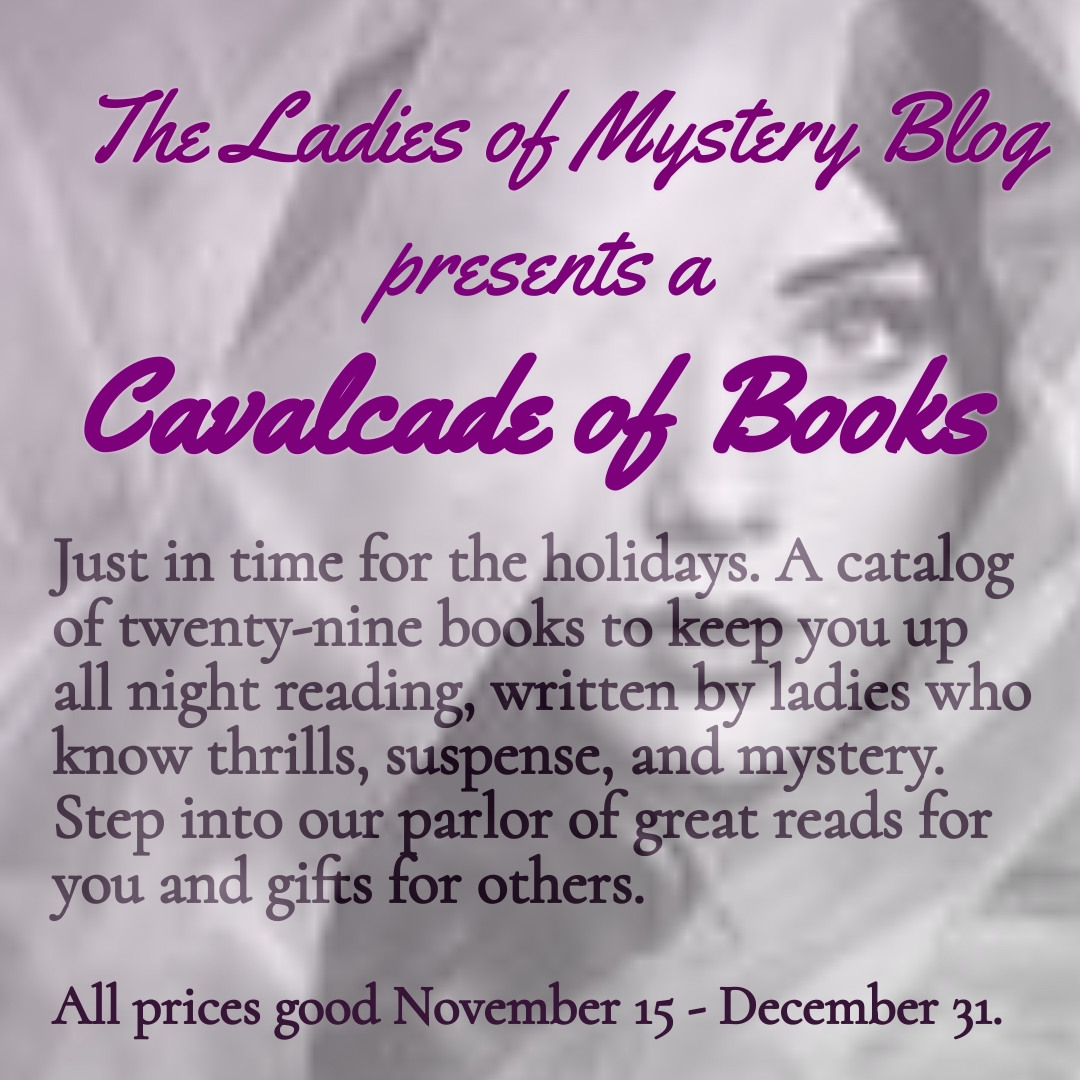
A friendly reminder, The Ladies of Mystery, Cavalcade of Books is available at https://bodiebluebooks.com/ladiesofmystery. It’s filled with wonderful tales, some with well-hidden evil. Twenty-nine great reads, including three of mine.

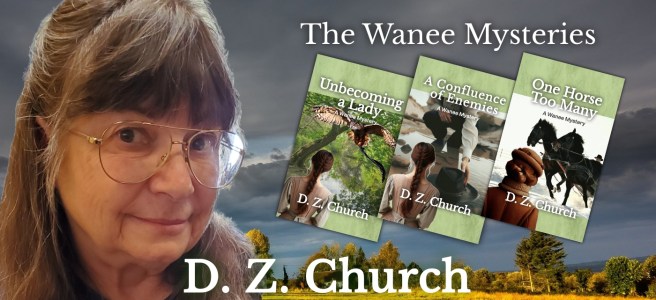
Find me at https://dzchurch.com and on Amazon, just search on d. z. church.

So long, farewell, auf wiedersehen… by Karen Shughart

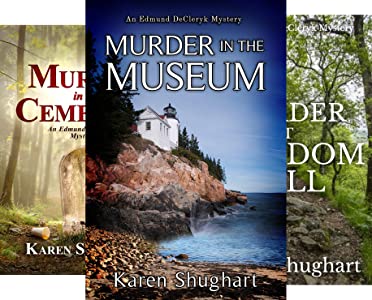
The song from The Sound of Music kept popping up in my head as I struggled to choose a title for this blog, which will be my last for Ladies of Mystery.  I started writing these shortly after the first book in my Edmund DeCleryk mystery series, Murder in the Museum, was published in early spring, 2018, and other than missing one a while back, I’ve managed to write every month for the past six years.

You’ve read not only about my books, investigative procedures and writing processes, but also what it’s like to live in the northern Finger Lakes region of New York, our travel experiences and family gatherings, and even eulogies for those I’ve loved. I’ve enjoyed every minute of it and feel gratified by how many wonderful and positive comments I’ve received as a result, and friends I’ve made along the way.

The decision has not been easy, it’s taken me weeks to feel comfortable with it. As I’ve grown older (and by most standards I’m in the elderly category), simplifying my life and deciding what takes priority seems tantamount to residing in a world that’s become far too complex for me as of late. Family always takes precedence, we’ve committed to spending more time with our children and siblings; also with friends whom we hold dear to our hearts. Some live hours and sometimes a plane trip away.

When I wrote the first book, my publisher asked for a series, and that’s what she got. I’m now working on book four, Murder at Chimney Bluffs, which, like the others, includes a historical backstory that provides clues to why the murder occurred, this time Prohibition and rumrunning. There was much activity between Canada and our side of Lake Ontario during that period of time, with contraband liquor unloaded onto a beach beneath Chimney Bluffs, drumlins that were created from icebergs millions of years ago.

Authoring books is a time-consuming process and one that I integrate into the other facets of my life, which include writing a monthly blog for Life in the Finger Lakes magazine, serving on the board of directors at our local library, and occasionally volunteering for other organizations here. An active social life and attendance at a multitude of cultural events are included in the colorful tapestry of our lives.

I truly appreciate that I, as a newly published author of mysteries, was given the opportunity to show off my writing skills here. Thanks so much, Paty Jager, for your unwavering support along the way and for understanding my decision at this juncture of my life, and to the rest of you who have steadfastly been with me throughout this journey.

 So, for now, so long, good-bye, auf wiedersehen, good night, and may peace and love follow you everywhere you go.

Karen Shughart is the author of the Edmund DeCleryk cozy mystery series, published by Cozy Cat Press and set in the Finger Lakes. She has also co-written two mysteries with Cozy Cat authors, two non-fiction books, and pens a monthly blog for Life in the Finger Lakes magazine https://www.lifeinthefingerlakes.com/.  A member of CWA, North America Chapter, and F.LARE (Finger Lakes Authors and Readers Experience), she lives with her husband, Lyle, in Sodus Point, NY.  Her books are available at local gift shops and bookstores and in multiple formats at  amazon.com