Guest Blogger ~ Skye Alexander

Clothes Make the Woman

The fashion world is ever-changing, and in the 1920s when my Lizzie Crane mystery series takes place the clothes a woman wore not only expressed her sense of style but also the changing ideas and mores of the Jazz Age. Modern ladies were shedding outdated social roles and restrictions as fast as they cast off their corsets. Hemlines rose to previously shocking lengths, baring ankles and calves. Some daring young women even painted images of their beaus on their knees––their short skirts revealed the pictures when they danced the Charleston. Glittery flapper dresses, resplendent with sequins and fringe, exposed plenty of skin. On the beaches, swimming costumes crept up high enough that policemen known as “beach censors” trod the sand, measuring ladies’ legs to make sure no more than six inches of flesh showed between hem and knees.

Wearing trousers, too, signaled not only a desire for comfort and convenience, but a shift toward equality between women and men as well. In most circles at that time, a lady dressed in pants raised eyebrows. Some towns in the Midwest and South even outlawed wearing trousers and fined brazen women for doing so. In the first novel in my Lizzie Crane mystery series, Never Try to Catch a Falling Knife, my jazz singer heroine from Greenwich Village gets off to a rocky start her first day on the job by wearing trousers when she meets her conservative Yankee employer. Sportswomen, however, were grudgingly allowed to don knickers on the golf course or men’s white trousers while playing tennis. Although off-the-rack pants for ladies weren’t available in the early Twenties, the 1927 Sears catalog offered tweed woolen knickers to golfing girls for $2.98. If you wanted something more in line with what Katherine Hepburn popularized a decade later, you had to have them custom-made or buy men’s and alter them yourself.

The Inside Scoop on Intimate Attire

As women’s outer garments changed, so did their underwear. No longer confined by tight corsets and multiple petticoats, liberated ladies shed the many layers their mothers wore in favor of slinky teddies, camisoles, and bloomers that slid comfortably beneath their slim-fitting dresses. Nylon, polyester, and other synthetic materials didn’t exist at that time, so wealthy women chose undies made of silk whereas ladies of lesser means garbed themselves in cotton, rayon, and wool. Instead of only boring white, lingerie now became available to style-conscious women in pink, peach, beige, light green, and naughty black. https://www.sewhistorically.com/dressing-the-1920s-woman-1920s-lingerie/

Prior to the Roaring Twenties, women wore thick stockings primarily for warmth. Now, with their legs on display in their new short skirts, modern ladies switched to sheer stockings that showcased their calves. Silk stockings were the preferred choice for those who could afford them at $1.48/pair in 1925 (the equivalent of about $25 in today’s money), in colors ranging from champagne to black. Rayon provided a cheaper alternative for cost-conscious women––and if they objected to the material’s sheen, they dusted their legs with powder to soften it.  

Women who still chose to wear girdles clipped their stockings to attached garters. Free-spirited fems rolled their stockings into place and fastened them just above the knee with elastic bands. The bands, sometimes called “jazz garters,” soon became a fashion statement in themselves, decorated with lace, ribbons, and rhinestones in sexy colors such as purple, red, and black. And if a woman wanted to keep a nip nearby in defiance of Prohibition, she could wear a garter flask that featured a pocket with a small silver container to hold her drink of choice.

Shopping for Clothes in the Roaring Twenties

Prior to the 1920s, most women made their own clothes. But as more entered the workforce during the Jazz Age––half of single women were employed outside the home in 1930––they had less time to devote to sewing. In response to this trend, department stores such as Macy’s and Bergdorf Goodman began selling off-the-rack garments. Now, busy ladies could purchase ready-made dresses, coats, and other clothing rather than engage in the time-consuming task of creating their own wardrobes or paying seamstresses to fabricate them.

For people who couldn’t afford to buy at upscale department stores, a shopping alternative arose during the 1920s: thrift shops. Prior to this time, peddlers hawking used clothing and other goods were common in America’s cities and towns––especially in less affluent neighborhoods. Many of these merchants were Jewish immigrants. But during the Twenties, Christian churches began establishing outlets to sell clothing and other products donated by parishioners with the goal of raising money for their churches. Goodwill trucks collected used clothing from more than a thousand households in the Twenties. Proceeds from thrift stores funded half the Salvation Army’s budget. Chanteuse Lizzie Crane, my style-savvy protagonist, realizes that wealthy ladies wouldn’t be caught dead wearing the same evening gown twice, and she buys most of her attire secondhand at church charity stores.

Hemlines and the Economy

Not only do the clothes a woman wears reveal her personal tastes, social class, and ideology, they may also be an indication of the economy. According to the “Hemline Index,” skirts rise during periods of prosperity and lengthen during leaner times. The short skirts of the Twenties celebrated a post-war boom as well as newfound freedoms for women. During World War II and the recession that followed, women’s hemlines dropped again. When times were good in the 1960s, the fashion world gave us the miniskirt and the bikini.

That’s not to say investors should take tips from haute couture––it’s likely that the fashion industry follows economic trends rather than predicting them. But perhaps something more than personal taste or vanity influences a woman’s choice of clothing. Risqué styles reflect a sense of playfulness, confidence, and freedom from limitations or worries, whereas more serious garb suggests a desire for protection, endurance, and the security of tradition. Whether or not these psychological connections have any merit, certainly the Roaring Twenties transformed the way women thought of themselves and their place in the world––and their clothes reflected that transformation.

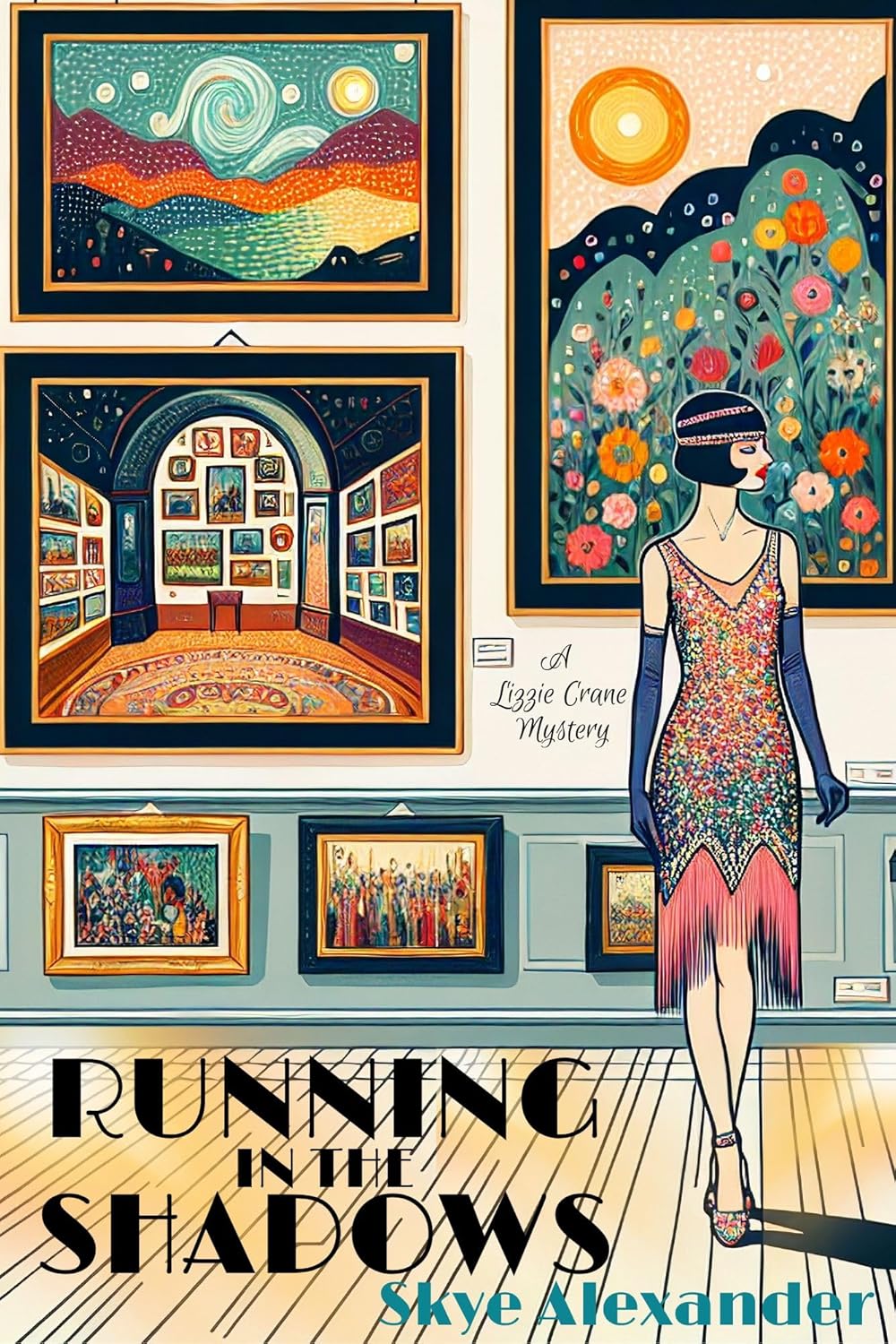
Running in the Shadows
March 1926: Salem, Massachusetts

A spring equinox party at the mansion of a rich, flamboyant, and controversial art collector promises New York jazz singer Lizzie Crane and her band a fat paycheck, lucrative connections, and plenty of fun. She’ll also have an opportunity to reconnect with a handsome Boston Brahmin she fancies.

But the excitement she hopes for doesn’t turn out the way she expected. On the night of the musicians’ first performance, a naked young woman trots into the ballroom on horseback, sweeps up a talented artist named Sebastian, and rides off with him into the night. The next morning, Lizzie discovers the artist’s body tied to a tree, shot full of arrows like the martyred Saint Sebastian in Botticelli’s painting.

            Soon Lizzie learns that her business partner, pianist Sidney Somerset, once had a close relationship with the dead man––and police suspect Sidney may have murdered him. As she tries to protect her friend and discover the killer, Lizzie gets swept up in the treacherous underworld of art theft and forgery, a world where fantastic sums of money change hands and where lives are cheap. 

Buy links :Amazon – https://www.amazon.com/Running-Shadows-Lizzie-Crane-Mystery/dp/1685127061/

Barnes & Noble – https://www.barnesandnoble.com/w/running-in-the-shadows-skye-alexander/1146168035?ean=9781685127060
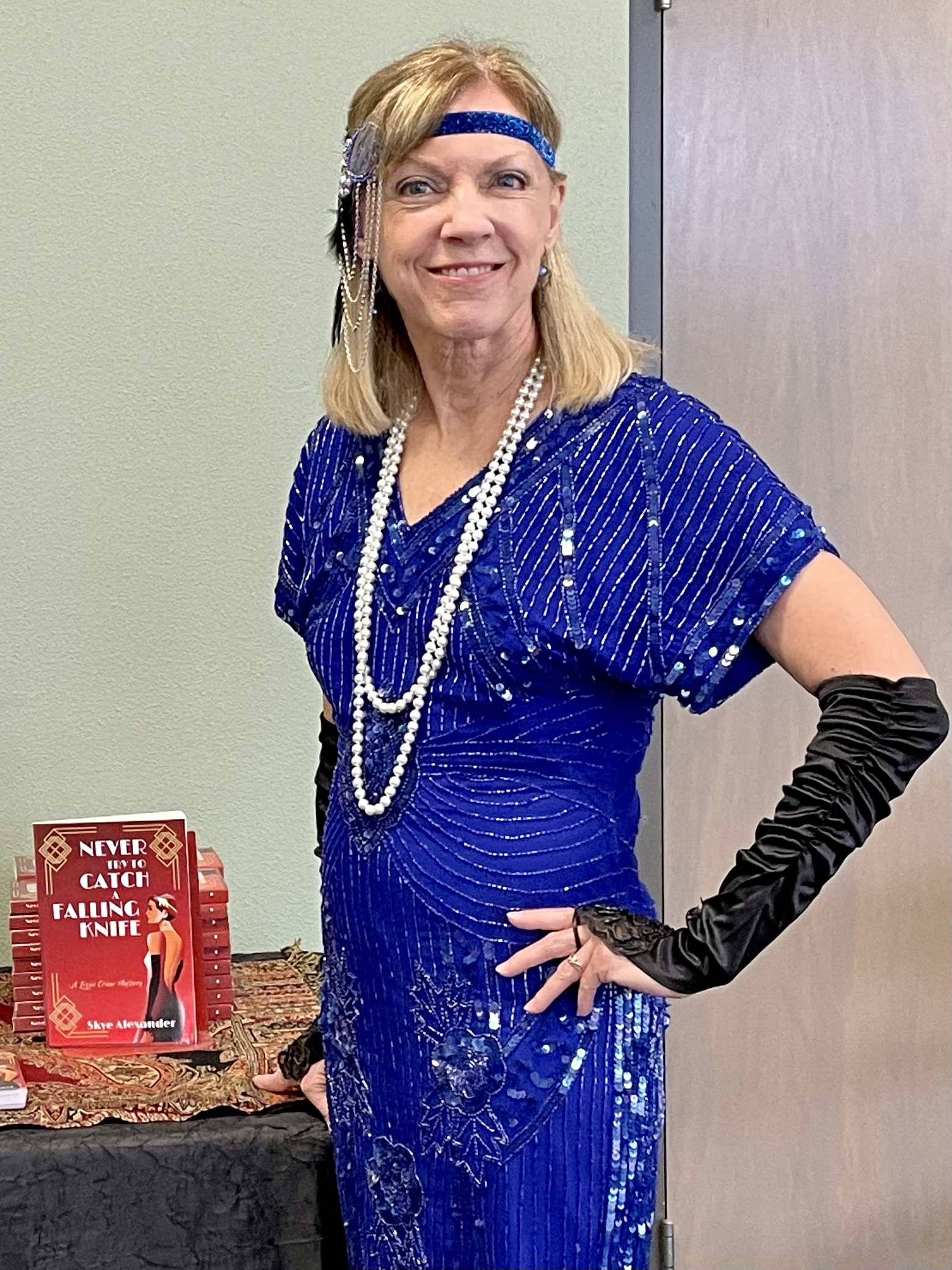
Skye Alexander is the author of more than 50 fiction and nonfiction books. Her stories have appeared in anthologies internationally, and her work has been translated into fifteen languages. In 2003, she cofounded Level Best Books with fellow crime writers Kate Flora and Susan Oleksiw. So far her Lizzie Crane mystery series includes four traditional historical novels set in the Jazz Age: Never Try to Catch a Falling Knife, What the Walls Know, The Goddess of Shipwrecked Sailors, and Running in the Shadows. Her fifth, When the Blues Come Calling, is scheduled for release in September 2025. After living in Massachusetts for thirty-one years, Skye now makes her home in Texas.

Visit her at https://skyealexander.com
Guest Blogger ~ John Ferriso

Why I Write True Crime.            

Many things can lead us to write down our stories. My writing journey did not just begin; it was always there. As a child, I would remember an incident and retell it to anyone interested. A television show or a stickball game were topics that, years later, I retold to my friends and family. As a child, I watched the police-related television drama Barney Miller, and its dry cop humor interested me. Hill Street Blues had the precinct crime that I enjoyed. Movies like Serpico, Dog Day Afternoon, and Fort Apache the Bronx showed the gritty portrayal of street-level crime; I was hooked and wanted in on the action.    

Growing up in New York, the nightly news inspired me to want a career in law enforcement. I watched the nightly news as the reporters talked about the 44 Caliber killer who murdered his victims; the newspapers referred to him as the Son of Sam. I looked at the morning newspaper headlines and the horrible photos of the women shot. My neighbors talked about him, and teenage girls had their hair color changed. I understood that the Police were looking for the guy. I was fascinated with the stories adults told about the crimes and the ongoing investigations described.

I read true crime, which interested me. I was a reader before my NYPD career and my writing endeavor began. I was in college when I read about the suspects, the investigations surrounding them, and the detectives who hunted them down.

I was in college, working at a sports bar, and waiting to get called to the police academy. I was standing near the waiter’s station, pondering my future law enforcement career. I had a few tables and only a few dollars in my pocket. It would be five more months until the police academy; what type of cop would I become? I will write down what I experienced in the NYPD.

My childhood dream of being in law enforcement propelled me to write. To become a writer, you must focus on what interests you. I no longer needed to listen to the stories of other cops: I was living the same short stories I once read about. I took note cards to work and scribbled pencils to paper my thoughts and engaging experiences. I kept these notecards secret from my co-workers; it was my writing journey.

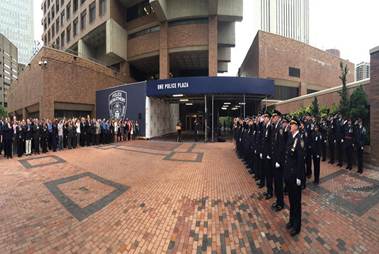
On the morning of September 11, 2001, I was working in Lower Manhattan, half a ½ mile from the towers. The events of that day and all I witnessed would be imprinted on my mind like an ever-playing movie scene. The day’s horrible events would give me a story to tell others. A few days after the events, I began writing in my spiral notebook everything I witnessed. I condensed my thoughts and observations to 17 pages. I wanted to do more than tell my story; I wanted others to read about it. On the 20th anniversary of the attacks, my story was published online. Free for all to read about what I was an eyewitness to on that horrific day.

In a New York Minute: An officer’s eyewitness account of the events of September 11, 2001 – The Juniper Park Civic Association

After retirement, it was time for me to tell my stories and get my work published. I began with one story about an intoxicated businessman who parked his vehicle on the roadway. I wrote it down as a short story and sent it to Psychology Today. What if the Police called all your contacts? What would they say about you? They published my story! I now knew I was more than just a storyteller; others were interested in what I experienced and what I was saying.

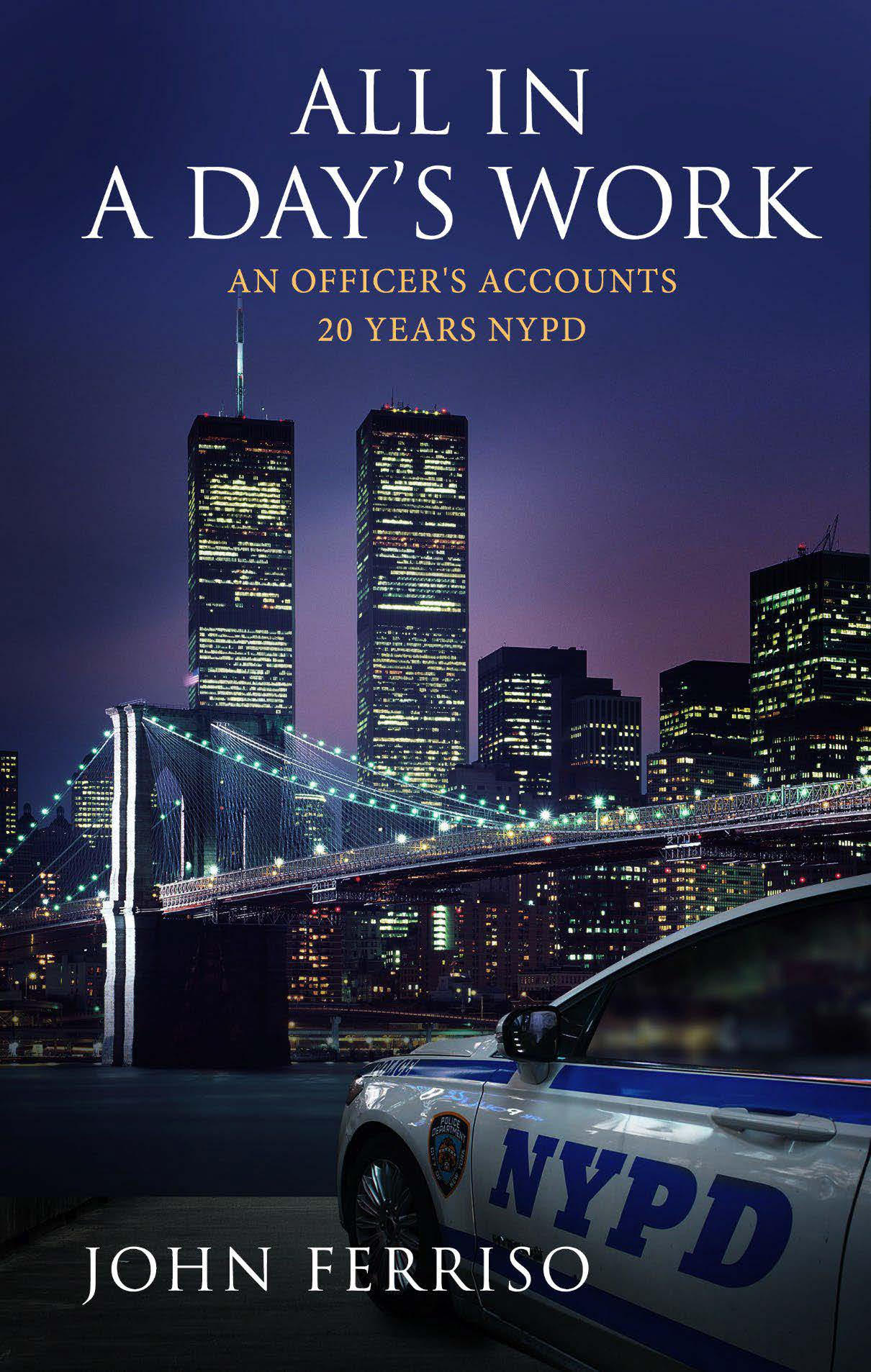
In 2023, it was time to take short stories and self-publish them. All in a day’s work: an officer’s accounts 20 Years NYPD. Soon after, I was a podcast guest in the USA, Australia, and England. I was now telling my stories to a broader audience, discussing my writing journey and the interesting cases I investigated.  

ALL IN A DAY’S WORK

When you are a New York City police officer you become a social worker, chauffeur, human relations consultant, and tour guide. You are expected to do all those tasks while stopping crime as it occurs, preventing crime, and keeping the peace in a city that never takes a break. Let’s not forget you get to do all this within a workday or tour as we call it.

These separate tasks come to you at random times, so going to work is like a roll of the dice. One moment, you are driving with your partner, talking about nonsense, and five minutes later, you are coming face to face with dangerous people who just committed a criminal act. The weight of these tasks can become overwhelming and mentally drain you if you allow it to happen. Many times, you do not have time to reflect on the day’s events. You just move on to the next crisis. Within days or a month, NYPD cops will get involved with and witness more toxic events than an average person will see in a lifetime. Active cops must navigate and work with their coworkers, supervisors, the public, and criminals. What people believe cops do daily regarding police work is often far from the truth.

You will find within my short stories what is occurring inside those moving police vehicles. What the city was like in the days after September 11, 2001. Take a close, in-depth look at the investigation within the NYPD detective squad room. Within the squad room, the pen can influence like a hammer, and a phone call can arrive like a hurricane. If you want the gritty, alarming, and sometimes comical truth behind police work, you have arrived at your destination.

buy link: https://a.co/d/gHVCzb7

I also began to network with authors regarding my law enforcement experience. I could advise other writers on how to place accurate and interesting police-related material into their stories. I could technically advise about the progression of the cases, how the reports are written, and even cop humor. Beyond storytelling and writing, giving back to the writing community is essential and will propel me in future endeavors.

I mainly write true crime because I lived it, which has always kept my interest.

John can be contacted at:

https://ferrisinvestigations.org/

John.Ferriso1970@gmail.com

www.linkedin.com/in/john-ferriso

Guest Blogger ~ Millicent Eidson

Three years since my initial guest blog in 2022 (https://ladiesofmystery.com/?s=eidson), my microbial mystery world has expanded to multiple disease threats worldwide. It’s a good time to catch everyone up.

For decades, I was immersed in zoonotic diseases transmitted from animals. Scientists estimate that three-quarters of new or emerging infections are zoonoses.

As a veterinarian working in public health, I dropped smelly baits from a helicopter over the Adirondacks to vaccinate raccoons against rabies. I tracked down people with explosive diarrhea from a scenic New Mexico train ride. I coordinated reporting and collection of dead birds when West Nile virus showed up in the western hemisphere.

Serious illnesses and deaths are tragic but stamping out disease outbreaks is exciting. Each cluster of ill people is a mystery for a disease detective. Everyone knows about Rizzoli and Isles from the wonderful Tess Gerritsen thrillers. But veterinarians exposed to deadly hantavirus when collecting infected mice are less familiar medical heroes.

When I retired from fulltime work as a veterinary epidemiologist at the Centers for Disease Control and Prevention and two state health departments, I continued part-time teaching about zoonoses to graduate students. It’s rewarding to open up the eyes of new public health practitioners to the fascinating world of zoonoses. But I wondered if I could do the same for the general public.

Our daughter is adopted from China like thousands of orphans with the one-child policy. In my fiction, I wanted to explore how it might feel for someone whose Asian role models are replaced by Anglo, Hispanic, and Native American cultures embedded in a rich landscape.

And many of us struggle with mental and physical health challenges from birth, injury, or illness. Can someone wrestling with that history contribute fully to our demanding, fast-paced world?

So Maya Maguire was born, inspired by my daughter’s heritage and my own with mostly Irish ancestors. Like me, Maya Maguire starts her public health career after completing years of work toward veterinary and master’s degrees. Unlike me, she’s a bit of a genius and completes all her training young, adding further stress when expected to perform at the level of other more mature CDC trainees.

The initial three novels primarily immerse us in Maya’s world, other than diary excerpts from a mysterious young boy facing his own roadblocks near the Arizona/Utah border. In “Anthracis,” Maya is in her first year of training as a CDC Epidemic Intelligence Service officer stationed in New Mexico. Along with veterinary and physician colleagues, she battles perplexing new means of anthrax infection in the Southwest.

Her second year of EIS training still finds Maya in the Southwest, tackling tick-borne Borrelia infections across Arizona and New Mexico. Then she joins a colleague based in Norway on outbreaks in multiple European countries and north Africa. Personal relationships are impossible to balance with her work obligations.

In “Corona,” Maya experiences the COVID-19 outbreak along with all of us, first in Arizona, then in Denmark with infected mink, and finally in her home country of China to find its origin in bats. Like many, she won’t escape the pandemic fully unscathed.

Mosquitoes bring “Dengue” from Puerto Rico to New York City, then New Mexico and Hawai‘i. This novel expands the MayaVerse by alternating point-of-view chapters between Maya and her public health veterinarian mentor, Faye Simpson. Faye’s a kick-ass character in her late sixties, transplanted from a childhood on a Colorado ranch to a career with the New York City health department.

“Ebola,” available this summer, broadens even more with the perspectives of multiple male characters confronting the virus in West Africa, New York City, and New Mexico. Maya’s finishing a final training year with the CDC and Faye is retired from fulltime public health work but still enmeshed in Ebola crises.

These brief summaries only touch on the lively characters in the stories. Fred Grinwold and Nancy Bingham are Maya’s physician supervisors in New Mexico and Arizona. Their early romance and outbreak puzzles are available along with other Faye Simpson stories in “Microbial Mysteries,” my short story collection.

Sci fi thrillers are entertaining but sometimes based on pure imagination. For a peek into the exciting real world of zoonotic disease control through the perspective of colorful and compelling characters, join me in the MayaVerse!

Dengue: A Microbial Mystery

Is dengue the next pandemic? Two veterinary medical detectives, decades apart in age and experience, battle the tropical disease on the mainland, then in Hawai‘i. Even in paradise, people can’t escape blood-thirsty mosquitoes spurred on by a warming climate. Join these resilient women as they push through personal challenges to discover the scientific truth and stop the relentless death toll.

From reviews:

Maya Maguire is a deeply complex character, with a backstory that contains both heartache and joy. I have thoroughly enjoyed getting to know her … As for the medical terminology in the book … You’re in capable hands. Dr. Eidson uses real-life medical words and situations in the book, but they’re always put into a context that allows the reader to understand exactly what’s going on. (As an aside, the research that must have gone into this book is mind-blowing.)

Buy Links: https://books2read.com/millicenteidson/  or  Dengue: A Microbial Mystery (MayaVerse): Eidson, Millicent: 9781955481168: Amazon.com: Books

Millicent Eidson, a master of intrigue and suspense, weaves her literary magic through the pages of the Maya Maguire microbial mystery series. With a keen eye for detail and a passion for scientific puzzles, she invites readers into a world where microbes hold secrets more treacherous than any criminal. Millicent’s career as a public health veterinarian and epidemiologist began at the Centers for Disease Control and Prevention. After days filled with pathogens and outbreaks, the nights belonged to whispered tales of microbes dancing in her imagination. Upon retirement, her passion for storytelling blossomed into the MayaVerse, https://drmayamaguire.com/.

She can be found at Facebook, Millicent Eidson, | LinkedIn, Millicent Eidson (@EidsonMillicent) / Twitter, and Millie Eidson (@drmayamaguire) • Instagram photos and videos

Guest Blogger ~ Mike Nemeth

Why Does a Nice boy from Wisconsin Write Murder Mysteries?

The simple answer is: I grew up reading detective stories, from John D. MacDonald to Ross Macdonald to Eric Ambler. I admired the intricate plotting that kept me guessing as their stories unfolded. Later, I discovered Elmore “Dutch” Leonard, a prolific writer of tales about ex-cons and petty thieves looking to strike it rich with their next caper and usually failing miserably. You may know Dutch by the many movie adaptations of his novels including, Be Cool, Get Shorty, Fire in the Hole, Killshot, Jackie Brown, Out of Sight, 3:10 to Yuma, Cat Chaser, 52 Pickup, Hombre, The Big Bounce, Stick, Mr. Majestyk, and Freaky Deaky. As much as I enjoyed Dutch’s stories, I was influenced most by his cinematic style. He never got in the way of his characters and let them tell their stories through dialog and action scenes.

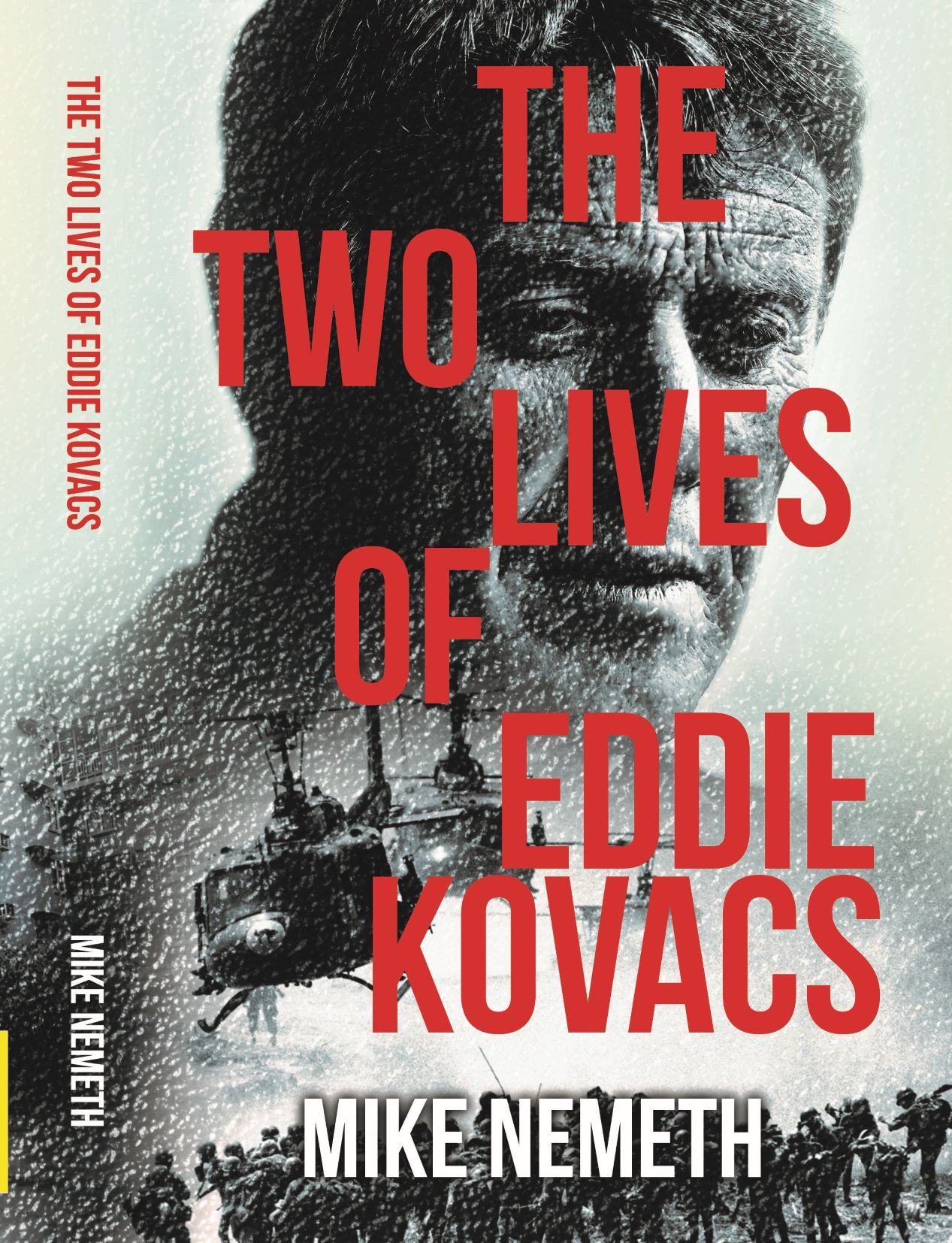
The second reason I write murder mysteries is that the genre allows the writer to fold in subplots from other genres that become clues in the solution to the murder. In most of my novels an unexpected love story comes from out of nowhere and smacks the protagonist upside the head, the sort of romance that causes the protagonist to wake up and pay attention. Such is the case in The Two Lives of Eddie Kovacs. Eddie, a grieving widower, goes undercover to solve suspicious deaths at a luxury condo complex and runs into Madeleine, a wealthy widow who awakens long-dormant feelings in Eddie but is also the key to the mystery. She becomes the focal point for Eddie’s decisions about the case, his desire for redemption, and his future.

My third reason for writing murder mysteries is that a good story must contain high stakes for the protagonist and few stakes are higher or more enticing than murder. And two murders are better than one. In The Two Lives of Eddie Kovacs, the unsolved murder of Eddie’s investigative partner during his stint in the Army has haunted him for decades. Eddie has always wondered if he had inadvertently set his partner up for the crime. When another murder occurs at the condo complex during his surreptitious investigation, Eddie begins to connect the dots and sees the truth.

And finally, the murder mystery genre allows for an underlying theme that isn’t preachy and doesn’t detract from the pleasure of solving a complicated crime. In The Two Lives of Eddie Kovacs, the solution to the murders calls into question the boundary between personal freedom and the encroachment of the law. This question is a dilemma for Eddie as he grapples with love, his integrity as a lawman, and his desire for redemption.

Murder mysteries are such fun!

Propelled by two murder cases, separated by decades, The Two Lives of Eddie Kovacs is, at its heart, a provocative and suspenseful love story that explores the unbreakable connection between the past and the present, and the boundary between personal freedom and the law.

Eddie Kovacs is tormented by his experience in Vietnam when he derailed an illegal CIA plot, and deflated over his forced retirement as a DA’s investigator. When the sheriff of Chatham County, Georgia offers him an undercover assignment, Eddie jumps at the chance to end his career in a blaze of glory. His assignment is to solve the riddle of suspicious deaths at a luxury condo complex on Tybee Island before the DEA exposes the scandal that would dash the sheriff’s political ambitions.

Eddie has spent his life looking over his shoulder for the vengeful CIA agents who have tirelessly pursued him. As he investigates the deaths, he discovers that a former agent has remained vigilant for fifty years and is in the building, stalking Eddie. To make matters worse, Eddie is a grieving widower irresistibly drawn to a resident named Madeleine, and his infatuation feels like infidelity, not to mention a betrayal of his badge. In a race with the DEA and hunted by the CIA, Eddie lays a trap for his suspect and discovers Madeleine’s darkest secret—a secret that forces Eddie to choose between love and redemption.

The Two Lives of Eddie Kovacs can be found on Amazon at amzn.to/3CVzMY4 (that’s Bit.Ly short form link).

It is also in the Ingram system and can be ordered at any bookstore or online from Ingram. 

Mike Nemeth is the author of Defiled, which became an Amazon bestseller, The Undiscovered Country, which won the Beverly Hills Book Award for Southern Fiction and the Augusta Literary Festival’s Frank Yerby Award for Fiction, and Parker’s Choice, which has won a Firebird Award for Thrillers, and American Fiction Awards for Romantic Mystery and Diverse & Multicultural Mystery. Creative Loafing named Mike Atlanta’s Best Local Author for 2018.

The recurring theme of Mike’s novels is that morality and legality are two different things. The stories are romances tucked inside mysteries.

https://mikenemethauthor.com/

Guest Blogger ~ Claudia Riess

Choosing to write an art history mystery series came relatively late in my career, but the seed was planted very early in childhood, and was as much a part of the natural course of events as learning to read and being read to—Winnie the Pooh, Mary Poppins, Alice in Wonderland—and being told laugh-out-loud stories, ad-libbed by my father, about a little girl named Jeanie, clearly my alias, and her adventures with her anonymous daddy, clearly my own.  And like bedtime stories, my introduction to art—my association with art—was, and is, bound up with family, adventure, safe harbor. 

It began with outings to museums.  We lived in Brooklyn, and a couple of the great ones were a short subway ride away.  The Metropolitan, the Museum of Modern Art, the Frick, the Brooklyn Museum.  Typically, these outings were followed by take-out Chinese food and talks around the kitchen table about what we had seen that day.  We talked about the different ways painters saw the world; debated about which perspective better described the real world—and what the real world really was.  Color and light?  Shape and dimension?  And what about imagination? Created imagery.  Distorted reality.  Ideas about the relative nature of beauty and truth were woven into these conversations, and all the while we were savoring our chicken chow mein and fried rice with lobster sauce.

It stands to reason that my idea of the art world was a romanticized one, but by the time I’d written a few rom-com-like novels and murder mysteries and was considering writing an art suspense novel, I’d learned a lot more about its seamier side.  How the price of art is virtually uncontrolled, dependent on the whims of collectors and dealers and the transient tastes and fads of the times.  How art is ransomed, forged, used to launder money, stolen then sold on the black market.  In short, that the art world is where the most sublime of human instincts collide with its basest.  What a great amalgam for fiction!

I pitched the idea of my writing an art suspense novel to my brother, Jonathan, an art history professor at the University of Cincinnati, and he off-handedly suggested, “What about finding a lost study of Michelangelo’s Battle of Cascina?”  As he enlarged on the subject, a conversation I’d had years ago popped into mind.  It was my first week at Vassar College, and I was out of my social depth, trying to hold my own with one of my classmates, a seasoned debutant.  I suppose the incident remained etched in memory because our life experiences were so disparate.  Especially vivid was the story of how her father’s sugar plantation in Cuba had been confiscated by Fidel Castro’s government.  It was this historical nugget that instantly dovetailed with my brother’s suggestion.  In that moment, the American sugar plantation owner became an art collector, and as he and a freshly materialized plantation manager and a lovely cook’s assistant hid out in a basement storeroom, the art collection was being hauled off by a band of wannabe Castro rebels looking to raise money to buy arms.

The imagekicked off the prologue to Stolen Light, Book 1 of my art history mystery series.  I’m a stickler for historical accuracy, and as a rule I take off from it, filling the gap with events that conform to its character, and therefore might have been.  Then, in a butterfly-effect maneuver, I fast-forward to the present and drop a pair of resourceful lovers into the challenging set of circumstances that has developed—multiple murders included—and see if the sleuthing duo can sort it out. 

For example, the impetus for Knight Light, Book 3 in the series, came from two quotes.  From the painter Marcel Duchamp: “Not all artists are chess players, but all chess players are artists.”  From World Chess Champion, Alexander Alekhine: “Chess for me is not a game, but an art.”  From there, I discovered that the two had actually been team-mates on the French chess team in the 1933 Chess Olympiad.  And that furthermore, Alekhine’s death in 1946 has been considered a cold case to this day.  My fiction, integrated with the facts, took off from there.

Dying for Monet, Book 5 and the most recent in the series, is structured with the same criteria, except this time a crucial plot-twisting component hog-ties me to a bare-boned blurb.  I’ve never felt more in danger of giving away the spoiler.  I’m okay discussing Claude Monet and the Impressionists; Paul Ruand-Durell, the renowned art dealer based in Paris, carrying on in London during the Franco-Prussian War; the art museums in London; the disappearance of a still life painting; a brutal murder.  Even the End Notes, where I mention books that were part of the research phase, omits a critical one whose title would blow it.  Luckily, I’ve got my two sleuthing protagonists, Erika and Harrison, about whose ever-evolving love story I could go on forever.

Book 6, the last in the series, is in the works.  Its plot is powered by the subject of artificial intelligence, boon and curse of the art world, depending on your definition of art or stake in its profits.  My fascination was doubly sparked by an episode of CNN’s “The Whole Story with Anderson Cooper,” which focused on the Dead End Gallery in Amsterdam, the world’s first art gallery dealing solely in art generated by AI, and the Whitney Museum’s exhibition of Harold Cohen’s AARON, the world’s first AI program for art-making. These experiences raised questions regarding the genesis of inspiration, the act of creation, and the boundaries of ownership, all of which are potential harbingers of conflict, including the most deadly.

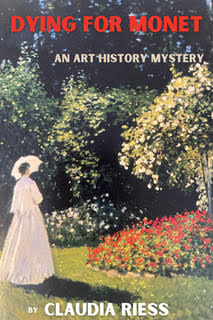
Dying for Monet

A gala evening auction at Laszlo’s, an upstart auction house in New York City, is in progress.  Without notice, a much sought-after Impressionist painting is withdrawn from the block.  Moments later, its broker is found dead at the foot of an imposing statue in Laszlo’s courtyard.

Amateur sleuths Erika Shawn, art magazine editor, and Harrison Wheatley, art history professor, are once again drawn into an investigation involving an art-related homicide, this time sharing an unnerving coincidence with violent crimes occurring abroad.

As Harrison searches for clues in the archives at the Ashmolean Museum in Oxford, Erika is on a stakeout in Brooklyn Heights gathering information on the owner of the hijacked still life.  After Harrison experiences a disastrous encounter in London, he returns home, where he and Erika, along with a few of their usual cohorts, find themselves ever more deeply at odds with the movers and shakers on the dark side of fine arts commerce.

https://www.amazon.com/Dying-Monet-Art-History-Mystery/dp/1685126545

Claudia Riess is an award-winning author who has worked in the editorial departments of The New Yorker and Holt, Rinehart and Winston, and has edited several art history monographs.  Stolen Light, the first book in her art history mystery series, was chosen by Vassar’s Latin American history professor for distribution to the college’s people-to-people trips to Cuba.  To Kingdom Come, the fourth, will be added to the syllabus of a survey course on West and Central African Art at a prominent Midwestern university.  Claudia has written articles for Mystery Readers Journal, Women’s National Book Association, the Sisters in Crime Bloodletter, and Mystery Scene magazine.  She has been featured on a variety of podcasts, blogs and Zoom events.

claudiariessbooks.com.

https://www.facebook.com/ClaudiaRiessBooks