Guest Blogger ~Joanne McLaughlin

Repeat That Name, Please  

            Identity is a big deal in my novels. Maybe it has something to do with all the Superman comic books I read in the barbershop while my dad was having his hair cut. Lots of identity stuff in those stories, secret and otherwise. Midwestern farm boy or big-city newspaper reporter? Mild-mannered, bespectacled guy or visitor from another planet able to leap tall buildings in a single bound?  

            Names—specifically, who we are versus the person we allow the world to see—are a common thread in my first four published novels, three darkly romantic vampire tales and a thriller. Vampires reinvent themselves from century to century; the rest of us sometimes do, though over shorter lifetimes. And, of course, in literature and in life, often all we know of a person at first is the name presented to us.

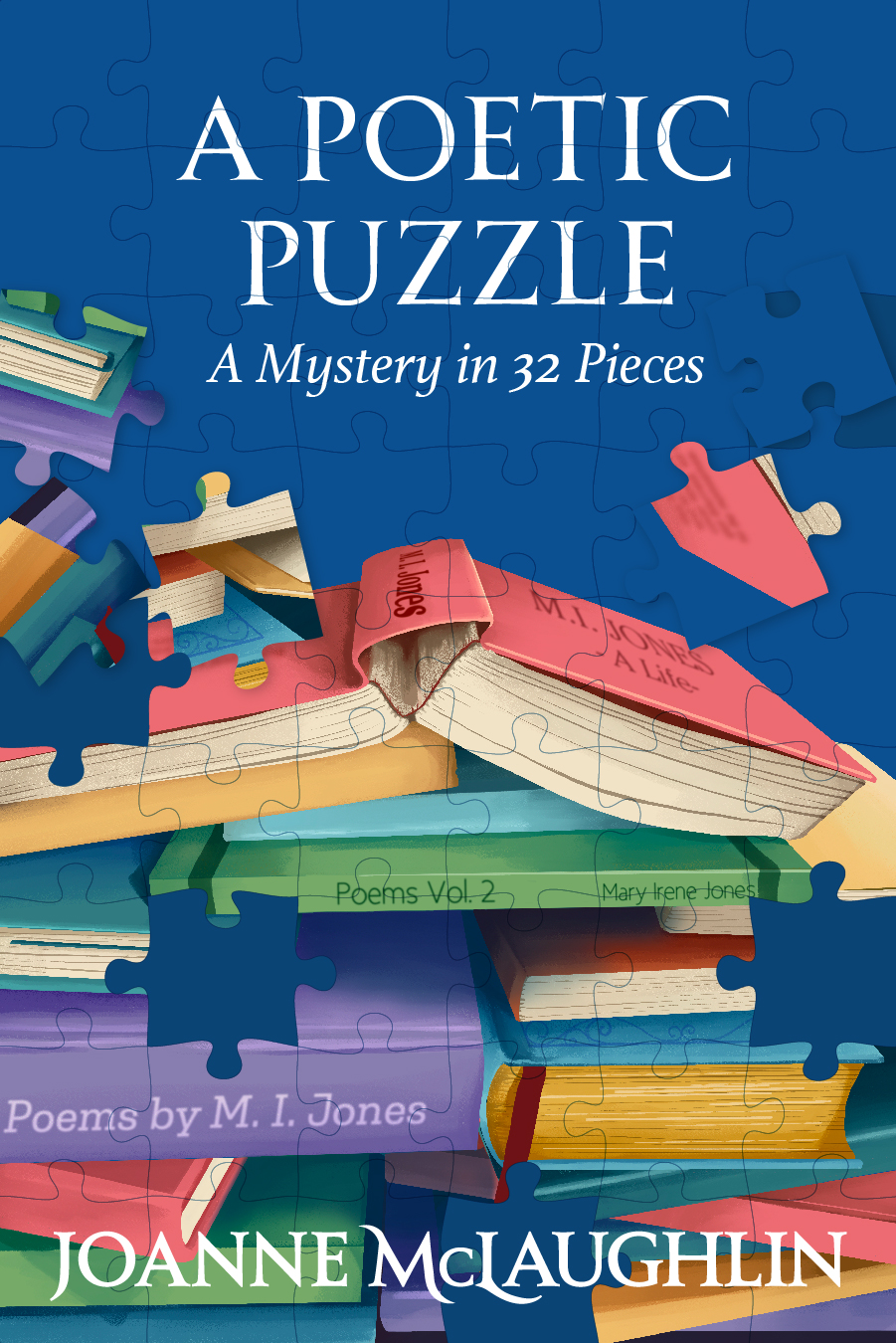
            In my fifth novel, A Poetic Puzzle, one name sets my protagonist, M. Irene “Mimi” Jones—an under-recognized, under-employed poet/English literature professor—on a mission. It’s the name she shares with internationally acclaimed poet Mary Irene Jones, who has vanished, but not before sending Mimi a cache of her heretofore unpublished manuscripts. Is the timing of these two events a coincidence? Are the manuscripts clues of some sort? And if so, why entrust them to Mimi, of all people? The same-name thing must be significant, right?

            I should mention here that the house Mimi lives in is one she inherited from yet another Mary Irene Jones, the paternal grandmother for whom she was named.

            About that: The name Mary Irene Jones is what prompted me to write A Poetic Puzzle.

            You see, my own father’s mother was a Mary Irene Jones, too, before she married my grandfather. She didn’t disappear, per se, but I never got to know her. My dad scarcely did—he was only nine years old when she died in 1931 of what was apparently characterized as “women’s trouble.” My mother suspected that meant some sort of reproductive or breast cancer. I’m not sure anyone now living would know. My father was the family’s youngest child; he, his older brother, and his two older sisters are gone now.

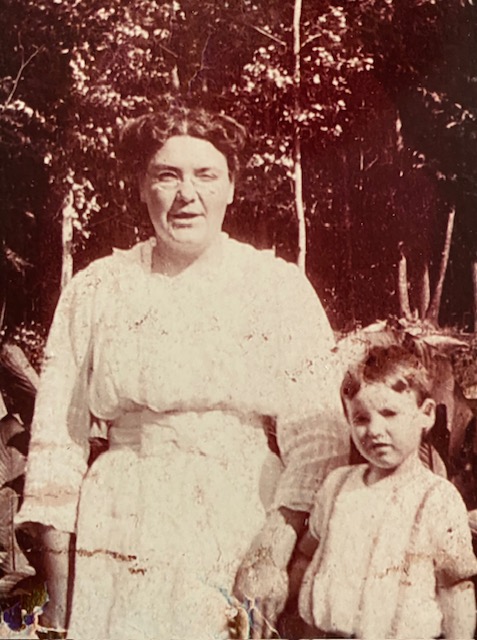
            I look like my father, as does my son. Both of them more closely resemble George McLaughlin, Mary Irene’s husband, my paternal grandfather. But in the lone photograph I have of her, I can see myself.

            That photo, actually a picture of a photograph, may be the only one that still exists. I don’t know whether she had siblings whose children or grandchildren might have family photo albums. I have never had close ties to my McLaughlin relatives, let alone any Jones descendants who might be her family. Judging from her husband’s birth year, I think this Mary Irene was born in the United States in the late 19th century, but I don’t know when or where. I know she married a man from northeastern Pennsylvania and ended up living in Philadelphia, but I don’t know the circumstances. Except for the year, I don’t know the date of her death or where she was buried.

            That sepia-tone image of my grandmother sits next to my laptop as I write this. I’ve studied it endlessly, searching for clues beyond the obvious. In it, she has dark hair, brown, I suppose, since my father and I and at least one of his sisters had dark brown hair. She has a long face not unlike mine—my late Aunt Vera, whom I resemble a bit, had the same long face.

            Pince-nez eyeglasses sit on my grandmother’s nose—maybe she was near-sighted the way I am. Her light-colored, lacy long-sleeved dress is cinched at the waist with a bow. And she is standing outdoors, with trees in the background. Holding her left hand is a small boy, maybe sandy-haired, maybe five years old. He is dressed for warm weather. My mother told me that she had been told that the boy was not my dad, but who offered that information, I don’t know.

            Were my grandmother and this boy, presumably her other son, standing in their backyard? Were they having a picnic in a park? Were her daughters—one older than the boy, one younger—playing away from the camera’s lens? Was my father an infant napping nearby?

            How my mother came to give me this photo, I don’t recall. Did my uncle’s wife, a distant cousin of Dad’s who married his brother, give it to my parents? My mother always suggested that particular aunt-by-marriage was the source of whatever McLaughlin family history we were aware of. Ancestry.com shows any number of second and third and more distant cousins with whom I share a bit of DNA, but because I have no details about my grandmother’s forebears, I can’t readily know which of these many cousins, if any, sprang from the same branch of the family tree she and I came from. Answers might lie at the bottom of a deep and daunting rabbit hole, to add another garden metaphor, or it might be a fruitless search.

            Truly, Mary Irene Jones McLaughlin is a mystery to me.

            Which got me thinking back in spring 2022: What if I immortalized her (sort of) in a mystery? What if, given that I knew little more than her name, that’s where my story began?

            I dropped her married name from the plot line, lest someone think this book was nonfiction. Also because, as names go, Mary and Jones are definitely common ones.

            As A Poetic Puzzle opens, the reader learns that the two Mary Irene Joneses not only have the same name, but also the same occupation, and are affiliated with the same small college in suburban Philadelphia. It soon becomes apparent, however, that what’s in a name is a confounding, confusing bit of business.

            Mimi Jones discovers much as she scrutinizes the pieces of A Poetic Puzzle, not the least of which is this:

            How well do we really know anyone?  

A Poetic Puzzle

Internationally acclaimed poet Mary Irene Jones has vanished—calls and texts unacknowledged, bank accounts emptied, car abandoned. But before she disappeared, she mailed never-published manuscripts to a lesser-known namesake poet, M. Irene “Mimi” Jones. Are the manuscripts clues only Mimi can decipher? And what about the handsome Philadelphia cop assigned to the case? He seems as intrigued by Mimi as by the missing celebrity poet. Talk about a person of interest…

Amazon.com: A Poetic Puzzle: A Mystery in 32 Pieces: 9781951967130: McLaughlin, Joanne: Books
A Poetic Puzzle – Kindle edition by McLaughlin, Joanne. Romance Kindle eBooks @ Amazon.com.

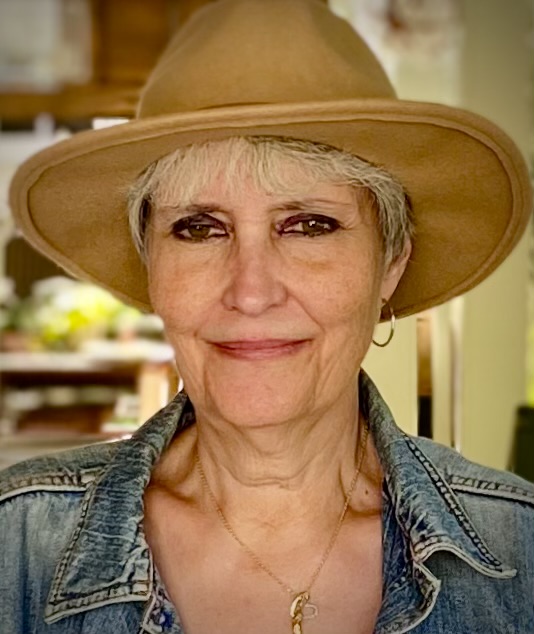
Joanne McLaughlin began telling stories in second grade, creating superhero fan fiction in the Philadelphia rowhouse where she grew up. She has worked for public media and newspapers in Philadelphia, upstate New York, and northeastern Ohio, involved in award-winning coverage of topics from politics and public health to fashion and financial markets, as well as Pulitzer Prize-finalist architecture criticism and a Peabody Award-nominated podcast. For several years, she also served as vice president of a firm that managed and booked blues musicians. Her novels include the romantic mystery A Poetic Puzzle; Chasing Ashes, a crime thriller; and Never Before Noon, Never Until Now, and Never More Human, a vampire trilogy. Her latest short fiction appears in Ruth and Ann’s Guide to Time Travel, Volume 1; the short stories Peppina’s Sweetheart and Grass and Granite are available on Amazon. Joanne is inspired by strong women like the ones who raised her, determined to meet challenges head on. Joannemclaughlin.net

Social media:
https://facebook.com/joannemclaugh

https:Instagram.com/joannemclaugh

@joannemclaughlin.bsky.social

Joanne McLaughlin (@joannemclaugh) / X

Joanne McLaughlin | LinkedIn

Guest Blogger ~ Liz Alterman

A big thank you to Liz for getting a post for me in time to fill in for Heather Haven, who asked me to find someone to fill her Thursday this month.

Why I write psychological suspense:

During my teen years, my favorite way to spend the weekend involved sitting in the eerie darkness of a movie theater, sharing a bucket of popcorn with friends, waiting to be scared—not by zombies, dinosaurs, or tornados but by the nanny who wasn’t as kind as she appeared, the handsome husband leading a double life, or the woman posing as an author’s biggest fan who will ultimately hold him hostage.

That fear, the feeling of goosebumps sprouting, hair rising on the back of my neck, was such an enthralling sensation, almost like those chilling moments when a roller coaster inches up that steep incline, I couldn’t get enough.

Since the afternoons when my mom read to me as a child, I’d always wanted to write a book. While my first was a memoir, when I turned to fiction, I longed to try to evoke the same tension and anxiety I fell in love with in the fourth grade while reading Lois Duncan’s Ransom and, later, in other novels by authors like Megan Abbott and Patricia Highsmith, and, of course, in those frightening films.

I’ve now written several thrillers and while I’m in the thick of plotting each story, I worry that it won’t come together in the end. (Another source of fear!) That said, I love the way the process can feel akin to putting together a puzzle. You’re working toward a complete picture, your brain turning around the pieces until they lock into place. When they do and you can surprise yourself—and, hopefully, your readers—it’s magical.

Reading and writing thrillers, suspense, and mystery also gives you a healthy sense of wariness. When you’re dialed into the possibility of darkness lurking around every corner, it keeps you on guard. One morning when I was in my twenties and walking through a parking lot, a man approached me and asked if I wanted to see the puppies he had in his van. I almost said, “Are you kidding? I’ve seen Silence of the Lambs three times! There’s no way I’m getting near your van!”

Writers have rich imaginations, which is both a blessing and a curse. I joke that once you start writing thrillers, suspense, or mysteries, that becomes the lens through which you view the world. Last fall, I attended a short writing retreat. Beyond my window lay a field, a dense fog muting the colors of the autumn landscape. My gaze shifted to a pair of dogs sniffing around but always returning to the same patch. Were bodies buried out there? I couldn’t help but muse. 

I often wonder if romance writers are similarly afflicted. When they see a couple, do they create an elaborate backstory for them? A meet-cute? A conflict involving a former love interest that leads to a break-up and eventually a happily-ever-after? Is all this imagining an occupational hazard? Either way, it’s often a delightful escape from reality.

Writing thrillers has also been a wonderful way to work through pent up feelings of frustration and even revenge fantasies. Murder a busybody neighbor? No problem. Put snarky dialogue in the mouth of your protagonist as she outwits a villain? Done. Leave all your animosity on the page.

Though I love writing personal essays and humor pieces, suspense is a genre I always return to for the chance to bask in the unsettling appeal of impending doom.

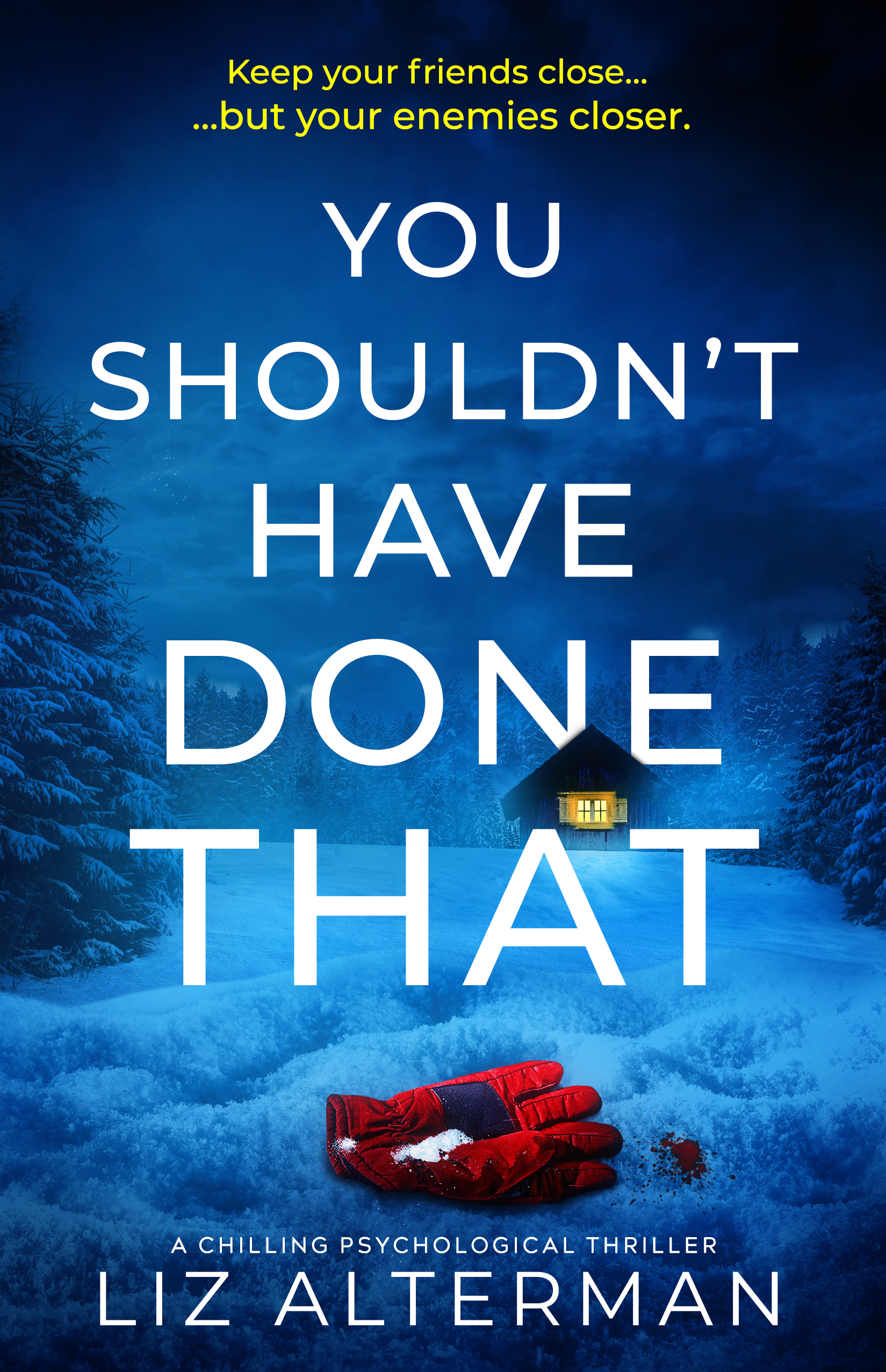
You Shouldn’t Have Done That

Jane Whitaker and Ivy Chapman have been best friends for twenty years – ever since their sons Cal and Brad attended the same preschool.

But their close bond is severely tested when their now adult sons go skiing together in Wyoming and only one returns.

Where is Cal Whitaker and why didn’t Brad Chapman report him missing?  With growing fears for Cal’s safety, his family begins to suspect Brad knows a lot more than he’s saying.

Friendship turns to suspicion and then to open hostility when Cal’s sister Emerson posts an online appeal that ignites a vicious crusade against Brad.

As decades-old loyalties crumble, Jane and Ivy find themselves on opposite sides of a deadly divide. How far will each mother go to protect her family? And what happens when saving one son means destroying the other?

Buy link: https://www.amazon.com/Shouldnt-Have-Done-That-psychological-ebook/dp/B0F1DPWT5D/ref=tmm_kin_swatch_0

Liz Alterman is the author of the memoir, Sad Sacked, the young adult thriller, Hell Be Waiting, the suspense novels The Perfect Neighborhood, The House on Cold Creek Lane, and You Shouldn’t Have Done That, as well as the forthcoming romcom Claire Casey’s Had Enough. Her work has been published by The New York Times, The Washington Post, McSweeney’s Internet Tendency, and other outlets. Follow her on Instagram or subscribe to her Substack where she shares the ups and downs of the writing life (and cat photos).

Guest Blogger~ Zaida Alfaro

The Hidden Track: A Miami Music Mystery, is the third and final book of the Miami Music Mystery series, and it serves as a culmination of everything the series has been building towards. In this final installment, readers are taken on one last thrilling ride through the vibrant music scene of Miami, with a mystery that not only ties up the story arcs of our beloved characters but also brings resolution to the long-standing questions and tensions that have been simmering throughout the series.

The book follows the same characters we’ve grown attached to, but with deeper layers of growth and development. They’ve come a long way from the first book, with their personal lives and relationships more complex and interwoven into the unfolding mystery. In The Hidden Track, the stakes are higher than ever. The main character, Vy, faces a challenge that requires not only solving a crime but confronting personal demons, facing difficult decisions, and navigating the delicate balance between their musical passion and the dangers that come with it.

What sets this book apart is the sense of closure it provides, while also giving readers the chance to reflect on the themes that have been consistent throughout the series—loyalty, trust, and the power of music to heal and connect. The music itself is integral to the story, not only as a backdrop but as a vehicle for the plot, with song lyrics and performances playing key roles in solving the mystery. Music is a language of its own, and in this book, the hidden track symbolizes the final piece of the puzzle, something that’s been waiting to be discovered all along.

Wrapping up the Miami Music Mystery series has been an emotional and reflective journey. After working on these characters and storylines for over five years, it feels surreal to finally bring everything to a close. There’s a mix of happiness and sadness—happiness in knowing I completed the vision I set out for the series, but also sadness in letting go of the world and characters I’ve spent so much time with.

The process of tying up loose ends in the final book was both challenging and rewarding. Every subplot needed resolution, and I wanted to make sure the characters’ growth and the mysteries were satisfying to readers. There were moments of doubt, especially with the last few chapters, but pushing through and seeing it all come together was worth every bit of effort.

What’s also been important for me is knowing the story has reached its natural conclusion. While it’s bittersweet to say goodbye to Miami, its music scene, and the characters who’ve made it so special, I’m proud of what I’ve created and the way everything has come full circle.

I feel a sense of accomplishment, but I also look forward to exploring new projects. There’s a mixture of pride in the series’ completion and excitement about what comes next. It’s been a chapter of my life that I will always cherish, and I’m grateful for the readers who have been part of the journey.

THE HIDDEN TRACK

Vy has finally hit her high note. After years of clawing her way through the ruthless music industry, dodging dangerous rivals, and surviving murderous encounters, her dreams of stardom are within reach. With a record deal secured and her debut single climbing the charts, Vy is ready to shoot her first music video—a moment she’s been rehearsing in her mind for as long as she can remember.

But as always in Vy’s life, nothing stays in tune. As tensions crescendo and chaos threatens to drown her out, Vy must find a way to keep her creative vision intact. All the while, shadows from her past echo through her mind—could there be someone still out there, determined to see her career hit its final note?

As Vy’s close-knit band of friends and collaborators face their own personal trials, the stakes have never been higher. Has Vy’s murderous melody finally ended, or is there still danger lurking in the final verse? In the end, will Vy get the happily ever after she’s fought so hard for, or is there a hidden track playing a haunting melody, waiting to pull her back into the shadows?

Buy link: https://linktr.ee/Zaidamusic

The vibrant city of Miami, Florida, serves as the heartbeat of the Miami Music Mystery series—a city I deeply cherish, having been born and raised there. Like the series’ protagonist, Vy, I am a singer-songwriter and Grammy-considered independent artist, with a profound passion for music and literature. 

Years ago, I discovered cozy mysteries and was immediately captivated by their engaging, intriguing, and often humorous storylines. Inspired by these works, I decided to merge my love of music with my newfound passion for storytelling. This led to the creation of my debut novel, The Last Note: A Miami Music Mystery. 

Following its success, I continued Vy’s story In the Key of Dead: A Miami Music Mystery. Drawing from my own life experiences, I wove elements like phobias, dream sequences, and quirky personalities into the narrative—all grounded in truth. Through these novels, I aimed to share my love for Miami, its rich Cuban culture, my family, and the world of music. 

Now, with the release of The Hidden Track, the final book in the Miami Music Mystery series, I’ve brought Vy’s journey to a thrilling conclusion. This latest installment delves deeper into the city’s vibrant backdrop and Vy’s evolving story, tying together the mysteries, challenges, and triumphs that have defined her journey. 

I hope readers feel the same passion for Miami, music, and storytelling that I’ve poured into these novels. It’s been a joy to bring this series to life and share a piece of my world with you. 

Zaidamusic.com

Instagram/Twitter: zaidamusic

Facebook: zaidaauthor and zaidamusic

Guest Blogger ~ M.E. Proctor

Bop City Swing, or When Writers Click

By M.E. Proctor

We should write something together, I’ve heard these words many times. The suggestion is always vague and about as binding as the clichéd ‘let’s do lunch one of these days’. Many years ago, a friend and I planned to write a book. He was a big science fiction fan, so that’s what we decided to do. I delivered the first chapter. My friend never produced chapter 2, and I ended up doing the entire thing. It turned into a four-book dystopian series, The Savage Crown.

So, when fellow crime writer Russell Thayer typed in a social media chat that “Tom should go after Gunselle someday. Imagine the interrogation scene!” I agreed that bringing our two recurrent short story characters together was a cool idea, but I doubted it would go anywhere.

I was wrong. We’re a year later and Bop City Swing is on the bookshelves. Even better, Russell and I are working on another mystery featuring the same two leads.

Russ’s creation is Vivian Davis, aka Gunselle, a contract killer. He has written more than twenty short stories spanning the late 1930s-early 1950s with her in the starring role. My guy (he’s in a dozen stories so far) is Tom Keegan, a homicide detective in 1950 San Francisco. A professional killer and a cop, in the same place at the same time … sounds like a match made in Noir heaven.

Early last year, Russ and I both happened to have pieces published at the same time in two different magazines. A mash-up—in the vein of CSI meets Law & Order—was top of mind again and we started brainstorming ideas for a short story. What if she’s hired to bump him off … What if they’re after the same killer… We eventually decided to build the story around a political assassination that would involve both characters, coming at it from their respective angles. The detective investigates the case, in straight procedural fashion, and the contract killer is embroiled in it sideways. She didn’t commit the crime.

We never discussed the mechanics of the collaboration. It felt natural to tell the story from a double point of view (POV), Russ writing the Vivian-Gunselle chapters, while I wrote Tom’s scenes. The differences in our styles fit the particular voice of our respective characters. If there were awkward disparities or rough edges, we figured we could polish them off after the first draft.

Russ sent me a snippet of Gunselle being hired for a job she dislikes—fixing somebody else’s mess, i.e. the assassination (that plot line was discarded later on)—and a few days later, I sent him Tom’s arrival at the crime scene, the ballroom of a luxury hotel. The suspect is a musician in the jazz band hired for the event.

Everybody knows that most of the research should be done before starting to write the story, it’s a lot more efficient, but we were both eager to get something going. Now, with two scenes drafted, we had to make sure we were historically correct on the when and the where.

The when would be 1951, an election year. That November, San Francisco re-elected the incumbent republican mayor, Elmer Robinson. The fictional who (the victim) would be Charles Forrester, the democratic challenger launching his campaign at a June fundraiser. Where would be the Palace Hotel, conveniently located downtown, with a good size ballroom—an internet deep dive delivered period-accurate floorplans.

We knew when, where, and who, but like our two lead actors, we were stumped by the motive. Why was Charles Forrester shot? We wouldn’t find out for a while.

Writing a story is like a treasure hunt. Every sentence, written on the fly, contains potential clues. Here’s an example. The decision to make the killer a jazz trumpeter gave the plot a definite slant. It also gave us the opportunity to dig into the rich Bay Area music scene of the early 50s, the various clubs, the talent on display, the racial tensions, the lure of the city at night, the early involvement of the Mob in the drug trade. Russ had touched on the music angle in some of his stories and brought all that background into the plot, with great secondary characters. One of them, Maggie, became central to nailing down the motive and the final resolution. Through Maggie, we also touched on the war, only six years in the past, and its aftermath, how deeply it scarred many characters in the story.

Very soon, the project was no longer a short story. Bop City Swing had turned into a book.

During the months it took to complete a solid first draft, we had a couple of mini-debates. One of them was about who would enter the scene first.

Homicide cops always get there after the fact, by definition. We decided to start with Gunselle and put her in the ballroom, at the very beginning, before the shots ring out. That gave us the story hook. She was hired for the hit and somebody beat her to it. She’s pocketed the down payment. For doing nothing. As a professional, it sticks in her craw.

Another discussion was about the key confrontation between our two characters. Up to that climactic moment, they’d both gone through their moves separately, with only a glancing accidental contact that showed mutual interest. Yes, this is where it gets sexy … Who would write that scene, in whose POV? We considered writing it twice, in a ‘he says, she says’ tango, but it proved clunky. I wrote the initial scene, from Tom’s voice, then Russ took it and turned it around. It worked a lot better that way, Gunselle initiates the event and is the more active character. It was also fun to write Tom’s reaction afterwards.

We initially wrote our respective scenes separately. After a few weeks, we built a master document that we carried all through to the end, highlighting changes, constantly adjusting things. Russ writes snappy action scenes and I tend to be atmospheric. In the master document, we started blending things. He added bite and I added background.

Mid-way through the process, we built a timeline. The characters were all in motion and the investigation picked up speed. A beat-by-beat sequence of events helped us figure out the ending. None of what happens in the last act was in the cards from the start.

The time we took to consider options, writing them and discarding parts of them, might appear to be a waste but was crucial in coming up with the best solution. The beginning of the story, in particular, was rewritten multiple times. Part of the fun in a collaboration is having your partner put something on the table that you would never have come up with on your own.

Writing is a solitary pursuit. Sometimes, it feels good to share. Russ and I had so much fun, we’re doing it again. There will be more Tom and Gunselle in the future. I’ll keep you posted!

—-

Bop City Swing

San Francisco. 1951.

Jazz is alive. On radios and turntables. In the electrifying Fillmore clubs, where hepcats bring their bebop brilliance to attentive audiences. In the posh downtown venues where big bands swing in the marble ballrooms of luxury hotels.

That’s where the story begins, with the assassination of a campaigning politician during a fundraiser.

Homicide detective, Tom Keegan, is first on the scene. He’s eager, impatient, hot on the heels of the gunman. Gunselle, killer for hire, is no longer there. She flew the coop, swept away in the rush of panicked guests.

They both want to crack the case. Tom, because he’s never seen a puzzle he didn’t want to solve, no matter what the rules say. Gunselle, because she was hired to take out the candidate and somebody beat her to it. It was a big paycheck. It hurts. In her professional pride and wallet.

The war has been over for six years, but the suffering and death, at home and abroad, linger as a horror behind the eyes of some men. And one young woman.

Bop City Swing is the brainchild of Russell Thayer, author of the Gunselle stories, and M.E. Proctor, who occasionally takes a break from Declan Shaw, her Houston PI, to don Tom Keegan’s gray fedora.

Buy Links:

Bop City Swing is available in eBook and paperback

On Amazon at https://www.amazon.com/Bop-City-Swing-Proctor-Thayer/dp/B0F4DSSQ9V/

From reviews:

“A wild ride down the neon-lit streets of post-WWII America, with bebop wailing in the nightclub on the corner, the white witch pumping through the veins of the junkie on the barstool, three slugs draining the life from the charismatic politician with a shady past, and enough snappy dialogue to light up the faces of Raymond Chandler and James M. Cain.”

M.E. Proctor (www.shawmystery.com) was born in Brussels and lives in Texas. The first book in her Declan Shaw PI series, Love You Till Tuesday (2024), came out from Shotgun Honey, with the follow up, Catch Me on a Blue Day, scheduled for 2025. She’s the author of a short story collection, Family and Other Ailments, and the co-author of a retro-noir novella, Bop City Swing. Her fiction has appeared in VautrinToughRock and a Hard PlaceBristol NoirMystery TribuneShotgun HoneyReckon Review, and Black Cat Weekly among others. She’s a Derringer nominee.

Social Links

Author Website: www.shawmystery.com

On Substack: https://meproctor.substack.com

Facebook: https://www.facebook.com/martine.proctor

Twitter: https://twitter.com/MEProctor3

BlueSky: https://bsky.app/profile/meproctor.bsky.social

Instagram: https://www.instagram.com/proctormartine/

Russell Thayer’s work has appeared in BrushfireTough, Roi Fainéant Press, Guilty Crime Story Magazine, Mystery Tribune, Close to the Bone, Bristol Noir, Apocalypse Confidential, Cowboy Jamboree Press, Hawaii Pacific Review, Shotgun Honey, A Thin Slice of Anxiety, Rock and a Hard Place Press, Revolution John, Punk Noir Magazine, Expat Press, Pulp Modern, The Yard Crime Blog, and Outcast Press. He received his BA in English from the University of Washington, worked for decades at large printing companies, and currently lives in Missoula, Montana. You can find him lurking on Twitter @RussellThayer10.

Guest Blogger ~ Lois Winston

Truth is Stranger than Fiction

By Lois Winston

First, a little literary history regarding the expression, “Truth is stranger than fiction.” It’s been around for a long time. In 1897 Mark Twain published the travel book Following the Equator: A Journey Around the World. Chapter Fifteenth included the epigraph, “Truth is stranger than fiction, but it is because Fiction is obliged to stick to possibilities; Truth isn’t. — Pudd’nhead Wilson’s New Calendar.”

However, Twain wasn’t the first to come up with some version of the saying. Seventy-four years earlier, Lord Byron had Don Juan opine, “’Tis strange — but true; for truth is always strange; Stranger than fiction; if it could be told, How much would novels gain by the exchange!”

Why am I telling you this? It’s because I’m not only a news junkie, but I’m also a diehard eavesdropper. I developed that skill at a very young age, learning all sorts of interesting stories while listening from behind closed doors. The adults in my life thought I was off playing with my dolls or watching cartoons, but I quickly realized that far more interesting tales were being told around my grandmother’s kitchen table. I became Harriet the Spy, well before Louise Fitzhugh ever dreamed up Harriet.

My grandmother, aunt, and great-aunts loved to gossip. Consequently, I learned some fascinating stories about my relatives and their private lives. Little did I know at the time that much of what I overheard would eventually wind up decades later as inspiration for characters and plots when I first got the itch to write a novel.

Much of what I heard involved my grandfather, who had a decades-long career in law enforcement during the heyday of organized crime in the New York metropolitan area. By the time I came along, he’d risen to captain of a major metropolitan police force. However, back in the day, he was personally responsible for the apprehension of many mobsters. But get this: one of his brothers was a bootlegger! And one of his wife’s brothers was romantically involved with a woman whose family was in the Mafia! I wound up going to school with two of her nieces. Mind-boggling, right?

Is it any wonder Anastasia Pollack, my Jersey Girl reluctant amateur sleuth so often finds herself tangling with Mafia henchmen?

To date, I’ve published twenty-three novels and five novellas. The plots and subplots for all have been drawn from events I’ve either observed, overheard, or read about—going all the way back to those early childhood days of listening with my ear pressed up to the kitchen door.

However, in Seams Like the Perfect Crime, the fourteenth and most recent book in my Anastasia Pollack Crafting Mystery Series, I didn’t draw on memories of conversations from my childhood. Instead, I looked no further than across the street from a former house my husband and I bought in 1998.

Over the years, I’ve had some very strange neighbors. Many of them have made their way into my books, but the couple who lived in the house across the street from us back then tops the Strange Neighbors List.

In Seams Like the Perfect Crime, readers meet the very odd Barry Sumner, a half-naked man who spends hours each day mowing his postage stamp-sized yard of weed-infested packed dirt. When the mower runs out of gas, Barry settles onto the top step of his porch, downs a six-pack or two, and passes out. Every day, year round, weather permitting.

And here’s where truth being stranger than fiction comes into play. The characters of Barry Sumner and his wife are based on the neighbors who lived across the street from my husband and me twenty-seven years ago, including the same strange mowing obsession and beer guzzling habit, as well as his wife’s suspicions regarding some hanky-panky. Luckily, this former neighbor didn’t meet the same fate that awaits Barry Sumner in Seams Like the Perfect Crime.

Seams Like the Perfect Crime

An Anastasia Pollack Crafting Mystery, Book 14

When staffing shortages continue to hamper the Union County homicide squad, Detective Sam Spader once again turns to his secret weapon, reluctant amateur sleuth Anastasia Pollack. How can she and husband Zack Barnes refuse when the victim is their new neighbor?

Revolutionary War reenactor Barry Sumner had the odd habit of spending hours mowing a small patch of packed dirt and weeds until his mower ran out of gas. He’d then guzzle beer on his front porch until he passed out. That’s where Anastasia’s son Nick discovers his body three days after the victim and his family moved into the newly built mini-McMansion across the street.

After a melee breaks out at the viewing, Spader zeroes in on the widow as his prime suspect. However, Anastasia has her doubts. There are other possible suspects, including a woman who’d had an affair with the victim, his ex-wife, the man overseeing the widow’s trust fund, a drug dealer, and the reenactors who were blackmailing the widow and victim.

When another reenactor is murdered, Spader suspects they’re dealing with a serial killer, but Anastasia wonders if the killer is attempting to misdirect the investigation. As she narrows down the suspects, will she jeopardize her own life to learn the truth?

​Craft projects included.

Buy Links

Amazon: https://amzn.to/49KvjaG

Kobo: https://www.kobo.com/us/en/ebook/seams-like-the-perfect-crime

Nook: https://www.barnesandnoble.com/w/seams-like-the-perfect-crime-lois-winston/1146583329?ean=2940184679983

Apple Books: https://books.apple.com/us/book/seams-like-the-perfect-crime/id6738502932

Books2Read Universal Link to Other Sites: https://books2read.com/u/3LXa1e

USA Today and Amazon bestselling author Lois Winston began her award-winning writing career with Talk Gertie to Me, a humorous fish-out-of-water novel about a small-town girl going off to the big city and the mother determined to bring her home to marry the boy next door. That was followed by the romantic suspense Love, Lies and a Double Shot of Deception.

Then Lois’s writing segued unexpectedly into the world of humorous amateur sleuth mysteries, thanks to a conversation her agent had with an editor looking for craft-themed mysteries. In her day job, Lois was an award-winning craft and needlework designer, and although she’d never written a mystery—or had even thought about writing a mystery—her agent decided she was the perfect person to pen a series for this editor.

Thus, was born the Anastasia Pollack Crafting Mysteries, which Kirkus Reviews dubbed “North Jersey’s more mature answer to Stephanie Plum.” The series now includes fourteen novels and three novellas. Lois also writes the Empty Nest Mysteries and has written several standalone mystery novellas. Other publishing credits include romance, chick lit, and romantic suspense novels, a series of romance short stories, a children’s chapter book, and a nonfiction book on writing, inspired by her twelve years working as an associate at a literary agency.

Learn more about Lois and her books at www.loiswinston.com where you can find links for her other social media sites and sign up for her newsletter to receive a free download of an Anastasia Pollack Mini-Mystery.

Website: http://www.loiswinston.com

Newsletter sign-up: https://dl.bookfunnel.com/dc9t0bjl00

Killer Crafts & Crafty Killers blog: www.anastasiapollack.blogspot.com

Booklover’s Bench: https://bookloversbench.com

The Stiletto Gang: https://www.thestilettogang.com

Goodreads: https://www.goodreads.com/author/show/722763.Lois_Winston

Bookbub: https://www.bookbub.com/authors/lois-winston