

Truth in Fiction
Readers often ask me if my mysteries are based on real-life crimes and circumstances. My answer is that my imagination provides what I need for my plots, so using actual cases is not necessary. However, there are several elements in the stories that are based on fact.
For my Sydney Lockhart Mysteries, set in historic hotels in the 1950s, I research what the hotels were like back then: the menu items and prices, the cost of a room and its décor. I search for old photos and articles of the hotels. In Murder at the Arlington, I describe what the restaurants, bars, bathhouses, and tourist’s sight were like seventy years ago. In Murder at the Luther (the Luther Hotel in Palacios, Texas) I drew on the colorful history of this once-thriving little town on the Texas coast. President and Lady Bird Johnson were regulars at the Luther Hotel back when LBJ was a Texas state senator. During WWII, Camp Hulen, located nearby, housed almost 15,000 personnel and interred thousands of German prisoners. The government brought in celebrities like Guy Lombardo, Rita Hayworth, Shirley Temple, and Carol Lombard to entertain. I wove these facts into the story. The same is true for Murder at the Galvez (Galveston) and Murder at the Driskill (Austin).
I don’t use people I know as models for my characters, but I do use strangers that grab my attention. Once I witnessed a domestic dispute while driving through the countryside. A wild-haired woman dressed, in orange T-shirt and pink tights, was throwing pine cones and profanity at her retreating husband, a fellow who looked as if he’d suffered years of spousal abuse. She told him if he got drunk and forgot to pick up the kids at school again (This couple had kids?), she was going to shoot him. Alas, Paula Steiner, was born and she’ll make her debut in my third Kate Caraway mystery, Eagle Crossing, which will be released in a little more than a year.
I also give my own feelings, experiences, and passions to my main characters. In my latest Kate Caraway animal-rights mystery, A Two Horse Town, Kate experiences a couple of hair-raising moments when she is traveling along a steep switchback mountain road. Her fear of heights is based on my own acrophobic experiences.
However, some writers fictionalize the truth, creating an even better story. Think of it this way: reading about an actual crime, adventure, heartwarming story, or heroic gesture in a magazine article, newspaper, or blog is captivating, but the readers are only provided limited points of view. A fiction writer can take a situation and delve deeper into telling the story, using multiple points of view, a compelling background, and a wide range of other emotions like suspense, thrill, fear, humor, something a reporter or writer of nonfiction might not do.
For instance, the Gothic novel, Rebecca, by Daphne du Maurier, is a story of jealously, misunderstanding, heartache, and tragedy wrapped up in one of the best mysteries ever written. Du Maurier loosely based the story’s origin on her own suspicions that her husband, Lieutenant General Frederick “Tommy” Browning, was still attracted to the striking woman he’d once been engaged to. Du Maurier also admitted that she and Browning had not been faithful to one another during their marriage. The couple’s infidelity was also used in the novel. Max De Winter and his first wife, Rebeca, (deceased) had cheated on one another, and De Winter’s his second wife’s jealously intensified as he became withdrawn and secretive, filling the story with tension strong enough to snap one’s nerves.
I’ve also read the excellent biography, Manderley Forever: A Biography of Daphne du Maurier. Author Tatiana de Rosnay’s book has received raved reviews, but it was Rebecca, the fictional account of an obsessively jealous and fearful wife, that sold almost three million copies. I’m not as bold as Du Marnier to use my private life in a story—but then she’s sold a lot more books than me. So maybe I’ll rethink this.
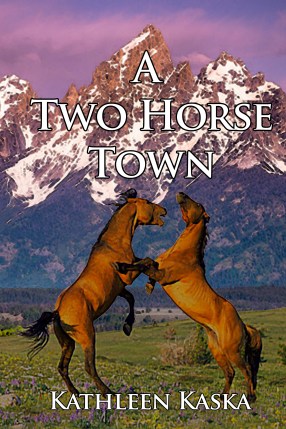 Blurb:
With her coffee-guzzling dogs and a welcome mat that starts at the business end of a shotgun, Ida Springfield weathers all the challenges life hands her. Until the local government gets the idea to build a dam to help the ranchers, a dam that would dry up the water on her ranch and destroy the habitat for the herd of mustangs living there. After further alienating the “goofballs at town hall,” Ida lets go of her pride and accepts the help of animal rights activist Kate Caraway. Kate feels a need to escape life in Chicago after so many years in her beloved Africa. She’s eager to get to Montana and find some peace from rural surroundings. After tumbling down a mountain, finding a body, and getting warned off by the mayor, Kate understands why her husband wants her to come home. But Kate can’t leave without saving the mustangs and helping the 82-year-old woman and her mentally challenged twin sister stand up to the town bigwigs. To do that, she has to find out who killed Ida’s estranged son and why town officials believe her great-grandson committed the crime.
Buy Links:
Amazon
Barnes and Noble
Bio:
 Kathleen Kaska is the author two awarding-winning mystery series: the Sydney Lockhart Mystery Series set in the 1950s and the Classic Triviography Mystery Series, which includes The Sherlock Holmes Triviography and Quiz Book. A Two Horse Town, Kathleen’s second mystery in the new Kate Caraway animal-rights series, was released in December 2018. She is also a writer and marketing director for Cave Art Press. Her collection of blog posts was released in September 2017 under the title, Do You Have a Catharsis Handy? Five-Minute Writing Tips.
Social Media Links:
http://www.kathleenkaska.com
http://www.blackopalbooks.com
https://twitter.com/KKaskaAuthor
http://www.facebook.com/kathleenkaska
https://www.instagram.com/kathleenkaska/
www.caveartpress.com
https://www.linkedin.com/in/kathleen-kaska-942aa511/

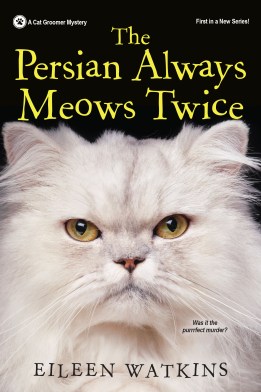 My Cat Groomer Mystery series evolved from a theme suggested by my publisher, but animals always have been a passion for me. As an only child, I grew up with pets instead of siblings, and related to them almost as brothers and sisters. I’ve never worked with animals professionally, but felt that with a little research I could step into the shoes of someone who did.
 Eileen Watkins specializes in mystery and suspense fiction. In 2017 she launched the Cat Groomer Mysteries, starting with The Persian Always Meows Twice, from Kensington Publishing. The Bengal Identity came out in spring of 2018 and Feral Attraction this fall. The Persian Always Meows Twice won the David G. Sasher Award for Best Mystery of 2017 at the Deadly Ink Mystery Conference, and received a Certificate of Excellence for 2017 from the Cat Writers’ Association, Inc. Eileen previously published eight novels through Amber Quill Press, most of them paranormal suspense, as “E. F. Watkins.”

 The Poetic Murderer
 Christoph Burmeister was born on the 16 April 1987 in Bad Oldesloe on the river Trave. That’s why he originally wanted to become a clown.
 Even before I joined the ranks of college faculty, I loved a good academic mystery—one with a professor solving a murder, whether it happened on campus or on vacation. Now that I write academic mysteries (The Penningtons Investigate) I’m loving the fresh voices among the ladies of mystery whose sleuths are professors. Here are just a few.
 C.T. Collier was born to solve logic puzzles, wear tweed, and drink Earl Grey tea. Her professional experience in cutthroat high tech and backstabbing higher education gave her endless opportunity to study intrigue. Add to that her longtime love of mysteries, and it’s no wonder she writes academic mysteries (The Penningtons Investigate) that draw inspiration from traditional whodunits.
 Ladies of Mystery
You must be logged in to post a comment.