What’s Your Method? By Karen Shughart

I recently read an article about renowned American author, John Steinbeck, who gave six tips on writing that were included in a letter he wrote in 1962 to a friend. These caused me to reflect on how I write my cozy mysteries, and I was astonished to realize how much of his advice applied to me. Below are the tips with my italicized notes beside them:

  1. Abandon the idea that you are ever going to finish. Lose track of the 400 pages and write just one page for each day, it helps. Then when it gets finished, you are always surprised. I don’t write every day, but when I do I try to write at least a chapter or two. I don’t have pages in mind; instead, I aim for 60,000-75,000 words, the length for cozies.
  2. Write freely and as rapidly as possible and throw the whole thing on paper. Never correct until the whole thing is down. Rewrite in process is usually found to be an excuse for not going on. It also interferes with flow and rhythm which can only come from a kind of unconscious association with the material. This one hit home. I write the entire story and revise and expand afterword, my first draft is typically too short.
  3. Forget your generalized audience. In the first place, the nameless, faceless audience will scare you to death and in the second place, unlike the theatre, it doesn’t exist. In writing, your audience is one single reader. I have found that sometimes it helps to pick out one person—a real person you know, or an imagined person and write to that one. Instead of picking a person, I write towards a targeted audience, mainly women (and some men) who are middle-aged or older. Cozies are called “clean” novels because they do not contain graphic language or violence or explicit sex scenes, something that appeals to my readers.
  4. If a scene or a section gets the better of you and you still think you want it—bypass it and go on. When you have finished the whole, you can come back to it and then you may find that the reason it gave trouble is because it didn’t belong there. I do this a lot. See below.
  5. Beware of a scene that becomes too dear to you, dearer than the rest. It will usually be found that it is out of drawing. I have a slash and burn mentality when it comes to writing. I may fall in love with a scene, but I’m brutal about cutting it if it doesn’t fit.
  6. If you are using dialogue—say it aloud as you write it. Only then will it have the sound of speech. I do this with every character. Sometimes when I’m writing dialogue for a male, I check with my husband to see if it sounds authentic.

So, there you have it. I hope you authors reading this blog take time to reflect on your own writing methods. For those of you who are our readers, perhaps you’ve gained a little insight into the writing process, at least for John Steinbeck and to a lesser extent, me..

Guest Blogger ~ Jill Piscitello

Genre Hopping

By Jill Piscitello

After two sweet, holiday romances, I decided to dip a toe into the world of cozy mysteries. As a long-time fan of the genre, I’ve enjoyed the thread of sweet romance that is often woven throughout the stories. For me, the genre is the best of both worlds. Readers’ heartstrings are tugged as they are swept along a twisting tale riddled with suspects, clues, and red herrings. They can expect suspense without graphic violence and a nice, tidy ending. Predictable? Maybe. But many genres follow a structure that appeals to a specific audience.

Similar to sweet romance, most cozy mysteries are set in small, close-knit towns. However, I find that I have more freedom to invoke a bit more humor and fun into the story. No character should ever be perfect. Flaws are much easier to relate to. But it often seems that most of the leading ladies in romance novels are gorgeous. My heroine/sleuth, Maeve Cleary, is never described as a great beauty. Much to her mother’s dismay, she’s in desperate need of a trip to the salon to touch up her highlights and lives in worn-to-death shorts and T-shirts. But she came home to mend a broken heart, not to enter The Miss Hampton Beach beauty pageant.

Maeve introduced herself right away. She’s a woman who speaks her mind and acts on instinct. Moving in with her polished and successful mother had all the makings of a critique-laden stay. I enjoy dissecting the dynamic of mother-daughter relationships and hope readers find their back-and-forth barbs entertaining.  

A Sour Note also sent me hopping from fictional towns into the real setting of Hampton Beach, NH in July. One might think building a setting from the ground up with only your imagination to depend on would prove far easier than writing about a place you know well. However, when an author creates a story world, no one can dispute what is missing or inaccurate. Writing about a popular vacation destination is filled with pressure I didn’t anticipate. In the end, I chose to invoke a creative license when writing about restaurants and other locations within the town. Readers who know the area might enjoy guessing at which places inspired a few hot spots.

My family makes several trips to Hampton every summer. When the idea for A Sour Note took shape, I couldn’t imagine choosing another setting. The sights, food, entertainment, and people watching along one of the most popular boardwalks in the nation provide everything needed for an endless stream of writing ideas. The next book in the series will require a fair amount of research because it will occur during the off-season. I look forward to a few trips north for more insight into what the town looks like when tourist numbers dwindle and am confident an empty beach has quite a bit to offer to the cozy mystery genre.

A Sour Note (A Music Box Mystery)

When murder provides a welcome distraction…

On the heels of a public, broken engagement, Maeve Cleary returns to her childhood home in Hampton Beach, NH. When a dead body turns up behind her mother’s music school, three old friends land on the suspect list. Licking her wounds soon takes a back seat to outrunning the paparazzi who spin into a frenzy, casting her in a cloud of suspicion. Maeve juggles her high school sweetheart, a cousin with a touch of clairvoyance, a no-nonsense detective, and an apologetic, two-timing ex-fiancé. Will the negative publicity impact business at the Music Box— the very place she’d hoped to make a fresh start?

Purchase Links:

Amazon

Barnes and Noble

Excerpt:

With his mouth set in a grim line, he waited.

If anyone else had enough nerve to presume she owed them an explanation, she would respond with a solid mind your own business. Instead, the seventeen-year-old still inside her refused to tell him to get lost. “He was hiding money in his office.” This was one of those times when learning how to wait a few beats before blurting out inflammatory information would come in handy. Each second of passing silence decreased her ability to breathe in the confined space. She turned the ignition and switched on the air conditioner.

“How do you know?” His volume just above a whisper, each dragged-out word hung in the air.

“I found it.”

“When were you in his office?” He swiped at a bead of sweat trickling down the side of his face, then positioned a vent toward him.

“Last night.” When would she learn to bite her tongue? Finn’s switch from rapid-fire scolding to slow, deliberate questioning left her unable to swallow over the sandpaper lump in her throat.

“Where was Vic?”

She stared at the back of the building, wishing she’d kept her mouth shut. “He’d left for the night.” If she averted her gaze, she could pretend his eyeballs weren’t bugging out of his head, and his jaw didn’t need a crane to haul it off his chest.

“You were at the town hall after hours? Did anyone see you?”

“A custodian opened his door for me.” She snuck a glance. Sure enough, features contorted in shock and horror replaced his boy-next-door good looks.

Jill Piscitello is a teacher, author, and an avid fan of multiple literary genres. Although she divides her reading hours among several books at a time, a lighthearted story offering an escape from the real world can always be found on her nightstand.

A native of New England, Jill lives with her family and three well-loved cats. When not planning lessons or reading and writing, she can be found spending time with her family, trying out new restaurants, traveling, and going on light hikes.

Social media links:

Website ~ Twitter  ~ FacebookInstagram  ~ Amazon ~ GoodReads~ BookBub

What is it about the Great Lakes? by Karen Shughart

A book I read as a child, set in the 1950s on Lake Superior, resulted in a lifelong fascination with the Great Lakes.  I can’t remember the title, I wish I could, but I do remember snippets of it: family gatherings that included winter sports and summer outings; homemade ice cream made with snow and maple syrup; berry cobblers when the sun was warm and the days long and bright.

I grew up in a city about two hours from Lake Erie, and I have happy memories of family trips there: beaches, amusement parks, and many attractions you’d find at the ocean, but without the salt or sharks. We went to the Jersey shore on the Atlantic, too, and I loved it, but for some reason I always felt drawn to that lake. Many years later, I attended college in Buffalo, NY, and when the weather cooperated spent weekends at a beach cottage owned by family friends in nearby Fort Erie, Canada.

As fate would have it, about 20 years ago my husband and I decided one weekend to explore Lake Ontario, north of where we lived in Pennsylvania.  We discovered a tiny village through the internet; found a charming B&B with water views that was a short walk to the lake, the bay, a small but bustling business district, museums and restaurants, and a quick drive to Finger Lakes’ wineries. Two weeks later we bought our house.

We never expected to live here year ‘round, we planned to use the house as a getaway, but as time went by we were drawn to the region’s many charms.  We worked diligently to restore our house, it had been built by a lighthouse keeper more than a century ago and needed loving care. There’s mystique here: shipwrecks; sightings of massive lake creatures; British ships invading our village during the War of 1812; the transporting of runaway slaves to Canada; a rumor that a tunnel under our backyard hid some of those slaves before they fled. And the brisk business of rumrunning during Prohibition.

Each season has its own appeal. Summer months we revel in the resort vibe enjoying concerts, fireworks, outdoor movies, days spent beachcombing, shopping at farm stands, and lots of gatherings on our deck. During fierce winter storms we snuggle safely in our sturdy home, fireplace burning and soup on the stove, drinking wine with friends. Spring and fall are glorious, too, with acres of fruit trees in fragrant bloom or ripened apples hanging heavily at harvest, and a clean, sweet smell in the air.

In truth, our journey here was serendipitous, and we’ve never regretted it. Like the village on Lake Superior in the book I read so long ago, it’s an enchanting place filled with warm, kind people, and a peaceful quality of life.

From the time I was a child, immersed in Nancy Drew books, I wanted to write mysteries. One night several years ago, I dreamed the plot of my first Edmund DeCleryk cozy mystery, Murder in the Museum. Since then I’ve written three, published by Cozy Cat Press, all set on our lake with backstories that depict the history of this place we now call home. Writing has been a passion for me since I was young, but I never expected that someday my dream, coupled with a fascination with the Great Lakes, would become reality.

Guest Blogger~ Sally Carpenter

Scots, kilts and crime

By Sally Carpenter

Thanks to Paty for this opportunity to guest on Ladies of Mystery.

When I created the main character for my Sandy Fairfax cozy series, I gave him a Scottish heritage so I could put him in a kilt. I love men in kilts. Sandy’s real name is Farmington, which has its own family tartan.

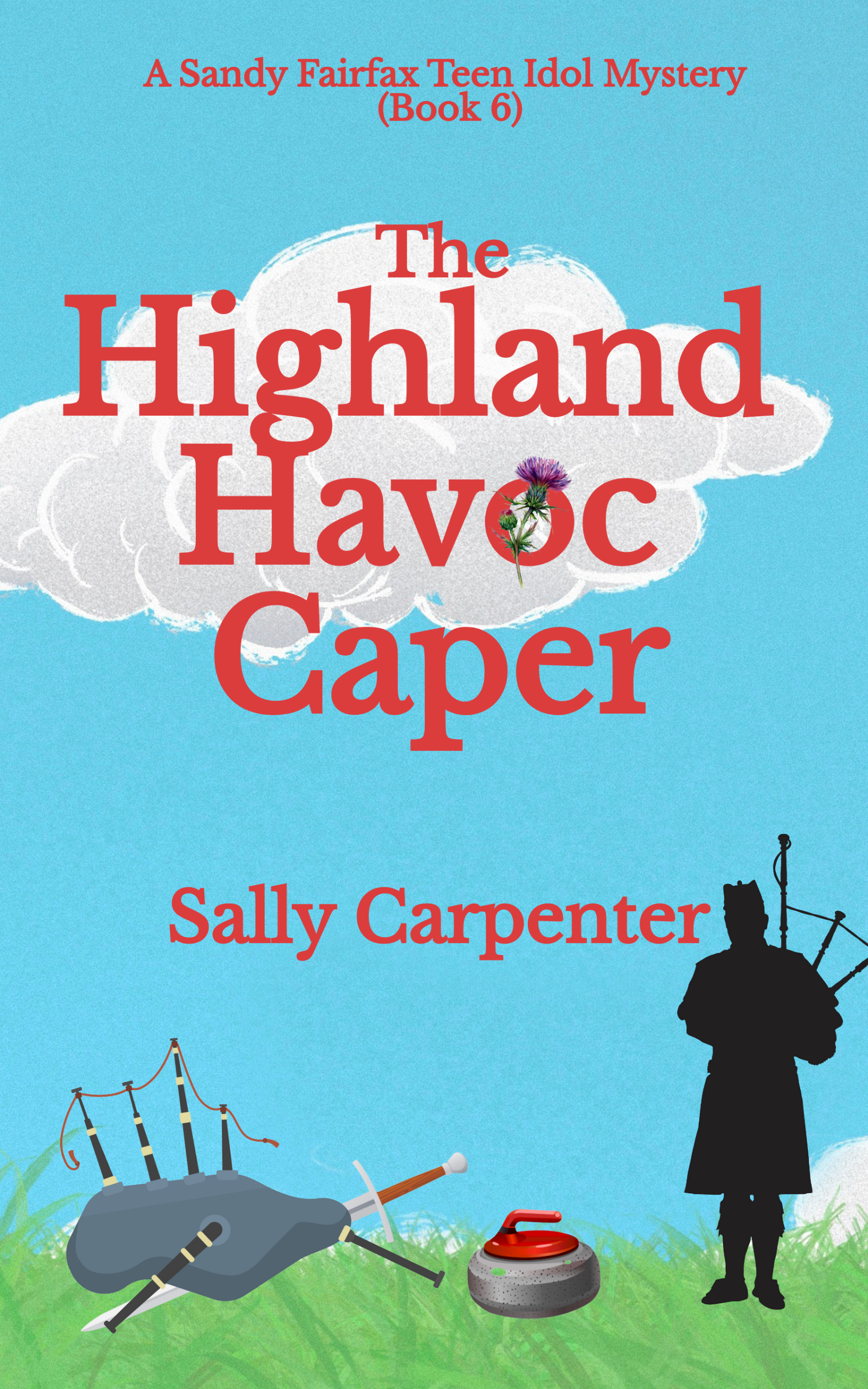
At long last the opportunity arrived. My new book, No. 6 in the series, is The Highland Havoc Caper. The story begins at the Seaside Highland Games in Ventura, California, based on the real Seaside Games in the city. I didn’t have the chance to attend the games when I was writing the book, but I pulled a lot of useful information off the event website. The games are held at the Ventura County Fairgrounds, which I’ve visited on other occasions, so I added some realistic features, such as the grounds are on the coast, providing a terrific ocean setting.

I found videos of other Highland Games on YouTube, so I was able to piece together an authentic depiction of the festivities. The event is a celebration of Scottish culture, music, dancing and “heavy athletics,” what the Scots call their sports of caber tossing, sheaf throwing, shot put using large stones and more. The sports are not for the weak of body nor faint of heart.

Sandy’s in a kilt for most of the book. I researched kilts via internet. The garment itself is a long piece of fabric that is wrapped around the body with the pleats hanging on one side. An ornamental pin keeps the kilt from flying open. A belt holds the kilt in place. Each family has its own tartan design.

The man also wears hose (knee-high stocking) held up with flashes (garters) that have small fabric tags visible under the top of the hose. Sometimes the shoes worn have long laces that are wrapped around the calf and tied below the knee.

Since kilts don’t have pockets, the man also wears a sporran, the large object hanging down the front of the kilt. The sporran is basically a purse, although I think nowadays it’s more decorative than practical. For formal occasions, a dress sporran is worn. This might have large tassels or artwork.

Women don’t wear kilts; they have tartan skits without the sporran.

In the book, Sandy tops his kilt in three different ways, depending on the occasion. When he sings during the games’ Saturday opening ceremonies, he wears a white shirt, a tartan tie and a solid-color jacket. He returns to the games the next day with a more casual look in a leather ghillie shirt that has a pointed collar, long sleeves cuffed at the wrist and leather laces at the neck instead of buttons.

For a formal dinner, Sandy dons a white Victorian shirt with a black bow tie and a tartan waistcoat. His jacket is left open to expose the waistcoat.

During the week Sandy is shooting a guest spot in a TV show in which he plays a Scottish ghost. Once more he’s in a kilt, although this one is a black tartan with the addition of a fly tartan, a sash that’s worn across the chest from the hip to the shoulder.

When Sandy’s at home or going places around town, he’s in regular clothes:  jeans, corduroys and sweatshirts.

On YouTube I also found some Scottish music that I used in the story. The phrase “You take the high road, and I’ll take the low road” is the chorus from the song “On the Banks of Loch Lomond.”

YouTube also shows Highland Fling and other Scottish dances. Sandy’s daughter takes dance lessons, so she’s in a Highland Fling contest during the games.

And we can’t talk about the Scots without haggis, that quintessential Scottish dish. Sandy’s served this at a dinner party. I asked my writers’ group if anyone had eaten haggis. Some liked it, others didn’t, and one said it’s a Scottish mainstay and I shouldn’t make fun of it. I didn’t, but I described what’s in it.

Other Scottish dishes making an appearance are mince and tatties (ground beef and mashed potatoes), neeps (turnips) and Red Kola (a Scottish soft drink).

I put in a few Scottish slang terms (nothing naughty), but didn’t write in dialect so that the reader could understand the dialogue.

I had fun with the research; crossing my fingers that I got it correct. I’m hoping my readers will enjoy this interesting look into Scottish culture and the twists in the mystery.

Former pop star Sandy Fairfax engages in a dangerous hobby—amateur sleuthing. At the Seaside Highland Games in California, he and his teenage son, Chip, discover more than their heritage. In a castle transported from Scotland, they find a body bludgeoned with a curling stone. But when they go for help, the corpse vanishes. Without a body or even a name, how will Sandy find the killer? As he and Cinnamon plan their wedding, more bodies pile up. A piper plummets from the castle tower and into the ocean. Another body is found behind a Scottish pub in L.A. And when Sandy takes a guest role on the Spook Spotters TV show, the worried dad must keep Chip safe from an amorous young actress. Whether you take the high road or the low road, can you solve the case before Sandy does?

Kindle link: https://www.amazon.com/Highland-Havoc-Caper-Fairfax-Mysteries-ebook/dp/B0BX8P1GXV

Print link: https://www.amazon.com/Highland-Havoc-Caper-Fairfax-Mystery/dp/1952579562

Sally Carpenter is a native Hoosier now living in Southern California. She writes retro-cozies: the Sandy Fairfax Teen idol series (six books) and the Psychedelic Spy series (two books). She was a finalist for the 2012 Eureka! Award for Best First Mystery Novel. She has a master’s degree in theater, a Master of Divinity and a black belt in tae kwon do. You can download free stories from her website http://sandyfairfaxauthor.com.

So Many Blogs…. by Karen Shughart

This is my 45th blog for Ladies of Mystery. I started writing at this site in September, 2019, and I’m proud to say I haven’t duplicated a topic, not once. That’s a lot of blogs, and when I realized how many I’d written, I was surprised and took some time to reflect on this. Is it really possible to blog every month and avoid duplication? Why yes, it is.

Think about it. There’s a huge world out there, with infinite possibilities for observation and discourse. You can write about the seasons, or the place in which you live. You can write about writing, the writing process, your latest releases, the struggles, and challenges, of creating a book or a chapter or the characters in your books. About marketing and promoting. You can write about family and friends and animals. Music. A special outing. It’s an endless list if you just look around and observe.

You can write about gardening, beaches, swimming or snowshoeing. Trips taken, meals eaten, beverages sampled, and cultural events you’ve attended. Wine tastings. Memorials to loved ones and pets who have passed. You can write about rain and snow and sun and wind. You can write about suffering, loss, and experiencing joy. During Covid, one of my blogs was about kindness and the many ways it manifested itself in our community; another about what it’s like to live across the street from a large lake in the middle of apple growing country.

Sometimes I whiz through whatever blog I’m writing for the month. My rough draft gets tweaked a little, and then voila, it’s ready to publish. Other times it takes a bit longer, sometimes more than a bit longer, as I search for the right word or tone or to put a semblance of order into my thoughts. It depends on the topic, and my mood, but eventually it gets done.

When I first started writing blogs here, I carefully constructed a list of the topics I wanted to write about for each month during that particular year, and I stuck to it. It helped me focus and because I was new at it, it also helped alleviate some anxiety when faced with a deadline. Then, occasionally, I would scratch the blog I planned to write for something that seemed more appropriate at that time. As I’ve become more comfortable, I typically pick my topic on a monthly basis, depending on my mood and life experiences at the time.

The books in my Edmund DeCleryk cozy mystery series typically run (give-or-take) about 70,000 words. I try to limit blogs to no more than 500, they’re easy to compose; really, no more than a page in a book. Plus, readers don’t want to spend a whole day reading a blog. And that’s why I’m stopping here. There’s more to write about, but I just checked and I’m coming up on those 500 words.

Karen Shughart is the author of the maritime-themed Edmund DeCleryk cozy mystery series that includes historical backstories with a twist, and recipes provided by the sleuth’s wife, Annie, the head of the local historical society. Book three, Murder at Freedom Hill, is an International Firebird Book Award winner in the mystery and fiction categories.