What Being a Writer Means to Me

I started writing stories when I was a youngster. I wrote my own versions of the books I read. My first original was a story about fairies which I illustrated. My mother sent it to a publisher, who sent back a nice note telling me to keep writing, and I did for a long time.

My first efforts as an adult were rejected and I’m sure because I had no idea what I was doing. I didn’t get serious about writing until I had grandkids. My sister did our family genealogy and I decided to write an historical family saga based on both.  I had to do lots of research about places and times my ancestors lived and believe me it took a long, long time.

The second one I wrote was published by a major publishing company. I had no clue about marketing or promotion and did one book signing. When the 2nd was published, I knew a bit more.

Next came my first mystery, and another.  I’ve been at this a long time, and now have 50 published books all available on Amazon. Along the way I’ve learned so much about writing and promotion.

Besides the fun of writing and creating characters who seem as real as the people I know, I’ve had a great time over the years traveling all over the county attending writers workshops and mystery cons—Bouchercon and Left Coast Crime, plus many of the smaller ones  that have disappeared like Mayhem in the Midlands and Crimefest.

I was able to meet some of my favorite authors like Mary Higgins Clark, William Kent Krueger, Craig Johnson, Naomi Hirahara, and so many, many more. Plus, I made friends with so many other writers and more importantly readers.

When I read about how much writers and readers enjoyed this most recent Left Coast Crime, I was a tad envious, but then realized I had so many great memories of conferences past and all the interesting people I’ve met over the years.

I’m now in the process of my two favorite writer pursuits: 1. Planning for and promoting my latest book, the last in the Rocky Bluff P.D. series, Reversal of Fortune and 2. Putting together ideas for my next Deputy Tempe Crabtree mystery.

Being a writer is a wonderful and rewarding part of my life in so many ways.

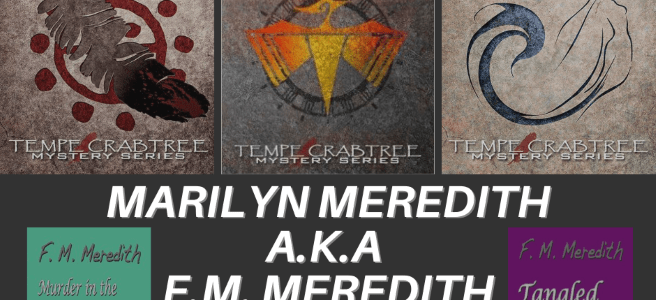
Reversal of Fortune is about the death of a fortune teller. It’s available in paper and for Kindle on Amazon: (I wrote this series as F. M. Meredith)

It Never Rains in Southern California by Karen Shughart

We just returned from a visit with our son and daughter-in-law, who live in southern California. There was a song in the 1970s entitled It Never Rains in Southern California, and although the lyrics did not particularly inspire joy, the title is apt, it truly hardly ever rains in southern California. As my son reminded me when I mentioned how nice it was to not have to deal with the inconsistent weather events like blizzards and blinding rainstorms like we do here in the northeast, he reminded me that California has plenty of their own climate issues: mudslides, fires, earthquakes, and damaging winds. Good point.

During our visit we sat under a pergola in their backyard and snacked on tangerines picked from a nearby tree. One night for dinner we ate freshly-caught Pacific salmon with lemon slices we plucked from another. Avocados, plentiful in that part of the world, hang heavy on branches drooping over fences A bottle brush tree with vivid red flowers and clusters of bright yellow daylilies attract a multitude of hummingbirds and Monarch butterflies. The air is redolent with sun-ripened foliage and the salty brine that drifts inland from the broad, blue Pacific Ocean.

Photo by Gary Barnes on Pexels.com

We arrived back in New York to a gray, cloudy day with a drizzle of fine rain and yet, when we pulled into our driveway, our daffodils and forsythia were beginning to bloom, the hyacinths were emerging from the earth, and nestled in among our own burgeoning daylilies were bright, purple violets, signs that spring is surely on the way. While the weather is fickle, each day here brings a surprise; now some days are warm and bright, on others, winter doesn’t want to lose its frosty grip.

I thought about how climate and weather affect writing. My Cozies are set in a small village along the south shore of Lake Ontario, much like the village where we live.  Four defined seasons provide the setting to the mysteries:  a dark, stormy, windblown night is a metaphor for what’s to come, as is the juxtaposition of bright summer days and a murder that’s occurred in a lush garden setting.

If we lived in California, I would still be writing Cozies, but they would different. Mine have a backstory based on the history of our state: the Revolutionary War, the War of 1812, the Underground Railroad, to name a few. If we lived in California, I’d choose Spanish Missions, the Mexican American War, or the Gold Rush.   The setting, too, would change. A California beach town and one on Lake Ontario have few characteristics in common, our beaches are rocky and not as wide, we don’t have sidewalks and parking lots along the water, and the distance across the lake to Canada is a mere 80 miles, compared to more than 6,000 to China. We do, surprisingly, have pelicans, but we’ve never seen a whale. Still, it’s fun to contemplate what I’d do differently if my mysteries were set in a part of our country where it never snows, hardly ever rains, and the sun shines almost every day.

Never Too Old

I think back to my childhood every time I find myself digging for more information. I loved school and learning. While math wasn’t a favorite and I struggled to be proficient in it, I understood it was necessary to learn the basics. In the fourth grade every evening while my mom and I washed and dried dishes, she would quiz me on the multiplication table. And today, I can pretty much spout out the correct answer with a few minutes to pull numbers out of my filled brain. 😉

Writing books has been my way of continuing to learn and fulfill my love of research and discovering new things. From the occupations my characters have:

Vase by Olaf

Shandra Higheagle, my Native American potter character, gave me the opportunity to spend time with ceramicist Ted Juve, or Olaf, the name he signs to his work. He taught me the process of extracting pure clay from clay soil that he uses for some of his pieces and the method my character uses for her art pieces.

My character Gabriel Hawke allowed me to spend a day with an Oregon State Trooper with the Fish and Wildlife Division in the county where I have my stories set. That was an eye-opening day with lots of notes taken as we drove around the county. He gave me insights into the job and some incidents that he had been a part of.

My newest character, Dela Alvaro, is taking me into the world of Tribal run casinos and the life of a lower limb amputee. Both new things to me and I’m soaking in all I can learn from many different sources.

This month I am also taking an online workshop from a retired law enforcement officer. He has over forty years law enforcement and what I appreciate the most is he has worked with lots of different law agencies and knows a lot about how different states handle things. And if he doesn’t know, he knows someone who can give us the correct answers.

The workshop started out with him attendees some law enforcement information and then he gave us the first responders view of a murder scene. We are now not only learning the whole business of processing the area and starting the investigation but also being asked along the way who we think might have killed the victim and why. He not only has us using our minds to learn, but to be creative in what we think might have happened or how it would have happened if we wrote this in a book. I like learning two things at once!

This workshop came at a good time for me. I sent out my most recent finished WIP (work in progress) to my retired LEO beta reader. He found fault with three different scenes. Two, I will learn about from this workshop. The third…is harder. It goes to the core of being a policeman for decades. I was being too soft. My character isn’t soft, so I can’t have him acting like I would act. He is tough and knows when his life is in danger he must react as he’s been trained. Another lesson learned. Did I say I like learning new things?

The reasoning my beta reader gave me made sense. It just didn’t work for the scene to come later, so I had to rewrite the scene to keep my character from killing someone they needed to question. I had my LEO wounding the man. But with an AR rifle aimed at him, my character would have “tapped” the suspect three times. (tapped=three quick shots to the torso) Which would end up with a dead, or close to dead, suspect they needed to question. I changed the scenario to the suspect realizing he was shooting at police and surrendering. He wasn’t the bad guy they were after, which the police discover after questioning him. Whew! That scene was rewritten three times before my beta reader gave it a thumbs up.

But he also questioned my character never giving the people he brings in for questioning Miranda Rights. That is why I am taking this workshop. To learn more about that process and how I can incorporate it into the books at the correct time.

There is always a need to learn something. And I love drinking it all up and using it in books.

As a reader do you like to learn while you are entertained?

As a writer do you feel the need to learn and get things right in your books?

Switching Horses Mid-Stream by Karen Shughart

The process of writing a novel takes a long time. First, there’s coming up with the idea for the plot, but from creation to completion there are lots of other steps along the way. Some authors set strict parameters, develop an outline, keep a set of note cards and pretty much stick to the plan. When I write, my mind never shuts off while I envision multiple possibilities. At times it drives me and my loved ones crazy, but as a result, I am able to shape what I hope will be a better story.  

I thought I’d be finished by now with writing book three in the Edmund DeCleryk Cozy mysteries series, Murder at Freedom Hill. It’s taking longer than expected because I’ve switched horses mid-stream. There’s a murder, for sure, but I’ve added a subplot that’s loosely related to that crime.

Photo by Karen Shughart

As with the other two books in the series, I created a backstory based on the history in the village where I live. For book one it was post-Revolutionary War; book two, The War of 1812; and for book three, it’s the abolitionist movement and Underground Railroad. Thus, the reason for the title of this blog – the phrase was conceived by Abraham Lincoln in a speech he gave in 1864 to members of the National Union League.  It fit.

But I digress. As the result of adding a subplot, I made other changes, too. In book one, a manuscript dated 1745 provides clues to why the victim was killed, in book two it was a series of letters written between 1814 and 1817 by the wife of a soldier. In this book I had first planned to insert newspaper clippings from the mid-1850s that were discovered at the local library. Just this past week I turned those into excerpts from a research project the victim was working on. As I thought about it, it just made more sense to do it that way because I changed the secondary plot from one that was probably a bit too political for a Cozy mystery to one that’s not.

Politics in Cozies, while permitted, aren’t necessarily encouraged, and I understand why.  When people read the genre, they want to be entertained, and they want to escape. Characters in Cozies are part of a tightly knit community, and the evil that lurks is usually not something you’d read about in the news today.  We get enough of that  every time we turn on our TVs, computers and our phones, and read newspapers and magazines.

For weeks I was losing sleep over this book trying to figure out what it was about it caused discomfort. Once I figured it out, I started rewriting, and I’m sleeping better now.  Yes, the process of writing takes a long time, but to paraphrase another sentence from a speech Abe Lincoln gave, this time on July 4, 1861, “Let us renew our trust… and go forward without fear.” Just so you know, July 4 is also part of the plot.

Guest Blogger ~ Nancy Raven Smith

Which Comes First – The Protagonist or The Situation?

Every author arrives at the protagonists for their books from a different direction.

When I decided to write my Land Sharks series I knew I wanted to write cozy mysteries about fraud, scams, and white collar crime A land shark is a nickname for a scammer, con man, or fraudster targeting people to steal money and other valuables.

The hardest part of planning the series became choosing the employment of the protagonist. They had to deal with frauds regularly or I wouldn’t have a series. That meant it couldn’t be a normal person because, even though the numbers are high for the victims of those crimes, a series couldn’t be based on one person being constantly the victim without them appearing unintelligent. I already knew my protagonist needed to be fairly smart.

Naturally, I thought of the police. A policeman/woman might sound logical, but it actually isn’t. I found that out the hard way when my checking account was crashed with bogus checks. I had to insist to get my local police department to file a report. The same is true for victims of identity theft and credit card fraud. It turns out that police departments rightfully give priority to ‘crimes against persons,’ not ‘crimes against property.’ They simply don’t have the time or budget to do anything else. So a protagonist who was a policeman/woman was out.

The next stop to get my checking account straightened out was the bank. I met with the manager. I brought the right proof to get the stolen money returned to my account. As I left the bank, the manager made a comment that “I might be contacted by their fraud department.” I didn’t think anything of it at the time.

I continued to consider and discard several other possible employments for my protagonist such as stock broker and Interpol. But then the bank manager’s words came back to me. The bank had a fraud department. Who deals with more financial fraud on a daily basis than a bank? An employee in an international bank’s fraud department was perfect for my new protagonist.

With my protagonist’s employment settled, I moved on to other character choices. This is always a fun part for me. Here are some of my final decisions. I wanted a woman. Although my first choice was to make her black, I had to discard that because, as a white woman, I didn’t have the personal experience to write from another race’s POV. So my character became white from necessity. I named her Alexis ‘Lexi’ Winslow. She became a diplomat’s daughter, which allowed a natural affinity for travel, languages, and unusual situations. I put her in her mid thirties, so physicality wouldn’t be a problem.

 I also decided she’d be a rising star in international banking fraud, until one con man left her with a broken heart and a destroyed reputation. As book one, A Swindle in Sumatra, opens, she’s been fired from the big New York bank she’s been with because of the situation with the con man, and is employed at a small, privately owned bank in Beverly Hills where the other employees are suspicious of her.

As a reader/writer, I’d love to hear how other writers have developed their protagonists. And which came first – their protagonist or the situation.

BUSHWHACKED IN THE OUTBACK 

“If you can’t follow the money, follow the body.”

Lexi loves her job as a Beverly Hills bank fraud investigator. It lets her pursue scam artists and con men – known in the business as land sharks.

Sadly, one crook left her with a broken heart and a destroyed reputation. And the bank’s president is looking for any excuse to fire her.

Yet she risks everything when she follows a dead embezzler’s casket to Coober Pedy in the Australian outback. She knows it’s a gamble, but it’s her last hope to recover the bank’s stolen money. Unfortunately, she’s persona non grata in that country. She needs to get in, find the money, and get out before the Australian police discover her presence. But will the unexpected appearance of an ex-lover make her linger too long?

If you like cozy mysteries in exotic locations with deadly secrets and touches of humor, then you’ll enjoy the multi award winning Land Sharks Cozy Mystery series.

Available on Amazon.com at https://www.amazon.com/dp/B0794M2Q3M/

Nancy Raven Smith grew up in Virginia, where she ran and participated in horse sport events. On their farm, she rescued horses, dogs, and cats and is an advocate for animal rescue. Later in California, she traded her event experience for film work. Her screenplays and novels have won numerous major awards. Her first mystery, A Swindle in Sumatra was chosen as an Amazon Kindle Scout Program Selection. She is a member of Sisters in Crime, Women in Film, and Mystery Writers of America.

When not writing, Raven Smith enjoys her family and friends, reading, travel, art, movies, and white water rafting.

Visit her at:

Http://NancyRavenSmith.com

Http://Facebook.com/NancyRavenSmith.com

Http://TheReluctantFarmerOfWhimseyHill.com