Setting and Its Limitations

One of the most interesting features of any mystery novel for me is the setting. Create a world of rich details and the story seems to unfold naturally. In the draft of one story I used a setting that I had seen but not walked through. A Beta reader asked basic questions about the distance between two points, the nature of the trail between them, and more. It was a signal to me that the setting wasn’t clear. And how could it be? I hadn’t been there, walked through the area, taken note of crucial features.

Today I find myself at the other end of that continuum for setting. I’m working on a mystery novel set on a small island linked to the coast by a tidal causeway, and home to varied flora and fauna. The location is based on an island I know fairly well, having visited it numerous times in my earlier years. The only significant change I’ve made is in size–I’ve reduced the island from over eighty acres to about ten, and moved it closer to the mainland. I’ve borrowed the causeway from another part of the shore farther down the coast. I’ve chosen this site because of certain activities that can only happen in this kind of isolated setting, and because I know it fairly well. I’m also working into the plot a specific time–using the sunrise, moonrise, and tides as crucial factors.

In most stories the writer can adjust the crucial elements such as the time a train arrives, the time of high tide or low tide, the seasonal winds, and more according to the needs of the story. With my decision to use a specific month, I’ve chosen to work within a specific set of parameters. I want this grounding because the story is going to hinge on what is or is not possible according to the setting.

Consider the range in tides. In some parts of the world the range between high and low tide is minimal, and even the range between high tides is minuscule, as is the case in Southern India, which is fairly close to the equator. With an almost even twelve hours of daylight throughout the year, the tides are similarly even throughout the day. But the Bay of Fundy, located at latitude 45, has the highest range between high and low tides on earth, forty-three feet. At most places on earth the range is about three feet. I’ve chosen a location in which the range between high tides in one month is up to almost two feet.

I don’t think the area for my story is particularly exotic. But in exploring the details of the setting–sunrise, moonrise, tidal range and more–I have uncovered details that suggest specific clues and turns for the plot, features in a story particular to the setting.

When writers talk about setting, we are often thinking of a different kind of influence, such as the kind of people who might live in a rural area surrounded by forests or farms; the tight-knit community in a tenement building trying to stave off developers; or perhaps the mix of people riding on a train that is caught in a blizzard. In my current story I’m tying the crime and its solution more tightly to the earth, to the specific environment not exactly replicated anywhere else. I’m in the early stages at the moment, so I’m looking forward to how this is all going to work out.


 

A Thousand Thanks

Recently a fellow writer, Jacqueline Seewald, posted an article written by a mystery reader in response to one of her short stories. Along with several others, I commented that this was a gratifying response from a reader, and then I got thinking.

I began writing and publishing mysteries and mystery related articles, reviews, essays over thirty years ago, and to be singled out by a reader for praise is always a thrill. Like any other writer, I want readers to enjoy my work. The number of mystery-related conferences spread throughout the year and scattered around the US and the rest of the world means we are often thrown into contact with current and future (and sometimes past) readers. Both of us—writers and readers—have learned to take this in stride. I make note of which characters a reader liked particularly, a question about a character’s backstory, or hints at a new series or a new direction. But fans don’t have to wait for a conference to find us.

Writers get emails through our websites or blogs, posts on other blogs about a meeting or a particular story, or conversation about a book club. Readers can engage almost any writer on FB or Twitter, on Goodreads or other sites. Writing may be a solitary business, but the readership is ever present. Writers and readers almost can’t avoid meeting each other and engaging in an ongoing conversation. For most of those writing today, this is the norm and always has been. But not for me.

When my first mystery was published, Murder in Mellingham(1993), I was thrilled to have a book launch at Kate’s Mystery Books and meet other writers and readers. After this I attended Malice Domestic and Bouchercon, and met lots of other writers including those I’d never expected to meet in person let alone speak to or have dinner with. It was quite an experience.

But nothing since then has matched the first piece of mail (yes, snail mail) I received from a fan. I was a newbie, still very little known, but a man who read my mystery took the time to write to tell me how much a specific passage had moved him. He had recently lost his mother, and that one line seemed a particular comfort. I’d never received this kind of letter before (And why would I? This was my first mystery.) and barely managed to write a coherent reply.

I remember that letter because it took time to compose, write on paper, address, stamp, and send (and came through my publisher, as I recall) and was very personal. Of all the warm and enthusiastic responses I’ve had from readers, that one is still the one I remember. Did Jacqueline Seewald feel as excited about her reader’s response? Of course she did. Do younger writers who may never have taken to letter writing feel the same way, I wonder, about email notes from readers telling them how much they liked a book? I’m sure they do. But for me, a letter in the mail will always be the ultimate form of communication.

For the article inspired by Jacqueline Seewald’s story, go to: https://jacquelineseewald.blogspot.com/2020/01/how-readers-relate-to-fiction.html?

The Neglected Senses

In the middle of my current WIP I noticed that once again I’d fallen prey to my particular weakness in writing. I’m not the only one with this flaw but I have been working on correcting it. What is it? The tendency is something so obvious that I even wondered if I should write about it at all, but here it is. Despite all my workshops in which I encourage students to use all their senses when writing, I make the same mistake. I focus on the visual and sometimes the auditory and neglect the senses of taste and smell. (And in the above sentence I didn’t even mention the sense of touch.)

Writers are visual people. We tend to describe the landscape or an interior setting in great detail. We note clothing, especially as it indicates class or wealth, and physical mannerisms especially if they indicate emotional states or character. We tease out special feelings as two people become aware of each other, or we cogitate on clues, drawing the reader into the intricate web of evil. We feel the weather on our faces, our skin under a spring shower, or our fingers in thin gloves going numb in the cold. But we rarely catch a whiff of anything that matters–a lingering scent of a person we dislike or are suspicious of, a dinner of capons and carrots that distract us from a conversation we should be listening to.

In a recent mystery the protagonist enters a strange home where he will be staying and is visibly struck by the level of poverty of the village and the neglect in the home, but this is all visual. Poverty has a smell, and neglect has another smell. Because we don’t emphasize these experiences in our day-to-day lives, they may be harder to describe, but they are vivid for us when we undergo them.

When I’m confronted with a scene in which I want the olfactory sense to be dominant, I recall such experiences, usually around food but not always, and draw on those. These moments are never without people in them. I know these moments are important because I remember them so vividly, partly because of the unusual or captivating tastes and partly because of the environment or setting in which they occur and without which they would not.

During my first week in India, in 1976, I met a social worker who invited me to tea at her apartment. She was about my age, wearing a sweater over her sari (it was January in North India, which can get very chilly), and lived in an attractive two-bedroom apartment, small by Western standards but quite comfortable. She explained she was able to get this flat because of her occupation. (I’ve since learned that the job title Social Worker is closer to our Human Resources Director.) We sat on a small veranda/balcony for tea. Her maidservant (at that time, everyone in India had a maidservant, even the poor) brought in a plate of cheeses and samosas. The slice of cheese had been rolled in flour and dry roasted. I don’t know what kind of cheese, what flour, or what spices were used but to this day I remember this as one of the most succulent, delightful tastes my tongue has ever known.

When I walk through my neighborhood I sometimes notice a particular perfume and know that a certain woman has taken her afternoon walk. The fragrance isn’t strong in the usual sense but it does linger, and usually on the main street, rarely on side streets. Another aroma that still stands out is a cleaning material used mainly in Asia but starting to show up here. It was startling to encounter it in a store in New Hampshire until I remembered that this was an Asian grocery store.

All of these experiences remind me of how powerful taste and smell are in my life, and how effective they can be in deepening a mystery or adding to the description of a scene. One of my goals of the novel I’m currently working on is to use more of these two senses in the solution of the mystery as well as in the vividness of the story telling.


The Ones I Keep

Still on my bookshelf are books that I loved as a child: . . . And Now Miguel by Joseph Krumgold, The Fur Person by May Sarton, and Asian stories. But one day in my teen years I came across a book my mother purchased for herself, by a man everyone in town knew. Some books have an inexplicable pull on us because of what they teach us, and this is one in my life.

John Leggett worked in Boston in the 1950s and 1960s before moving back to New York City and a job in publishing; he had always wanted to write. He and his wife were well known in the small town where I grew up. They and their three sons lived a few houses away from us, and my best friend at the time babysat for the boys. Sometimes, usually in the summer, I kept her company. We walked to the small beach nearby, or passed a quiet afternoon at home. I don’t remember the boys being particularly rambunctious.

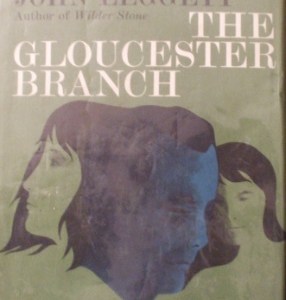
His second novel, The Gloucester Branch, published in 1964, was read by all in town largely because of its local setting. I had read his first book some years earlier, much to my mother’s dismay, and expected to like his second. I already knew I wanted to be a writer, and had already published one essay. I was only months away from writing my first short story.

The first news I had of Leggett’s second book was a spirited discussion among my parents’ friends about the title. One insisted it was bad because no one outside of the Boston area would recognize it. The Gloucester branch was the name of the B&M line that ran out to Cape Ann. The debate raged. Next came the characterization of the protagonist’s wife. I can still hear one woman saying, “That’s Mary to a tee. Why didn’t he disguise her better?” All of this whetted my appetite for the novel, and I dove in. I recognized the house the fictional family lived in, the streets they walked, even some of the minor characters (or so I thought). I read avidly from page one to the end.

Most writers I’ve talked to mention a well-known title or author as seminal in their development, usually someone I’ve read or at least heard of. When I think back, of course I can list numerous titles by important writers that swept me away, inspired me, and linger even now. So why do I remember a little-known writer of the last century? Why not remember another, better-known book of the same period: To Kill a Mockingbird (1960), The Spy Who Came in from the Cold (1963), Herzog (1964), Wide Sargasso Sea (1966), or any of the classics I read during that decade?

John Leggett never achieved great fame, though he ran the Writers Workshop at the University of Iowa and mentored a long list of award-winning writers. From there he moved on to California to become head of another writing program. He never became a household name outside of my hometown.

But in reading his novel The Gloucester Branch, I could see exactly what he had done, how he had taken real life and reshaped it, added twists and enhanced details to layer on meaning where there had been none or only the dull quotidian. I recognized the details, understood the changes he wrought, and appreciated the result. No other work of fiction had given me the same insight perhaps because no other had been so transparent in its reshaping of reality into story. Many books inspired me to write, tell a better story, or invent a richer character. But only one opened the window onto the simple transformations made by a writer’s mind.

Changing over Time

After one of my novels comes out in print, I rarely reread it. If asked, I’ll read passages and discuss them, but once the work has gone to press, it’s out of my life except for promotion. All that changed recently when my agent reported the interest of a new publisher in taking on earlier series. This wasn’t simply a nice bit of news. It was an assignment—a synopsis of each and every book.

Like almost any other writer, I dread writing a synopsis. I don’t know why I find these so onerous and difficult. Nevertheless, I turned to the Mellingham series and pulled the first book from the shelf, Murder in Mellingham(Scribner, 1993). No one ever asked for a synopsis. No one or five page treatment lurked in a now-defunct format anywhere on my computer. After much gnashing of teeth, I had a page that pretty much covered the story of the book. On to the next in the series, Double Take. On this title, the Kirkus reviewer commented, “Oleksiw is growing as a writer.” I thought that was nice, wondered what passage prompted it, and thought no more about it. By the time I got to Family AlbumI was actually reading the story. I came across paragraphs I enjoyed, lingered on the phrasing, and stalled. Did I write that? Apparently, yes. I had the same experience with the remaining four books in the series.

I don’t know why I should be so surprised at how much my style has changed over twenty-seven years. The real surprise would be if it hadn’t. When I first began reading mysteries, I had very catholic tastes, but one day I wanted to read all of Agatha Christie’s Miss Marple books in a row for a reason I’ve since forgotten. With copies of her twelve mysteries on hand (excluding Sleeping Murder, published after her death though written thirty years before), I began reading. Although these mysteries are somewhat evenly spaced over forty years, the style ranges widely. I had never noticed this until I read them one after the other, when the differences become evident.

The typical cozy mystery reader may not think of Christie as a writer of several distinct styles but I do. I think the variations are masked by her consistent approach to exploring crime and the attitudes of the period. This rereading also helped me recognize at least one reason for a flagging interest in writers I used to enjoy—the sense of sameness in the work. Each story feels like the last one I read, and I no longer feel the sense of anticipation when I pick up those writers’ newest title.

Now that the synopses are done, I’ve turned to my current WIP, a stand-alone that is a departure for me both in narrative style and structure. This story is written in first person with more physical action and draws on my experience with home renovation. I like the concreteness of the work. William Zinsser, author of On Writing Well, described an exercise he gave his students that was a turning point for many of them. Take an ordinary object in your home, something you use or see every day, and describe it and how it works. I gave my students this in-class writing assignment: What is a zipper and how does it work? The students talked about it for days.

I used to think that an artist’s or writer’s style changed with the subject matter, but no longer. The change may be the result of no more than the passage of time, of assimilating what we’ve learned from the just completed work, and transforming that into something new, where again we learn and change. Now that I’ve seen how my work has evolved over twenty-five plus years and twelve published mysteries (not to mention the ones that failed and sit not quite forgotten in a drawer), I’m curious about how my work will change over the coming five or ten years.