
Recently a number of writers chattered on line about writing a story during the coronavirus pandemic. I haven’t considered it yet, but I have noticed the details that signal the changes to my community, and these would probably appear in anything I wrote.
At first I thought the directions to pull back, self-isolate, etc., would lead to obvious changes, that the world would look startlingly different. But that hasn’t been the case. The world closed in gradually. Stay six-feet away from people; close the schools and study on line; work from home if you can. That all made sense. But the changes were more subtle.
Far fewer cars pass our house, and when I walk in the morning I’m struck by how many cars sit in driveways. They were usually gone by eight, and almost always by nine. Now they’re packed in. The streets are nearly empty, and on the rare day when cars are parked on a side street, I know that someone is ignoring the rules to stay inside and has gone visiting.
Most people I encounter seem to be following the rules; a few are nonchalant, letting masks fall, rubbing their eyes; others are defiant or oblivious. In a doctor’s office, twelve patients sat next to each other because there weren’t enough chairs to sit six feet apart. No one smiled, no one read a magazine, and no one escaped into their cell. People sat rigidly in their seats, keeping an eye on each other. No one sneezed, coughed, sniffled.
One morning a young mother parked on a side street, hustled three children out of her car, and followed them down the street to a house around the corner (no parking on that street). A play date? Home schooling?
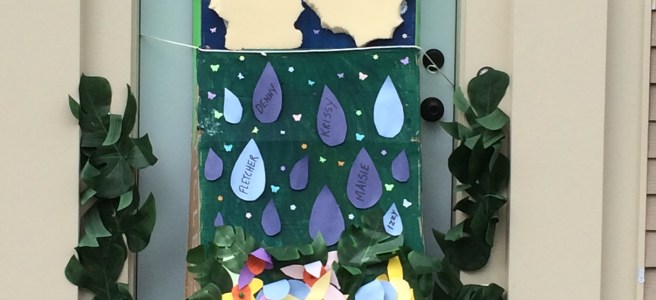
To counteract boredom, neighbors organized an art project, setting children to decorate their front doors. The goal is to give them something to do, and demonstrate that the community is working together even though they can’t play with their friends at this time. The dark side of this is the closing of playgrounds, where caution tape around swings makes the point in a different way.
Before the virus, late at night the bright lights of an alarm-silent police car or fire engine might wake me up. But not now. Far fewer police cars and fire engines fly past the house day or night. Throughout the city sirens are mostly silent. This may not mean less crime; perhaps the police have been hit by the virus and fewer men and women are available to answer the call. A 911 call that once took ten minutes three months ago might now take forty. And no cars have been on the road around five or six in the morning. Most workers have no early shifts to get to.
Our main street is shuttered, restaurants closed, few of them doing take-out. The train doesn’t rumble by in the distance at expected times; the schedule has been changed to a weekend schedule except for an increase in early morning trains to get workers into the city for the early shift change at medical centers.
The newspaper arrives, the trash is picked up, grocery stores are reasonably well stocked. But in all, the salad bar, fruit bar, and soup bar are closed, and in some stores all vegetables are now wrapped. No one gets to choose how many green beans she wants, or how many shallots. The bakery no longer puts out a tray of pieces of a new cake or cookie for customers to try.
These are the obvious changes. The less obvious are the more dangerous, and those arising from people who flout the governor’s directives are even worse. A husband who has threatened his wife before is confined with her in a small home in the woods. Young children in a family with an older brother who bullies them have no way to escape. A landlord who cares little for his tenants’ problems quotes the president announcing the situation is under control; time to go back to work and pay rent. A small business owner dependent on crafts made and supplied by women working at home takes in inventory–and resells it without keeping records. A woman who turns sixty-five in a month can’t reach any of her utilities to fight a shut-off notice.
These are real situations whose danger is amplified by our unusual circumstances in winter 2020. These are the stories we’ll write some day.




You must be logged in to post a comment.