The Season of Gratitude

This time of year publications on and off line are full of essays on gratitude, each writer searching for a unique expression that would set the writer apart. Having said this, I too am offering one of those essays. 

Some years ago I listened to a speaker on meditation talk about online meditations on various topics including gratitude, and how it changed his thinking. That sounded promising for someone who is often grateful for finding a parking space in Boston or catching the last train out or something else equally pedestrian. I decided to give the meditation on gratitude a try.

The instructions began with a sitting meditation of about ten minutes. After that we were instructed to begin listing the things for which we were grateful, and to keep going for another ten minutes. You might think ten minutes isn’t very long, but it is in fact a very long time, especially when you think you should be able to answer the question and then get on with it. (Obviously I hadn’t yet benefited from the practice of meditation.)

I began the list of gratitudes with the usual–my family, my health, my friends, the colleagues who read the first draft of my first mystery and didn’t tell me to get a day job. Then I scrounged around for things like our garden, the gifts from my family, the quiet streets of my neighborhood, and the like. I kept on going, even though I was feeling a little desperate and telling myself no one would know or care if I quit right then–at the three-minute mark. I passed through gratitudes for having a nice home, enough money to pay the bills, a husband who loved me (he got listed several times in different categories). 

The pressure was mounting. I still had several minutes to go. Without thinking (which is actually the same as thoughtlessly minus the emotional baggage), I began free associating. We had a dog, so I thanked him for bringing me close to broken bones every time he leapt to play with another dog. I thanked the person I offered to help when I saw him struggling with a bureau trying to get it into a truck, and he told me what a handsome dog I had. I was thankful for the mailman who came every day without complaint about our old porch stairs. 

By the end of the ten minutes I was ready to go for another as I thought about all the people I met and spoke with or somehow interacted with, and the feelings they’d left me with. I was grateful for the human qualities that are so often the source of pain and shame and disappointment. And even those qualities and others like them I was grateful for because they reminded me that I was human, and that was glorious.

Recently I read an explanation of why we have fantasies, daydreams, and the rest of it. The reason is, in that particular person’s view, a way to escape ourselves, that we humans will do almost anything to avoid spending time in true communion with our true selves. I don’t know if that’s true or not. But I do know that if you want to really know who you are, try a ten-minute meditation on gratitude. The discoveries are definitely worth the initial discomfort and awkwardness. Skepticism dissolves and something close to identity emerges.

My Take on the Natural World

I’ve been thinking about how I and other writers use the natural world in my stories. It’s a cliche to use a storm to reflect the turmoil within, sunny weather to underscore the openheartedness of a certain character, a snowstorm to emphasize the challenges that someone faces. To give readers a sense of the season, I might talk about the unexpected rain that thwarts a character’s effort to sneak into a home without leaving a trace, or the noisy dry leaves underfoot that give her away as she tries to sneak up to an open window. I’ve been thinking recently about how the literary use of fiction differs from the natural world as I encounter it daily.

My experience of the natural world consists of squirrels eating the pumpkins decoratively arranged on my front porch. And then there are the half-eaten early apples left by the rabbits. The raccoons have moved out of the garage because there’s a hole in the roof that lets in too much light. The skunks moved out ages ago because of the neighbor’s dog always barking at them. The mice have learned to stay out of the kitchen because we have a dog is too interested in them. That said, I have nothing against mice.

In this area, residents who live along the water, in lovely homes with terraces facing the sea, time their evening dog walks to avoid the coyote who has moved in recently. I spotted him trotting down the middle of the street when I was driving home late one night from an event. The wild turkeys seem to have moved on, which is fine with me. During the spring mating season the toms are aggressive. During the summer the birds stop traffic, attack any car that honks at them, and befoul yards and damage feeders. The toads in the garden are welcome but the aphids are not. The worms are also welcome, but I haven’t seen a garter snake in years. I’m very fond of bees, but they’re scarce now, as are the monarch butterflies. 

As writers we get to pick and choose the details we want to work with. If a man is trying to elude a car following him, he might speed up and then skid on wet leaves, which are as dangerous as snow and ice in some parts of the country. An old woman with dementia wants to hide her wealth from a designing nephew and buries it in the garden. We can see the plot twist coming–she never tells anyone and forgets where it is. But what about the squirrels that will dig up and eat anything? Now the squirrel is relevant.

The features of nature that are so prominent in ordinary life have no value if they don’t advance the story. Describing the mice that sneak around the kitchen at night might make the story feel grounded in real life but unless at least one mouse does something to help the story along, he’s clutter. The art of fiction is in transforming the mundane into something that matters, the string of a tea bag twisted around the bag and spoon to squeeze out every drop by a woman who resents her co-workers. The coyote no one has seen except one neighbor, who insists it’s out there, roaming the neighborhood after midnight. I want to know more about these two, that woman and that man.

The ordinary matters only when I as a writer make it matter. As I scratch out sentences and then tap them into the computer, I use what I see or recall to set the stage for a new story, and then I try to twist it into a compelling, haunting moment. Nature is neutral until it takes sides, helping one character or hurting another. One of my goals this year is to use more of the natural world that I experience and avoid cliches.

Writer’s Block

I recently read an article about writer’s block, and nodded as I read through the various suggestions to overcome it. The problem is, I don’t think I’ve ever had real writer’s block as it was described in that and several other articles. I’ve never felt the blank wall closing in on me, the paucity of the well of ideas, the cold empty feeling of not knowing what to do next, the inability to move forward in any way. I do, however, have moments when I don’t like the ideas I’ve come up with, I know they’re not going to work, and I can’t think of something better. I may not call it writer’s block, but I have something in my brain that’s not working.

Carl Jung believed in the all-powerful unconscious to create art in its many forms. 

“The creative process, so far as we are able to follow it at all, consists in the unconscious activation of an archetypal image, and in elaborating and shaping this image into the finished work. By giving it shape, the artist translates it into the language of the present, and so makes it possible for us to find our way back to the deepest springs of life.” (Collected Works 15, paragraph 115) https://jungiancenter.org/speaking-in-primordial-images-part-1-jung-on-creativity-and-the-creative-process/#_ftn2

I don’t think of myself as a Jungian, but I do think that the unconscious plays a role. When the ideas that seem obvious to me also feel unsatisfactory, I set the work aside and do something else, such as write a blog post, outline a different story, read. I let the obvious and unworkable material evaporate and hope something better will come along. And eventually it does.

John Cleese, a man who seems to exude creativity in everything he does once said that he never takes the first idea. If you clap onto the first idea that comes to you, you miss something better. You have to be willing to wait until the dross fades and the pure rises to the surface.

Sometimes I try out the less perfect ideas and use them as a bridge to the next scene or chapter, which I’ve already sensed is a good piece. After a while, the problem with the “bridge” scene becomes obvious and I can rework or remove it. 

One of the best pieces of advice I ever got from another writer was to take my time, don’t rush it, let the story grow organically. If that means setting it aside for a few hours or a few days, do it. The mode of expression is different but the idea lines up with letting the unconscious do its work.

It doesn’t take much to spark a story idea, but it does take more thinking to get the feel of the entire story, who the characters are and how they will interact, the setting and how it affects the characters and the plot, and the tone or mood of the whole thing.

In my experience the writer’s block occurs when I push forward too hard, before I’ve let the story develop. When ideas start popping (yes, like the first signs of popcorn popping), then I settle down to write it out, knowing that I’ll have to stop at a later point and wait for the rest of it to show up. A moment of writer’s block is telling me something, and I’ve learned to listen. 

Pandemic Dilemma

Last year about this time I began work on a new novel, making random notes on the main character, the obstacles thrown in her path, snatches of dialogue that came to me while I was out walking, and minor characters who might be interesting. This stage of the process is fun and always interesting. But there was one aspect that I couldn’t decide about. 

We were in the middle of the pandemic. Should I include that fact as part of contemporary life, or write as though there was no pandemic, no masking, no social distancing, no crowding in hospitals, and no arguments over masks. I couldn’t make a decision. If I mentioned the pandemic and all that it entails, would the restrictions of the pandemic play a role in the mystery, or could it remain in the background? (A ludicrous idea, all things considered.) If I didn’t mention it, I’d have to be clear the novel wasn’t set in 2020 or 2021—or even 2022. I waffled for weeks. At last, I went on FB and posed the question there. Should I or shouldn’t I mention the virus? The responses ranged along with the passions of the commentator.

Some writers suggested mentioning some aspects that wouldn’t interfere with the plot. This is honest and pragmatic, but as I watched the pandemic evolve, I wondered how long it would be possible to curate features of the pandemic. Others made a case for maintaining realism, depicting life and circumstances as they are and how they affect individuals in crisis, which is an honest take on a difficult problem, and probably harder to execute in practice than express in theory. And then there were the writers who were adamantly opposed to any mention of Covid-19, mainly because it would date the story and limit its appeal. I’m not sure if I agree with this or not. When I pick up a mystery, I generally know when it was published, and if not I check the date. Unless the writer is clear about the time period being different from the present, I assume the story is contemporaneous with the writer. So, yes, mentioning the pandemic would definitely date the story to a specific period, which we think is going to be a limited period. 

Every story is dated in some way. Cell phones, automobiles, DVDs, 45s stacked on a record player, or Polo coats, pedal pushers (not cropped pants), and jeans with the hems rolled up tell us where we are in time. 

In the end I still had to make a choice. We writers face choices every day even though we may not think of our work that way. We can’t get from one sentence to the next without choosing a series of words to carry a particular idea, which could change in the middle of the predicate. Still, my new novel was taking shape, and I had to decide if that shape would include masks and talk about Covid-19. Would I use the details of this disease and its spread, the restrictions on gatherings and the dangers of the illness, to move the mystery along, or would it stay in the background? Could it remain in the background? That became the key question. 

The issue boiled down to what I wanted to write about. If I included the pandemic and all its attendant issues, I had to make significant changes to the mystery, and in the end I didn’t want to do that. I decided to omit any mention of the pandemic, and I did so believing that this health crisis would pass and life would return to normal. I’m not sure I believe that anymore, but the decision was made and the novel written. It’s now in the hands of my agent. 

But now I’m starting another one, and the question is once again before me. And I still don’t know the answer. But once again, I’m probably not going to include any mention of the pandemic. If you have decided differently, I’d like to hear about your experience.

The First Line

In every creative writing class the instructor is sure to note at some point the importance of the first line. These few words should grab the reader, and lead her into the rest of the story. We all know the classic first lines by Tolstoy and Chekhov and Chandler and Christie, but those don’t really help us with writing our own. I didn’t always recognize the brilliance of some first lines, which made coming up with my own even harder.

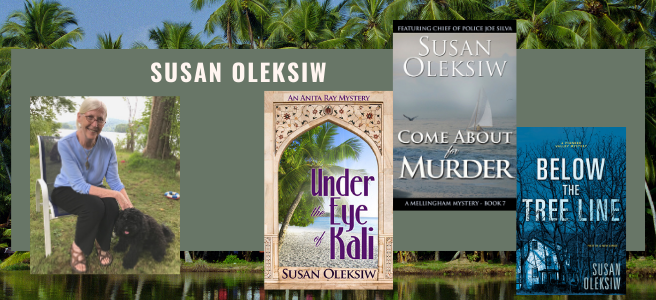
At first the issue seemed to be to write something intriguing. For the first book in the Mellingham series, I wrote and rewrote the first line along with the first chapter, writing, in the end, three first chapters and stacking them one in front of the other. In the end I was persuaded to cut most of them, and I ended up with what I thought was a pretty good first line for Murder in Mellingham. “It had been some time since Lee Handel had ventured out willingly on a social occasion, but his wife, Hannah, had reassured him that this party would be safe.” This line sets the stage for the evening to come but not much else. That line introduced the first of seven titles in the Mellingham series.

The first line of Under the Eye of Kali, the first in the Anita Ray series, was even less connected with the story to follow, but it set the scene nicely. “Guests from various foreign countries began filling up the Hotel Delite dining room, taking every seat at the main table—this was a small hotel, only eight rooms, with the owner’s, Meena Nayar’s, suite on the top floor, and that of her niece, Anita Ray, above a separate garage.” This was the first of four books, with a fifth one waiting on my desk.

You would think by the time I came to write my thirteenth book that I would have mastered the art of the first line, but you’d be wrong. Below the Tree Line opens with what I regard as a terrific line, but it isn’t necessarily the best first line for a mystery novel. But I didn’t come to this conclusion until recently. Below the Tree Line opens with this: “On the third night Felicity lifted the shotgun from its place in the cabinet, and this time she loaded it.” There isn’t much wrong with this line as it stands, but it doesn’t tell you as much as you might think about what’s coming next.

After publishing dozens of shorts stories and thirteen novels, I tried a new approach in creating the perfect first line. I don’t know if the result is perfect, but I established a definition of that first sentence that works for me. I now consider the first line as the apex of a pyramid, and the story is within that pyramid. Whatever happens must be traceable back directly to the first line. This by itself means extraneous scenes, extra characters, digressions into backstory, or a humorous or romantic subplot that is more filler than mystery, are all to be excluded.

In my current novel, now with my agent, I rewrote and reworked the first line more than a dozen times until I had something that, like a math or drawing compass whose points never deviate as they draw the circle, could embrace the entire story, holding each part in tight, streamlining and smoothing the narrative. This, then, is the first line of So Comes the Reckoning: “The first time Renee watched a man die, she was eleven years old, kneeling beside him as he lay on the ground.”

As I wrote the 82,000 word story I kept that first line in front of me and asked myself repeatedly, Is what I’m writing now linked to that statement? If not, why not? It was hard to find myself jettisoning entire chapters because I seemed to think they were needed but could find no connection to the first line and its implications. Why was she there? Why was this a first time? Why did she not, as an eleven-year-old child, run away or at least stand apart? The implications of those words kept me on track.

Since then I have come to appreciate the difference between a good snappy sentence and a good first line to a particular novel. They are not necessarily the same. The challenge is to combine them in such a way that the story unfolds from those opening words. It’s an ongoing challenge.