Halloween and the loss of innocence

By Sally Carpenter

How did Halloween change from a day of fun for kids to a time of terror?

Many mystery writers like Halloween because of its spooky nature and ghosts of the dead (murdered?). The day itself is on the eve of All Saints Day, when Christians honor the giants of the faith who have gone on to their eternal reward. Today, Nov. 2, is All Souls Day to remember all of the dearly departed, especially loved ones.

But to most people, Halloween is a time of dressing in costumes, parties, special decorations, watching scary movies and that greatest tradition of all, trick-or-treating.

Growing up in the country outside a rural Midwest town, Halloween didn’t make an impact on me. Mother brought costumes from the five and dime store and drove my brother and me to the three or four nearby neighbor houses for trick-or-treating. My haul was only a few pieces of candy. The next day on the bus to school, I saw a couple of schoolteachers’ homes that had been TP’d (the trees covered in the toilet paper) during the night. My church youth group had a Halloween party. Halloween was just a time of fun and harmless pranks

Some years later, Halloween took a dark turn. The news media reported kids finding laxatives and razor blades in apples in their t-or-t bags. Kids were urged to only stop at the homes of people they knew, trick-or-treat in groups and go out in daylight.

Concerns grew over store-bought costumes catching fire or ill-fitting plastic masks that blocked a kids’ vision. Costumes grew gorier. Motorists were hitting trick-or-treaters crossing streets. Pranks had degraded into vandalism and destruction of property.

Halloween had become a deadly holiday.

Where I live now, many cities, schools and houses of worship host their own Halloween family  events, described as “safe and fun trick or treating.” These events offer supervised games, mildly scary haunted houses, costume parades and “trunk or treat,” where adults hand out candy from the trunks of their parked vehicles. Everyone stays in one area and nobody roams through the city streets.

Police issue annual warnings, telling kids to use caution when crossing streets, to carry flashlights and wear costumes that allow one to see clearly. Adults are encouraged to hand out healthy snacks to kids at their doors. The local dentists host “buy backs,” paying kids to turn in their Halloween candy for money instead of eating all of those sugary snacks. State law forbids registered sex offenders from participating trick or treating and even from putting out Halloween decorations.

While some order has been restored to an unruly tradition, it seems to say that the world at large is a scary place. People can no longer trust their neighbors-in large cities and apartment/townhouse complexes, many residents don’t even know their neighbors. What was once a kids’ holiday has become a time of fear.

Have we degraded into such a violent society that kids can no longer trust their neighbors to give them a treat and not a trick?

What are your thoughts? Is Halloween fun for you and your family or not?
Raising the curtain on stage mysteries

By Sally Carpenter

I love watching plays as well as reading and writing mysteries. However, despite the fact that longest running play in history is a mystery (Agatha Christies’ “The Mousetrap,” continuously running in London since 1952), mysteries are seldom produced in local theater.

One reason could be that musicals sell more tickets than non-musicals and comedies are more popular than dramas. “A Gentleman’s Guide to Love and Murder” is doing well on Broadway because it’s a musical comedy and also is based on the same novel as the well-known movie “Kind Hearts and Coronets.”

Some mystery plays that I’ve seen on stage:

“Arsenic and Old Lace.” Not a mystery but plenty of murder and dead bodies. Is there any amateur company that hasn’t done this show? I ran props for my high school’s production and saw it years later at a community theater. Its popularity seems odd due to the questionable moral ethics: the killer aunts are not punished or stopped for their crimes, neither do they show regret or remorse.

“Prescription: Murder.” Richard Levinson and William Link adapted their play into the pilot episode for “Columbo.” The play takes place in New York City but the TV movie was set in Los Angeles for filming purposes. In the play, the detective wears an overcoat, not a raincoat. The ending of the original script and the movie are different. For the 2004 production at West Valley Playhouse (Canoga Park, Calif.), Link rewrote the ending to match the movie version. Bob Van Dusen, who played Columbo, fortunately didn’t attempt a Peter Falk imitation. He played the detective as quirky, inquisitive imp and I loved it.

“The Mystery of Edwin Drood.” A musical based on an unfinished novel by Charles Dickens. Since the book doesn’t name the killer, at the play’s conclusion the action stops long enough for the audience members can vote for the killer. After ballots are tallied, the play is resumed with a final scene based on the votes. When I saw the show in 2007 at the Simi Valley Cultural Arts Center, the voting results were not released, so I don’t know if the company presented the same ending each night or not. It’s possible the actors rehearsed a variety of endings.

“Victor.” Not a mystery but an adaptation of the “Frankenstein” story. I saw this in 2007 at the High Street Arts Center (Moorpark, Calif.). Spooky atmosphere and great acting in this production.

“Angel Street.” The American title for the British play “Gaslight” in which a husband tries to drive his wife insane so he can search for missing jewels. Seen at Conejo Players Theatre in Thousand Oaks, Calif.

“The Murder Room.” I never heard of this play until I saw it in 2007 at the tiny, 50-seat Stage Door Theater (now closed) in Agoura Hills, Calif.  It’s a funny, zany spoof of British mysteries with the standard upper-crust characters, foggy evenings, loony plot twists and secret compartments build into the set. Catch it if you can.

“And Then There Were None.” An adaptation of Christies’ “Ten Little Indians.” I’ve seen this play at theaters in two states. A good show except as the characters are killed off, the suspect pool dwindles until the killer’s identity is fairly obvious.

“Pack of Lies.” An interesting script set in England and something of a spy thriller. A man, who seems connected with the police, uses the home of an ordinary family to spy on their neighbors. Are the family’s best friends up to no good? That’s the mystery. I saw the show staged by Panic Productions in T.O.

I’ve seen the movies made from “Witness for the Prosecution,” “Anatomy of a Murder,” “Deathtrap” and “Sleuth” but not the stage versions. I’m hoping someday a local theater will a production of any or all of these.

What are your favorite mystery plays?


What’s so mysterious about black cats?

Carpenter photo_WEB gif

By Sally Carpenter

One of the common images seen in crime and mystery stories as well as Halloween decorations is that of a black cat prowling in the night, a sinister and evil figure. Yet most black cats are just as friendly and playful as other cats. In the words of Curly Howard, they’re “a victim of circumstance!” How did black cats get such a bum rap?

A black cat is not a specific breed. The Cat Fanciers Association allows solid black coloring in 22 of its recognized breeds. The only breed with all-black felines is the Bombay, produced by mating a Burmese with a black American Shorthair. Male cats are more likely to be black than females.

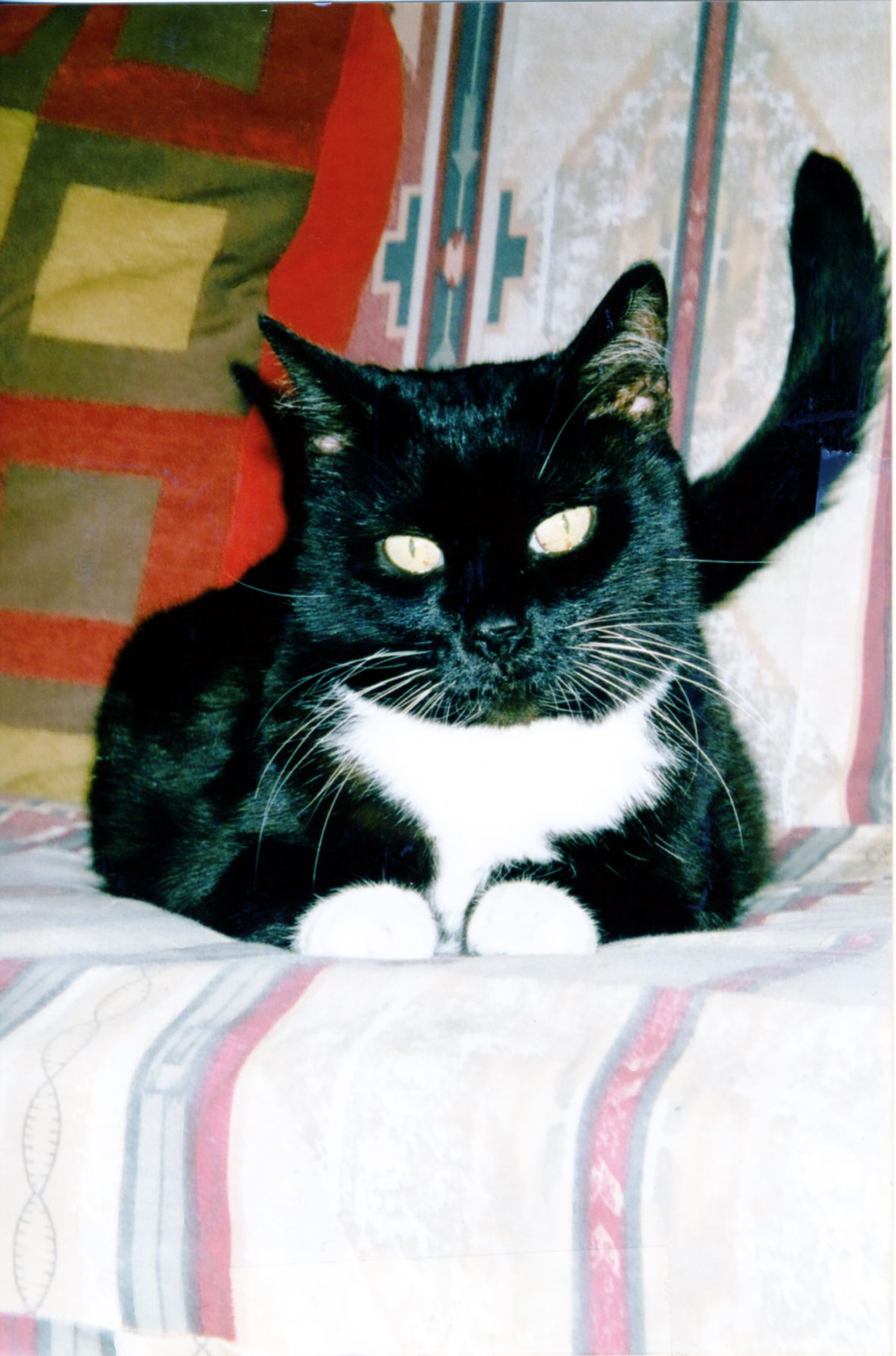
A common variation on the color is the “tuxedo cat,” a black cat with a white chest and sometimes white paws, as illustrated by my dumpling, Boots.

Boots

Pop culture has produced such black cat heroes as Felix, who debuted in 1920s silent cartoons, and Snowball II of “The Simpsons.” In the 1970s John Lennon had a black cat named Salt and a white one dubbed Pepper.

Famous fictional tuxedo cats are: Sylvester of Warner Bros. cartoons, Figaro of Disney’s 1940 animated “Pinocchio,” and Mr. Mistofflelees of Andrew Lloyd Webber’s musical “Cats,” based on T.S. Eliot’s “Old Possum’s Book of Practical Cats.”

Black cats were not always stigmatized. In Egypt around 3,000 B.C., cats were worshiped. The goddess Bast (also spelled Baast or Bastet) was often depicted as a black cat or a woman with the head of a cat. Killing a cat was a capital offense, and dead cats were often mummified. As early as 1,000 B.C. cats were domesticated as pets.

In Asia and Scotland, black cats are considered lucky.

But in Europe during the Middle Ages, cats were seen as the familiars of witches. The sight of poor, single women feeding feral cats gave rise to this idea. The belief was that cats could change into human form and spy on persons. Early settlers to America brought their superstitions with them.

In the 1300s, communities killed hundreds of cats, resulting in a rise in the number of rats that then spreaded bubonic plague, the “Black Death” that killed millions of Europeans.

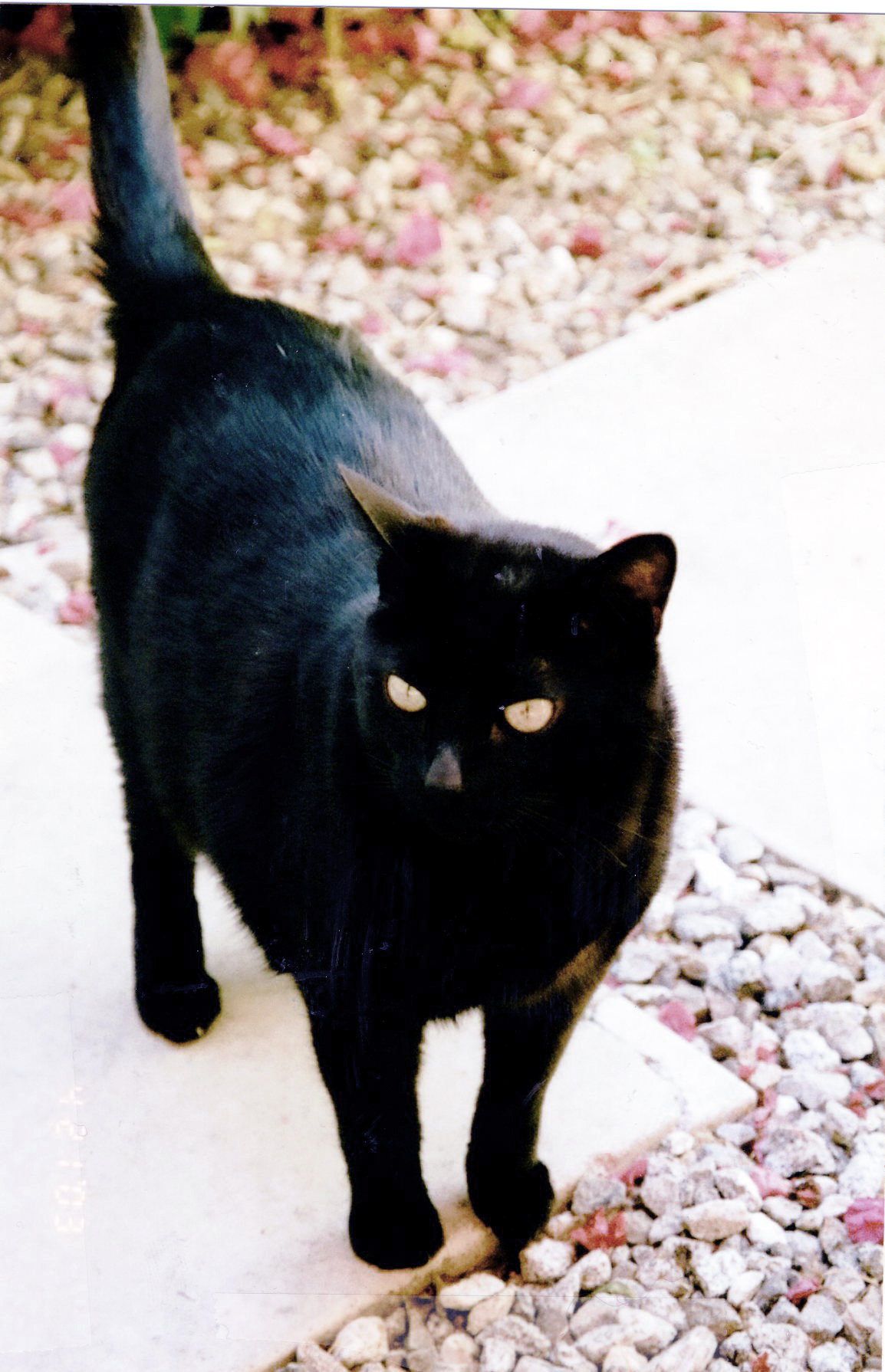
In modern times, blacks still have bad luck. In animal shelters, black cats are often the last color of animal adopted and the first that is put to sleep. Shelters often have more black cats than any other cat color. One local shelter stated that guests often see the more brightly colored animals before they notice the black cats, so the darker pets are often missed. This is Felix, a stray that some people found and turned over to my vet for treatment and who ended up in my house.

Felix

Pet owners in England are ditching their black cats because they claim the animals don’t photography well in selfies, according to www.mirror.co.uk. The RSPCA (Royal Society for the Prevention of Cruelty to Animals) reports that 70 percent of the unwanted cats housed in its national animal centres in England are black or black and white.

But according to my experience, black cats make wonderful pets. I don’t know why but all of my cats have been gray or black. I didn’t set out as a “black-only” owner; in one case the cat chose me. Maybe these felines know I’m a sucker for an outcast or a hard-luck story.

So next time you’re writing that detective story, pause before putting that black cat in a dark alleyway. Why not make it white dog?

This post is based on an article previously published in the Acorn Newsapers.

Book review: ‘The Mystery of Nancy Drew, Girl Sleuth on the Couch’

Carpenter photo_WEB gif

By Sally Carpenter

What does Nancy Drew have in common with fairy tales, virgin goddess and Jungian psychology? Quite a lot, actually.

I found this book by a happy accident years before I began writing mysteries. I wasn’t even a Nancy Drew devotee. I saw the book on a shelf when I was browsing in Catholic bookstore in Chicago and on a whim bought the book.

The author is Betsy Caprio, a Jungian psychologist. In an engaging manner she examines the psyche of the girl sleuth. Despite Nancy’ constant upbeat manner, she has a dark side that craves adventure and danger. In fact, according to Caprio, Nancy displays many characteristics of an adult child of an alcoholic!

The Drew books play out several universal archetypes: the virgin goddess comprised of strong feminine energy and who is complete without a man; the fairytale princess who is always young, beautiful, and dresses in lovely clothes; the eternal teenager who never ages and is free of the responsibilities of school, job and family; and the paradise setting of River Heights, squeaky clean on the surface but possessing a dark underworld of crime.

Caprio gives a brief history of Nancy’s creation in 1930 by the Stratemeyer Syndicate, the publishing firm that also produced the Hardy Boys, Tom Swift Jr. and more than a hundred wildly popular juvenile adventure series. Over the decades the Drew books have gone through numerous ghostwriters, changes in Nancy’s character and story elements, various cover designs and even complete revisions of the older titles.

Caprio demonstrates how the Drew stories follow the “hero’s journey/quest,” a storytelling format dating back to ancient epics and legends. Simply put, the journey has: Invitation to the Quest (Nancy is asked to solve a mystery); Road of Trials with warnings, foes and helpers; “Death” Experience (Nancy is tied up, imprisoned or stranded), and Rebirth with order restored, a reward/gift for Nancy and glorification of the heroine.

Caprio ends her book by showing readers how they can be a “detective” and search for “clues” in understanding their own life’s journey using Jungian psycho-spiritual development.

The book is full of illustrations from Drew books through the years, showing how the girl sleuth has changed in appearance.

Some fans may not appreciate the negative aspects of Nancy’s personality, but to me this helps to balance the girl’s annoying cheerfulness and incessant do-gooding.

The book is full of insights into the elements that comprise a good mystery and a multi-layered heroine. I plan to reread the book soon to find tidbits I can add to my own writing.

Caprio’s book is out of print, but used and new copies can be found on Amazon and possibly in used book stores.

Creating more ‘dramatic’ characters

Carpenter photo_WEB gifBy Sally Carpenter

When I began writing in earnest, I was more interested in playwrighting than penning novels. As a kid, I checked out plays from the local library to read instead of novels. Plays read fast (knock one off in an hour!), had lot of white space on the page, and got to the action immediately. Books had hundreds of pages of close-set type, long passages of boring description and slow moving plots.

Now that I’m entrenched in writing cozies, the skills I learned as a playwright are still serving me well. One of the primary tools for character development that I picked up from acting class is major meanings. The following is an over-simplification of the process.

Every person has major meanings in her life. These are the two to three things the person needs to have a fulfilling life. Major meanings are tangible items, not abstract ideas like joy, peace, security and safety (although the major meanings might provide such things.)

The major meanings create tension among each other. When one major meaning is realized, another meaning may be neglected.

An example: a middle age female executive has the major meanings of career advancement, family and sobriety. However, climbing the corporate ladder leaves little time to spend with family. Business lunches and networking parties with an abundance of booze flowing might tempt her sobriety. She may forgo a job promotion so she can care for an aging parent.

Watch the sparks fly when two characters have different major meaning. The wife values peace and quiet but hubby, who loves auto racing, wants his buddies over to watch the Indy 500 on the big screen TV. Resolving the conflict to everyone’s satisfaction (or not—that’s when the murder occurs) is the stuff of good storytelling.

For the writer, major meanings are often not planned in advance and may pop up as the manuscript progresses. The author should never state major meanings outright but let the reader discover them.

When an actor approaches a play, she reads the script until she finds her character’s major meanings and then she internalizes them. She imagines herself as the character living out her major meanings and life history. When the meanings are ingrained, the actress goes on stage and, as she says a line or listens to the other characters, the right feeling and reaction will occur because the major meanings will spring to the surface naturally and in the moment. This provides a more natural performance than for the actor to plan to advance how she will say or react to a line.

 In my writing I often imagine myself in the character’s place or “see” the character acting out the scene in my mind. If I’m stuck for what the character will do or say next, I let the major meanings simmer and the character will do the right thing. (Writing is harder work than acting. An actor only had to build one character whereas the author has to do the work for several!)

To put this idea into practice, take a favorite novel, play or movie and find the protagonist’s major meanings. How do these meanings cause the character to make the choices she does? How do the major meanings of the other characters, cause conflict for the heroine?