Paty Jager is an award-winning author of 50 + novels, novellas, and short stories of murder mystery, western romance, and action adventure. All her work has Western or Native American elements in them along with hints of humor and engaging characters. Paty and her husband raise alfalfa hay in rural eastern Oregon. Riding horses and battling rattlesnakes, she not only writes the western lifestyle, she lives it.
I have written two mystery series with Native American characters, while I am not Native American. I’ve read books by Native American authors, have a friend who lives on the Colville Reservation with her Native American husband, and I have lived in an area that has so much Native American history I feel it seeps into you.
But I am facing my biggest challenge as a writer, now, when it is more politically correct to be of the same heritage as the characters you write.
I started slowly, with my heroine, Shandra Higheagle being only half Native American so I could have her raised without that influence and have her discover it as I did writing her story.
Paiute Dancer photo by me
But I felt the area where I grew up, needed more exposure about the people who lived and were stewards of the land before if was favored as lush feed for cattle. And that was how my character, Gabriel Hawke, came to be. He is of Nez Perce and Cayuse heritage. He is working as a State Trooper with the Fish and Wildlife Division in Wallowa County, the land where his ancestors summered and winter. While he hasn’t lived on the reservation since graduating high school, I feel I can pull off his loyalty to his ancestors and still have him respect his culture but not be fully immersed in it.
Now, as I am writing the last Shandra book and moving onto a new character, I have to tame the lump in my gut and start contacting people on the Umatilla Reservation. My next character will be living and working on the reservation. I will need first hand knowledge to make this character ring true and to make her not only show the life of someone trying to end the cycle of prejudice and move on, but also someone who values her people’s culture.
That my writer and reader friends is what I will be trying to achieve the next few months. Connecting with people who are willing to allow me into their world and to show a life that I am not a part of but believe in.
Wish me luck! And let me know if you have anyone on the Confederated Tribes of the Umatilla Reservation who would be willing to help me. I’m sending out feelers this week.
Write What You Know (And always listen to your best friend)
By Tara Lush
When I first started writing fiction six years ago, I turned to romance. It was a genre that I’d read and loved — along with mystery and true crime, of course. When I told my oldest friend about my plan to write a steamy novel, she scrunched up her face.
“Why aren’t you writing crime fiction?”
It was an excellent question. I’ve been a newspaper and wire service journalist in Florida for two decades, with many of those years devoted to the weird, the horrific, and the criminal. I’ve covered many of the state’s biggest crime stories. High-profile ones such as Casey Anthony and Trayvon Martin. Lesser-known murderers who had abducted children and those who attacked fellow citizens in a drug-induced haze. I’ve also covered eleven mass shootings (including Parkland and Pulse) and witnessed thirteen executions in Florida’s death chamber.
“Pfft. Why would I write crime fiction?” I asked my friend. “It’s too depressing. Too much like my day job. I want to do something different. My muse is telling me to write about sex.”
And yet, my muse told me to write a romantic suspense for my first novel. I moved on from there, writing contemporary romance and erotic romance. And while I had some measure of success — a RITA finalist book in 2018 — it never felt a hundred percent right, either.
In 2019, I was on a trip to Vermont and sitting around my best friend’s house. I was musing aloud about my next steps for my fiction career. Self-publishing contemporary romance was increasingly difficult and competitive, I told her, and writing the happy-ever-after between the couple wasn’t as satisfying as it had been in previous years. I wanted to tell a story about justice, but with humor and nuance.
I’d recently finished a series about couples in a quirky Florida town, and let’s just say the eccentricities of the characters weren’t resonating with romance readers. I was frustrated.
“What about a mystery novel?” my friend asked.
I mulled this over for the entire month of August while I was on a monthlong vacation. I’d been reading Kathy Reichs’ Deja Dead, and although I loved it, I couldn’t imagine myself writing something so dark. There was the matter of the day job trauma, after all. But what if I could write something softer, something with a little romance and a twisty murder… something gentle.
A cozy mystery, perhaps?
While sitting in a café in Quebec City and drinking the best espresso I’d ever had, I sketched an outline for my cozy. I used my experience as a crime reporter to plot the murder. First I chose a victim. Then I chose a murderer. I worked backwards with the details and clues, thinking about all the police reports I’d read over the years, all the news conferences I’d been to, and all the cops I’d chatted up. Suddenly everything made sense.
You know those wooden puzzle boxes, the ones that seem so hard to open? That’s what my brain felt like. Each clue, each detail, unlocked something inside my creative soul in a way that romance didn’t. I was able to blend my quirky characters and my love of a Florida setting with a murder and a romantic subplot. Justice as an HEA was more alluring than a fictional marriage proposal.
What was this sorcery?
That fall, I wrote my cozy mystery and in March of this year, sold it to Crooked Lane Books.
The lesson here is to always listen to your best friend. And perhaps, listen to what your muse is whispering.
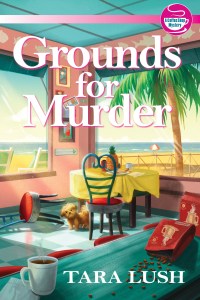
Barista Lana Lewis’s sleuthing may land her in a latte trouble as Tara Lush launches her debut mystery series.
When Lana Lewis’ best — and most difficult — employee abruptly quits and goes to work for the competition just days before the Sunshine State Barista Championship, her café’s chances of winning the contest are creamed. In front of a gossipy crowd in the small Florida town of Devil’s Beach, Lana’s normally calm demeanor heats to a boil when she runs into the arrogant java slinger. Of course, Fabrizio “Fab” Bellucci has a slick explanation for jumping ship. But when he’s found dead the next morning under a palm tree in the alley behind Lana’s café, she becomes the prime suspect.
Even the island’s handsome police chief isn’t quite certain of her innocence. But Lana isn’t the only one in town who was angry with Fabrizio. Jilted lovers, a shrimp boat captain, and a surfer with ties to the mob are all suspects as trouble brews on the beach.
With her stoned, hippie dad, a Shih Tzu named Stanley, and a new, curious barista sporting a punk rock aesthetic at her side, Lana’s prepared to turn up the heat to catch the real killer. After all, she is a former award-winning reporter. As scandal hangs over her beachside café, can Lana clear her name and win the championship — or will she come to a bitter end?
Tara Lush is a journalist with The Associated Press. Her debut cozy mystery, GROUNDS FOR MURDER, will be published Dec. 8. learn more about her and her books here:
Murder is a shocking and terrifying taboo. The very word sends an icy frisson slithering down one’s spine. And yet, it is an occupational hazard for a crime writer. On a cerebral level, the taking of a human life is fascinating. It is a serious business, requiring cunning and sangfroid mingled with passion, anger or fear. A certain degree of luck is necessary to pull off a murder without getting caught. The faint of heart would be riddled with remorse and horror at this deadly transgression.
Setting aside the moral considerations, I find it deliciously thrilling to plot a murder. The omnipotent power to kill is a dizzying prospect. Murder is an art form, if one thinks about it. The killer must be creative. But how does an author choose from the plethora of methods available? Your character is the key to unlocking this mystery. Therefore, an author must first delve into the murderer’s psyche to thoroughly understand why he or she came to make the fatal decision. Is he or she an assassin, a spurned lover, a business partner who has been swindled, or an average individual pushed to the brink in an extraordinary situation? Once the author has sketched this character profile, the pieces will fall into place and the story will begin to flow. The author must have absolute trust in the murderer. He or she will guide you down the evil path and determine if the victim expires quickly or suffers a slow, lingering death.
In most cases, murder stems from a rupture in an intimate relationship. This personal animus is likely fueled by emotion and an overwhelming thirst for revenge. Consequently, this means inflicting pain. The thrust of a knife into the heart, stomach or between the ribs would do the job nicely. With stabbing, the murderer and victim must be at close range. Generally, stabbing ensures that the killer’s face is the last thing the victim sees in this world, satisfying a desire to mete out punishment. For this reason, the murderer in one of the books in my series featuring journalist Emmeline Kirby and jewel thief/insurance investigator Gregory Longdon slashed the throat of an unscrupulous man, who had derived malicious glee from ruining other people’s lives.
Meanwhile, shooting also would induce pain. With this method, the author has the option of killing someone instantly, forcing the culprit to hastily cover his or her tracks. This provides an opportunity to sprinkle red herrings through the story. Conversely, the dark deed can rattle the murderer to the point that he or she is no longer thinking clearly and makes mistakes. Another possibility is that the gunshot does not kill the victim outright. It may cause a grave wound, presenting the murderer with a chance to finish off the victim another way. Let’s say by poison, for example.
Ah, poison. To me, it’s so sinister and tantalizing. I believe I share this view with my hero Agatha Christie, who masterfully eliminated dozens with a soupçon of poison. Some poisons are tasteless and odorless. Then there is cyanide, which smells like bitter almonds, while arsenic, when heated, gives off an odor resembling garlic. Depending on what your story dictates, poison can work instantaneously or the victim can waste away little by little. Russian spies, and Putin in particular as a former head of the KGB, have a penchant for using poison to dispatch enemies, defectors and anyone who dares to oppose them. As a result, poison was my weapon of choice in another novel. The story dealt with a defector who recklessly pitted Putin against Russian mafia boss Igor Bronowski. At the same time, both had unsavory entanglements with a ruthless British entrepreneur. All were obsessed with a flawless blue diamond. I will confess that two victims succumbed to poison in the book. However, poison is not the exclusive domain of the assassin. An author can wield it perfectly well among those who have a personal score to settle. On this point of the professional versus the amateur (for want of a better word) killer, an assassin can employ stabbing or shooting in a pinch for expediency’s sake.
A lethal arsenal would not be complete without strangulation, drowning and smothering. But all three may prove troublesome because they require a degree of strength and the victim will most certainly put up a struggle. A murderer wants death to come swiftly with a minimum of fuss to have time to disappear before the body is discovered. On the same token, bludgeoning someone to death with a heavy object could prove messy, since several blows would likely be needed thus causing a good deal of blood to be shed. Of course, an author may want to employ bludgeoning for precisely this reason to set the stage for the murderer’s ultimate undoing. For in the haste to flee, he or she may miss a trace of blood.
Allow these diabolical musings to steep in your mind. After a while, you’ll come to realize that it’s criminally good fun to acquire a literary taste for murder.
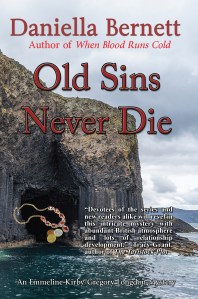
OLD SINS NEVER DIE
Never look back…Treason is deadly
While in the Lake District, journalist Emmeline Kirby and jewel thief/insurance investigator Gregory Longdon overhear a man attempting to hire international assassin Hugh Carstairs, a MI5 agent who went rogue. They race back to London to warn Philip Acheson of the Foreign Office and Superintendent Oliver Burnell. But it’s a devil of problem to prevent a vicious killing, if the target is a mystery.
More trouble brews as Emmeline pursues a story about shipping magnate Noel Rallis, who is on trial for murder. Rallis is desperate to keep the negative publicity from exposing his illicit schemes, especially something sinister called Poseidon. Lord Desmond Starrett, whose dark past made him easy prey for blackmail, is getting cold feet about their dubious partnership. Hovering in the shadows of this ugly secret world is a Russian mole buried inside MI5. Scorned prima ballerina Anastasia Tarasova makes the fatal mistake of threatening to reveal all she knows. The hunt for the answers takes Emmeline and Gregory up to Scotland, where they learn that the truth has lethal consequences.
Daniella Bernett is a member of the Mystery Writers of America NY Chapter and the International Thriller Writers. She graduated summa cum laude with a B.S. in Journalism from St. John’s University. Lead Me Into Danger, Deadly Legacy, From Beyond The Grave, A Checkered Past and When Blood Runs Cold are the books in the Emmeline Kirby-Gregory Longdon mystery series. She also is the author of two poetry collections, Timeless Allure and Silken Reflections. In her professional life, she is the research manager for a nationally prominent engineering, architectural and construction management firm. Daniella is currently working on Emmeline and Gregory’s next adventure. Visit www.daniellabernett.com or follow her on Facebook at https://www.facebook.com/profile.php?id=100008802318282 or on Goodreads https://www.goodreads.com/user/show/40690254-daniella-bernett. Old Sins Never Die, the sixth book in her series, was released today.
This year, I’ve been banging the keyboard and getting projects done…until last month. It seemed like every time I got in a good day, or two, of writing, something came up and I went days without getting a word down on my WIP (work in progress).
This month, I’m determined to get the 6th Gabriel Hawke book written and out to my CPs (Critique Partners) I’ve had this story idea in my head since I did my ride-along with a State Trooper before I started this series.
It’s something that happened in real life but I’m putting a different spin on it. On the ride-along, the trooper pointed out a campsite and said, “See that burnt spot?”
I did. It was a campfire ring of charred rocks and grass three feet around the ring.
“A vehicle rolled over the fire with a man in it. It was written up as an accident.” The trooper looked over at me. “What do you think?”
“There is no way it was an accident,” were my words. The area was flat. A vehicle even if knocked out of gear wouldn’t have rolled the distance the vehicle was parked away from the fire.
“The victim was drunk. His wife kicked him out of the tent and he went to sleep in his vehicle. They say, he must have bumped the gearshift and it rolled.” He glanced at me again.
I shook my head. “Why was it pronounced an accident? I don’t see how it could have been.”
“All the investigators wanted to call it a homicide but the District Attorney said we didn’t have enough evidence and didn’t want us digging into it any further.”
I could hear the dismay in his voice. He clearly felt someone had gotten away with murder. And that is why my book, Turkey’s Fiery Roost, is about Hawke tracking down the killer.
Writers, do you like to use real life murders/criminal activity to spur ideas?
Readers, do you like knowing that writer’s try to write their own form of justice when putting together a murder mystery?
The story idea for Peril in Paradise came after a news story featuring a Portland mother whose daughter had gone missing on her way to school. The mother’s anguish, and hope, as she pleaded for her daughter to be found, moved me. Unfortunately, as the story unfolded, the young girl’s body was found a few houses from her home, tucked into some bushes. I found myself wondering how this mother was coping with the death, and rape, of her daughter? What kind of monster had the young girl encountered, in less than a mile from her home, in a neighborhood where she felt safe?
The mother didn’t make another news appearance, heartbroken beyond words I imagined. The man responsible for the girl’s death was apprehended and eventually sent to prison. Closure for the girl’s mother, and the rest of her family. Possibly.
I couldn’t let go of the idea that sending the murderous rapist to prison actually brought closure. Questions such as: What would I have done if it was my child? Would I have been comforted by the man’s conviction? Or would I have wanted a more permanent type justice.
Justice versus revenge? What would bring me comfort? I knew I couldn’t kill someone, which triggered the thought: Maybe I could hire someone? Of course, I watch enough crime shows to know hiring someone to do the deed doesn’t ensure you won’t get caught. The young girl’s rape and murder, coupled with her mother’s helplessness, continued to torment my thoughts.
And then I had a dream . . . I love when my writer’s brain takes a thought and creates a fictional scenario that can be woven into an intriguing story. Hence, Peril in Paradise was born!
In my dream, I could clearly see my villain. I had been trying to come up with a story idea for my Mexico Mayhem series but hadn’t been able to find a plausible storyline that began in the United States and ended in Mexico. Viola ~ Damian Garza provided the crossover opportunity I needed.
I could also visualize my hero. A man tortured by Damian’s previous villainous acts. A man who I could imagine carrying out a murder for hire scenario. Jackson Brady had his own need for justice . . . or revenge.
What I couldn’t see in my dream was my heroine. I knew she existed because I felt her pain and anger over losing her daughter. But I couldn’t see her. But not being able to picture Clara Marsh wasn’t a problem for me. As a mother, I could truly imagine her suffering. Her grief. Her guilt. Her need for justice. Her desire for revenge. I knew Clara Marsh would be a little like me.
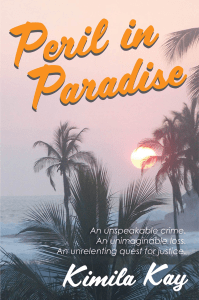
Peril in Paradise
Mexico Mayhem Book 1
Imagine—A brutal rape. A vicious murder. Now—what would you seek if it involved your daughter? If the monster is her stepfather. Justice or revenge? In Peril in Paradise, Clara Garza is faced with this dilemma while trying to stay one step ahead of her deranged ex-husband, Damian Garza. As she embarks on her voyage for justice, Clara meets Jackson Brady, a man also seeking his own revenge—a man trying to capture her heart. The two find themselves resolving one issue only to face another sinister challenge. Readers will want to join Clara and Jackson as they navigate a journey of justice, revenge . . . and survival.
Kimila Kay lives in Donald, Oregon with her husband, Randy, adorable Boston Terrier, Maggie, and feisty black cat, Halle.
Her professional accomplishments include three anthologized essays in the CUP OF COMFORT series. In three separate contests, PERIL IN PARADISE, has won two first place awards, and a third-place award in the romantic suspense category. Kimila is currently a member of a writing critique group, Northwest Independent Writers Association (NIWA), Windtree Press, and Willamette Writers.
PERIL IN PARADISE is the first novel in a planned cross-cultural series, Mexico Mayhem, which will include Malice in Mazatlan (January 2021), Chaos in Cabo, Vanished in Vallarta, and Lost in Loreto.
REDNECK RANCH will be the first novel in a planned mystery series, The Stoneybrook Series, set in a fictional Oregon town. REDNECK RANCH is slated for publication in 2022.






 Ladies of Mystery
You must be logged in to post a comment.