Guest Blogger ~ Thonie Hevron

Be Careful What You Wish For
I’ve been writing stories since I could hold a pencil. I remember getting a 5th grade class assignment during a mythology segment. We were to write a myth. I wrote a story, “How the Leopard Got His Spots.” All I remember now is the main character was up a tree in a jungle, hiding from a leopard prowling around beneath him. The character had a bucket of black paint and was shaking with fear, so much that he dribbled paint on the animal. I got an A+.

Years later, I still wrote but rarely completed a work of fiction. I’d written procedural manuals for work. I’d spent two decades in law enforcement in Northern California, mostly Sonoma County. By 1994, my husband and I were planning our retirement—still years away, in the Eastern Sierras. We were tired of the traffic and congestion of the Bay Area and wanted a more peaceful setting. When my firefighter husband suffered a career-ending injury, we stepped up plans to retire. Until I qualified to retire, I accepted a job as a dispatcher at a small police department. In less than a year in the Sierras I found myself so homesick that even the catastrophic floods of 1996-97 in my old neighborhood made me want to be back in Sonoma County. I’d worked three previous floods and missed helping during the disasters.

One night on a quiet graveyard shift, seeking a bit of consolation, I scratched out a description of a Russian River (Sonoma County) home I saw in a magazine. The seed of a story germinated, and I wrote the story. That tale became By Force or Fear, the Nick and Meredith Mysteries, about a Sheriff’s detective Meredith Ryan (and her partner Nick Reyes) stalked by an influential judge.

Since my husband and I moved back in 2004, I’ve written and published a total of four books—all set mainly in Sonoma County. If I dare simplify my goal for writing these stories, it’s to humanize the people behind the badge. By the time I retired, I had thirty-five years of service as a civilian law enforcement employee. I worked as a Parking Enforcement Officer (yes, meter maid), Dispatcher, Records Supervisor and Community Service Officer. I’d known scores of police officers, male and female, sheriff’s deputies, FBI, ATF and other alphabet soup agencies. My observations over the years varied with the faces that I saw—some decent, dedicated officials who wanted to make a positive difference in people’s lives. Others not so much, but the vast majority came to work every day with commitment. I wanted to write about them and do my part to discourage the “Die Hard” stereotype. Thus, Nick and Meredith were born.

I know I’d have picked up a pencil sooner or later in my life. But I’m darn certain that homesickness played a huge part in jump-starting my writing. Be careful what you wish for—you might get something entirely different and better!

In this fast-paced story, sheriff’s detective Meredith Ryan surprises an intruder leaning over her baby’s crib in the middle of the night. Unable to catch him, she launches a dangerous journey to protect her family. The death of her father the next day leads her to look into his past where she discovers her father was involved in a robbery and homicide many years ago. Working through a web of deceit and mystery, she discovers the robbery and homicide are connected to the mysterious man in her nursery. With Nick, her husband, they unravel her father’s involvement in the robbery/homicide. The loot from the robbery has been long sought by competing crime rivals who are trying to use her family as bargaining chips. Meredith and Nick must find the truth in the next 24 hours before the criminals close in on her family.

Buy links: https://www.amazon.com/gp/product/B08ZJW2YRR

Thonie Hevron’s law enforcement experience is the inspiration for suspense novels based on the lives behind the badge. A Sonoma County resident for over thirty years, she lives in the historic Northern California Town of Petaluma with her husband and two dogs and a cat. Dressage and travel are her real-life passions outside of family and writing.

Her four thrillers, By Force or Fear, Intent to Hold, With Malice Aforethought and newly released Felony Murder Rule are award winners at the Public Safety Writers Association Writers (PSWA) Writers Contest in 2012, 2014, 2016, 2018, 2020 and 2021. All books are available in bookstores and on Amazon.com.

Website: www.thoniehevron.com

Facebook: ThonieHevronAuthor page

Guest Blogger ~ Jennifer Worrell

Atmosphere is the most delicious aspect of any book. I connect strongly with stories that envelop me into its world and make me feel like I’m living it along with the character.  I like to unsettle readers and immerse them in the same way, so they feel there’s no escape until they reach the last page. 

I wanted to write a modern noir inspired by the black and white movies and dark fiction of the 40s and 50s, The danger lurking in the quiet corners, the unspoken emotions, the dialogue delivered in short patter, hits all the right buttons for me.  So I was pleased as punch that someone called it “Midwest noir” in a review. 

My protagonist, Val, came from my enjoyment of reading characters that are a little off-center.  People who are not so nice, with twisted thoughts and less-than-savory motivations, yet not quite villains.  Characters who are less than successful, especially when they don’t realize how much.  They feel more like real people than we’d maybe care to admit. 

His love interest, Sandra, as well as his agent, Graham, are both antagonists as well as the story’s brighter characters.  Though I consider Sundown pretty dark, they counteract the shadows with a little lightheartedness.  Sandra’s dry wit was fun to write, and Graham is the type of friend anyone would be grateful to have in their corner.

The idea for the plot came from asking “what if” to things I was seeing on the news at the time.  Val (a much more successful author than I am) decides to write a dystopian conspiracy thriller about the crime rate in his city, with a nameless society covertly ending the lives of its residents when they no longer serve a purpose.  Being an older gent himself—Val’s personal “last chapter” looming closer than he’d like to admit—this concept feels urgent and chilling.  Unfortunately for him—and quite a few other people—the idea isn’t new.  It isn’t fiction.  And the members of this society are prepared to do whatever it takes to keep Val’s book from hitting shelves and revealing their secrets.

One of my favorite subgenres to read is the fugitive story.  Although Edge of Sundown doesn’t qualify in the traditional sense, a few of the final chapters have that feel, and they contain some of my favorite scenes.

I’m pleased to announce there’s a promotion going on until November 15.  Click here for a chance to win a $260 Amazon gift card.  Later this month, Edge of Sundown will be discounted to celebrate my publisher’s tenth anniversary.  Subscribe to my newsletter for an update.

Val Haverford’s sci-fi and western novels made him a household name. But that was then. A decade of creative stagnation and fading health has left him in the literary wilderness. Attempting to end his dry spell and secure his legacy, Val pens a dystopian conspiracy theory set in a tangential universe where alien invaders eliminate ‘undesirables’ perceived as drains on society. But as he digs deeper into violence plaguing his adopted home of Chicago, he discovers unsettling similarities between his work in progress and a life he thought he left behind. Soon he finds his fictional extremists are not only real—they’re intent on making sure his book never sees the light of day. As he pieces together haunting truths about his city and his motives, Val realizes his last chance to revive his career and reconcile the past could get him—and the people he loves—killed. Will he make the right choice? Or will it be too late? Edge of Sundown is a provocative story that shows how the desperation of lost opportunity can lead to drastic and unexpected consequences.

If Jennifer were to make a deal with the Devil, she’d ask to live—in good health—just until she’s finished reading all the books. She figures that’s pretty square. In case other bibliophiles attempt the same scheme, she’s working hard to get all her ideas on paper. She writes multi-genre fiction and is currently working on a sci-fi novel and a handful of picture books that may or may not be suitable for children. Edge of Sundown is her first novel. Her short fiction and essays appear in Write City MagazineWriting DisorderRaconteurLittle Old Lady Comedy and Beneath Strange Stars.

Socials: Facebook, Instagram, Twitter, Website

Buy link: mybook.to/edgeofsundown

Not Just a Pretty Face

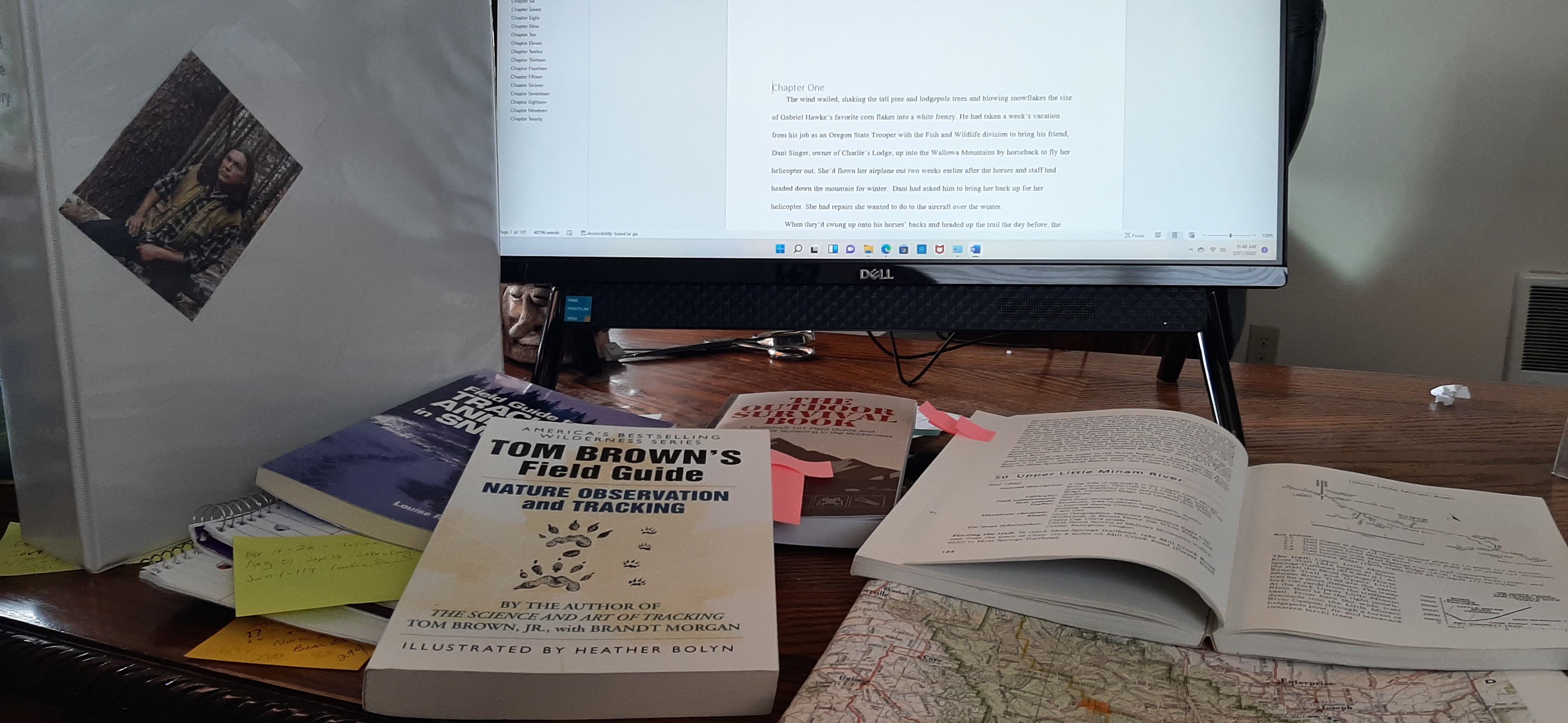
I’ve been taking online workshops through the International Thrillerfest Online school. While a couple of topics are ones I’ve attended workshops on before, each presenter has their own unique spin they bring to it. Which means, I have picked up a few new tricks and things to try.

The first one was a workshop by Adam Hamdy on Pacing. While I had learned about most of what he talked about before, it was his discussion on how he went from a pantser (someone who just starts writing with no idea where they are headed) to someone who does plot out the book in a basic way. Not an outline or thorough scene by scene . He writes the tag line then expands that a bit, then expands that a bit more, until he has 5-7 lines for each chapter with the action or external plot of the story and maybe some of the internal plot that will play out.

I decided to try this for the latest book I’m working on. I’ve always known my beginning, a couple of plot points in the middle, and my end, but when he said by taking the time to do this step speeded up his writing process, I thought it was worth a try. And the last book I had so many interruptions, I’d repeated myself in several places- which was discovered by a beta reader.

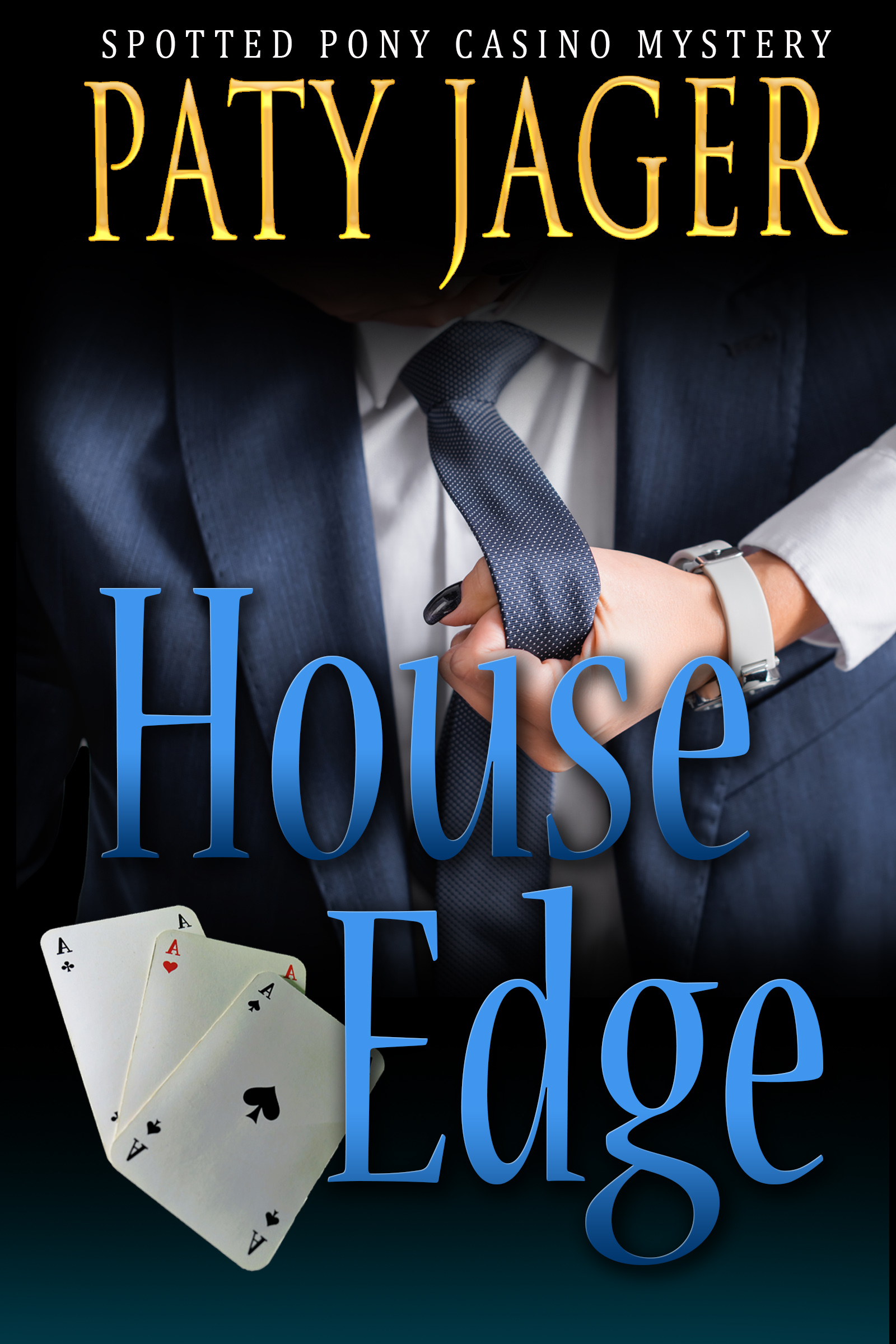
It took me two days to discover what my book was about, write up my suspect list, and write the 5-7 sentences per chapter. This is just the investigation, or external plot, that will be brought up in each chapter. After starting the book, I added in a new secondary character who will help add more dimensions to my main character and also add more internal conflict in House Edge, book 2 in the Spotted Pony Casino Mysteries.

And you were wondering where the title of this post came from… A bonus workshop we received dealt with what mystery/suspense/thriller readers look for in a book cover. I found the information insightful. So much so, I sent an email to my cover designer to redesign the first three covers in the Spotted Pony Casino Mystery series. I have Poker Face published and available to the public but it is the first book. I decided it was best to get it and the next two I’d had made to get a consistency in the series from the beginning.

Here are the books I had made before the workshop:

These aren’t bad and convey a bit of the story. However, the survey taken by a marketing firm who works with all the big publishers and some of the larger writing organizations said that mystery/suspense/thriller readers don’t care if the image on the cover is anything like what’s in the book. They read the title first. They want a title that catches their imagination and is a play on words. Check- my titles do that. They don’t like people/faces on the books. They don’t mind shadowy figures and prefer covers that look like a puzzle. They want to see creepy, mysterious, or action depicted on the covers. And they prefer a description of the type of book: Mystery, Thriller, True Crime, Action Adventure, Suspense not A Novel.

And these are the new covers:

Simpler images, in-the-face title, and the word Mystery is easier to see than in the logo that sweetened the look of the books. These covers also leave more to the imagination.

I’m glad I had this workshop now and not a year from now when the fourth book would be coming out.

And I’m thankful I went with simple covers on the Gabriel Hawke books and I have a play on words for the titles.

It might be just a book cover, but it is the face of the book I want to draw readers into. So while pretty is nice, I want a cover that exudes mystery, intrigue, and a reader can’t pass without at least taking a peek inside.

What do you think of the change of cover?

Guest Blogger ~ Lorie Lewis Ham

Why I Write Mysteries

I have been writing in some form for most of my life—poems, songs, short stories, articles, and of course, mystery novels. It was in my mid-teens that I discovered mysteries, thanks to my younger brother who introduced me to Sherlock Holmes and Agatha Christie. From that moment on, I was hooked—not only as a reader, but I knew that was what I wanted to write.

In my early twenties, I took a creative writing class and my teacher kept trying to get me to write Christian romances. I think she saw me as an innocent Christian girl so she felt that was what I should write—but how wrong she was (a story for another time LOL). Not only was I not a fan of romances, but every time I tried to write one to appease her, I ended up killing someone. I think it is important to be a fan of the genre that you write or else you can’t really do it justice.

The reason I write mysteries is the same as the reason I read mysteries. I love the puzzle of them—I love crafting one as a writer and as a reader, I love trying to figure it out. There is also satisfaction in seeing criminals brought to justice—of getting a satisfying conclusion that too often doesn’t happen in real life. In the real world things may be a mess and sometimes there is very little we can do about it—but in a mystery suddenly we have control—we can provide order and justice. Or as a reader, we get to experience it. I believe that is partially why mysteries have been so popular during the pandemic. I get a thrill out of putting together all of the clues and leading my main character, and the reader, to the solution. There is nothing quite like how it feels when it all comes together.

Personally, I also feel that mysteries give you the chance to delve deeper into your characters than you might in a romance because you are seeing more than the good side they may present to win the one they love—you see that no one is black and white. Not even our heroes are all black and white in a mystery—look at Sherlock Holmes—it is the “grayness” of his character that makes him so appealing. To find out what makes an ordinary person commit a crime fascinates me. What in their life, their journey, and their personality led them to this dark place? While I’m sure you can do this in any genre, in a mystery you almost have to.

I guess the bottom line is that a mystery can have everything-romance, murder, even at times fantasy or science fiction, but at its heart, it has to have a puzzle and a search for justice. This is what I love to read and to write.

One of Us

At thirty-five, children’s book author Roxi Carlucci finds herself starting over again after her publisher drops her book series. With no income, she has to pack up her life on the California Coast, along with her pet rat, Merlin, and move in with her cousin, P.I. Stephen Carlucci, who lives in Fresno, California. The one redeeming factor is that Stephen lives in the Tower District—the cultural oasis of Fresno. 

Stephen talks Roxi into helping out with a community theatre production, which is also a
fundraiser for a local animal rescue. Then someone is murdered during a rehearsal in the locked theatre, and now she and Stephen are hired to find the killer. The killer has to be one of Roxi’s new acquaintances since the theatre was locked at the time of the murder, but no one seems to have a motive. How can they solve a murder without a motive? Could the local gossip website hold any clues? Can they stop the killer before they strike again?

My new mystery One of Us is available on Amazon, Barnes and Noble online, and Kobo.

Lorie Lewis Ham lives in Reedley, California and has been writing ever since she was a child, and publishing since she was 13. For the past 11 years, Lorie has been the editor-in-chief and publisher of Kings River Life Magazine, and she produces Mysteryrat’s Maze Podcast where you can now hear an excerpt of her new book One of Us. You can learn more about Lorie and the new book on her website mysteryrat.com, where you can also sign up for her newsletter, and you can find her on Twitter @mysteryrat and Facebook.

Guest Blogger ~ Pamela Cowan

When I start a new mystery as a reader, it’s like starting a puzzle. I watch breathlessly as a character I’ve become invested in finds clues, solves riddles, and eventually sees justice delivered.

As a writer I find that it’s fun to develop that character, as well as setting and plot and it’s challenging to plant information that the reader can use to solve the puzzle. I just want to be sure the reader doesn’t discover that solution until the last page!

When I wrote my first mystery, SOMETHING IN THE DARK, I wanted to keep that element of surprise. I didn’t want my readers to know who the killer was until I told them, but before I could create a nice, twisty ending, I had to find a compelling place to start.

They say most first novels are somewhat autobiographical in nature and I certainly wouldn’t argue with that.  The idea for SOMETHING IN THE DARK came directly from my childhood.

When I was young, eight or nine, my family lived in military housing on an army base in Germany. There was a laundry room in the basement of our apartment building. While the mothers did laundry the children played in the hallway. The hallway was long and narrow, perfect for races, and had white and dark gray floor tiles, perfect for hopscotch.  For races we’d usually start near the laundry room and end at the big hole-in-the-wall.

The hole was the entrance to an old cold war shelter. Its thick metal door had been wired open so that no one could get in, shut the door, and accidentally be locked inside. Beyond the door, a narrow band of light from the hallway fluorescents showed a strip of dirt floor. Beyond that, nothing but impenetrable darkness. No doubt our older and braver siblings would have explored that shadow-filled space. My friends and I preferred to stick with the familiar well-lit corridor.

As an adult who loved to read mystery and suspense thrillers, the memory of the scary atmosphere of that shelter came back to me. I wondered what it would have been like as a child to have entered that room only to have the door slam shut behind me, to be trapped in that room in the dark? Below is an excerpt from the book.

              ‘After a while, not knowing what else to do, she knocked on the door again, first rapping with her knuckles, then with her balled fists, and finally with the palms of her hands. Smack, smack, went her hands. Just like patty cake. Slap, slap, slap.’ 

After this sort of trauma, I suspected that even as an adult she would hate the sense of being closed in, that she’d avoid crowded rooms, airplanes, or elevators, and prefer the outdoors. Maybe finding herself in the dark would trigger a panic attack so severe she’d lose consciousness.

I decided she’d own a lawn maintenance company and work outdoors. She’d also own a small plant nursery. (With lots of delicious buildings in which she could be trapped.) She would have a supportive brother, a close friend, and a handsome therapist. Because, why not?

Wouldn’t it be strange and horrible though, if every time her phobia triggered an attack and she blacked out, that she’d come to, only to find someone close to her had been murdered?

All that remained to finish outlining my plot was to decide who was responsible for the murders and how Austin could keep the body count from rising. Was a serial killer playing games with her? Was something evil inside her, driving her to kill? Or had something in that bomb shelter come back with her—something she’d met in the dark?

Once I knew the answer, all I needed was one final element. A few days later I picked up a novel by a favorite writer of mine. It started out with a man standing under a group of pine trees in the snow, waiting. I realized that the element of setting, the Pacific Northwest, and the sense of hushed waiting that a fresh snowfall can give you was just the mood I needed. I sat down and six hours later had the basic outline, and first few chapters, of SOMETHING IN THE DARK.

Although I’ve published eight more novels and numerous short stories since then, and even though SOMETHING IN THE DARK has all the flaws and failings of a first book, it is still one of my favorites. 

If you’d like to read SOMETHING IN THE DARK free or check out my other novels, please visit my website at, http://www.pamelacowan.com where you can sign up for my monthly newsletter and subscriber drawing.

I also have a Facebook page,  https://www.facebook.com/pamelacowanwriter where I post new releases, reviews, and slightly dark but almost always hilarious humor.

Something in the Dark

Austin Ward thinks she’s learned to live with her fear of the dark. She’s put the past behind her and there’s even a new man in her life.

But when people she cares about are brutally murdered Austin realizes she can no longer pretend. To find the truth behind the deaths she must face and overcome her fear.

But who is the killer? Is it someone out to get her? Has a serial killer come to her small Pacific Northwest town? Or, has something sinister followed her from childhood, something she met once before…in the dark?

This is Eulalona County, where the trees whisper and the deep lakes hide secrets you don’t want to know. 

Pamela Cowan is an award-winning, Pacific Northwest author best known for her psychological thrillers. Cowan is the author of the Storm Series which includes Storm Justice, Storm Vengeance and Storm Retribution, books which follow Probation Officer Storm McKenzie on her single-minded quest for justice. She is also the author of two stand-alone novels based in fictional Eulalona County, Oregon, Something In The Dark and Cold Kill. She recently published Fire And Lies, the first in the new El & Em Detective Series