Guest Blogger ~ Dominique Daoust

Why I write cozy mysteries

When I was in my late teens and early twenties, I felt like I had to prove I was a dedicated reader by opening the pages of the classics.  But regardless of how many times I forced myself, I simply couldn’t connect with them, they weren’t for me.  And why bother reading something during your free time if you didn’t enjoy it?

After some trial and error, I finally zoned in on what I liked.  I’m a big fan of mysteries and thrillers, historical fiction, true crime and other non-fiction like biographies.  They all bring something to the table that resonates with how my brain works.  I love the twists and turns of a good thriller, the time travelling in historical fiction, the stark realness of true crime, and the revelations of biographies.  My Goodreads TBR list exclusively contains those genres, but there’s one more I recently added.

I think it doesn’t come as a surprise to anyone when I say the past few years have been rough.  Other than cuddling my pets and watching reality television (big shout out to RuPaul’s Drag Race!), the only other thing that kept me mentally afloat was my newfound discovery of cozy mysteries.  The laid-back, small-town settings, the quirky characters and pets, the element of mystery that still pulled me in even though it was lighthearted.  It opened my world to a whole subgenre of mystery I could enjoy without it feeling so harsh and heavy.  And who knew there were so many categories!  Cafes, bookstores, gardening, vineyards?  Cozies basically cover every hobby and profession in existence and it’s perfect (cheers to London Lovett and Vivien Chien!).

When I finally decided to start writing, choosing the genre was a no-brainer.  I could include elements I like from all the other genres I’ve been reading for years and wrap them up in a cozy little package.  My goal wasn’t to create a new classic but rather write some fun mysteries that people can enjoy.  Not only did it relieve the pressure and expectations of the end result, but they were a blast to write! 

With The Deadly Exclusives Trilogy, I’ve incorporated a setting and job I’m familiar with, all wrapped up in a historical period I’ve been obsessed with for years.  I grew up in the suburbs of Montreal, my first job was as a maid and I studied journalism.  And I’ve watched so many 1930s movies on the Turner Classic Movies channel that I can’t keep count.  I doubt any genre other than a cozy mystery could quite capture the tone I wanted. 

Many cozies have brightened my days and I sure hope my trilogy can do the same for others.   
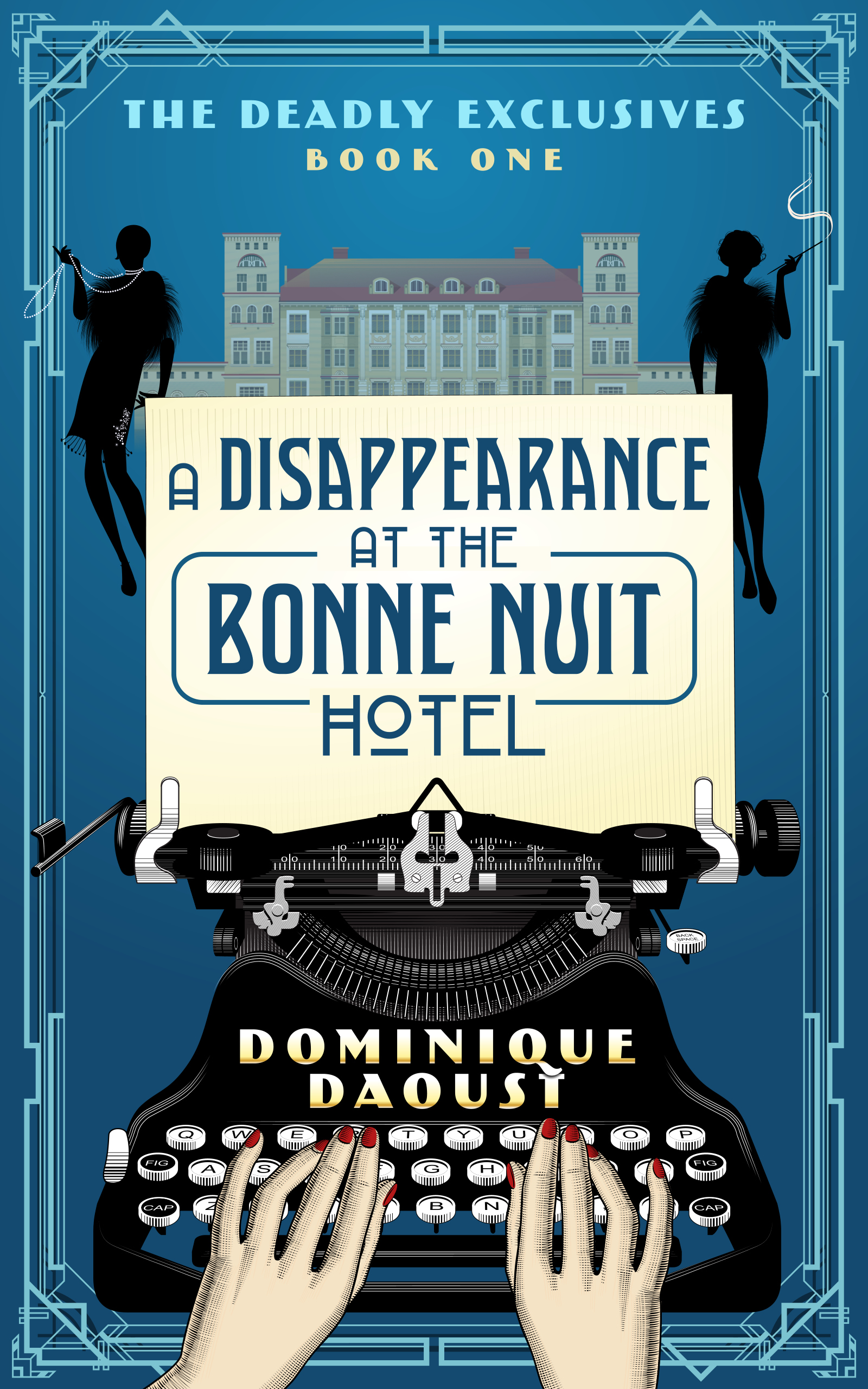
Secret sources have a whole new meaning.

Newbie reporter Rita Larose is tired of getting assigned boring stories at one of Montreal’s most popular newspapers. It’s 1930 after all, women don’t need to only write about household chores anymore! But when a high hat socialite gossips about the New Year’s Eve party at the Bonne Nuit Hotel, a riveting mystery falls right into Rita’s lap. This is her chance to prove to herself and her underestimating colleagues that she has what it takes to write the hard-hitting articles.

While going undercover as a maid to get the scoop, Rita will soon discover unexpected friendships and an unusual gift of her own to contend with. Will she be able to juggle this newfound ability while not blowing her cover and jeopardizing her career-making article?

Purchase here: https://www.amazon.ca/Disappearance-Bonne-Nuit-Hotel-Exclusives-ebook/dp/B09WVW6L53
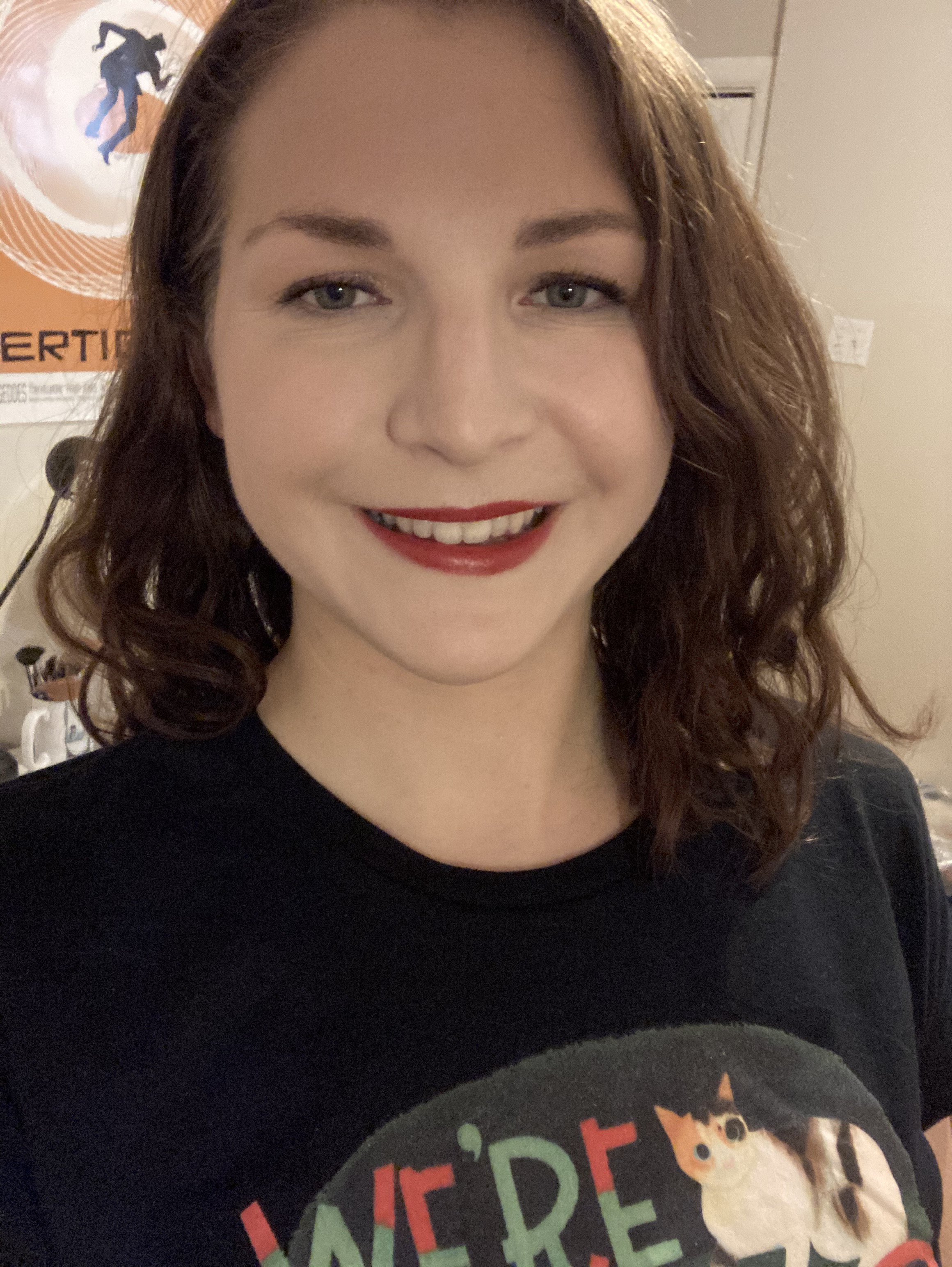
Dominique Daoust is the author of The Deadly Exclusives Trilogy. She is a journalism graduate from Concordia University in Montreal, Canada. When not reading or writing, she likes to do yoga, drink margaritas, incessantly quote Friends and listen to rap while doing mundane household chores.

You can follow her on

Instagram: https://www.instagram.com/dominique.daoust/

Facebook: https://www.facebook.com/DominiqueDaoustAuthor

Goodreads: https://www.goodreads.com/author/show/22331118.Dominique_Daoust

Never Too Old

I think back to my childhood every time I find myself digging for more information. I loved school and learning. While math wasn’t a favorite and I struggled to be proficient in it, I understood it was necessary to learn the basics. In the fourth grade every evening while my mom and I washed and dried dishes, she would quiz me on the multiplication table. And today, I can pretty much spout out the correct answer with a few minutes to pull numbers out of my filled brain. 😉

Writing books has been my way of continuing to learn and fulfill my love of research and discovering new things. From the occupations my characters have:

Vase by Olaf

Shandra Higheagle, my Native American potter character, gave me the opportunity to spend time with ceramicist Ted Juve, or Olaf, the name he signs to his work. He taught me the process of extracting pure clay from clay soil that he uses for some of his pieces and the method my character uses for her art pieces.

My character Gabriel Hawke allowed me to spend a day with an Oregon State Trooper with the Fish and Wildlife Division in the county where I have my stories set. That was an eye-opening day with lots of notes taken as we drove around the county. He gave me insights into the job and some incidents that he had been a part of.

My newest character, Dela Alvaro, is taking me into the world of Tribal run casinos and the life of a lower limb amputee. Both new things to me and I’m soaking in all I can learn from many different sources.

This month I am also taking an online workshop from a retired law enforcement officer. He has over forty years law enforcement and what I appreciate the most is he has worked with lots of different law agencies and knows a lot about how different states handle things. And if he doesn’t know, he knows someone who can give us the correct answers.

The workshop started out with him attendees some law enforcement information and then he gave us the first responders view of a murder scene. We are now not only learning the whole business of processing the area and starting the investigation but also being asked along the way who we think might have killed the victim and why. He not only has us using our minds to learn, but to be creative in what we think might have happened or how it would have happened if we wrote this in a book. I like learning two things at once!

This workshop came at a good time for me. I sent out my most recent finished WIP (work in progress) to my retired LEO beta reader. He found fault with three different scenes. Two, I will learn about from this workshop. The third…is harder. It goes to the core of being a policeman for decades. I was being too soft. My character isn’t soft, so I can’t have him acting like I would act. He is tough and knows when his life is in danger he must react as he’s been trained. Another lesson learned. Did I say I like learning new things?

The reasoning my beta reader gave me made sense. It just didn’t work for the scene to come later, so I had to rewrite the scene to keep my character from killing someone they needed to question. I had my LEO wounding the man. But with an AR rifle aimed at him, my character would have “tapped” the suspect three times. (tapped=three quick shots to the torso) Which would end up with a dead, or close to dead, suspect they needed to question. I changed the scenario to the suspect realizing he was shooting at police and surrendering. He wasn’t the bad guy they were after, which the police discover after questioning him. Whew! That scene was rewritten three times before my beta reader gave it a thumbs up.

But he also questioned my character never giving the people he brings in for questioning Miranda Rights. That is why I am taking this workshop. To learn more about that process and how I can incorporate it into the books at the correct time.

There is always a need to learn something. And I love drinking it all up and using it in books.

As a reader do you like to learn while you are entertained?

As a writer do you feel the need to learn and get things right in your books?

Guest Blogger – Judy Willmore

I am a history buff, and years ago I stumbled on the Affair of the Poisons: in the 17th century poison and witchcraft permeated the court of Louis XIV. I was fascinated: did Louis’ mistress have a black mass celebrated over her beautiful naked body? Historians have been arguing over that for years. The tempestuous marquise was certainly no angel, and she was competing with every pretty face at court for Louis’ wandering eye. When the King learned about poison and witchcraft at court, he appointed Lieutenant-General of Police Nicolas de La Reynie to investigate. Soon, suspects were pointing their grimy fingers at the marquise—but how do you arrest the King’s mistress?

My varied background helped me figure it all out: I have a MS in Clinical Psychology and a former career as a private investigator, plus I am a practicing astrologer. I devoured stacks of trial transcripts, diaries and letters, focusing on the marquise and La Reynie, the first modern police officer, who uncovered a massive ring of poisoners and con artists. These so-called “witches” were nothing like “wise women” or today’s Wicca: they lured in gullible clients with promises of love spells, then advised them how to get rid of a troublesome spouse—with poison. The suspects claimed the marquise was a client of the witch La Voisin, burned at the stake. Worse, she was linked to the infamous black mass.

But she wasn’t the only one. Several noblewomen also got caught up in the scandal, and like the desperate marquise, they were all trapped: prisoners of their fathers, brothers, husbands. Disobey, and you might find yourself locked up in a convent. The noblemen too could not leave Versailles and the King’s presence, or they would risk losing any chance of advancement. In my book, the courtiers compare their existence with the creatures trapped in the Versailles menagerie, with His Majesty as the gamekeeper dispensing both discipline and rewards. Desperate, they resorted to fortunetellers and purveyors of poison.

The suspects whispered of a criminal mastermind behind the poisons, and even a plot to kill the marquise. What really happened? To fill in the blanks I needed to create a fictional character, someone wide-eyed and innocent; so along came Sylvie, a young embroiderer. She went to work in the household of a prime suspect, and the gates of the Versailles menagerie clanged shut behind her.

I am now working on a sequel to The Menagerie set in Les Gobelins, the manufactory that made Versailles’ tapestries. The artisans were Huguenots, Protestants faced with either converting at sword point or leaving—and leaving was illegal.

FranÇoise-AthÉnaÏs de Rochechouart de Mortemart had to have Louis, King of France, but his other mistresses stood in the way. Then she meets the very helpful sorceress and AthÉnaÏs gets her wish. But soon Louis hears tales of witchcraft and poison, a conspiracy spreading through his court—like the beasts in the Versailles menagerie, courtesans are clawing their way to his favor, and his bed. He orders Lieutenant General of Police Gabriel-Nicolas de la Reynie to investigate. Mysterious deaths mount while La Reynie presses on, hauling in witches, charlatans, and the nobility alike. Grimy fingers point to AthÉnaÏs, the King’s mistress, with whispers of a black mass celebrated over her naked body. Then La Reynie discovers a plot to kill her.

Buy link: https://smile.amazon.com/Menagerie-Passion-Power-Poison-Court-ebook/dp/B08XQXMG6Q

Judy Willmore is a former journalist, then private investigator, and now a psychotherapist who practices in Albuquerque, New Mexico. Her historical mystery The Menagerie was published in 2021 by Artemesia Press, and she is now working on a sequel.

https://www.facebook.com/JudyWillmoreAuthor

https://judywillmoreauthor.com/

Guest Blogger ~ Nancy Raven Smith

Which Comes First – The Protagonist or The Situation?

Every author arrives at the protagonists for their books from a different direction.

When I decided to write my Land Sharks series I knew I wanted to write cozy mysteries about fraud, scams, and white collar crime A land shark is a nickname for a scammer, con man, or fraudster targeting people to steal money and other valuables.

The hardest part of planning the series became choosing the employment of the protagonist. They had to deal with frauds regularly or I wouldn’t have a series. That meant it couldn’t be a normal person because, even though the numbers are high for the victims of those crimes, a series couldn’t be based on one person being constantly the victim without them appearing unintelligent. I already knew my protagonist needed to be fairly smart.

Naturally, I thought of the police. A policeman/woman might sound logical, but it actually isn’t. I found that out the hard way when my checking account was crashed with bogus checks. I had to insist to get my local police department to file a report. The same is true for victims of identity theft and credit card fraud. It turns out that police departments rightfully give priority to ‘crimes against persons,’ not ‘crimes against property.’ They simply don’t have the time or budget to do anything else. So a protagonist who was a policeman/woman was out.

The next stop to get my checking account straightened out was the bank. I met with the manager. I brought the right proof to get the stolen money returned to my account. As I left the bank, the manager made a comment that “I might be contacted by their fraud department.” I didn’t think anything of it at the time.

I continued to consider and discard several other possible employments for my protagonist such as stock broker and Interpol. But then the bank manager’s words came back to me. The bank had a fraud department. Who deals with more financial fraud on a daily basis than a bank? An employee in an international bank’s fraud department was perfect for my new protagonist.

With my protagonist’s employment settled, I moved on to other character choices. This is always a fun part for me. Here are some of my final decisions. I wanted a woman. Although my first choice was to make her black, I had to discard that because, as a white woman, I didn’t have the personal experience to write from another race’s POV. So my character became white from necessity. I named her Alexis ‘Lexi’ Winslow. She became a diplomat’s daughter, which allowed a natural affinity for travel, languages, and unusual situations. I put her in her mid thirties, so physicality wouldn’t be a problem.

 I also decided she’d be a rising star in international banking fraud, until one con man left her with a broken heart and a destroyed reputation. As book one, A Swindle in Sumatra, opens, she’s been fired from the big New York bank she’s been with because of the situation with the con man, and is employed at a small, privately owned bank in Beverly Hills where the other employees are suspicious of her.

As a reader/writer, I’d love to hear how other writers have developed their protagonists. And which came first – their protagonist or the situation.

BUSHWHACKED IN THE OUTBACK 

“If you can’t follow the money, follow the body.”

Lexi loves her job as a Beverly Hills bank fraud investigator. It lets her pursue scam artists and con men – known in the business as land sharks.

Sadly, one crook left her with a broken heart and a destroyed reputation. And the bank’s president is looking for any excuse to fire her.

Yet she risks everything when she follows a dead embezzler’s casket to Coober Pedy in the Australian outback. She knows it’s a gamble, but it’s her last hope to recover the bank’s stolen money. Unfortunately, she’s persona non grata in that country. She needs to get in, find the money, and get out before the Australian police discover her presence. But will the unexpected appearance of an ex-lover make her linger too long?

If you like cozy mysteries in exotic locations with deadly secrets and touches of humor, then you’ll enjoy the multi award winning Land Sharks Cozy Mystery series.

Available on Amazon.com at https://www.amazon.com/dp/B0794M2Q3M/

Nancy Raven Smith grew up in Virginia, where she ran and participated in horse sport events. On their farm, she rescued horses, dogs, and cats and is an advocate for animal rescue. Later in California, she traded her event experience for film work. Her screenplays and novels have won numerous major awards. Her first mystery, A Swindle in Sumatra was chosen as an Amazon Kindle Scout Program Selection. She is a member of Sisters in Crime, Women in Film, and Mystery Writers of America.

When not writing, Raven Smith enjoys her family and friends, reading, travel, art, movies, and white water rafting.

Visit her at:

Http://NancyRavenSmith.com

Http://Facebook.com/NancyRavenSmith.com

Http://TheReluctantFarmerOfWhimseyHill.com

My “Little Gray Cells” Are Getting Full

As Hercule Poirot, one of Agatha Christie’s prominent characters, was often to say, his “little grey cells” were working. I have been feeling of late that my “little gray cells” or brain is getting too full to handle much more. LOL

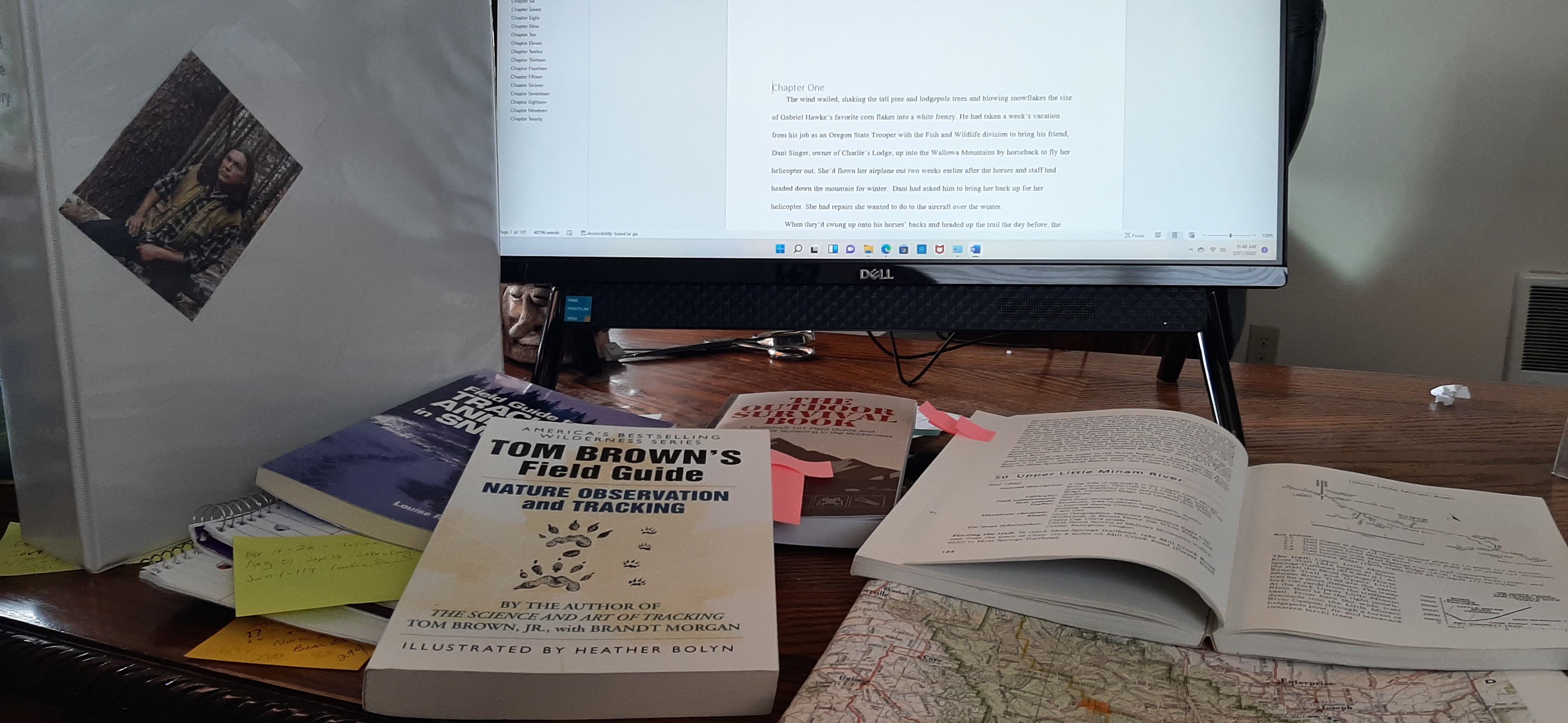
Between the research I’ve been doing for the latest Gabriel Hawke book I’m writing, which is set in the winter in the mountains, to the research for Dela Alvaro, a lower limb amputee, I feel like I finish one book on a subject, only to pick up another book and read about something else I need to know for the book I’m writing or plotting.

While I sound like I’m complaining, it is the research I love the most about writing a book. Well… maybe that’s a second to coming up with an interesting or unique way to kill someone. They are close in what I enjoy most about writing a murder mystery.

I have been using Tom Brown’s Field Guide to Nature Observation and Tracking, The Outdoor Survival Book, Hiking Oregon’s Eagle Cap Wilderness, Field Guide to Tracking Animals in Snow, and the Oregon Gazetteer, not to mention Google Maps and numerous sites I’ve pulled up on the internet to answer questions. These are all for Owl’s Silent Strike, book 9 in the Gabriel Hawke series.

My character has to take care of a broken leg on his significant other in three feet of snow. Care for another person’s frostbite on their feet and keep all three of them away from men with AR rifles that Hawke believes are after the man he found wandering on the mountain. So you can imagine I had to also research caring for a compound fracture and frostbite.

I also was lucky enough when I started this series to make friends with an aviator who is always willing to help me with aircraft questions as Hawke’s significant other is a pilot. He helped me figure out why she wouldn’t be able to fly the helicopter, they came after, off the mountain.

There are some books, like this one, that I feel like I put in twice as much time with the research as I do actually writing the book. I hope all of this effort pays off in the incidents sounding plausible and realistic.

I have also been filling my head with as much information as I can about a lower limb amputee for my character, Dela Alvaro, in my Spotted Pony Casino Mysteries. I found a book the other day titled AMPossible. It’s written by a lower limb amputee who also counsels other amputees. It has all the nuts-and-bolts information about how a person feels after the amputation, from emotions to physical and what to expect. It has been very helpful for knowing how to portray my character.

All of this and the research I will continue to do for each book as it comes along is why my “little gray cells” are getting full. It’s no wonder I forget the little things. Where’s my phone? What did I do with that letter? What was I supposed to do when I finished writing?