A Comma-dy of Errors

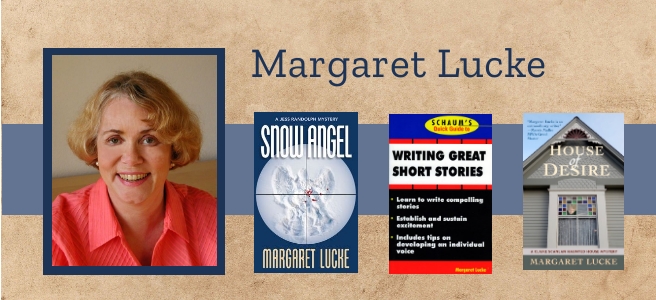
by Margaret Lucke

I don’t recall what the sentence said. I no longer know the subject of the report that contained it, although you’d think these details would have impressed themselves on my mind.

All I remember is the yelling.

I was working in my first editorial job, for a firm of international economics consultants. My role was to tidy up the grammar and punctuation in the proposals and reports that the economists produced.

The sentence in question was critical to the central point that the document was making. But it needed one small change. I inserted a comma. After making a few other tweaks, I sent the report back to the economist who’d written it.

When it came back to me for the next round of editing, my little fixes were intact. Except for that comma—the author had taken it out. So I put it back.

A few days later the report landed on my desk again. Time for the final proofreading.

Once more, the comma was missing.

Now, some commas are optional. Some are a matter of style. But the presence or absence of a comma can be crucial to the meaning of the sentence.

Take the title of author and editor Lynne Truss’s handbook on punctuation, Eats, Shoots & Leaves. It comes from an old joke about a panda that comes into a café, consumes a sandwich, and then fires a gun at the waiter. As the panda walks out, the manager yells, “Hey, what did you do that for?” The panda calls back, “I’m a panda! Look it up.” The manager finds a dictionary and checks the definition: “Panda: a black-and-white, bearlike mammal found in Asia. Eats shoots and leaves.” Simple and straightforward. But add that comma after eats . . .

Or consider this sentence from an Associated Press article I saw a while back: “Netanyahu has been an outspoken critic of the international efforts to negotiate a deal with Iran, which does not recognize the Jewish state, and supports anti-Israeli militants like Lebanon’s Hezbollah and Palestinian Hamas.” Having two commas makes a nonrestrictive clause of the words in between them (the ones I’ve italicized). This means that if you take out those words, the sentence should retain its meaning. But when you do that in this case, you’re left with “Netanyahu has been an outspoken critic and supports anti-Israeli militants …” Not what the author intended. You have to remove that second comma from the original sentence to make its meaning clear.

Of course other small changes in punctuation and, for that matter, spacing can alter meaning too. Consider the difference in response you’d get to these two ads:

Wanted: one nightstand.
Wanted: one-night stand.

And notice how changing periods to commas and changing their placement around gives you a different impression of an evening’s events (from KidsCanReadandWrite.com):

I ate. My mother washed the dishes. Then I went to bed.
I ate my mother, washed the dishes, then I went to bed.

A row of colorful commas

The comma in the economist’s report was like these examples—its presence or absence altered the meaning of the sentence. It needed to be there, yet the author kept taking it out. So I trekked down the hall to his office to explain why I’d added it and why keeping it was important.

He didn’t believe me. I was younger than he was, I was female, and I held only a lowly B.A. while he had Ph.D. He assumed that all of these factors were reasons to dismiss my arguments. In his opinion the comma was clutter, the sentence looked cleaner without it, and so it had to go.

I’m a calm and reasonable person by nature, not given to raising my voice. So I’m not quite sure how our discussion turned into a shouting match. But there we were, screaming at each other over a comma, while everyone else in the workplace gathered in the corridor outside his office to enjoy the entertainment

Finally the economist yelled, “Prove it! Show me the rule.”

“Okay, I will,” I snapped back, and I stomped away.

I spent the rest of the day scouring grammar guides and style manuals. Finally I found a statement about comma usage that was so clear and so close to the case of our particular little comma that I figured even he would get it. I ran back to his office and thrust the open book at him, jabbing my finger at the proof. “Here it is. See? See?”

I won. The comma stayed.

A Love Letter to Libraries

By Margaret Lucke

“I have always imagined that Paradise will be a kind of library.”
Jorge Luis Borges, author

A public library is an amazing place. You can choose a book or a DVD and take it home–for free. If you need a computer, you can use one there–for free. You can attend a concert, or hear an author speak, or take a child to listen to stories–all for free.

A library offers a wealth of education and entertainment at no charge. As it happens, though, it costs a lot of money to do that.

“A library is not a luxury but one of the necessities of life.”
Henry Ward Beecher, social reformer

Friends of the Library 25th Anniversary celebration

I’m on the board of my local Friends of the Library, which recently celebrated a milestone—our 25th anniversary. The library staff and another library support group honored the occasion by throwing us a wonderful party.

For nearly four decades, my town had no public library. It was the second largest city in California without one. When the state’s voters approved a bond for library funding in the late 1990s, local leaders decide to apply for some of that money. Some civic-minded folks got together and set up the Friends group to demonstrate to potential funders that building a library here had strong community support.

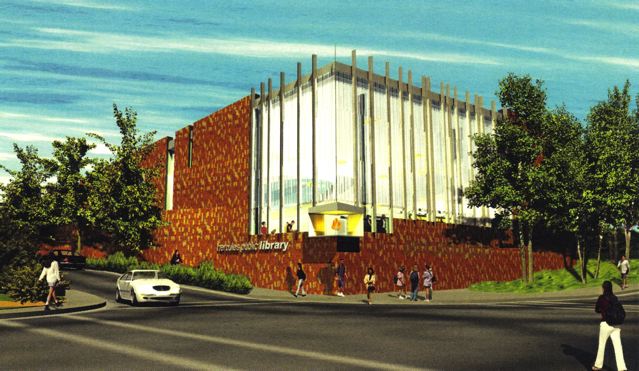
Hercules Public Library

There was a huge celebration when our beautiful new library opened in 2006. Our Friends group was proud to present to a check for $25,000, raised by sales of used books donated by the community, for the Opening Day Collection.

The enthusiasm continues. The library gets close to 25,000 visitors every quarter. Last year more than 10,400 people attended nearly 326 free programs, and patrons checked out 86,400 books and other materials. In many ways the library has brought the community together and become its heart.

Some people would have you think that in this era of Internet access and high-tech gadgets, public libraries are obsolete. Not so. They are well used though, sadly, not always well funded. The Friends are doing our bit help. To date, we’ve raised $350,000 to expand our library’s collections and support its programs.

“A library outranks any other one thing a community can do to benefit its people. It is a never failing spring in the desert.”
Andrew Carnegie, industrialist and philanthropist

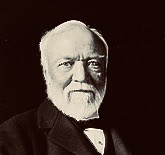
Andrew Carnegie portrait

Steel magnate Andrew Carnegie (1835–1919), one of the richest men in the world in his time, was a big believer in libraries. At age 12 he emigrated with his family from Scotland to Allegheny, Pennsylvania, now part of Pittsburgh. Though the move ended his formal schooling, he was much impressed by a local businessman who, every Saturday, opened his personal library so workers could borrow books, thus allowing Carnegie to continue his education.

Carnegie vowed if ever he had any surplus wealth he would use it in lending books to others. Years later, he made good on that promise by giving some $56 million (a lot of money in those days) to build 2,509 public libraries worldwide, including 1,679 in the United States. He shaped the concept of public libraries in this country. If you have one in your community, you have Carnegie to thank.

“The best thing about the library is that it is available not only to me, but to everyone. It does not discriminate.”
David Horowitz, political writer

Libraries are among the most democratic of our institutions. The access they provide to computers, books, films, and music is invaluable, not only to individuals but to our society. Libraries bring people together. They enlighten and inspire. They open the doors to the world.

Some years ago I was hired by two Bay Area library systems to write the documents that would present their new strategic plans to their communities. Both of the planning task forces grappled with how to define the audiences they served. One opted to list the possibilities: “The Library welcomes all members of the community regardless of culture, ethnicity, age, gender, sexual orientation, physical ability, or socioeconomic status.” The other wrestled with the question for a while until one member said: “Doesn’t ‘everyone’ mean everyone?” So their statement simply says: “The library systems … promote[s] learning and enjoyment for everyone.”

Everyone is welcome. How many of our institutions can make this claim?

“Libraries are places where the imagination begins.”
Heather Barbieri, author

Have you been to your local library lately? I urge you to pay a visit and see all that it has to offer. While you’re there, check out some books, because funding is often based in part on circulation numbers. Join your Friends group. Make a donation. Vote for tax or bond measures that will secure its funding. Your library deserves your support.

“Libraries are a public good and a civic responsibility. They are about our future as much as they are our past.”
Andrew Lopez, university librarian

What a Writer Does in Her Spare Time

By Margaret Lucke

Spare time? What spare time?

The other day someone asked me what hobbies I enjoy. When I’m asked a question like that, I never know what to say. A hobby is a pastime—that is, an interest or activity you enjoy passing time with when you’re not working. But when is a writer not working?

Really, it’s a 24/7 job. No matter what else we’re doing, half of our mind is focused on writing the book. With that kind of schedule, who has time for a hobby?

Consider some of my favorite activities. You might think they’re hobbies but they qualify as work just as much as the time I spend at my desk.

Reading. Writing changes how you read. When I pick up a book my mental red pencil is poised to rearrange sentences and trim out extraneous words. I nod at clever word choices and apt descriptions, and shake my head at clumsy ones. Every book is a potential course in professional development. How can I achieve what Author A does so well? How can I avoid doing things as badly as Author B? Sometimes, to my delight, a book absorbs me so completely that my mental red pencil disappears. Other times, it’s so busy that I get annoyed and set the book aside for good.

Movies. I’m a big fan of movies, and I especially like seeing them in a theater. The big screen, the dark auditorium, and of course the popcorn add a lot to the experience, if you ask me. A writer can learn so much from movies. How is the backstory made clear when there’s only dialogue, action, and visual cues to work with? How is the main character’s point of view made clear when we can only observe that person from the outside? How are the plot points presented and transitions made from Act I to Act I to Act III? By the time the credits roll, my husband is blinking back tears while I’m analyzing how the scriptwriter achieved that emotional impact.

Walks. A hike on a forest trail and a walk along a beach are my favorite forms of exercise—or. even a stroll around the neighborhood. I’m fortunate in that the San Francisco Bay Trail goes through my town, and it’s not unusual to find me there. I enjoy the fresh air, the sunshine, the bird song, and all of the story ideas that pop into my head. Maybe it’s the rhythm of the steps or the letting go of other thoughts as I attempt to be present in the moment. I try to remember to tuck a pad and pen into my pocket so I can be ready to grab the elusive ideas as they float by.

Sleeping. Sleeping is one of my better skills, and it’s definitely a way I enjoy passing the time, especially in the middle of the night. But even when I’m asleep, my story machine is cranking away. I’m sure I’m not the only writer who’s dreamed the entire plot of a novel during the course of a night. Of course, as soon as the alarm clock rings it all vanishes, except for a couple of tantalizing but meaningless tidbits. That’s not the point. What’s important is, even though my body is at rest my mind is still at work.

So none of those activities really count as hobbies. I can think of only one pastime I have that doesn’t contribute somehow to my writing: 

Sudoku. Nine digits. Arrange them in rows, columns, and squares so that none are repeated. No math, just logic. And it’s nonverbal, leaving no room for words and ideas to jostle their way into my head.

Except—what if there’s a major sudoku competition, with a top prize big enough to kill for? And what if it pits two expert players against each other, two experts with secrets in their pasts? And what if there’s a cheating scandal? And what if …

Farewell, Bulwer-Lytton

By Margaret Lucke

As April 15 rolls around, I’m saddened to report of the demise of one of that date’s most cherished annual events.

No, I’m not talking about the deadline for filing your federal income taxes. You still have to do that, and if you haven’t yet started dealing with all of those numbers and all of that paperwork, I recommend you stop reading this blog right now and get busy with that task.

What I’m referring to is the late, great Bulwer-Lytton Fiction Contest. It was announced not long ago that 2024 would be this beloved competition’s final year.

While entries were accepted any time, the official deadline was each year April 15 –which, as the contest’s organizer, Professor Scott Rice, noted, is “a date that Americans associate with painful submissions and making up bad stories.”

The English Department of San Jose State University began sponsoring this annual wordfest in 1982. Writers were urged to come up with the opening sentence to the worst of all possible novels.

It’s a challenge for any writer to come up with an opening line that will grab our readers and pull them into reading the rest of the book. With the Bulwer-Lytton winners, there was no rest of the book.  They were often complete single-sentence stories. Anything more would have been superfluous.

The contest was named for Edward George Earle Lytton Bulwer-Lytton, 1st Baron Lytton, a minor (perhaps deservedly so) but prolific British novelist of the Victorian era. His best-known title is probably The Last Days of Pompeii, and he originated the saying “The pen is mightier than the sword.” But he is most famous today for penning the immortal opening line: “It was a dark and stormy night … ” Thus begins the novel Paul Clifford, the story of an English gentleman man who moonlights as a criminal.

The complete sentence reads:

“It was a dark and stormy night; the rain fell in torrents–except at occasional intervals, when it was checked by a violent gust of wind which swept up the streets (for it is in London that our scene lies), rattling along the housetops, and fiercely agitating the scanty flame of the lamps that struggled against the darkness.”

Snoopy, famed beagle from the Peanuts comic strip, appropriated the first seven words for the title and first sentence of his own novel. Snoopy is not one to waste words. His entire novel is only 214 words, not all that much longer than Bulwer-Lytton’s single sentence. A born mystery writer, he jumps straight into a suspenseful plot with his second sentence: “Suddenly a shot rang out.” 

Back to the Bulwer-Lytton contest: In its first year it attracted three submissions. In its second year, thanks to a little publicity, the number grew to 10,000. Writers were invited to submit as many abysmal first sentences as they like. One year a hopeful author sent in more than 3,000. If he had strung them together he would have had an entire book, which surely would have qualified as a the worst of all possible novels.

I submitted my own masterpiece of a first line one year. Sadly it didn’t win, possibly because it exceeded the recommended length of not more than 50 of 60 words. I’m fond of it anyway, and I can’t resist including here:

“Until the night he set her house afire, burning down the only home she’d ever known, incinerating the manuscript of her nearly completed novel, turning her cherished photos of Daddy to ash, though thank goodness the cats escaped … until the hour when sparks soared across the heavens like shooting stars and the smoke from the conflagration carried away all her hopes and dreams … until the moment when a firefighter squelched her screams and drenched her nightgown with a well-aimed hose … until that very instant Isabelle believed her love affair with Rolf would last forever.”

Hmm, maybe I should think about writing the rest of that book.

If you’re interested in reading the sentences that the judges, in their wisdom, preferred to mine, you can find an archive of the winners and dishonorable mentions here: https://www.bulwer-lytton.com/winners

What to Pack for a Mystery Convention

By Margaret Lucke

As I write this, I’m getting ready to travel to Denver for Left Coast Crime, affectionately known as LCC—a wonderful annual convention for readers and writers of mysteries and thrillers and a highlight of my calendar each year.

I enjoy conventions and conferences and I’ve been to quite a few, starting with a Bouchercon, the World Mystery Convention, in San Francisco long ago. I was one a few dozen mystery writers and fans who gathered to celebrate our favorite genre at the very first Left Coast Crime in 1991. I’ve attended Malice Domestic several times, as well as conventions that focus on other genres–romance, horror, science fiction and fantasy. I celebrated a significant birthday at a conference in Los Angeles organized around the 100th anniversary of the publication of Bram Stoker’s Dracula.

If you’ve just signed up for your first LCC or another conference and are wondering what to bring with you, let my experience be your guide. Here are a few tips and pointers about what put in your suitcase.

Clothes (of course). I go for business casual but lots of people opt for casual-casual, which is fine too. Just remember to think layers, and bring a sweater or indoor-type jacket along. Conference events take place in hotel meeting rooms, and according to law meeting-room thermostats must be set for the wrong temperature. If you’re dressed for warm weather, the room will be freezing, with a drafty wind aimed at your chair. If you dress in expectation of a chill, the room will be hot and stuffy. Whatever the temperature in the room you go to for a 10 am panel, you can count on the room with the 11 am panel being twenty degrees hotter or colder.

Highlighter. The bigger the convention, the more activities there are to keep track of. That means you’re almost certain to be in the wrong place at the wrong time. You’ll receive a handy pocket program to carry around, but the type will be too small to read without squinting. Marking your must-see panels and events in bright yellow (or a color of your choice) can help you tell at a glance where you want to be at 2 pm.

Cell phone. You and your friend from the other side of the country will both be at the same conference. You email her to say, “Let’s get together for lunch on one of those days,” and she agrees. When you get to the conference hotel, can you find each other amongst the hundreds of people? Maybe, but maybe not, which is why you’re glad to be carrying your phone, programmed with the numbers of everyone you might want to contact while your at the conference. And be sure to bring a charger! Don’t forget, though, to turn off your phone while you’re in the audience for a panel or program.

Business cards, bookmarks, postcards, swag. Whether you’re a reader, writer, or other, you’ll meet people you’ll want to keep in touch with, so business cards are great to have. If you’re an author, you’ll want items to hand a fan to alert her to your latest book. In the past I’ve brought home recipes, pens, coasters, notepads, those things you use to twist of jar lids, and more. In Denver, look for the word search puzzles I’ll be leaving on the giveaway tables, along with my pamphlet called “10 Clues to Writing Great Fiction.”

Extra space in your luggage. You’ll need room in your suitcase to tuck in all of those pens and coasters, not to mention the books you’re going to acquire. You will need to accommodate the books in the bag you receive at registration, the books you buy in the dealers room, the books you grab off the swap table …

Energy and stamina.  Conferences are fun. They’re busy. They’re demanding. They’re exhausting. Be sure to bring along an abundance of energy and stamina, or whatever will help you achieve those thing—extra vitamins, your walking shoes so you can leave the hotel and get some fresh air and exercise, earplugs so you can enjoy a good night’s sleep despite your roommate’s snores.

Smiles. You’ll want to have plenty of these on hand so you can hand them out freely. Fortunately, you’ll be able to replenish your supply with all of the smiles that people will give to you.

I hope to see you next week in Denver! If you’ll be at LCC, be sure to seek me out and say hello. A couple of opportunities to find me easily are the panels I’ll appear on: “Art & Crime” on Friday at 9 am, and “The Craft of Writing,” which I’ll be moderating, on Saturday at 2:45 pm.