Gratitude by Karen Shughart

“Gratitude: The quality of being thankful; readiness to show appreciation for and to return kindness.” Oxford Dictionary

photo of autumn mood forest

Every morning, while drinking my cup of tea, I watch the news on TV.  Lately, it’s not been a great way to start my day. The news is filled with images and events that are disturbing and stressful, and at times I’m overwhelmed by the state of our nation and world:  bombings, shootings, horrific natural disasters, cruelty to children and animals, disrespect for differences, the list goes on and on.

Every evening before I go to bed, I read from a booklet that contains daily meditations, inspirational tips and advice for living in these very troubling times. At the beginning of each issue there’s an essay that’s connected to the monthly theme, written by a spiritual guide, therapist or religious leader. This month, as is fitting as we prepare to celebrate Thanksgiving, the theme is gratitude.

The author of the essay for November works as a therapist, counseling clients working in a variety of high-profile professions. She believes that, for our emotional well-being, we are obliged to take stock of our lives and instead of feeling angry when life doesn’t go the way we want, we must focus on what’s going well. She suggests keeping a gratitude journal, writing down three things each morning and evening for which we feel grateful.

I’ve thought a lot about that word, gratitude, and take time most days to be thankful, not always for what’s large or life changing, but instead for those everyday occurrences that help to keep my life in balance. I feel grateful when I awaken after a good night’s sleep.  I feel grateful that I can enjoy that hot cup of tea. I feel grateful that I can see the lake from my bedroom window and hear the crashing of the waves. I feel grateful for glorious bright colors of autumn leaves, or the crunching of the snow on winter walk; the sip of a good red wine. I feel especially grateful for the love that encircles me and the love I can give back: to my husband, children, relatives, friends.

The list, really, is endless, and I try and focus on what really matters rather than what brings status and recognition. It’s not the size of the house, it’s that there’s a roof over my head. It’s not the filet or lobster, it’s that we have food on the table. It’s not the make and brand of the car, it’s the vehicle that can get me safely where I want to go. It’s not the number of friends, it’s the quality of relationships.

What I’ve discovered is that even in the bleakest of times, those days and weeks where it seems like the stress will never end, there is something to feel grateful for. And, it’s amazing how one’s perspective changes after taking a minute or two to count one’s blessings.

Overused Words by Karen Shughart

There is something I want to tell you. As absolutely awesome and nice it is to see you, often when we’re together it’s because I really find you interesting and amazing which isn’t bad; in fact, it’s good and fine and makes me a bit happy. Really.  But therefore, I hope you are well and will continue to be thereafter. So long.

If you’re completely puzzled after reading the above paragraph, I admit I’m guilty. It’s terrible, and I wrote it, but there was a method to my madness. Read further, and I’ll explain.

I’ve been working on the second book in the Edmund DeCleryk series, Murder in the Cemetery. After several drafts, the process of editing and polishing has begun, and for me, this is the hard part. After writing everything I could think of that will create and enhance the plot, I start

words text scrabble blocks
Photo by Skitterphoto on Pexels.com

winnowing it down. First, I look for inconsistencies. For example, in book one, Murder in the Museum, one of the characters and his wife had recently welcomed their second grandchild. A year-and-half later, in this second book, the grandchild is in kindergarten. Whoops!

As I read through the book, I also look for extraneous narrative. Annie, wife of Ed, the investigator and a sleuth in her own right, provides an intern who is working on a project for her with contact information for her friend, Charles, who lives in Canada. Charles, who had a large role in book one, has expertise in the field the intern is researching. As much as I wanted him to reappear in book two, I realized that the intern didn’t need Charles’ help and never would, the task was simple. Goodbye, Charles.

I’m pretty good at spelling, grammar and punctuation. I was an English teacher, for gosh sake. That said, I always find errors. Sometimes my brain works faster than my fingers as they pound away at the keyboard; I make mistakes. This is the phase in the book where I read carefully and slowly; I don’t want my publisher to think I’m illiterate or careless, heaven forbid.

Now we come to the reason for the sentence at the beginning of this blog. I know from experience that it’s easy to overuse certain words, as I did above. Sometimes we get attached to phrases, we use them to pad the word count, or our overuse of words is completely unintentional. If we want our writing to flow, if we want it to look professional, these must be deleted. At least most of them.

Using computer software, I can search my document for a certain word, and it’s highlighted every time it appears. It’s frustrating because the computer can’t distinguish the as in was from the word as. Still, it’s a good tool. It takes time, but once I’ve identified these overused words, I can rewrite sentences that are original, creative. And, hopefully for you, the reader, much more compelling.

Why it’s Okay Sometimes Not to Write by Karen Shughart

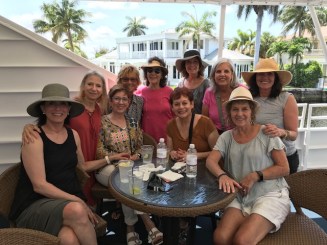
We traveled a lot this past spring and summer: family gatherings, a wedding, visits with our children who live on the east and west coasts, a reunion with friends in Florida and a very long trip last month to the Atlantic and Maritime provinces.  I don’t use a laptop but instead write with a desktop PC, and during those times we were away I didn’t write, not a blog, not a newsletter or social media posting, nor a chapter of the book I’m working on now. At one point we were on a ship, so not only didn’t I have use of a computer, I also didn’t have internet. Talk about being removed from the world!

IMG_0183

At first, I felt pressured. And guilty. Many of us authors try and write something every day. It makes good sense, keeps us in the flow of our current work, and keeps us on our feet. Not writing for several days was anathema to me, and I was uneasy that I wasn’t producing at least something on the written page.  But then it hit me.

After a couple big sighs, I gave myself permission to take a break. In fact, in my estimation taking some time off can result in better writing. For one, I was able to enjoy and experience our trips and register those experiences both in my mind and with photographs that I might, someday, be able to weave into my story lines for other novels or blogs. I was able to be in the present and savor those moments and experiences with family and friends.

It wasn’t that I didn’t think about writing. On occasion, I mulled over chapters I’d been working on or thought about topics for this blog. But I didn’t spend all that much time doing it. The “ah ha”! moment came when I realized that not writing for a while cleared my head. And that was a good thing.

Once we were back home from our trips, the laundry done and bills paid, we settled back into our routine. I turned the computer on and started writing again. What I realized was that I was able to approach my work with a fresh perspective, and I could be more objective about the chapters I was writing and more critical of what was working and what was not.

I discovered that taking a break made me more creative. I’ve added chapters that should have been written in the first place and removed others that didn’t add much to the plot. I’ve diversified language, and dialogue has become brighter and more interesting. By reading my own work with a fresh eye and committing to making changes, the book is better.  Taking a break from the writing for a few weeks wasn’t the disaster I had portended; in fact, it helped. My perspective has changed, my energy level  has increased, and I’m much more at ease with tackling the tough parts with relaxed determination.


Keeping Track of Details by Karen Shughart

Well, I’m almost there. I’ve been slogging away at writing book two of the Edmund DeCleryk mystery series, Murder in the Cemetery, for upwards of a year and now I’m in the editing, polishing and cut-and-paste phase of the book. There are more details in this one than Murder in the Museum, so way more things to keep track of:

For example, in an earlier chapter, Annie DeCleryk, wife of sleuth Edmund DeCleryk, invites a friend of hers to speak at an evening event sponsored by the Historical Society where Annie works. Low and behold, a later chapter indicated that it was a luncheon event. Boy, was I glad I discovered that one!

At another point I write about an unidentified set of tire tracks at the murder scene, that’s early on in the story, but as I reached the end of the first draft I realized I’d never come back to it and explained why they were there.

There are a set of historical letters written into the plot, they take place in the 1800s. I have them interspersed throughout the book in chronological order. At least now I do. When I scrolled through the manuscript, I discovered that in a couple places they were in the wrong order.

white painted papers

Then there are chapters. As I write and revise, I sometimes remove chapters or move them to another location. Sometimes I divide one chapter into two. I spent one afternoon making sure the chapters were in order and correctly numbered. In a few cases they weren’t.

I also try and eliminate redundancy. Ed and Annie take a trip to England, you’ll learn why when you read the book, and they discover there’s a connection with something that happens on that trip and the murder in Lighthouse Cove. I explain it fully in that chapter and yep, I had Ed explaining the same scenario, multiple times, to other characters who were helping solve the crime. You, the reader, probably don’t want to revisit the entire story more than once, so in subsequent explanations I went back and had Ed summarize.

Photo by Pixabay on Pexels.com

I was a journalist once and as a result, my fiction writing, at least those early drafts, is typically very succinct. So, then I go back and expand the plot. Once done, I usually realize I’ve written more than I need, so then I cut.  What that means is that sometimes I get rid of a chapter I’m emotionally attached to, because as much as I like it, it really doesn’t enhance the plot.

Writing a novel takes a lot of work, not just making sure the plot makes sense, but also keeping track of all the details that make a book flow the way it’s supposed to. I do that on handwritten notes, charts, notes in my computer and, also, in my head. Phew! But I’m gratified when the finished product finally goes to print.


Acknowledging Technical Support by Karen Shughart

police motorcycle in middle of road
Photo by Jimmy Chan on Pexels.com

I write mysteries. They’re Cozies, which means they don’t include graphic violence, explicit intimate scenes or coarse language.  But they do have a sleuth who investigates the murders, and although the books are fiction and there’s a lot of sway in writing them, I want them to be at least somewhat technically correct.

There’s wiggle room, of course there is. No one is holding my feet to the fire if I miss a detail that a real detective wouldn’t. But my aim is to make the books as realistic as possible, so that’s why I decided to get technical support.

Technical support offers credibility to any work, and it’s important to me, as an author, to feel comfortable that what I’m writing has at least a semblance of investigative reality. Plus, it’s a fun way to meet competent experts in a wide variety of fields, in my case criminal justice.

Before completing Murder in the Museum, the first of the Edmund DeCleryk Mysteries, I attended an eight-week class sponsored by our county sheriff’s office. I learned all the ins-and-outs of our county’s criminal justice system, everything from investigative procedures to arrests and bookings to how a K-9 unit works. There are also a number of other services provided to the community by our sheriff’s office that have nothing to do with solving crimes; services to the elderly and children, for example, and learning about those gave me an appreciation for all the fine work our sheriffs do.  When I had additional questions, I was delighted when the sheriff and two of his undersheriffs offered to meet with me to answer those questions.

A retired commander from a sheriff’s department in another county, two retired police officers-one a professor of criminal justice at a local community college-helped me not only understand how our legal system works but also the steps in conducting a solid investigation. It was high praise, once the book was published, to get an email from one of my contacts who said the investigation in the book was “spot on”.

Now I’m working on the second book in the series, Murder in the Cemetery. I’ve kept notes and all the information from those wonderful and talented folks who helped me with the first book, but in this one I needed additional support. Our district attorney who is a former physician’s assistant, provided valuable insights and information. A possible connection to the murder with the CIA resulted in a lengthy and productive conversation with that agency’s public affairs director. A retired beat cop and friend gave stellar examples of how law enforcement agents can be compassionate.

blur close up focus gavel

Writing a book takes a lot of work. Keeping track of details, making sure the plot flows and keeping characters straight are part of the process, but  including realistic investigative procedures results in not only a better book but also one that passes the test for accuracy.