Truth vs Stereotypes, or Do Grandmothers Giggle?

by Janis Patterson

In these days of fraught political correctness when being offended at something has become almost a career choice, we as writers have to be very careful about what we say. We must always be on our guard against using stereotypes and prolonging misconceptions. But sometimes it’s hard.

A couple of years ago I wrote a short story for inclusion in an anthology centered on wedding days. I thought it was a pretty good piece – four generations of women in a family (girl, mother, grandmother, great-grandmother) and their reactions to a wedding coming up the next day. Of course – as you have doubtless already noticed – I am a dyed in the wool contrarian, so naturally I had to do something different. The bride in this case was the grandmother, who was marrying against her mother’s and daughter’s wishes – the granddaughter was in favor of the match. During the course of this familial sturm und drang the grandmother/bride and granddaughter have a special moment and the grandmother giggles. This is when the reader first realizes that the bride is the grandmother, not the granddaughter.

I thought it was a special moment.

The editor thought differently. She almost exploded with angry disbelief. “You mean the bride is the grandmother? And she giggled? Grandmothers,” she stated unequivocally, “do not giggle.”

I replied with my usual tact and polite restraint that I was a grandmother, and I giggled frequently. In fact, a dear friend once stuck me with the nickname of ‘Giggles.’ The editor was openly disbelieving. Well, after a lengthy and sometimes acrimonious discussion the giggling stayed in the story, but the editor was most vocally unhappy about it and we’ve never worked together since.

Another story, this time a stand-alone novel, another year if not another decade and another editor. I had my characters out driving in the remote wastelands in the Texas panhandle. This is the area where you can drive for two hours and never see another car or sign of human habitation. My characters found a bad car wreck, but the driver was still alive. They picked him up and drove him to the hospital in whatever town was closest. (It’s been years, and I don’t remember…)

Well, the editor went ballistic. How, she asked, could I be so uncaring and stupid as to move an accident victim? My characters should have called (as if there were any cell service out there) for an ambulance and waited with him until the ambulance arrived. To do anything else, she yelled, was irresponsible.

I tried to explain that in that part of Texas it would be irresponsible not to get the man to the hospital as quickly as possible, as he might die in the time it took an ambulance to respond. This editor – who, by the way, was openly proud she had never been west of the Alleghenies – was completely disbelieving, and turned down the book simply because of that. She had offered me the out of rewriting, and (if I really insisted) making them closer to a town where an ambulance was a logical inclusion, but I declined. The loneliness and isolation of the area were too deeply interwoven into the story – almost a character in itself – and part of the moral understructure of the book. We agreed to cancel the contract.

Yet one more story about a New York editor, though it has little to do with a book. I had worked with this editor several times, and was tossing around an idea about a couple being trapped in an ice storm. She absolutely hooted at my idea of setting it in North Central Texas, because, as she said “everyone knows Texas is tropical!”

Well, apparently the weather gods were tired of Yankees being so ignorant about Texas, because within a very few weeks we had a paralyzing ice storm that pretty much shut down the city… and it was the middle of April. There were photos on the front page of our newspaper of horizontal winds and trees breaking under an inch thick coating of ice. Smiling with unrepentant glee, I risked life and limb skating over the ice to get a fresh copy of the paper from a nearby box, stuck it into a big padded envelope and sent it to her. I didn’t even include a note. The subject was never mentioned again.

So – even when it does not even touch on the ungodly mess of political correctness (which to me brings up images of the Fire Swamp in The Princess Bride) we all have to be very careful about indulging in the lazy shortcut of stereotypes and misconceptions. We write fiction, but to be believable fiction, it has to have a firm grounding in basic truths.

Time to Write and Other Fictions

by Janis Patterson

I used to have a dream… a dream of a place where I have no responsibilities, no job to go to, no social obligations to fulfill, no time-consuming errands to run, no organizations to which I have made promises… nothing but time and quiet in which to write. The archetypical ivory tower.

Well, I can tell you the archetypical ivory tower is very overrated. Like everyone else, The Husband and I have been pretty much self-quarantined at home for what seems like the last couple of aeons. Oh, we have gone to the grocery about once a week (a giddy exercise in freedom!) and once to the bank (drive-thru only) and occasionally to pick up a take-out meal from Desperados, our very favorite Mexican restaurant (food is good as ever, but just not the same experience), but to a modern couple living in a big city with lots of connections and work and organizations, our recent adventures have been pretty thin.

Which, you would think, would be wonderful for my writing. Aside from fixing dinner most nights and a load or two of laundry each week, I have nothing to do but write.

Except I can’t.

The Husband is very good – most of the time – about not bothering me while I work. It took a couple of years in the early part of our marriage, but he did learn that when my office door is closed no one disturbs me unless there is blood or flame! (I should say we’re an older couple, and it’s just the two of us and one very bossy little dog.) While we’ve been sequestered he’s been working his way through some stuffed old boxes of his stuff that date from the time of our marriage.

Me – “You need to go through those boxes and get rid of a lot of that stuff.”

Him – “I know what’s in every one of those boxes, and it’s all stuff I want to keep.”

Me – “Well, then, go through and pack it carefully in new plastic boxes – those cardboard boxes are yucky.”

Him – “I’ll get around to it.”

Repeat this conversation a time or two a year for almost every year – and there are a number of them – we’ve been married.

Well, the Chinese plague lockdown has taken away all his excuses. He can’t go to work, we have no meetings, and he can watch only so much idiotic TV, so he finally said he’d do one box. Of course, that led to another and another (we’re actually seeing parts of the storage room floor we haven’t seen in a couple of years!) and now it’s a treasure hunt.

Him – “Look at what I found! I’ve been looking for this!” is repeated several times a day. The first few times I was jubilant – and just a little bit self-satisfied – but after a day or two I decided I had to work and went behind the closed doors of my office.

Except I can’t.

I am facing two book deadlines (not counting my recurring blogs) and I need to write. Deadlines have been sacrosanct my entire life and I will do just about anything to meet them. Worse still, I pretty much know what I’m going to write, so it isn’t a real case of writer’s block, it’s just… just… The best description I can come up with is a non-religious accidie… a laziness or indifference to the entire process.

My mind wanders – and not creatively, as it should when you’re writing. I find myself either becoming fascinated with something that has nothing to do with what’s at hand or just shutting off and staring at something, such as the rose bush outside my window or the TV screen, and both are just about as edifying.

Perhaps the dirty little secret of this Chinese plague lockdown is a lack of structure. I’ve worked since I was in school, and most of the time done it well, but there has always been a structure. There have been structure-less days, of course, and on occasion a week or so such as in a vacation or an illness, but I always knew that at the end of  a certain period of time the structure would surround me again and that knowledge kept me going. Or started me up again, to be honest.

Now, with no real end in sight and a tragically changed world waiting outside my (metaphoric) front door, I don’t know what to do. I was always pretty good at living inside a structure, but I suck at creating one. However – I know something has to change, and the only thing I can influence or change for sure is myself, so I have been working at writing out a schedule. Somehow that makes it the more real. It’s about time I learned how to schedule… oh, I’ve always known how. It’s simple. The hard part, the part I must master, is fulfilling it.

Hope all of you are staying safe and well. Please take care of yourselves.

Confessions About the Covid Crazies

by Janis Patterson

How are you surviving the Covid lockdown, which – thankfully – is finally fading away?

While my office is in my home and I don’t go out too much in normal times (which, please Heaven, are finally coming back!) just the idea of not being able to go out or have any place to go to have driven me crazy. Crazier.

For the first time in many years I am not face-up against a deadline, usually multiple deadlines, which come racing at me like an express train. Well, I do have one, but it isn’t until October, and the way this year has been going who of us is positive there is even going to be an October this year?

And that’s why this post is so frightfully late. I forgot until last night, when the lights were out, our goodnights said and The Husband had drifted off to sleep. Suddenly I remembered and sat bolt upright, gasping at my unprofessionalism. Dragged from sleep he wanted to know what was wrong, but when I told him he merely snorted and said to go back to sleep. The sad thing is I did, which is very unlike me. This lockdown has activated my inner sloth – I chose the sloth as my spirit animal a few years ago when a prolonged bed rest was dictated while recuperating from a surgery, and the wee little beastie has played havoc with my work ethic ever since.

One good thing about this lockdown is that The Husband is only working half weeks – 2 ½ days – and this makes a perfect rehearsal for when he retires in the not-too-distant future. One thing I’ve learned – he is ignorant of the writing process, as I do 95% of it when he’s not here. Plus, he’s a science person, not a word person. I’ve been writing in our den for years, and not too long ago made the decision to turn the guest room into my office, a task about which I have been distressingly dilatory. I need to get on it NOW, so when he does retire fully I can retreat in there. I’m working on it every day, and trying to decide whether or not I can install a moat.

Plus, during this time of plague I have been slowly morphing from a writer who works at home into a housewife, a strange and alien creature I have never been before. I’ve been excavating the dining room (verb chosen deliberately) and for the last three days sorting through ancient tax papers that go back to 2007. So far The Husband has taken two enormous tubs of old papers to his office to shred in their commercial shredder.

I won’t bore you with tales of the strange wonders I’ve found during this time of excavation, but I did find my iron which I lost several years ago. It’s a fine example of cleaning making more work for you, because now I’m going to have to go to the trouble of losing it again, and do you know how hard it is to lose an iron?

Well, the clock is ticking (yes, we still have one that ticks, a Seth-Thomas kitchen clock that was a wedding present to my father’s parents in 1899) and I need to get this posted. I hope you all – assuming you have read this far – are safe and well and all in your world is good. Please take care of yourselves and believe we will get through this. At least, I hope so, because housework is making me crazy! Crazier.

Where? When?

by Janis Patterson

It is one of the so-called pieces of wisdom in mystery-land the body should appear as quickly as possible, just as in some parts of romance-land the hero and heroine have sex almost immediately after they meet. I’ve even read some stories where they end up in bed before they’ve been introduced!

Haven’t these writers ever heard the phrase “it’s not the destination, it’s the journey”?

This isn’t a new rant of mine – you’ve probably heard it in one form or another before, but I believe it bears repeating, especially in mystery-land. Murder is a terrible crime. It permanently alters everyone even remotely touched by it. It should not be treated as an hors d’oeuvre.

Back when I was traditionally publishing I allowed the house editor to convince me (convince, as in “We won’t publish your book if you don’t!”) to bring on the body as early as possible in the first chapter. I wanted to be published by this particular house, so always an over-achiever I put the discovery of the body on the second page, and it was a grand disservice both to the poor thing and to the story. The victim had no history, no backstory, no personality, and there was no emotion, no sense of loss in his passing. In other words, he was nothing but a stage prop. (“Hey, Fred, put the body down stage left!”) Even a villain – which he was – deserves a more fitting end than that.

Of course, we had learned something about him by the end of the book because to solve a murder you must know why someone would want to kill him, but it was dry and anticlimactic – nothing but tags that eventually pointed the way to his killer.

I am a whole-story kind of person. I believe that to feel the kind of outrage that murder should engender we have to know the people involved in the tale so that when there is a murder we feel a sense of loss, of outrage (even if the character deserved his ignominious and premature death) and a sense of satisfaction when the murderer is finally run to earth and justice is served.

Not everyone agrees with me. I have been severely dinged and chastised for having the murder occur close to the middle of one of my mysteries. It’s a good story, it has a large cast of characters (three of whom are killed) and it is a complex story, with the solution inextricably interwoven with the dynamics among the characters. But apparently that’s not fast enough to be acceptable for some readers. Neither, I hasten to add, was the setting – a scholarly Egyptological conference without a tea shop, a B&B or knitting store in sight. One correspondent was particularly incensed that the entire conference did not shut down in order to bring the murderer to justice. I don’t understand that; yes, everyone is somehow altered when murder enters their sphere, but unless they are close to the crime or the victim few change their entire focus. Most of us would probably cling desperately to what is normal in an effort to bring stability back – unless, of course, the murder affects them personally, which changes everything.

As I’ve said before, murder is an horrific crime. Both it and its victim need to be treated with a certain respect and dignity. To cheapen death is to cheapen life.

We Are The Other?

Janis Patterson

In these tiresome days of Political Correctness and ‘woke-dom’ there is a small battle raging about using italics for non-English words in book manuscripts. “It is divisive,” shriek the PC crowd. “It fosters other-ness and is not inclusive.”

Well, duh!

When speaking of a book written in English for the use of an English-speaking audience, of course the writer should use italics for foreign words and phrases. The words are foreign words, not English words – they are ‘other.’ Italics show that. It’s not divisiveness, it’s clarity, showing the reader that this is a different language. Some words in other languages are spelled the same but have wildly different meanings. (For example : douche (French) and douche (English) while having the same familial root are totally different things.) Without italics to differentiate what is English and what is another language, the reader can be confused and pulled out of the story to puzzle it through, and no writer wants that. Of course, that homophonic mayhem happens in all-English books, too – if I read one more story that mixes up ‘grizzly’ and ‘grisly’ that book, like a number of others, will end up smashing against the wall. Words are the tools of the writer, and one should learn to use one’s tools properly. To do less is to disrespect both the art of writing and the intelligence of the reader.

To make things even more confusing, the PC crowd applauds the use of a bunch of weird self-chosen pronouns that a small portion of the population uses to describe themselves which, while doubtless emotionally satisfying to them, are linguistically and societally bizarre. How can there be anything else but a deliberate ‘other-ness’ when an individual refers to him/her/itself as ‘they’? Talk about mixed signals!

Of course an individual has the right to call themselves anything they like; that is freedom of speech in its purest form and is guaranteed under the First Amendment. Those who want to use the ‘new’ pronouns are most definitely free to do so, but no one has the right to demand that everyone else use them, most especially in a written format. The result is a linguistic minefield.

The essence of language is communication. Language is nothing but a collection of sounds and syllables to convey ideas, but it only works if everyone understands what those sounds and syllables mean. This is especially true for writers, for they must communicate by written symbols only, without the supporting means of vocal intonation and facial expressions.

Can you imagine the delicious confusion (or might it be deliberate obfuscation?) in a mystery when a single individual obviously speaking in the first person refers to himself as ‘they’ or ‘we’? How does the poor confounded detective/sleuth react, especially if he is not up to speed on this linguistic trend? That could almost be a subplot in itself.

Conversely, the essence of communication – especially for writers and the written word – is language. We need the same reference points, the same starting points for efficient interaction. Standard linguistics offer this universal base. If a non-English word in an English language book is italicized, everyone knows it is not English, even if it is identical in spelling to an English word with a totally different meaning. If a writer uses the ‘new’ pronoun structure, he’d better have a really good reason that forwards the story or risk confusing and perhaps even alienating his readers.

Years ago someone coined the phrase K I S S – Keep It Simple, Stupid (or Silly, depending on to whom you’re talking). It’s still good advice. Good communication is simple, and the foremost tool in the writer’s toolkit.


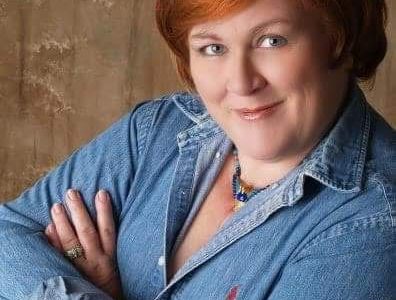
Personal Note – if you have been a reader of this blog for a while doubtless you have been accustomed to seeing my picture with blonde hair. It’s red now, both in the picture and on my head. I finally decided that it would be a charitable act to give the general populace a warning label.