We the Jury

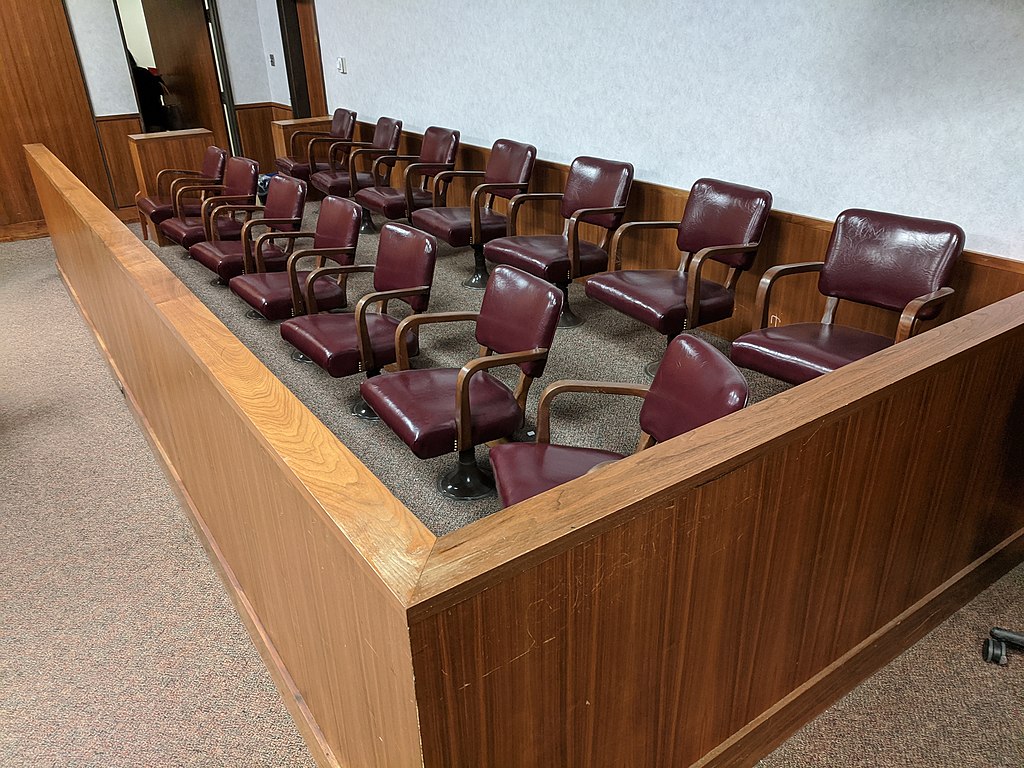
I have a jury duty summons for July. In California, I’ll check my county’s website a few days before that date to find out if I must report in person at the Alameda County Courthouse in downtown Oakland. In the past, I’ve reported several times, only to be told later that morning to go home. A few times I’ve made it into the jury pool, which means a trip to the courtroom to find out more. In a couple of instances, it’s been a civil matter.

I always figured if I was going to be on a jury, at least make it something interesting. More than a decade ago, it was.

On that morning, the jury pool was large, with people crowding the first-floor jury reporting room. To me, that said this was a serious case. We were summoned to the courtroom in groups and informed that this was a murder trial, with two defendants.

Back in the jury room, we filled out long questionnaires. Those who felt they had a good reason for not serving on the jury were told they would have the opportunity that afternoon to discuss their situations with the Superior Court judge presiding over the trial. The jury pool of 150 people, we were told, would be cut down to 75 people. Then a series of interviews to be held the following week would winnow down the pool, leaving twelve jurors and three alternates.

I have no objection to serving on a jury. It’s my duty as a citizen. At that time, I’d never had the opportunity before. But I thought my status as a writer of crime fiction would disqualify me. In fact, a few years later, when I was summoned to the courtroom for another murder trial, the defense attorney in that case dismissed me from the pool in record time.

But this earlier case was different. I made the first cut and was called back the following week for jury interviews.

The judge informed us that this was not a case where the jury would determine who killed the victim. One defendant had already confessed. The jury’s job was to determine whether this killing was murder in the first or second degree, or whether it was manslaughter, voluntary or involuntary. The jury would also determine whether the second defendant was an accessory. There were various other charges as well.

The jury interviews were revealing. Some people felt that anyone charged with murder must surely be guilty and that was that. Others revealed prejudices and biases that led to their disqualification. Many felt that they could be open and unbiased, making their decision based on the evidence presented during the trial, despite the fact that many of the witnesses, as we were warned, had various misdemeanor and felony convictions.

During my interview, the judge remarked on my status as a mystery writer. He asked questions about my ability to sift fact from fiction and used this as a springboard for comments about how this wasn’t an episode of a TV show. The defense attorney asked if this case would wind up in one of my books. My answer was frank and truthful. I told the court that everything that occurs in my life is grist for the mill, and I might very well use my juror experiences in fiction.

At that point, I was sure I’d wind up on the jury. I was right. For five weeks, I was in that courtroom, listening to witnesses, or in the jury room upstairs with my fellow jurors, where we were under strict orders not to discuss the case.

The experience made a lasting impression. At the start, I thought the case was going to be straightforward, another senseless killing in a rough neighborhood. But it wasn’t that simple.

I listened to the testimony of witnesses who contradicted each other, making an effort to determine who was telling the truth. I got a sobering picture of the aimless lives of many of the people involved in this case.

Then there were the crime scene photos. Those images will stay with me. They showed the damage done to a human body by a semi-automatic weapon fired a close range.

We the jury – we took our job very seriously. We were aware that we held in our hands the fate of these two defendants.

We spent days deliberating and discussing the evidence. The jury instructions given to us by the judge became our Bible. All the information we needed was there, if only we could parse it out. None of this was easy, or cut-and-dried.

The verdicts? In the case of the first defendant, guilty of voluntary manslaughter and several other charges. Later that year, he was sentenced to thirty years in prison. The second defendant: not guilty of the accessory to murder charge, guilty of several other charges.

Pantsing and Plotting to the Finish

Pantser or plotter?

Well, I’m somewhere in the middle, but probably closer to pantser.

A plotter is a writer who plots before writing the book. A pantser writes by the seat of the pants. Most writers I know are a bit of both, like me.

The pantser-or-plotter question came up recently at a library event, with a question about writing process. A fellow author said that he researches his book for several months, then writes a detailed outline, which could also take several months. Then he writes the book. He needs to know exactly what happens along the way and by the time he finishes a first draft, it’s polished and doesn’t require revisions.

I’m glad that works for him. Not me. My process is messy and always involves multiple rewrites, revisions, tweaks, fine-tuning—you name it.

When I envision a book, I know where I’m going to start and where I’m going to finish. It’s those pesky middles where the hard work takes place. Often the middles get rearranged, because I discover that particular scene works better over here, and another scene needs to be moved there. Sometimes I revise a chapter to foreshadow future events, or go back to a previous chapter to drop in a clue I just discovered.

I start with a timeline, a list of events that happened before the book opens. Those past events are what leads to the current mystery. This process also helps me understand how the characters have evolved. Why is that character the way she is now? Perhaps it’s due to something that happened years ago.

The same is true of settings. In The Sacrificial Daughter, the first in the Kay Dexter series, there’s a long-abandoned hot springs resort. The locals like to hike down to the derelict building and hang out in the creek’s warm pools. There’s a scene at the old resort in the middle of the book, but the place’s back story is important to the plot.

I’ve found that in the middle of writing a book, I need to revise the timeline to incorporate everything I’ve learned since I started out. I also like to leave room for detours and blind alleys. Or, as in a quote attributed to Tony Hillerman, write myself into a corner and see if I can write my way out. Another quote, supposedly from Raymond Chandler, when I get stuck, send two guys with guns through the door.

That happened when Jeri Howard, my Oakland private eye, went to Monterey in Don’t Turn Your Back on the Ocean. I knew that one character, her cousin, was a person of interest in the death of his girlfriend. I didn’t send two guys with guns through the door, just a cop with handcuffs. I upped the ante by having him arrested.

Instead of writing from start to finish, I often jump ahead. It helps me get past places where I’m stuck. When writing Witness to Evil, Jeri was in Bakersfield, in California Central Valley, investigating a case. Then I got stuck. As in, what happens next? I knew that Jeri needed to go to Los Angeles to follow a lead, so off she went, heading south to the City of Angels. I wrote six chapters in rapid order and when I got Jeri back to Bakersfield, I had a very good idea of where I was going forward, and what I needed to go back and fill in.

So, pantser or plotter? I have one foot in each place.

Throw Spaghetti at the Wall

I want to write. That’s what I really want to do every day. Butt in the chair, fingers on the keyboard—write.

That’s what leads, in fits, starts and detours, to the finished product, be it novel or short story. Then it’s navigating through all the wickets to get the book published. But after that, I can’t just sit there and hope the book sells itself.

Marketing. Translated as doing whatever I can to make sure readers know the book is out there.

Back in the old days, before ebooks and indie/self-publishing altered the landscape, there was sort of a formula. I say sort of because it really didn’t work well.

My first nine books were published by big New York publishers. Their marketing strategy, if you could call it that, was “throw spaghetti at the wall.” If it sticks, well, it might be working.

My first novel, Kindred Crimes, got a better-than-average jump off the published writer diving board because I won a contest for the best unpublished private eye novel. That got me attention, reviews, award nominations.

The way things worked back then, I scheduled book events at local bookstores and hit most of the mystery bookstores in the western United States. I went to mystery conventions such as Bouchercon and Left Coast Crime, meeting readers, other writers, and selling a few books. All of this was on my own dime, of course.

I did have a few small book tours, mostly on the West Coast, on the publisher’s dime. The publicists booked me into upscale hotels. Nice, but I’d rather they spent less money on the hotel and sent me to more cities. At one point I suggested an East Coast excursion, because they had mystery bookstores there, too. The answer was no. Since my books were set in California, how could they possibly appeal to readers in the eastern part of the country or the Midwest? Go figure.

Then I got dropped by the New York publisher and went with a small California press. I still did my own marketing, as I always had. Over the years most of the mystery bookstores closed. I scheduled events at local bookstores when I could. A lot of the local bookstores closed. I remember someone I worked with in San Francisco asking me if my books were available on Amazon. Yes, they were. They were also available at the big downtown bookstore four blocks away. That bookstore is no longer there.

We were in the era of buy it online. Then came ebooks. A lot of big publishers thought that was a passing fad. They were wrong. I’m glad I got back the rights to those first nine books right before that, because I spent a lot of time and money converting those novels to ebooks and I sell a lot of them. The small publisher also closed and I got back the rights to those books as well.

Along with all of this came social media and using the Internet to connect with readers. In these days of self-publishing, readers have so many choices. I contribute to blogs, like this one, and sometimes do guest blogs. My fellow writer D. Z. Church and I send out a newsletter each month. I tried Twitter once and hated it. Couldn’t see the point of that, or some of the other platforms. As for Facebook, it seems most of my “friends” are other writers, mystery fans, as well as a few longtime friends and relatives. I have a personal page for pictures of my cats and the like. And an author page, where I post notices.

Advertising. I’ve done some of that in the past, but not much. Recently I did something different. I participated in the Five-Day Author Ad Profit Challenge, which is free, sponsored by the Author Ad School, which costs money. The Challenge is, well, challenging. I’ve been up to my eyeballs in categories and keywords and have been rethinking blurbs and hooks. I’ve learned a lot and hope it will be useful in building sales.

Maybe when I throw the spaghetti at the wall, I’ll hit the target.

Writing, Housework and Cat Hair

I hate doing laundry. It ranks high on my list of onerous household tasks. But needs must, as the Brits will say.

When household tasks loom, I think of a quote from French philosopher Simone de Beauvoir:

“Few tasks are more like the torture of Sisyphus than housework, with its endless repetition: the clean becomes soiled, the soiled is made clean, over and over, day after day. The housewife wears herself out marking time: she makes nothing, simply perpetuates the present … Eating, sleeping, cleaning – the years no longer rise up towards heaven, they lie spread out ahead, grey and identical. The battle against dust and dirt is never won.”

At my house, the battle against clutter and cat hair is never won. One pass with the vacuum cleaner and I have enough cat hair to build a new cat.

What, you ask, does this have to do with writing? To me, writing is a bit like housework. It never ends. I wrote a blog post last month and here it is, time for another one. Same with the newsletter. I spent two years writing The Things We Keep, the Jeri Howard book that was published in March. Now I’m back to work, on a new book.

It’s starting all over again, that perpetual cycle for the writer. Having released my polished progeny into the wild, to be purchased by avid mystery readers, I am once again struggling to whack the next novel out of the brush, wielding brain and keyboard instead of a machete. The book is tangled with plot threads that must be woven together, somehow. And full of characters that I envision inhabiting the book. Plus some that I didn’t imagine—who showed up anyway.

The next months will be spent wrestling with the new book, making the idea come together, persuading the people in my head to behave the way I want them too. Or in some cases, going along with them in the direction they lead me.

And doing research. This is a historical novel and it’s easy to jump down the rabbit hole, wondering what my protagonist wears, how she travels from place to place, and what she fixes for dinner. The novel is also based on actual historical events and features real people in supporting roles. So the timeline of my plot must account for that. In other words, I don’t want my protagonist talking to a historical figure when that person was out of town that week.

No wonder I’m talking to myself, and my characters.

Ah, well, I finish the novel, then I start a new one, and the process goes on and on. While the battle with dust, dirt and cat hair is never really won, at least when I’m finished writing a book, the end result is out there, available to readers.

The Things We Keep

It began with a house.

On a sunny Saturday morning, I headed to the Farmers Market in Alameda’s West End. I found a parking spot about a block away, in a residential neighborhood.

The house on the corner was an old Victorian. That’s a term describing those houses built in the era from 1880 to the early 20th century. These houses are common in Alameda. This one was a Queen Anne, a style that often features bay windows and turrets.

This particular house hadn’t been painted in a long time and a number of the window panes were cracked and dirty. Abandoned, I thought. But no, there was a car in the driveway, on that day and on several other Saturdays. Someone was living in the house, despite the state of disrepair.

It made me wonder about the stories hidden within those walls. As writers do, I made up my own story, asking myself, “What if?”

What if my Oakland PI Jeri Howard found a footlocker full of old bones in that house?

As Jeri says in Chapter 1, “I had a feeling this old house had secrets, lots of them.”

The title was always The Things We Keep. Because in life, as in fiction, the things people keep often reveal a lot about them, and the past.

As Jeri investigates any of the cases put to her, she sifts through the tangibles and intangibles that accompany people through life. In Bit Player, an earlier book in the series, Jeri found clues by reading letters that her grandmother wrote.

Now, in The Things We Keep, the bones that Jeri finds are tangibles, along with other items inside the footlocker. DNA and dental records may provide answers, but those are the purview of the police and Jeri has no control over if and when. But discovers clues in other ways. Old newspaper articles accessed online add flesh to the bones. Jeri also finds resources in property records, as well as internet archives and databases.

At one point she searches the California Department of Justice Missing Persons database:

The faces of the missing stared back at me. So many people, their lives and those of their families interrupted. Birthdays and anniversaries uncelebrated, questions unanswered.

The photographs were displayed on the web page – children, teenagers, young adults, older people, male and female, of all ethnic groups. In some cases there were multiple photos, some of those computer-generated to show what the person would look like now.

Photographs are indeed an important element of Jeri’s investigation. She talks with a woman who has a box of photos, hoping that the images will provide clues:

“I keep telling myself I should have this stuff digitized, but I haven’t yet. It was a long time ago. A lot of these snapshots are so faded you can barely see who’s in them.”

She removed the lid and took out several smaller envelopes that held photos and negatives, the kind you’d receive when you had a roll of film developed, back before the digital age.

Those are the tangibles. The intangibles are peoples’ memories, which are often selective and incomplete, colored by their own experiences.

There are many versions of the truth and Jeri must determine which story has the most veracity. The things that people have kept over the years will ultimately lead her to the resolution of this case that stretches back decades.