Revising the Landscape

Real places. For the most part, that’s where I set my novels. When I began writing the first Jeri Howard book, Kindred Crimes, I used Oakland, Alameda, and San Leandro as settings. I’ve lived in the Bay Area of California for decades, and at various times have called those cities home. In that book, Jeri travels to the town of Cibola in the Mother Lode, the old gold mining area along Highway 49. Cibola is fictional but it’s modeled on the towns I encountered there when I took a vacation in that area.

I also write about real places in the California Zephyr books, the places my protagonist Jill McLeod goes when she steps off the train. Alameda, of course, since Jill lives there with her parents. Also San Francisco and Oakland. In the most recent book, Death Above the Line, Jill is Niles, which was at that time (1953) a separate township soon to merge with four other townships to form the city of Fremont.

Downtown Niles

Writing about real places means I pay attention to the landscape as it exists and make every effort to portray it accurately. Although I will exercise the writer’s prerogative. That means if I want to put a café on that corner, I will.

I take field trips from time to time. Most recently, that involved going to the Niles District and walking around to check out what various fictional characters could see from real sidewalks and corners.
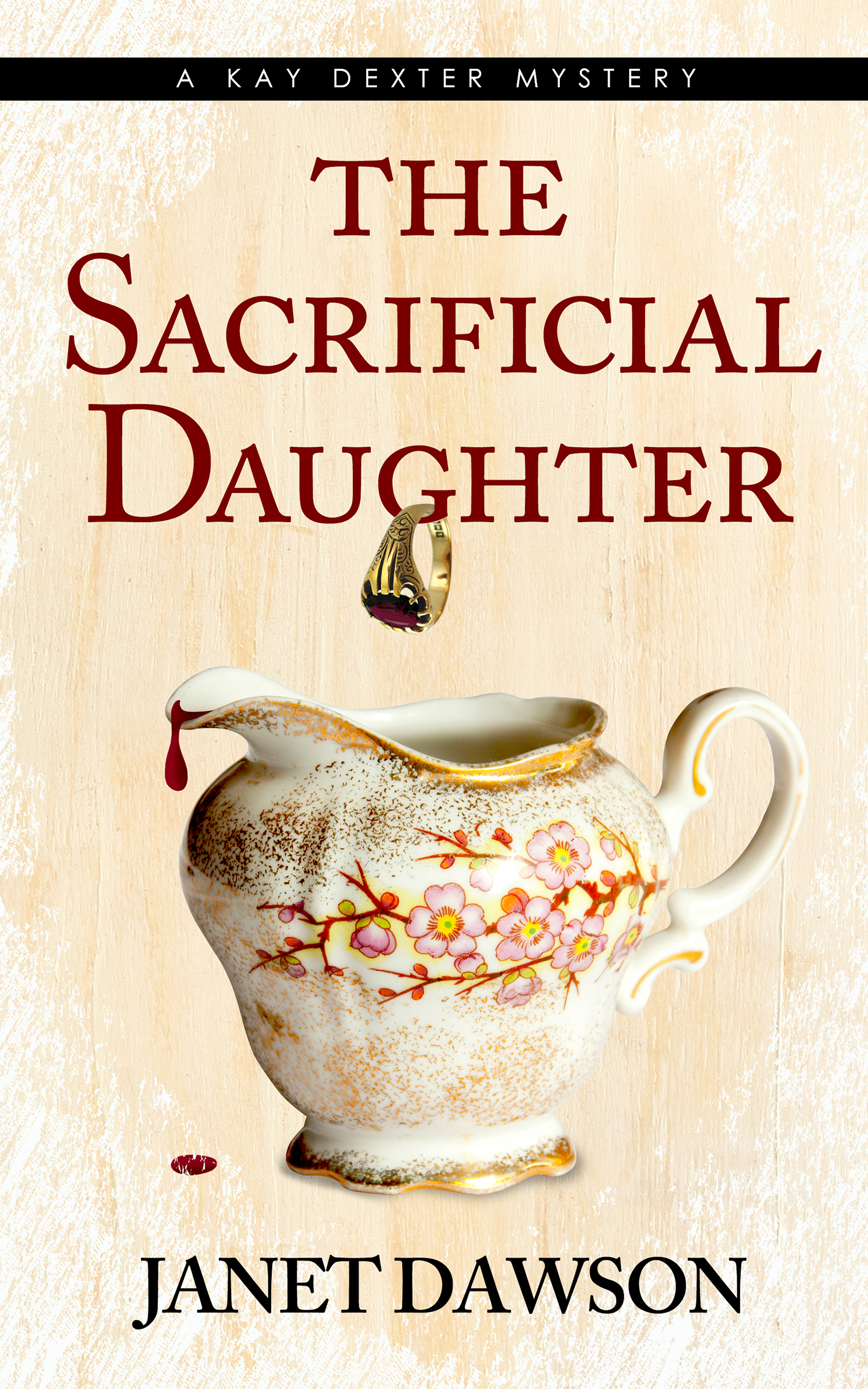
The Sacrificial Daughter will be published in mid-February. Protagonist Kay Dexter, a geriatric care manager, is an advocate for elderly clients and their families. The book is set in Rocoso, a city in a county also called Rocoso, located in the Northern Sierra Nevada. It’s the county seat and has a four-year college where Kay’s significant other, Sam, teaches history. There’s a historic narrow gauge railroad that goes up a scenic river canyon to an old mining town called Jermyn. The river itself is known for its Class Five rapids and is popular with rafting enthusiasts. At a midway point are the abandoned ruins of a resort hotel where people still go to soak in the hot springs along Lost Woman Creek.

None of these places exist, except in my imagination. And now, in the pages of my book.

To be sure, anyone who has ever been to Durango, in southwest Colorado, or who has ridden the Durango & Silverton Railroad will recognize their counterparts in Rocoso and the Rocoso & Jermyn Railroad. The landscape and hot springs at Princeton in the Colorado Rockies might strike a familiar chord. The river could be the American or Yuba in Northern California, the Animas or Arkansas in Colorado, or any rugged river where rafters challenge the rapids.
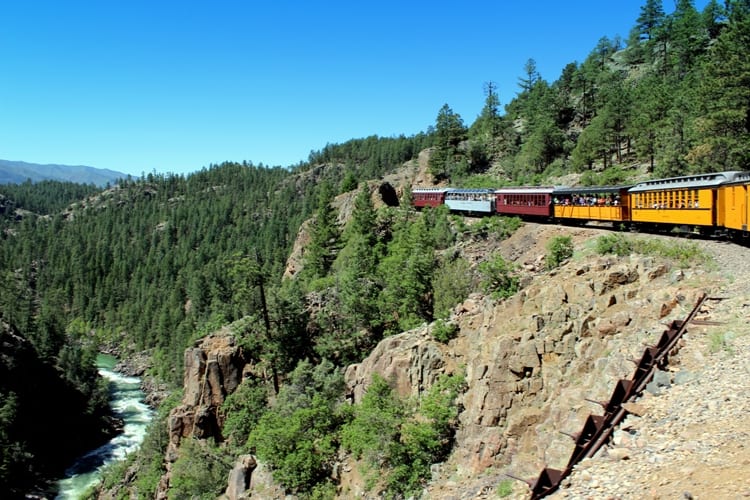
Train above Animas River

The advantage of creating a fictional setting is that I can arrange the streets to suit me, as well as the topography. And most important of all, the history and culture of the place. Kay’s office is located in the former stables behind Rocoso’s historical society and museum, a building that once housed a bordello. That derelict hot springs resort at Los Woman Creek plays a role in the plot. So does the river and the rapids.

That’s what writers do. We revise the landscape to suit our needs, whether it’s putting a nonexistent café on a corner in a real town, or making up a whole county full of towns and populating them with characters.

What a Difference a Lockdown Makes

I’ve been sheltering in place, more or less, since mid-March, when I got back from Left Coast Crime, which turned out to be about 24 hours long instead of the usual long weekend. I flew to San Diego on Thursday morning and the San Diego County Health Department cancelled the convention that afternoon. After rescheduling my flight to Friday morning, I adjourned to the bar. Me and a lot of other attendees. Prosecco helps!

A few days later, the governor issued the first stay-at-home order for California. Aside from my weekly jaunts to do errands and buy groceries, I’ve been—no surprise—staying at home. I did venture as far as Sonoma County at the start of the summer. From time to time, I get together for lunch with fellow authors Marcia Muller and Margaret Lucke, at a nice restaurant where we sit and talk as we eat delicious food. Not happening in 2020. We brought our own lunches and ate while socially distanced on a sunny back deck.

That’s the farthest I’ve traveled, including that jaunt to Berkeley to see my dentist after his office finally reopened. The good doctor wore a face shield and one of those paper suits. He ruefully informed me this was the “new normal.” Right now, normal is my collection of masks in a container near the front door, ready to grab and wear whenever I leave the house.

The lockdown of 2020, which has now spilled over into 2021, did not propel me into cleaning house or decluttering the closets. You know, those things I said I would do if only I had more time. Well, I had more time, but I can put that stuff off another year or so, just watch me.

More time to write, yes. And I used it. I finally finished a book called The Sacrificial Daughter.

I started the book over five years ago, in 2015. It took me a long time to write it because I was also writing books for Perseverance Press.

During that time, I wrote two books each in the Jeri Howard series (Water Signs and The Devil Close Behind) plus two books in the California Zephyr historical series (The Ghost in Roomette Four and Death Above the Line). I was under contract to finish those books by a certain date, so they took precedence.

Once I finished each book, I went back to The Sacrificial Daughter, reading through what I’d already written to get the creative juices flowing again, making decisions about characters, settings and point of view.

When the lockdown came in mid-March, Death Above the Line was on its way through the publication process. Suddenly I had time. My 2020 calendar, full of dates to go to the theater, the symphony, museums, now had page after page of cross-outs. Not going anywhere. At that point, I was already well into The Sacrificial Daughter, about three-quarters of the way, with a good idea of how it was going to end—and how to get there.

I got there. I finished the first complete draft. Then I read and tweaked and polished my way through revisions, with an assist from several readers.

I plan to publish the book myself, in my role as one-half of a publishing company called Bodie Blue Books. Back in the day, my publisher handled all that stuff. Now it’s me, shepherding my new book through formatting, cover design, and copyright.

Come February, I hope, The Sacrificial Daughter will be published, by me, in my role as publisher for Bodie Blue Books.

So I did get something done during lockdown, even if it wasn’t cleaning out my closet.

There’s A Cat in the Christmas Tree!

There are two cats in the Christmas tree photo above.

One is easy to spot. You’ll have to look for the other one. But he’s there.

I love my holiday rituals. That includes decorating my home and putting up a Christmas tree, usually the day after Thanksgiving.

Of course, when one has cats, and I do— Well, if you have cats, you know what I mean. If you don’t, I’ll tell you.

Bodie, an adventurous kitten.

Some cats don’t pay any attention to the Christmas tree. That has never been the case at my house. As soon as I start decorating, my feline companions gather, eagerly twitching their whiskers, as they happily contemplate that big cat toy that appears once a year.

Pearl, who went to the Rainbow Bridge decades ago, would carefully remove the shiny tinsel balls and bat them around the living room. She rarely broke one, unless she batted it into a chair leg.

Then there was Gus, also long departed, but still remembered fondly, especially for this story. One morning as I was getting ready for work, Gus was under the Christmas tree, checking out the presents and making the ornaments jingle and jangle. In a loud voice, I told him to get away from the tree.

To be fair, he did. But he was tangled in a string of lights, so he took the tree with him. He dragged it several feet across the living room, accompanied by the tinkle of broken ornaments.

The following year, I tied the tree to a sturdy piece of furniture.

I love the smell of a real pine Christmas tree. But disposing of the dried-out corpse at the end of the holiday season gives me the blues. The remedy for that was to go with an artificial tree. I bought a seven-footer at a local store’s after-Christmas sale. When I got it home, I put it up, just to see how it looked.

That’s when I discovered it would hold a full-grown cat. The cat in question, Dexter, was midway up the tree, resting comfortably on a branch.

Clio the kitten, perched midway up the tree.

The climbing-the-Christmas-tree baton was passed to Bodie and Clio, brother and sister, who appeared on my patio ten years ago with their mother, Lottie. That year as I put up the tree, the kittens enthusiastically climbed it.

The following year, I set up the tree and was getting ornaments out of the box when I glanced up and saw Clio precariously balancing at the very top. She stayed up there long enough for me to snap a photo.

Yes, that really is Clio at the top of the tree!

She doesn’t do that any more. The tree is smaller and she’s much fatter.

These days the Christmas tree tradition is mostly playing with the ornaments on the bottom and sleeping under the tree. Lottie likes to make a nest out of the Christmas tree skirt and snooze underneath. So do Bodie and Clio, both too big to climb the tree now. At least I hope so!

Bodie sits under the tree.

Happy holidays!

If you put up a Christmas tree, I hope it stays upright.

Working the Polls

Halloween is my birthday.

In a normal year, I would have gone to dinner with friends at one of the Bay Area’s fabulous restaurants.

But this isn’t a normal year.

This year there’s COVID-19. And an important election. This year on my birthday, I am working the polls.

I have been a poll worker for every election since the fall of 2014, a year after I retired from my day job (the one that provided the regular paycheck and the pension benefits). Writing is now my day job, but I do have time for other things.

During the primary in 2014, I voted at a polling place near my home and mentioned that I was interested in volunteering. One of the poll workers directed me to the Registrar of Voters website for Alameda County, California, which is where I live. I volunteered to work and got an assignment as a clerk during the general election in November, attending a mandatory class. My polling place was at a local high school, where the students were curious about the election and the voting process. They kept coming by the room to check it out. That’s a good thing, I thought.

For the next few elections, I worked as a clerk, judge (second in command) and then an inspector (in charge of the polling place). Our location was the social hall of a local synagogue. There were multiple precincts voting at the same location. Voters who showed up knew they were at the right address, the one on the voters’ guide that they’d received in the mail. But they were sometimes confused when asked which precinct. That we could determine by their address. Two polling places in that location was fine. Three was manageable. But for one election, we had five polling places in the same room. That was chaotic.

The primary for 2020 was early in March, before California battened down the hatches and locked everything down on March 17. The Registrar of Voters office has been working since then to devise the new procedures that are in place for the general election. The person in charge of the polling place will be a Registrar of Voters employee, with volunteers taking on the duties of clerk and judge.

In California, voters check in by signing the roster index next to their name. In the pre-COVID world, that was a loose-leaf binder. In the new normal, it’s a tablet computer with a stylus, and it will be sanitized after each voter uses it. California uses paper ballots. Instead of giving voters a ballot from a box, we will print each ballot individually. I’ll be staffing one of those computer/printer stations. My fellow poll workers and I will be wearing gloves, a mask and a face shield—and we will sanitize equipment after each use. Masks and social distancing required, which procedures in place for those who refuse to wear masks—which I hope won’t be a problem.

Alameda County has done away with those old polling places that might be located at a school, a synagogue or someone’s garage. Instead, each city has a number of accessible voting locations of 2,500 square feet or larger. The AVL is the place where people can vote in person or drop off the mail-in ballots received by all registered voters in the state. I’ll be at one of those AVLs and fortunately it’s just a couple of blocks from where I live. And this year, election day is a voting period, starting on October 31 and running through November 3.

I did celebrate my birthday, as it happens, by having dinner with friends. I hadn’t seen them in eight months. We wore our masks, except while eating, and socially distanced at their home, eating take-out from one of our favorite restaurants.

The Mystery of Movies

I grew up at the movies. Really, I did.

My mother’s family was in what they called the picture business. I’m not talking about the kind of pictures you put in frames. I’m talking about the picture show.

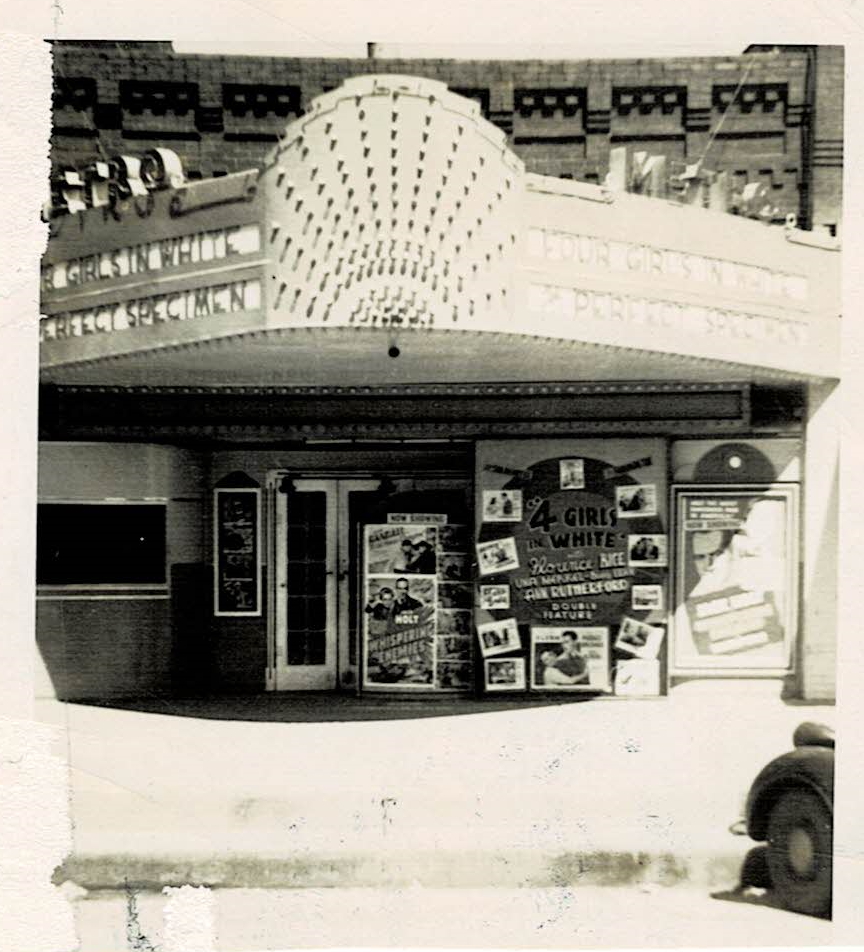
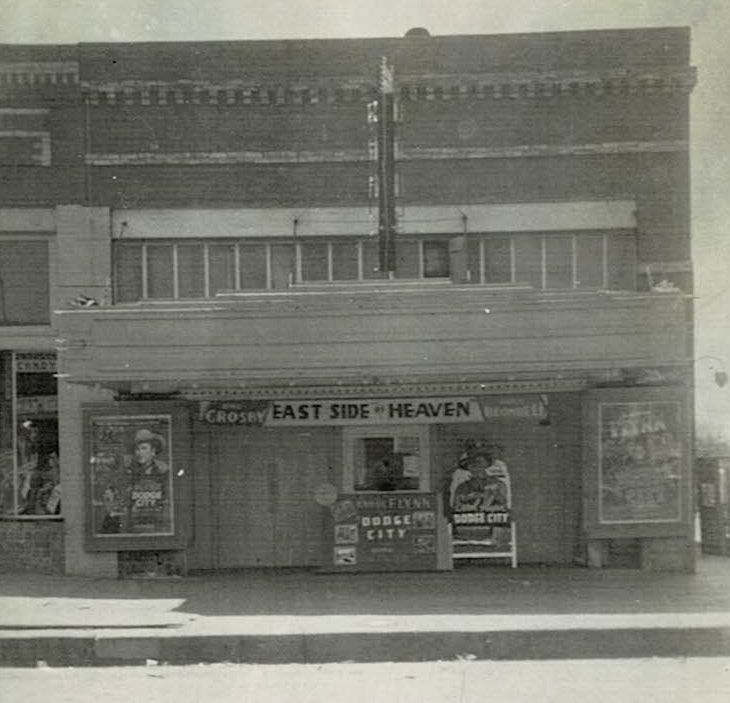
Way back in the silent years, before talkies became the rage, they owned movie theaters, in small rural towns, mostly in Oklahoma, but also in Nebraska and Arkansas.

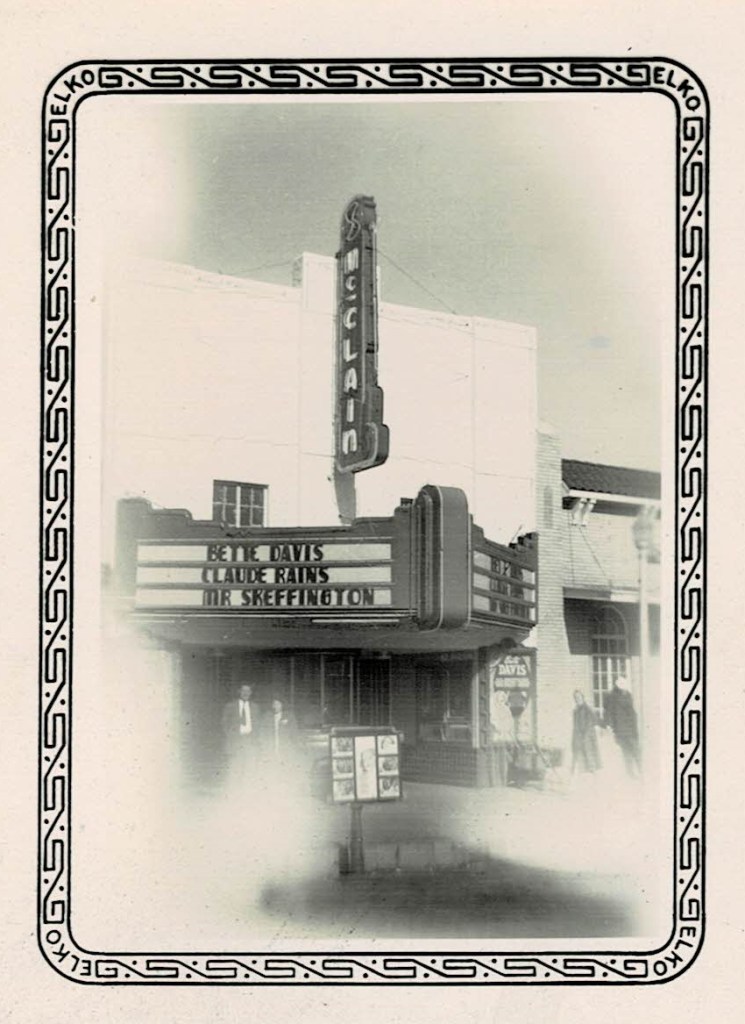
Mom grew up in Purcell, Oklahoma. The family theaters had names that evoke Hollywood’s Golden Age—the Ritz, the Metro, and the McClain, because it was McClain County.

My uncles ran the projectors. Mom and her sisters sold tickets, candy, and popcorn. In fact, Mom was selling tickets one evening during World War II when she met Dad, a young sailor from a nearby Navy training center. Mom’s older sister Flo met her husband the same way, at another movie theater in nearby Norman.

Years later, my Uncle Levi built a theater called the Canadian, because Purcell is located on the Canadian River. He also had a drive-in, the Sky Vue, south of town. The Canadian is the movie theater that’s imprinted on my childhood. When I was young, my family lived in Oklahoma City, some 45 miles north. On Sundays, after church, we’d drive to Grandma’s house in Purcell, for dinner with the family. Various aunts, uncles, and cousins would be there, but not Aunt Dorothy and Uncle Levi, because they were at the show.

The Canadian Theater in 1959, Purcell, Oklahoma

After dinner, the grownups would settle into Grandma’s living room and talk. The kids walked the the few blocks to downtown Purcell, where we were allowed to take tickets from movie patrons and work in what Aunt Dorothy always called the Sweet Shoppe. And we saw movies, lots of them.

Every now and then, I was allowed into the projection room at the Canadian or the Sky Vue. None of this digital stuff that they have now. This was back in the 1950s.

One of my clearest memories is of Uncle Levi, sweating in a sleeveless undershirt in that hot projection room, as he hoisted huge rolls of film onto the projector. Years later, when I saw Cinema Paradiso, I thought of my uncle.

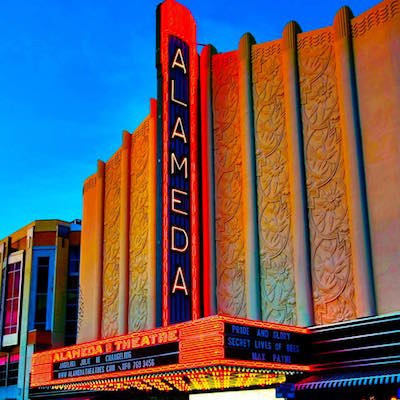
The Canadian closed a long time ago, turned into first an antique mall and later an event center. These days, I’m more likely to stream a movie. But I still like seeing movies in a theater. Especially in the 1930s Art Deco gem in downtown Alameda.

Alameda Theatre, Alameda, California, built 1932

As a mystery writer, I’ve mixed movies into my plots. My latest California Zephyr book, Death Above the Line, takes my sleuth Jill McLeod off the train and onto a set, playing a Zephyrette in a film noir. In Bit Player, private eye Jeri Howard investigates what happened long ago when her grandmother worked in 1940s Hollywood.

Check them out, and I’ll see you at the movies!