Murder Without Violence

thumb_IMG_1225_1024

I had the great pleasure this past weekend to attend a meeting of my local chapter of the Sisters in Crime (the Delaware Valley Chapter). The guest speaker for the meeting is a Conservator at the University of Pennsylvania Museum of Archaeology and Anthropology (which is, coincidentally, where I earned my PhD in Anthropology). Because it is a museum of archaeology rather than fine arts, Molly Gleeson conserves artifacts and other specimens. That includes human remains.

It was a fascinating talk — as they always are at these meetings. Ms. Gleeson prefaced her talk by warning us that she was going to show us images of human remains, then admitted that for this particular audience that might not be a problem. We all write and read about murder. We’re used to human remains, right?

IMG_2463Well…maybe. A murder mystery can be many, many things. It can be light hearted and funny. It can be chic lit. It can be dark, gritty. And it can be gory, a story of violence and evil. When choosing a new book to read, a mystery reader has to know what she’s getting into — or she reads at her own peril.

Personally, I prefer not to read gruesome stories. I particularly avoid books that include rape scenes, but I generally skim through (or avoid altogether) stories with too much gory detail, too much vividly painted violence. I write the books I like to read. Relatively dark mysteries, gritty even, but with the violence taking place almost entirely off the page.

As an aside, one of the most beautiful death scenes I’ve ever read was written by the late, great Ruth Rendell (who, incidentally, did not shy away from violence when she felt it was called for). I always picture that pretty corpse floating peacefully and elegantly down the river, surrounded by wildflowers, whenever I’m trying to write my own murder scenes. I have not yet achieved Rendell’s level of artistic description of death, but I’ll keep trying.

Screen Shot 2016-03-20 at 2.05.07 PMWhich brings me back to the Delaware Valley Chapter of the Sisters in Crime. Each month, a technical speaker is invited to come to our group, to share his or her knowledge of biology, ways to kill a person, how crime scenes are handled, even about ancient methods of human preservation (mummies). To an outsider, we probably seem like a pretty gory bunch.

Quite the contrary. In our group, you’ll find cozy writers, young adult writers, and many, like me, who write traditional mysteries that are high on mystery but low on sex and violence. But one thing we have in common: we’re all well-informed on those gory topics that inform the background of our stories, but don’t make an appearance on the page.

How about you? How much violence do you want to see in the mysteries you read?

janegorman.com


A Time to be Bold

thumb_IMG_1225_1024

Romance is in the air. We celebrated Valentine’s Day yesterday, a day for lovers to be together, for friends to celebrate friendship, for admirers to share their feelings. For many, this is a day to be bold. Romance requires a certain amount of boldness.

In the best romantic stories, the hero(ine) must fight for his or her love. Whether overcoming insurmountable obstacles to be with the one they love or fighting for the heart of the one they love, the heroes and heroines of classic romance understand the need to be brave. The need to be bold. Romance is not for the weak of heart.
Knight

Characters in a classic murder mystery have a similar need. A need to be brave, a need to be bold. The detective must determine not only who has the means and the opportunity, but also who has the motive, boldly digging into lives that the suspects would prefer to keep private.

Each character in a mystery must be bold, to face the inevitable confrontation with the detective, to face the other suspects without succumbing to fear, and to deal with the secrets that always lurk just below the surface of their own lives.

And of course the killer must be bold. Bold enough to hide the truth, to lie and to misdirect. Bold enough to be a worthy opponent of the detective.

I’ve hit that point in my work-in-progress when it’s time for me, as an author, to be bold. I’m putting the finishing touches on the last draft of What She Fears, book 4 in the Adam Kaminski mystery series.

It’s the last draft for now. I’m sending it off to my editor and it will come back with pages of notes, changes, revisions, additions, deletions. Some minor. Some that will require rewriting a significant portion of the text. As a writer, I dread this step. Not because of the suggestions — those will no doubt improve the work.

NJ Summer

No, my fear is in sending this text, a text that up to now has only been seen by my eyes, out to be read by someone else. Someone out there. Someone whose interest lies not in complimenting me or praising me, but in tearing my work apart, exposing its weaknesses and highlighting its flaws.

I’m not alone in this, and I gain strength from knowing that everyone who has written their heart and soul onto a page understands this feeling. With every new draft I share, every new book I release, I swallow my fear, tuck my doubts out of sight, and bravely go where every author has gone before. It is a time to be bold.

IMG_2039 (1)


Visit janegorman.com for information on all of Jane Gorman’s books.

There’s Always More to Learn

thumb_IMG_1225_1024

I love learning. Always have. There was a time in my life when I thought I’d have the privilege of being a perpetual student (which is to say, a professor…). That didn’t turn out to be my career, but it hasn’t stopped me from pursuing my dream. I read. I travel. I listen. And wherever I am, I learn something.

I’m taking a course now on body language — how to read it, how to write it, how to use it to communicate more effectively. I’m definitely learning a lot. Experts on body language will read postures, gestures and facial expressions to understand what people are really saying, their hidden words. It can be fun to test out in the real world!

IMG_2324

One of the things that struck me in this course on body language is how differently people learn. Some of us learn best by reading, others by listening, and others simply by doing — the old trial and error technique. I’m not surprised to hear that, but I’d never thought about how to apply that knowledge when I was teaching. I am now thinking very much about how to apply that knowledge when I am writing.

IMG_2011
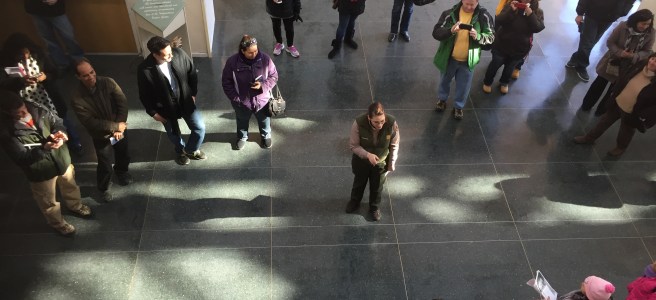
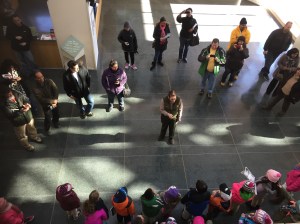
Learning in a group setting by listening to an expert

Writing is a skill, and while there is an art to it that perhaps cannot be learned, there is certainly a craft that can be. With each book I write, I strive to improve. Throughout the year, through the benefit of courses, conferences and workshops, I learn more about technique, style, character development. I practice, beyond what appears on the pages of my book. I write short stories, enter competitions, seek feedback from experts. Membership in organizations like the Sisters in Crime is invaluable.

IMG_2097
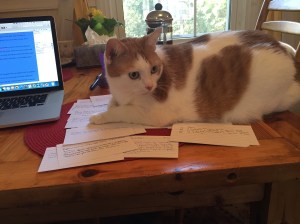
I practice writing whenever I can — and whenever the cats will let me!

I’ve always thought I was the type of person who learned best through reading. But as I write more, and work on my craft more, I realize that I also learn through doing. Practice and more practice, as they say. Of course, it doesn’t feel like practice when it’s something you love to do, does it?

I hope the work pays off, and that as my readers work their way through the books of my series, they find that each book is better than the one before.

More information about my books and links to online retailers can be found at janegorman.com.

Hope, or, Why we love a good #mystery #series

thumb_IMG_1225_1024

At this time of year, it seems perfectly reasonable to write about hope. We gather with family and friends, cuddle up in front of a cozy fire, laugh, talk — and read, of course! As the song says, “we’ll conspire, as we dream by the fire, to face unafraid, the plans that we made …”

books

I’ve been thinking about plans and hope. Not my plans (or my hopes) but those of Adam Kaminski, the hero in the Adam Kaminski mystery series.

Adam has dreams. Or at least he did. Until his view of the world was shattered through one cruel, heartless act. That devastation changed his dreams and changed his life course. He left teaching to join the Philadelphia Police Department, intent on chasing down the bad guys who posed a threat to the safety of the people he loved and cared for.

My job as author is to force Adam to face his lost dreams, to help him strive for his lost hope. It’s not easy! Sometimes it’s so much easier to let him sit back, take life as it comes, watch from the sidelines even. But that wouldn’t make for very interesting reading.

In any mystery, the detective, whether amateur or professional, must throw himself into the path of danger. She must face her fears, thwart the villain. And in each book, that’s exactly what happens. But the attraction of a series is that other story, the longer story arc that the character follows over multiple books.

IMG_2298

For Adam Kaminski, that longer story sends him on a quest to find the truth about his family legacy and to find the hope that he lost, the hope that led him to be a teacher in the first place.

Whenever I’m tempted to make life easy for Adam, to let him zip through a case, solve the murder in front of him without delving too deeply into other mysteries, I remind myself of his dream. I owe him. He needs me to let him dig deeper, to send him to unknown places, so that he can find the answers he needs, the faith in humanity that will give him back his hope.

IMG_2039 (1)

Links to all available retailers for the Adam Kaminski mystery series can be found at my website.


The Story Within the Story

thumb_IMG_1225_1024

One of the things I love about murder mysteries – traditional mysteries such as those I write, cozy mysteries, police procedurals, noir, all of them – is that the investigation is simultaneously crucial to the story and tangential to it.

The mystery, the puzzle the detective – and the reader along with her – has to solve is “whodunit”?puzzle dog

But before that, long before the butler is strangled or the chef chopped up or the heiress shot, before any of those things, there’s another story. The story behind the crime. The story of the criminal.

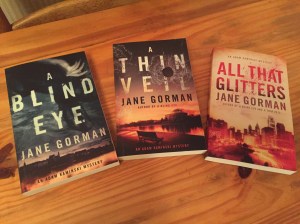
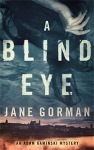
A-Blind-Eye-Web-SmallI love writing about the criminal. What intrigues me, what challenges me as an author, is writing that story. Because you have to write it within the story of the detective.

The detective who solves the puzzle is the protagonist. He examines the dead body, sees the scene of the crime. She must dig up clues, talk to witnesses, learn about the character and background of the suspects. That all happens on the page.

The other story, embedded deep within the surface story, is the story of the criminal. In my books, this person’s story starts long before the detective shows up. A wrong was endured, for example. Or an innocent mistake made. A mistake that snowballs. That propels someone inexorably toward murder.

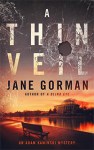
As an author, I can’t simply go back and write that story. It would ruin the puzzle! It’s a A-Thin-Veil-Web-Smallhidden story. Somehow, I have to find a way to paint a picture of events happening now in a way that exposes events of long before.

Telling the killer’s story means revealing feelings, actions and thoughts that led the killer to commit the crime. Exploring the passions that drove him months, perhaps years, earlier. But telling them in such a way that the reader experiences them as if they were new, fresh wounds.

That’s the story within the story of any murder mystery. The story of the killer. A story of pain, despair and ultimately a story of evil. A story that unfolds, bit by bit, piece by piece, as the detective unravels the killer’s lies, exposes the killer until his story rises to the surface.

The detective’s story and the killer’s story intertwine. By the end of the book, the two stories collide. The puzzle pieces all fit together.