Lost at Sea

thumb_IMG_1225_1024

I’ve always been jealous of writers who could think about a story then sit down and write it. You know, no plotting out red herrings and unrelated secrets, no writing up long and complicated character statements, just thinking about a story then sitting down and writing it.

Some time last year I read a fabulous profile of Lee Child. If you haven’t seen it, I recommend it. You can access it here. Child is very much a “pantser” — he doesn’t plot out his books in advance. He says in the article that when he ends one chapter, he doesn’t know what’s going to happen next.

leechild

Our very own Janis Patterson, fellow Lady of Mystery, wrote something similar on her blog last week. How exciting! To play out a story in your head as you write it. I can see why these writers’ books are exciting, thrilling, fun to read.

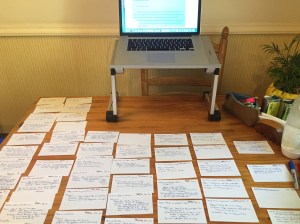
Me? I’ve got note cards, Word docs, downloaded files. I use Scrivener and all the complex tools it offers to organize and reorganize your plot. (As an aside, I recommend Scrivener for all writers who, like me, benefit from the help of plotting tools).

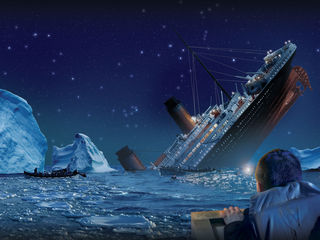
As many of you know, I’m working on book 5 in the Adam Kaminski mystery series. This time, after doing some preliminary plotting, I thought, why not? Let’s give it a try. What’s the worst that could happen?
titanic_sinking

Yeah. That.

Needless to say, I had to go back. Re-plot. Re-organize. Redevelop and rename characters.
img_3095

The sitting down and writing experience, as glorious as it sounds, is just not for me. At least now I know. When you’re a plotter, embrace it!

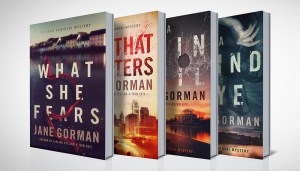
Jane Gorman’s books are available at Amazon, Barnes and Noble, and other retailers.

Learn more at her website, JaneGorman.com.
The Little Things

thumb_IMG_1225_1024

A good book draws the reader in, makes her forget her own worries, the to-do list waiting on the fridge, the snow outside that needs shoveling (at this time of year, anyway!). How do the best authors achieve this? There are many ways, but certainly one is getting the little details right.

architecture-942557_1280
If a reader has previously visited the town in which a book takes place — let’s say, Philadelphia — having the hero run up Broad Street and take a right onto Fourth would pull him right out of the story (for those not familiar with Philly, those streets don’t intersect). If a reader knows a little bit about history, having the murder happen in a historical location that gets its history wrong would be a buzz kill.

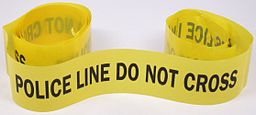
There are many resources available to mystery writers today, and I love to take advantage of as many as I can. As a member of the Sisters in Crime, as well as two local chapters (one in my area, the other online), I have access to online courses, in-person lectures, lists of helpful books, and of course experts themselves available to answer questions. I’ve listened to coroners, successful authors, and community workers share their stories. I’ve taken classes on crime scene investigation and firearms.

256px-%22police_line%22_tape

Did you know there’s an email list just on forensics and crime scene investigations? It’s such fun! I can be checking my email — laughing at a joke from a friend, deleting unwanted ads for home loans and bodily enhancements — when I come across a detailed analysis of the decomposition rate of a dead body in a cold lake. Cool!

Sometimes my membership in these groups keeps me a little too busy, taking me away from my writing, particularly the group for which I serve as a board member. But it’s all worth it. It’s thanks to these groups that I have access to such fabulous information. And I know that when writing, sometimes the most important part can be the little things.

Learn more about Jane Gorman at janegorman.com, sign up for new release alerts at Bookbub, or follow her on Facebook, Twitter and Instagram.
Adam-Kaminski-Mystery-Series


Going Somewhere Beautiful

thumb_IMG_1225_1024

I love going to beautiful places. After all, who doesn’t? Leaving your life and worries behind to visit somewhere romantic or cozy or exciting. And while I love traveling, that’s not the only way to get carried off.

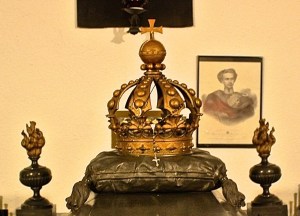
I recently watched the Netflix show, The Crown (yes, I binge-watched it). I loved it! A little history, a little romance, and a lot of monarchy and aristocracy. Once I was hooked, the available episodes were not enough to quench my taste for the royal. So I went right to my books.crown

Nothing transports me quite like reading. Watching a TV show or movie is fun, no doubt, but reading really gets into my head. Instead of sitting passively while someone else’s imagination creates landscapes and characters, I put my own imagination to work when I read, imagining what the characters look like, what their stately homes look like, how their fancy gowns feel or elegant dinners taste.

I worked my way through three mysteries, each set in England or dealing with the aristocracy. I’m not sated yet, so we’ll see what the next week brings.

IMG_4122

The greatest joy in reading, for me, is being transported. And I usually like to go somewhere beautiful. Which may make it seem strange that I enjoy mysteries. I do choose my stories carefully. Not for me the gruesome details of a serial killer or the torturous death of a child. I find that, in their own ways, mysteries can be beautiful, and not only when they’re located in a beautiful setting (though that helps!).

I agree with the sentiment, expressed by many before me, that crime fiction is good to read because the problem gets solved in the end. The killer is caught. Justice is served. Like in a classic western, the men in the white hats win.

fullsizerender

Things get solved. The world is right with itself. And we, the readers, get some time away from home.

I’m curious, what are your favorite “transporting” books?

Adam-Kaminski-Mystery-Series

The Adam Kaminski Mystery Series by Jane Gorman is available at Amazon, Barnes and Noble, iBooks and other retailers.

Follow Jane Gorman on Facebook, Twitter and Instagram.


The Fun Kind of Research

thumb_IMG_1225_1024

I had the great pleasure this month of conducting some serious research for one of my upcoming books.

img_2850


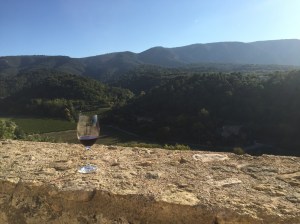
Each of my books takes places in a different city, town or country. I’m currently working on book 5 in the series (as yet untitled), which takes places on a cruise. But I’m also planning ahead to book 6 in the Adam Kaminski mystery series, and that takes place in Provence.

img_4417

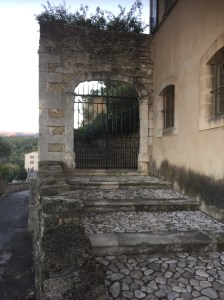
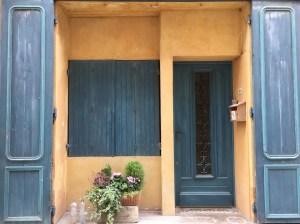
The beauty of the small towns and villages that thrive in this part of southern France is astounding. The cracks and crevices that add character to the facades of houses built hundreds of years ago, the color of the fading limestone contrasted with the bright pinks and greens and blues of painted shutters.

img_4620

The Mediterranean-style roof tiles, red and pink and brown in the golden, late afternoon sun. The air that smells of the vines, freshly cut and burning in small piles in the small vineyards that dot the countryside.

I am grateful to be fortunate enough to be able to travel, to see parts of the world so beautiful they make me stop, take a deep breath, and think of all the things that are good and sweet in my life.

img_4562

My goal with my writing — what I strive to achieve — is to share that joy, that beauty, with my readers. To let you see this world through my eyes, so that you, too, can stop and breathe and be happy.

And, yes, of course there’s always a murder to solve, too.

Adam-Kaminski-Mystery-Series

Learn more about my books at janegorman.com.


More than a Feeling

I have an old, rough, gray woolen blanket that means the world to me. The blanket has been in my family for three generations and can be traced back to a very sad time in my grandfather’s life, during WWII. The wool is harsh. Merciless. As I hold it against my face and feel the roughness, I also feel the history and the love of family.

family-portrait-copy
A portrait of my grandfather, made during the War

Most of us have the privilege of feeling. We have the sense of touch as one of our five senses (or six, perhaps, depending on your point of view). I’ve been watching a TV show recently in which a main character is not able to feel. He has a condition called congenital analgesia. Mostly the show focuses on the fact that he can’t feel pain, a clearly dangerous condition. But it also touches on the fact that he can’t feel good things either — the gentle caress of a warm raindrop, the rough edges of a woolen blanket, the warmth and softness of a kiss.

In my writing I focus, like all other writers, on developing three dimensional characters, on creating a setting that is real and vivid to my readers, and crafting a plot that keeps the reader trying to figure out whodunnit. In the process, I make sure that I catch all the senses: the dryness of an over-cooked steak in a cheap diner, the vibrations of a low bass that you feel as much as hear, the scent of a peat fire burning in the grate.

coffee-1149983_640
Can you smell this?

But I realized that the writers I enjoy the most focus even more on feeling; they allow readers to experience a touch from the character’s point of view. The blanket isn’t just rough, it rubs that sore spot that hasn’t quite healed. The rain isn’t just cold, it seeps deep into the bones and creates an ache in the ankle the character twisted when he was a teenager.

Just as a scent is a sure way to bring back a memory, so, too, is a touch. They’re so closely connected. By feeling something the way the character feels it, the reader is provided a glimpse deep into a character’s mind.

My challenge as a writer is to make sure that my readers experience a feeling — a physical feeling, not an emotional feeling — the way my characters do.

Learn more about books by Jane Gorman at janegorman.com or visiting her Amazon page.

Adam-Kaminski-Mystery-Series