Five New Year’s Confessions

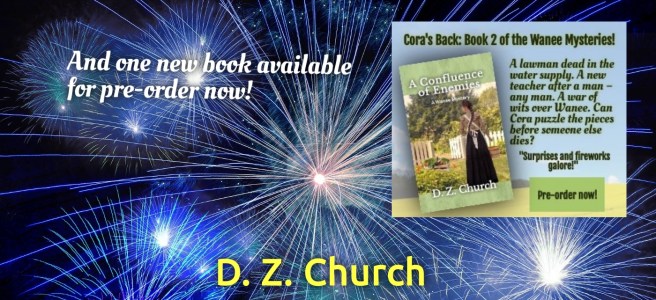
I’ve been scurrying around preparing for the January 15 launch of A Confluence of Enemies, the second book in my Wanee series. The fact that I’m scrambling doesn’t bode well for 2024.

And that’s not good since 2023 was a stinker. I think the earth has tilted too far, it seems darker at night than it used to and warmer outside, and oh, heck, what a mess. Resolutions for 2024, hardly. Instead, here are five things I confess need my attention:

Too Many People: I have a very crowded brain. I live in Wanee in my head and know all the preachers, teachers, and shopkeepers. And their children and grandchildren. I want my readers to know them, too. They’re great people, with their own foibles and dreams. But I need to be firm with them. You can’t be in this book! Maybe the next one — as the dead body — if you keep pestering me for your fifteen pages of fame. On the other hand, if you’re building a world for your readers, shouldn’t you populate it with characters readers want to watch grow? Sheesh.

Everyone’s name does not start with E. Note to self, just stop it. I carefully curate the names of my main characters, villains included, culturing their names like pearls. It is the rest of the folks that present problems. While reading the first draft of Of Waterworks and Sin, the future fourth book in the Wanee Mysteries, I discovered that all the female second banana’s names started with E. This makes some sense, since a century and a half ago the prairie was full of Ellies, Emmas, Ellas, Eleanors, and Elizabeths. As this is not the first time a letter has inhabited my mind, I need an alphabetical list of common first names for the era by my side as I write. Need, being the operative word.

The rhythm of the written word: I make sure the words used in my historical mysteries were in common usage when the books take place. And I attempt to follow the language constructs of the period, which were more formal and precise, leading to a deleterious effect on the simplest of descriptions. My first drafts are a hell of: the hat on the head of the lawman. Instead of the lawman’s hat, or better a black Stetson. The handle on the door. The roof over the porch. On a positive note, tending to these oddities results in more fulsome, precise descriptions. Or, so, I choose to believe.

Giant chapters. We’re talking humongous – up to twenty-two pages. I plot in days, not events. Days. Midnight to midnight. And since I’m writing historical mysteries, communication are slow … everyone is walking, talking, gossiping, visiting, leaving notes, clanking pots, making signs. None of this driving over in the car, dialing up the cellphone or texting the news. Wanee has a paper boy who delivers the daily paper. A telegraph office for news of the world. The local gossips at the dry goods store. Everything happens in person. That’s my excuse, dialog, getting to and from, moving through the labor of the day. In truth, I need to break my days up if for no other reason than to give my readers time to text someone about how much they are enjoying the book.

Stupid strange omissions. When will I get it through my head to include links to the preceding book in the series in my eBooks, or the series page, and in print in the print versions. How about my webpage? My newsletter? My Facebook page? My blog? You do it automatically, don’t you? I leave them off … everything … truly. What’s that about? So, here we go …

See, that wasn’t so hard, except for the Facebook part. Happy New Year, y’all!

The Art of Pumpkin Pie

Pumpkin pie is my favorite pie — hands down! Afterall, it is a vegetable and a pie! Like some of my books are thrillers and mysteries.

I come from a long line of ‘damn fine pie makers.’ One aunt has that exact wording etched in her tombstone. The best pumpkin pies begin with a luscious, heavy, ripe pie pumpkin. Thick meaty inside, easy to puree, with a heady pumpkin aroma. A perfect, light crust. Lots of nutmeg, to ease you into the after-turkey hallucination phase, but not too much. And heavy cream whipped by someone standing by with nothing to do but wait for the turkey to crisp.

When I was small, we grew pie pumpkins in a quarter acre truck garden on the family farm. Now we go to market or to a pumpkin patch with the sweet pie pumpkins relegated to the too small to carve but ideal to bake patch. Those who claim to know tell me the Dickinson pumpkin, an heirloom pie pumpkin, is the go-to pumpkin for cooking (Cucuribita moschata). I don’t know that I ever knew the name, just the weight, heavy for its size, not round but a wee tallish, with a little softness at the bud end. You want a pumpkin with firm texture, so the puree is thick. Watery puree mutes the taste of the pie.

The next step is, of course, to steam or bake the pumpkin until the meat is soft and tender and ready for the other ingredients to make it creamy, heady, and luscious. Now a days, you can take the stem out and pop in the microwave, saving untold amounts of time and guessing.

Every family – well, Midwestern family — has a pie recipe handed down from some past grandma. I’d guess most of the recipes use Eagle Brand condensed milk which originated in the mid-1800s and was a staple by the end of the Civil War. While Eagle Brand canned milk is credited with significantly lowering the rate of infant mortality, it is equally famous for fattening us all on pumpkin pie. I don’t know when the ubiquitous pumpkin pie recipe arrived in cookbooks, but I do know that in 1931 Borden’s offered $25 for recipes that used their condensed or evaporated milk and received 80,000 responses.

If you are making your pie from scratch, great grandmas everywhere advise baking the crust first to avoid a soggy bottomed pie. Like pumpkin pies, families passed down crust recipes and techniques from mother to daughter. Or, in my case, grandmother to granddaughter. My mother’s mother made magnificent crusts – pastries, of all sorts, would that I had her skill. Her crusts were truly flaky, firm, and tasty. I can still hear her advising to never overwork the ingredients. And she always had left over dough, taken from edges, or just more dough than pies. She used it to make pig ears. A pig ear is pie dough rolled in butter, cinnamon and sugar then coiled around itself and baked into a wonderful pastry, in case you didn’t have a Swiss grandmother with too much dough.

So, this Thanksgiving, I pause to genuinely appreciate the ladies in my past who baked in the old style, beginning with flour, fresh vegetables, fruits and meat, and the ever-useful measuring spoons on the ends of their wrists. As I write my historical mysteries featuring Cora Countryman and her cohorts, I rely on the lesson I learned in their kitchens to bring the demanding work, the sense of accomplishment, their dedication to my character’s lives.

Perhaps I’ll have Cora bake a pumpkin pie come fall 1877. Cora, of Unbecoming a Lady and A Confluence of Enemies (coming January 15), grows her own pumpkins in the garden on the corner of her boarding house’s lot. Her brother who runs a dairy co-op to the north of Wanee would supply the cream or she might buy a can of Eagle Brand at Layman’s Dry Goods in town. Cora will bake the crust, steam the pumpkin, mash, then whisk the pumpkin meat into puree, and add the cream and spices. The resulting pie would compete with her mother’s famous lemon bars. Her long-time boarder, the newspaper editor, and the new doctor in town would scarf it down, Doc getting whipped cream on the tip of his nose.

Happy Thanksgiving to all!

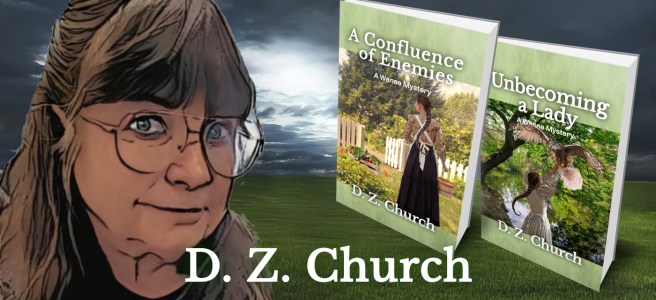
Cora’s adventures begin in Unbecoming a Lady, https://www.amazon.com/Unbecoming-Lady-D-Z-Church-ebook/dp/B0BTKBSP1B. A Confluence of Enemies, the second book in the Wanee Mystery series, is available January 15, 2024.

Wilted Daisies

Maybe it’s the darkness of the day, the brown leaves dripping with rain, or Halloween around the corner. Whatever, it conjures stories of visitors from beyond the veil. So, I offer a short-short-short-really short story for your October enjoyment.

No one had used the back parlor of Countryman House since the official government letter arrived twelve years earlier notifying Edith Countryman of her husband’s death at Chickamauga. The letter remained on the small table before the settee, held in place by a crystal vase of long wilted daisies.

As Cora Countryman entered the room, sunlight glissaded through two six-over-six windows, their red brocade drapes tied back to save the cloth, the open sashes allowing the soft clucks of chickens to invade the still of the room. Shelves of books lined the interior wall, some behind glass. When a girl, Cora sat at the carved mahogany reading table by the windows. Her feet dangling off the chair, her tongue between her lips, she drew pictures of sailboats, strange pyramids, and darkly clothed men from stories. Of course, that was when her father lived, before his loss forced her mother to take in boarders.

Twelve years seemed ample time to mourn, especially with her mother as gone as her father, though not as dead, well, not dead at all if the rumors that Edith was gambling on the Mississippi riverboats were true. Cora leaned over, touching the letter’s brittle paper. As she did, the room shook under the thunder of hooves so real she pivoted to face them, horses leaped over a stonewall onto pikes, men shouted as others fell, screamed, lay motionless. She removed her hand from the paper, the room ceased shaking, all before her vanishing.

Cora sat on the settee, staring into the marble fireplace with its walnut mantle, her right hand spread across her chest, her breathing rapid. She lowered her hand to her side, afraid to touch the vase of dead daisies, lecturing herself on her ridiculousness.

Once convinced, she wrapped her fingers around the vase, a withered white petal fell from a long dead stem, floating to the ancient letter. Laughter erupted and swirled around the room. A young woman, a daisy chain wreathing her brow, threw her arms out, twirling until she bobbled into the arms of a dark-haired youth of near her age. They lay together in the tall grass; he brushed a single daisy petal across her lips, until the marching of heavy footfalls brought them to their elbows.

Cora admonished herself, she was a modern woman, this was fantasy, or wishfulness. She lifted the yellowed paper between two fingers, it tore along a long-rotted crease.

“He is not dead, he is not,” a man in a blood-spattered coat insisted, his hands at the wrist of the body set before him. “Take him elsewhere, he belongs with the living.”

A soldier, his blue uniform filthy, positioned the dead man’s arms on his chest and with another lifted the stretcher. The two ducked out the tent flaps into cannon smoke, bullets smacking into trees and through tenting. They dropped the stretcher and ran for cover before men in gray on wild-eyed horses breaching the position.

Cora’s father lay before her, blood coursing from his wounds. A smile eked across his handsome face, a sly one. He opened one eye.

The government letter of notification in Edith Countryman’s right hand, she sank to the settee, placing the letter on the table. When a breeze ruffled the paper’s edges, she situated a vase of daisies on it. “He is not dead, I have seen him, I have seen his smile.”

The vase and letter remained there, twelve years, her mother forbidding all to use the handsome room. Determined to end the nonsense, Cora took the cut crystal vase of dead flowers in one hand and the yellowed notification in the other to the paned-glass section of the bookcase. The moment she set the items on a shelf, it began to vibrate and the glass panes to shimmy. She slammed the rattling doors closed, and holding them tight with her left palm, she locked the haunted souls inside. The key tight in her fist, she leaned, her back against the shelves. A wind howled down the fireplace flue and across the floor, swirling ashes over and about the table.

Her eyes on the fluttering ashes, Cora took a deep, freeing breath. There were eggs to collect.

Cora’s adventures begin in Unbecoming a Lady, available at https://www.amazon.com/Unbecoming-Lady-D-Z-Church-ebook/dp/B0BTKBSP1B. A Confluence of Enemies, the second book in the Wanee Mystery series, is available January 15, 2024.

Consequences and Truth

Sometimes, it seems as though every YA novel is about a dystopian world populated by evil, conniving adults who would do anything for power. People are starving, living in fear, fighting for existence, sometimes eating each other. And along comes a girl, a boy, a set of boys and girls with some superpower. Great archers, wizards, vampire slayers, and so on, who through their trueness and bravery vanquish the evil adults.

I ask you to think about that message. All government is bad. All adults in power are bad. A few youths are the heralds of virtue. It reminds me of the old disco song, Holding Out for a Hero, sung by Bonnie Tyler.

Where have all the good men gone
And where are all the gods?
Where’s the streetwise Hercules
To fight the rising odds?

Whatever happened to youths who overcame the obstacles of being a teen? Those books are out there with some censored by the arbiters of taste, unlike books where adults are killed wholesale or turned into mice.

I acknowledge that all youths and adults are not reading YA dystopian novels, but a lot are. What attracts them? I would wager that the teens and pre-teens, like we all did when that age, are grappling with adulthood, want control, and yet feel disenfranchised by adults refusing to see that they are pre-adult and capable of remarkable things. Thus, the appeal of a story that is based on this very angst. But think of the world promoted by these books.

Lack of faith in anyone who is in charge. Couple that with some social media time and – whoa – it all gets ugly fast since truth can be a bit hard to come by in a world of influencers pushing beliefs that may or may not be exactly true. If you believe all adults are evil, and you can’t trust anyone in power then you are ripe to be attracted like a bass to a shiny spinner by those who claim to be that hero you need.

Because these books sell well, the genre is packed. Admittedly, our current future has a tint of that dystopia (fire, floods, famine, war, lies). Now that the Mockingjay kids are all grown up, can they provide us a hero, or will they watch in expectation as evil actors take control of the world, and, yes, untrustworthy adults? Yikes!

I don’t know. Either way it gives me the whim-whams.

Our responsibility

So about now you’re wondering what the heck this blog has to do with ladies of mystery. Just this. As mystery writers we have a responsibility to consider the world we present to our readers. One where not every adult is a liar, villain, killer, rapist, serial killer or stalked by one (especially across books in a series).

Our heroes and their supporting cast may be flawed but they are human with human skills. For those of us who write historical mysteries, we are careful in our presentation of fact as we weave it into the fabric of our story.

Our mysteries provide a respite from the crazy world, a land where no matter what, everything turns out right. Justice lives in our pages. The bad ones get their just desserts. And along the way, we present our readers with some truths, comfortable or uncomfortable.

Whew, now that’s all off my chest.

Holding Out for a Hero lyrics © Sony/atv Melody

Amazon and Gaming the Objective Review

First, let me congratulate Amazon on a recent update. I presume authors reading this have noticed that when you do a search on a title, Amazon has changed how the customer reviews are presented: 4.3 (80% 4 or above). Why is this a good thing … and why does more need to be done …? Read on.

The Good Thing

Amazon’s new reporting of customer ratings is a step toward overcoming the pull of the extremes. A simple example is this: The first two readers gave the book a 4 and a 5. Along comes one curmudgeon who gives it a one (they thought it was a ghost story when it wasn’t). The book now has a customer score of 3.3. Though the book will never achieve a 5-star rating (ever), readers looking for a solid mystery will see that 66% of the raters gave it a 4 or above. In other words, most readers scored the book high, indicating the low scores are random and incidental.

Disturbing Trends

There are two disturbing trends, the first promoted in how-to-books on independent publishing and by marketing/sales gurus. That is to game the customer review system by having one’s followers or sites offering customer reviews flood a book’s page (particularly a new book) with 5-star reviews. Not a bad plan, except it makes a score of 5 meaningless and it hurts all buyers. If the scale means nothing on what does a mystery reader base their purchase? Further, it hurts new or other authors of equal quality with fewer followers.

The other, far more disturbing trend is this (recently noted in a New York Times article). A book consistently scoring in the 4-5 range is hit by a host of 1s. Within days of each other. To be clear, to be a 1 a book should be abysmal. So, a book that is truly a 4 or 5 cannot turn into a 1 overnight. It cannot. How does this happen?

Two ways. One, a reader dislikes something about the book that is a trigger point for them. That reader gives the book a 1 based on their trigger, then convinces friends or their reading group to do the same. It is a protest of sorts having nothing to do with the quality of the book, but a way to dis- and ban books that do not agree with one’s belief whether those beliefs are mainstream or not. And second, it may be used by authors or marketers to increase a book’s sales by effectively taking out competition.

What makes this possible is that a rater doesn’t have to read a book to rate it, which tells us that all customer scores are suspect. Amazon’s own policy reads: You can leave a rating or review for a book that you didn’t purchase on the site*. And when an Amazon review indicates a certified purchaser, it means: You must have spent $50 on Amazon.com, using a credit or debit card, in the past 12 months, to: Create reviews (including star ratings) Answer customer questions. Submit helpful votes. * These policies make it possible to line folks up to either praise or torpedo a book.

What Can Be Done

I don’t know how to stop this, fight it, or change it. Any change is unlikely with the publishing environment so competitive, readership down, and gaming the system (though inherently immoral) considered a legitimate marketing tool.

The only sensible solution is that all scores (but especially 5s and 1s) require a written review to count. The review cannot be one word “garbage” or “wonderful” but an explanation of fifty words or more about why the score given is valid and that gives some assurance the book has been read. This way the poor person trying to discover a new mystery can decide if the score of 5 or even 1 has any virtue.

In the meantime, Amazon has taken a step in the right direction.