The quizzing continues…

Try your hand at these. Scroll down for the answers.

#1: What is the largest theft in Canadian history?

A. The “Canadian Maple Syrup Heist” in 2011-2012
B. The “Pearson Airport Gold Heist” in 2023
C. The “Costco Cigarette Heist”in 2004

#2: Which Canadian city was once known as the bank robbery capital of North America?

A. Toronto (or T-Dot as the cool kids say)
B. Vancouver (or Raincity as the locals call it)
C. Montreal (the City of Saints, unofficially of course)

#3: Which Canadian criminal was known as the Flying Bandit?

A. Ken Leishman, convicted gold robber
B. Gilbert Galvan Jr., convicted bank robber
C. Johnson Aziga, convicted murderer

#4: Who is Canada’s most infamous female bank robber?

A. Machine Gun Molly (died after being shot by police)
B. The Church Lady Bandit (convicted of robbing 11 banks)
C. Ma Barker (matriarch of a bank robbing family)

Question #1: The answer is A. Over several months in 2011 & 2012, thieves stole nearly 3,000 tonnes of maple syrup from a storage facility in Quebec (value of about $30 million in 2024). The theft was featured in the Netflix documentary series Dirty Money  in 2018 (Season 1, Episode 5).

Question #2: The answer is C. From the 1950s to the 1970s, Montreal was the bank robbery capital of North America, with more bank robberies per year than even New York and Los Angeles. This was largely due to the light sentences handed down by Quebec courts—5 years in prison for convicted thieves compared to the 20 years in prison normally handed down by American courts.

Question #3: The answer is A & B. Canada had two Flying Bandits! The first was Kenny Leishman who masterminded the biggest gold heist in Canadian history—until the Pearson Airport Heist in 2023. He earned the nickname The Flying Bandit after he escaped from prison, stole a plane, and flew to the US where he was arrested. The second was Gilbert Galvan Jr., an American who escaped from a Michigan jail and fled to Canada where he robbed 59 banks and jewelry stores.  He was dubbed The Flying Bandit for his habit of flying from city to city to rob banks. He robbed banks in every Canadian province except PEI and Newfoundland. 

Johnson Aziga is the first person to be charged and convicted of first-degree murder in Canada for spreading HIV, after two women he had infected without their knowledge died.

Question #4: The answer is A. Monica Proietti, better known as Machine Gun Molly, was a Canadian bank robber from Montreal. She was suspected of masterminding at least 20 bank robberies during her short life. On September 19, 1967, she robbed a Montreal credit union with two accomplices. That set off a high-speed chase that ended with her being shot and killed by police. It’s been said that “If Al Capone had had a daughter, he would have wanted her to be Monique Proietti.”

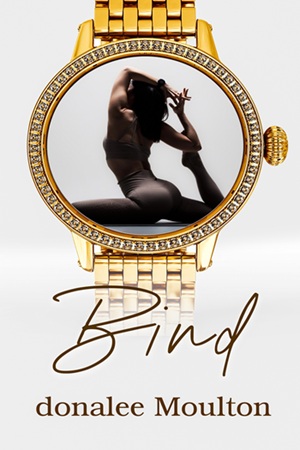
cover of donalee Moulton's book Bind

And the answer is…

Scroll down for the answers. Next month I’ll share the questions about theft.

#1: When were the first portable timekeeping devices — in other words, the world’s first watches — first invented?

A. 16th century (the Early Modern Age)
B. 18th century (the Age of Enlightenment)
C. 20th century (the Age when Bind’s characters were born)

#2: Who were wristwatches originally designed for?

A. Men, because men get everything first
B. Women, because they are the smarter sex
C. Police officers, because they carry guns

#3: When did wristwatches gain popularity among men?

A. During the Roaring Twenties
B. During the Industrial Revolution
C. During World War 1

#4: Which old Hollywood movie star’s watch shattered records when it sold at auction in 2017?

A. Clark Gable, The King of Hollywood
B. Archibald Alexander Leach (you probably know him as Cary Grant)
C. Paul Newman aka Cool Hand Luke

#5: From 2021 to 2022, luxury watch thefts rose by 65% in London. What happened as a result?

A. A petition to ban the sale of machetes
B. An ordinance prohibiting anyone wearing a luxury watch in public
C. A law forbidding anyone to take a photo of the Crown’s wristwatch

#6: If not for a Rolex watch, Albert Johnson Walker might not have served 26 years in prison. Where was he incarcerated?

A. England
B. Canada
C. St. Pierre

Question #1: The answer is A. German clockmaker Peter Henlein is credited with inventing the first watch around 1510. Because of its size (about 3 inches), it was best suited to be worn on a pendant or attached to a belt.  

Question #2: The answer is B. Wristwatches were originally created for women. They were seen as both elegant pieces of jewelry and functional timepieces. According to the Guinness World Records, Swiss watchmaker Patek Philippe made the first wristwatch in 1868 for a Hungarian Countess. Men preferred pocket watches at that time.

Question #3: The answer is C. During World War I, wristwatches became a necessity because soldiers needed to tell time quickly and easily. This translated to civilian life after the war. By the 1930s, wristwatch sales had surpassed pocket watch sales.

Question #4: The answer is C. Movie star and race car driver Paul Newman’s Rolex Daytona sold at auction for $17.8 million in 2017. The watch had been a gift from his wife actress Joanne Woodward—engraved with the words “Drive Carefully, Me.”

Question #5: The answer is A. A London councillor launched a petition to ban the sale of machetes after having his watch stolen by a machete-wielding thief in 2022. The petition got almost 140,000 signatures.

Question #6: The answer is both A & B. In 1996, British police used a Rolex watch to identify a body found in the English Channel. When they visited the home of Ronald Platt, they discovered his business partner, Canadian-born Albert Johnson Walker, pretending to be him.  In 1998, Walker was convicted of first-degree murder and incarcerated in England. In 2005, he was allowed to transfer to a Canadian prison where he was further convicted of embezzling millions from his Canadian clients. In 2024, he was still in prison in B.C.

cover of donalee Moulton's book Bind

I found joy – as a jellyfish (and other aquatic animals)

By donalee Moulton

My newest book is Melt. It’s the second in my Lotus Detective Agency series, and it focuses, as does the first book, Bind, on three women who meet in yoga studio and discover there is more to life than a downward dog. There are crimes to be solved.

Long before the series was even an inkling of an idea, I was practising yoga – and writing about life as a crow, a bird of paradise, and a pigeon. The article below, originally published in The Globe and Mail, unveils how I ended up birdlike and otherwise on a yoga mat, twisted, inverted, and smiling. 

There were several occasions in the last three decades when I took a yoga class, four by my latest count. Nothing stuck for more than 60 minutes. Now I’m on the mat (as we, ahem, like to say) four or five times a week.

Not sure what happened between decades three and four, but here I am today in my 60s actively seeking out a yoga flow class, searching YouTube for restorative practice and talking retreats with new-found friends. I have blocks, straps, pillows, bolsters, blankets and mats in many colours, designs and grips. I even have a plastic frog in full lotus. Truth is, I have a yoga room.

I’m not an exercise person. I have never had the desire to scale mountains, ski down or hike mountainous terrain. I’m equally averse to water aerobics: surfing, paddling, polo. Give it all the cool names you want – finswimming, aquajogging, wakeskating – and I’m staying on terra firma.

Fact is, I’d rather have an enema than exercise.

Actually, that was the old me. The new me would rather do a downward dog.

I’m not sure which came first – not being good at sports or not being interested in sports. They are indelibly intertwined, like chicken and egg or the yoga pose eagle arms and legs (which I can do).

Regardless, here I am, sports unenthusiast. I want to be healthy. What I’ve never wanted is to work at being healthy because it’s boring and hard (so I had come to believe). Yet, periodically I would propel myself to some gym, some piece of equipment, or even some yoga mat to get my body in shape.

In the case of yoga, that lasted for a full 240 minutes over 30 years. (In the case of lifting weights, running on the treadmill, aquacise, the number is much, much lower.)

The turning point in my yoga journey, it turned out, was around the corner from where I live. An instructor started renting studio space in a new building, and my aunt and I decided to give it a try. We liked it. We really liked it.

I’m not sure why. It may be the variety of poses we learned, that each class was new and different, that we got to know participants. But I had all that before. The reason, I discovered, is not important. The reality is.

At some point, actually several points, my body responded in ways it never had before. My feet touched the mat, both of them, when I did a downward dog; my hands (both of them) held each other doing a bound side angle.

I also noticed a marked improvement in my knee. My doctor had diagnosed a tear in my meniscus and wished me well. When I couldn’t complete a yoga pose because of it, an instructor recommended putting something like a sock between my knee and my bent leg. It worked. As I spent more time on the mat, I used the sock less and less. Today, I get no complaints from my knee, and use socks only to cover my feet.

It wasn’t only my knee that got better. My strength, my balance and my flexibility improved.

Perspective changes on the mat. There is a common yoga pose called child’s pose. You put thighs on calves, buttocks on heels, and fold yourself into a ball. It’s supposed to be a resting position, one you come to after other poses have offended your body in ways you didn’t know existed. For most of us, child’s pose is, at first, the farthest thing from a rest primarily because there is a wide gap between our bottom and our heels. Most of us accommodate, as yoga teaches us. We shove bolsters, blankets and blocks under our rear to close the gap. Still a faint wisp of failure lingers.

I’m in an extended child’s pose during one class and realize I’m enjoying this fetal shape. I am relaxed, breathing deeply, and feeling something new: contentment. I tried to figure out what had shifted and realized, in part, the answer was physical. My rear end was not pointed heavenward; it was nestled on my feet. I was a ball without the need of a bolster.

There are those poses that continue to confound. My legs refuse to rearrange themselves into a lotus, although they are inching closer. Crow pose eludes me. Both feet refuse to come off the floor, but one will, so I’m making progress. And there are those poses I have yet to attempt. Their names will tell you why: formidable face pose, handstand scorpion, destroyer of the universe.

Overall, however, I find a sense of peace and contentment in many poses and in my practice. Indeed, I find more than this. Yoga has taught me that practice is about more than positioning the body. It is about body, mind and spirit. It is about connecting with yourself. It is about finding balance. It is about going to the edge, but not over the cliff. It is about acknowledging growth and recognizing limitations. It is about joy. The joy that comes from sitting on a mat with your heels stuffed into your bottom and your heart soaring.

Ultimately yoga has taught me patience and acceptance. The fundamental reality of any practice is this: yoga teachers cannot count. They put you in a pose, say warrior II, then they suggest you place your right shoulder against your inner thigh while extending your left arm toward the ceiling, bending your elbow, bringing your left arm behind you, and clasping your right hand. It’s like scrubbing the floor while looking at mold on the ceiling.

I can actually do this. And I can hear my yoga instructor saying, “Hold for three breaths,” just before launching into a tale about their morning drive to work. Three minutes later – not three breaths – we unbind and unbend. All yoga teachers are trained to do this.

When instructors tell you to hold for five breaths – a lifetime when your hips are squared, your shoulders flexed, and your legs interwoven – they are lying. Admittedly, they are well intended. Some even come with timers, beacons of false hope.

In the end, it doesn’t matter. I am on the mat, moving in sync with my breath, finding my body moving with me (or against me) and I’m okay with that. I have learned the challenging poses – lizard, dolphin, fish – are friends. We meet here on this rectangular piece of vinyl, and I take pieces of them with me when I roll up my mat, put away my straps and head out the door.

The joy of having been for a time an aquatic animal infuses and informs. It is so much more than legs splayed, ankles nestled, arms extended. And holding for five delicious breaths.

Ish.

In the Right Place

by donalee Moulton

Céad míle fáilte. This Gaelic expression means “a hundred thousand welcomes.”

Nova Scotia

If you live in Nova Scotia, as I do, this is an expression you will have seen for much of your life. (Pronouncing it is a different issue altogether.) A hundred thousand welcomes in any language speaks to the type of people you are likely to encounter when you come here and the values they place on such encounters.

Riel Brava – attractive, razor-sharp, ambitious, and something much more – is the lead character in my first mystery, Hung Out to Die. He lives in Elmsdale, Nova Scotia, about a 40-minute drive from Halifax, the province’s capital. In East Coast parlance, Riel is a come from away.

Raised in Santa Barbara, California, Riel has been transplanted to Nova Scotia where he is CEO of the Canadian Cannabis Corporation – one of the estimated four to twelve percent of CEOs who are psychopaths. It’s business as usual until Riel finds his world hanging by a thread.

Riel’s chief financial officer is found hanged in his office. The police determine the death is not the result of suicide. Still, Riel resists the hunt to catch a killer. Detective Lin Raynes draws the reluctant CEO into the investigation, and the seeds of an unexpected and unusual friendship are sown. Ultimately, Riel finds himself on the butt end of a rifle in the ribs and a long drive to the middle of Nowhere, Nova Scotia.

Fact is, I could have placed Riel in the middle of anywhere. The murder is not location specific. The victim does not fall from the Brooklyn Bridge or mysteriously appear atop Old Faithful, places that are singular. Nova Scotia made sense for me as a writer, and it made sense for Riel as a character. I live here; I know this province better than any other place. I can write about it with ease, and with a personal perspective.

For Riel, who lives uncomfortably in a world where people hug each other because they care and share the pain of others because their brain is wired that way, being in a place where he does not have roots, where he is an outsider, mirrors what goes on within Riel. It’s the right place for him.

Because I am from Nova Scotia, I can also authentically and naturally insert elements of life here. Take the language, for instance. You may discover some new words such as “bejesus” and “tinchlet.” There will be expressions common to the area. “Bless your heart” is one you’ll hear a lot in Nova Scotia, and Riel hears it as well. It does not resonate.

There is also food that has Nova Scotia marinated into it, as Riel discovers. Turns out Riel is now a donair aficionado. (I am not.)

One of the things I have learned as a writer is that I am in control, and I am not in control. I can decide to situate a character in a particular place, and the character will let me know if that is the right place as the writing unfolds. In the case of Riel, he ends up in the dark of winter at a deserted row of cottages called, what else, Céad míle fáilte.

I did not see that coming. I have a feeling Riel did.

First sentence, first page, a first for me


Summer is here—and it has brought with it sunshine, warmth, and my new mystery Melt. I thought I’d share the opening page with you. It’s a different kind of first page for me, but then Melt is a different kind of book for me.

It’s the second in the Lotus Detective Agency series, and my first sequel. The first book, Bind, introduced three women who meet in a yoga studio and join forces to discover who’s stolen a Patek Philippe watch from what was supposed to be a secure locker. It opens gently basking in the warmth and serenity of the Asana yoga studio. There is no basking in Melt.

The first line came quickly. I deleted it just as quickly. It came back and stubbornly refused to move from top spot. I asked others—writers, editors, friends, wonderful strangers who turned up at my readings—for their opinion. Most liked it. Some loved it. Some shuddered.

Now I get to ask you what you think about the first sentence, and the first page. As you’ll read, there’s a bit of theme in these first 500 words.

Luke’s balls are itchy.

His left hand, casually resting on his left thigh, is mere inches from his testicles. He could surreptitiously edge his hand forward and find relief.

“Surreptitiously” is not a word in Luke’s usual vocabulary. It has nothing to do with IQ. Indeed, Luke is smart enough to read the room before he moves his hand a nanometer. He scans the beige walls, the brown tables, the black gowns, the onyx gavel. A courtroom, he concludes, is not the best place to scratch your scrotum. Luke clenches his legs together to stop the itching. Now he has to piss.

Luke looks up to see the judge looking down at him. “I want to confirm your plea. You understand by pleading guilty to trafficking a schedule one drug you could spend 25 years in a federal prison.”

This is not news to Luke. It is not good news, certainly, but it is not a surprise. It is what he has signed on for. Luke’s lawyer nudges him. Luke stands up. He returns the judge’s gaze without malice or defiance. “Yes, your honor, I understand.”

The associate chief justice of the supreme court of Nova Scotia quickly and efficiently takes in Luke’s demeanor, his clarity of voice. She takes in his blue suit, at least one size too large; his tartan tie, with Value Village written all over it; his left hand, which seems to have a small twitch. She looks into Luke Castle’s eyes. She sees what she often sees: fear. What she does not see is hope.

Justice Louise Redmond shifts her gaze to the Crown prosecutor. Then to defense counsel. She reaches for the gavel. “I am not sentencing a seventeen-year-old boy to federal prison before I have a fitness assessment conducted.” The judicial mallet hits its thick round oak base. “Under section 672.11 of the Criminal Code of Canada, I hereby order a comprehensive competency assessment be conducted on Lucas Raymond Castle. Sentencing will follow pending the results of the assessment.”

There is a shuffle of chairs as the lawyers rise. They reach for their files and their briefcases. The court reporter removes the flash drive from the stenograph. The bailiff moves toward the rear door that leads into the judges’ private offices. Justice Louise Redmond is not finished, however. She stands. “I would like to see counsel in my chambers immediately.”  Looking into the public gallery, she locks eyes with an attractive man in a grey suit and black turtleneck that contrasts perfectly with his onyx skin. “Detective Terrell, please join us.”

Justice Redmond walks through the rear door without looking back. The two lawyers look at each other and shrug. They turn to look at Detective First Class Michael Terrell. He shrugs.

Luke Castle scratches his balls.