Pets in Books

In the course of my life, I’ve shared my home with four dogs, eight cats, and one dog in a cat’s body. I don’t know if that makes me a dog person or a cat person, all I know is that I live in the country where coyotes, mountain lions, and other dangers mean that to have a pet now I would need to take supervised outdoor walks with them which my knees no longer let me do. And it’s even questionable if that would be enough to ensure my fur-babies safety; one of the cats was taken in broad daylight in a lightning-fast snatch as she preceded my husband out to the back patio where he routinely enjoyed morning coffee while she enjoyed napping on warm sunlit bricks.

It’s not bad living petless in the country as I do, though. I share my country home with scurrying bluebelly lizards, hummingbirds that sip water as I sprinkle my garden, foxes who bring their babies to visit, ravens who recognize me and perform arial shows as synchronized as the Blue Angels, and even a bobcat who is so friendly she lets me sit outside with her while she baths. Those creatures are special, certainly, but I do still miss my dogs and cats and I have many deep recollections of their quirks, foibles, and some of the adventures we shared.

To honor them, I have found a way to keep those memories alive by introducing lost pets in my books. In my Regan McHenry Real Estate Mysteries series, Sophie and Granite are mentioned regularly and some of the other cats make cameo appearances.

But I decided that wasn’t enough for me, so when I began to write the PIP Inc. Mysteries series, I made my Dalmatian Freckles (she was part of a long line of show dogs and her official registered name was Dama Pecosa) my protagonist Pat Pirard’s Dalmatian Dot while my real ginger cat Lord Peter Wimsey became ginger cat Lord Peter Wimsey in the books.

Those of you who have shared your lives with furry critters know they all have distinctive personalities; it didn’t take much for me to use my pets as characters in the books. Freckles came to my rescue more than once. In my younger years, I worked in a small library that, except for one two-hour overlap, was staffed by one librarian. We were open nights and I often worked alone until 9:00. A man started coming into the library whenever there weren’t any patrons inside complaining about the heat. He would start to disrobe and suggest that I should, too.

I was told if I was ever in trouble I was to call the main library, identify where I was and tell the person on the other end, “Tell Mercedes her book is here.” That was code for call the sheriff and send help immediately. Unfortunately, when I tried it, all I got in response was, “Who is Mercades and which book do you mean?”

My two-hour job share person was married to a deputy sheriff who tried to stake out the library, but the disrober remained elusive. Finally, in desperation, I decided to take Freckles to work with me. The librarian on duty sat behind a high counter on a bar-height chair. I looped Freckles’ leash handle under one of the legs of the chair and told her to lay down. She behaved perfectly, mostly napping as patrons came and left. That is until the man came in.

I still don’t know if she picked up on a vibe from him or sensed my fear, but within seconds, she was on top of the counter, teeth bared, snarling at him, and tugging at the leash. He never came back.

Usually, she was a sweet dog. Neighborhood kids would ask if she could come out to play. I knew what she was capable of, though, and wrote her into “The Funeral Murder” as the hero/defender she was under her spotted coat.

Wimsey gets his due in the books as well. The live Wimsey was a defender of his harem and took care of and older, smaller male, too. I never doubted he would defend me should he need to, never mind how aloof he might seem most days. He got his chance to defend my protagonist in “The Funeral Murder,” too.
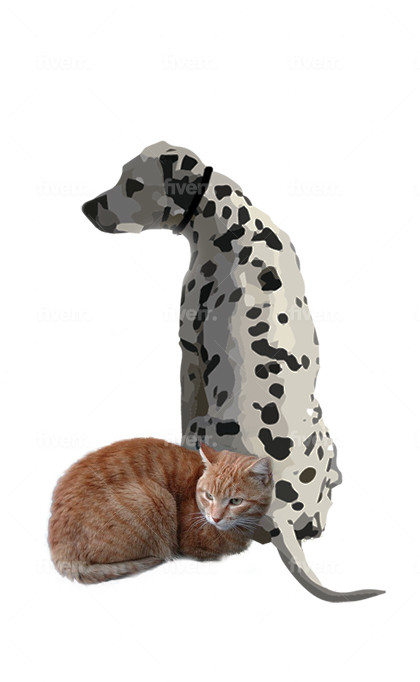
 So live on, my furry friends, as I get to remember you in more of the PIP Inc. Mysteries series.

Riding the Camel

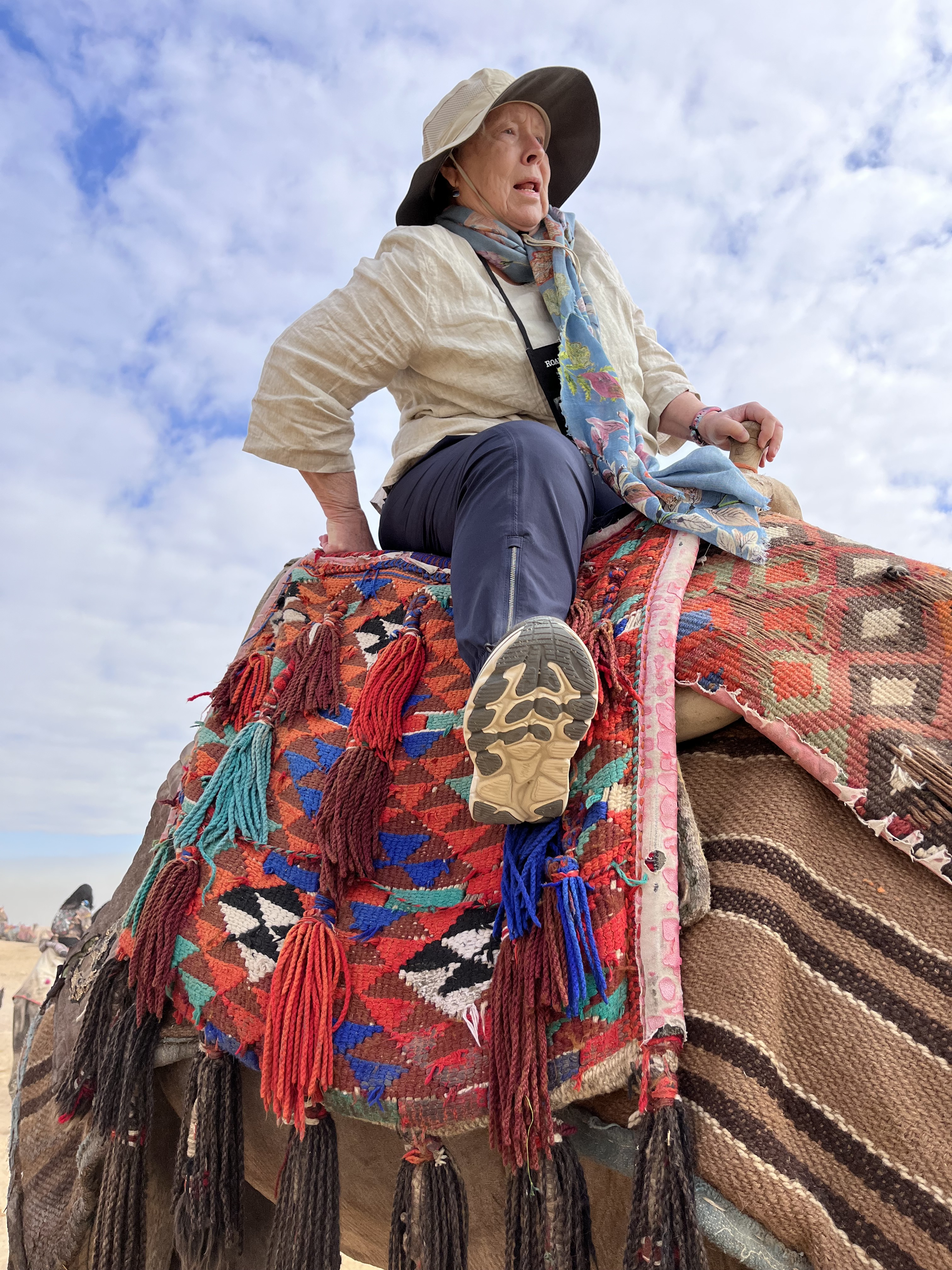
I rode the camel. Of course I did. It’s one of those touristy things I just had to do. I was in Egypt, after all, visiting the pyramids at Giza and contemplating the Sphinx.

This once-in-a-lifetime trip to Egypt was fabulous, marvelous, wonderful. It was a Road Scholar program called “Up the Nile and Into History: Sailing Through the Stories of Egypt.” There were twelve of us on the tour, a manageable group and what’s more, we all got on famously.

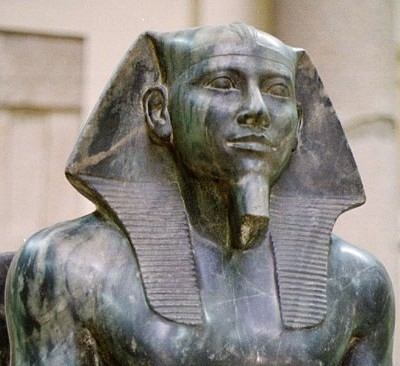
Our guide, Ahmed, was personable and knowledgeable, with a sense of humor and lots of stories. He also had a face like that of the Pharoah Khafre, whose statue is displayed in Cairo’s Egyptian Museum.

Khafre built the Great Pyramid in Giza. That’s where I rode the camel. The camel wore a saddle cloth with a number and the words Ali Bob Marley. I guessed this was the camel’s name, but I’m not sure. Now, I’m quite short and the camel was tall, even while kneeling. It took Ahmed plus the camel handler to get my foot in the stirrup, let alone get me into the saddle. And once I was up there I felt quite precarious, as I wasn’t seated quite right in the saddle.

I felt like I was going to fall off, especially when the camel got to its feet. The camel handler shifted me into the proper position and off we went. Two or three minutes of riding the camel was plenty for me. The camel knelt, I scrambled off, and Ali Bob Marley and I parted company.

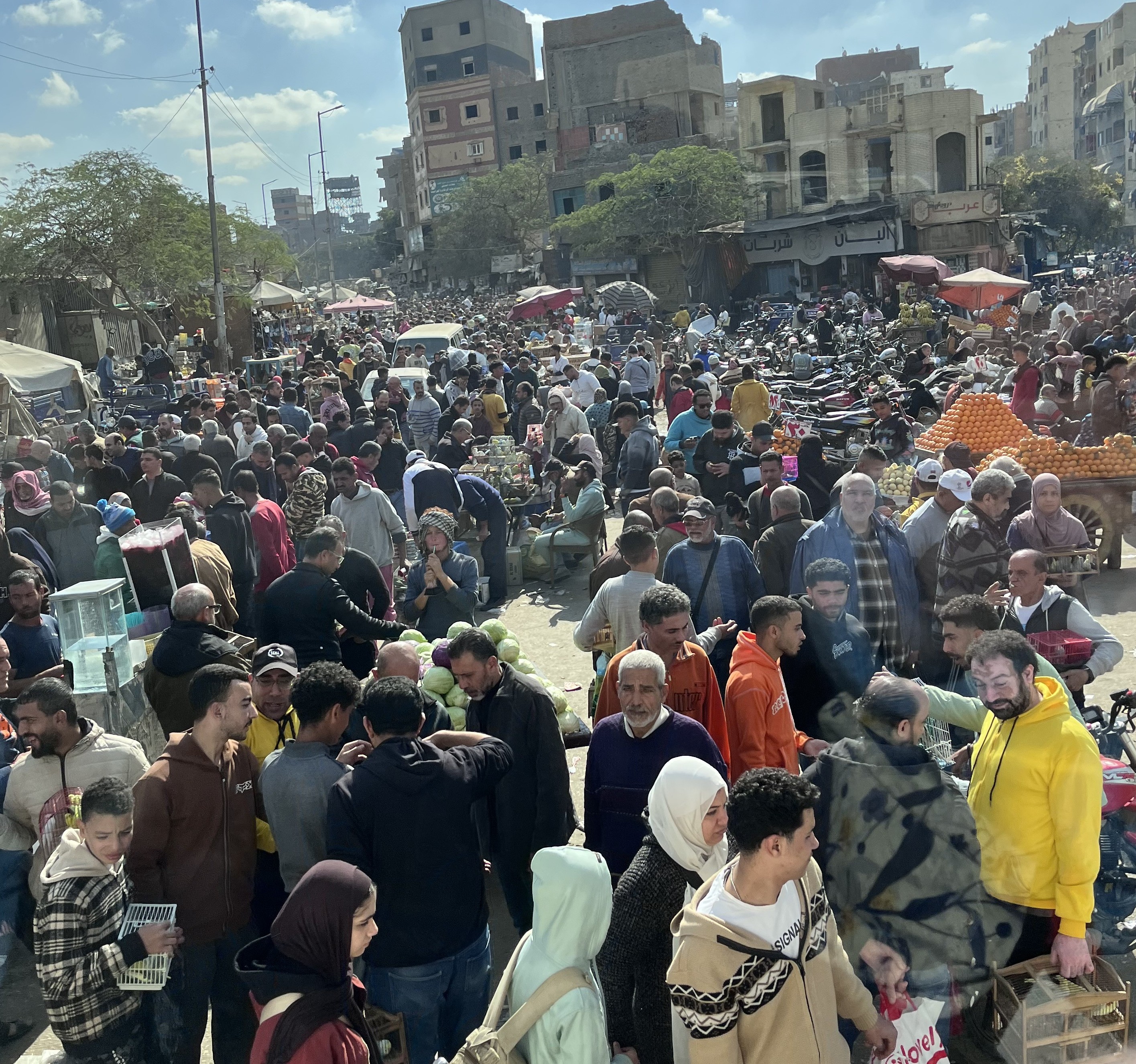
Cairo is overwhelming, full of energy, chaos, all sorts of images. The city is home to about 22 million people and it sprawls on both sides of the Nile, a juxtaposition of ancient and contemporary. Traffic is crazy. Ahmed told me that local drivers view traffic lights and travel lanes as suggestions only. As we navigated the streets in our bus, we saw minivans used as public transit as well as three-wheeled conveyances known as tuk-tuks. And motorbikes, everywhere.

Then there’s the City of the Dead, a huge and ancient cemetery complex that in the 21st century is home to thousands of people. It’s jarring to realize that people are living in those abandoned tombs, some of them with satellite dishes on the roofs.

We visited the recently opened Grand Egyptian Museum, which is vast. Ahmed told us the museum contains over 100,000 artifacts and that it would take a whole week to see everything. As it was, we hit the highlights, including the large gallery devoted to King Tutankhamun.

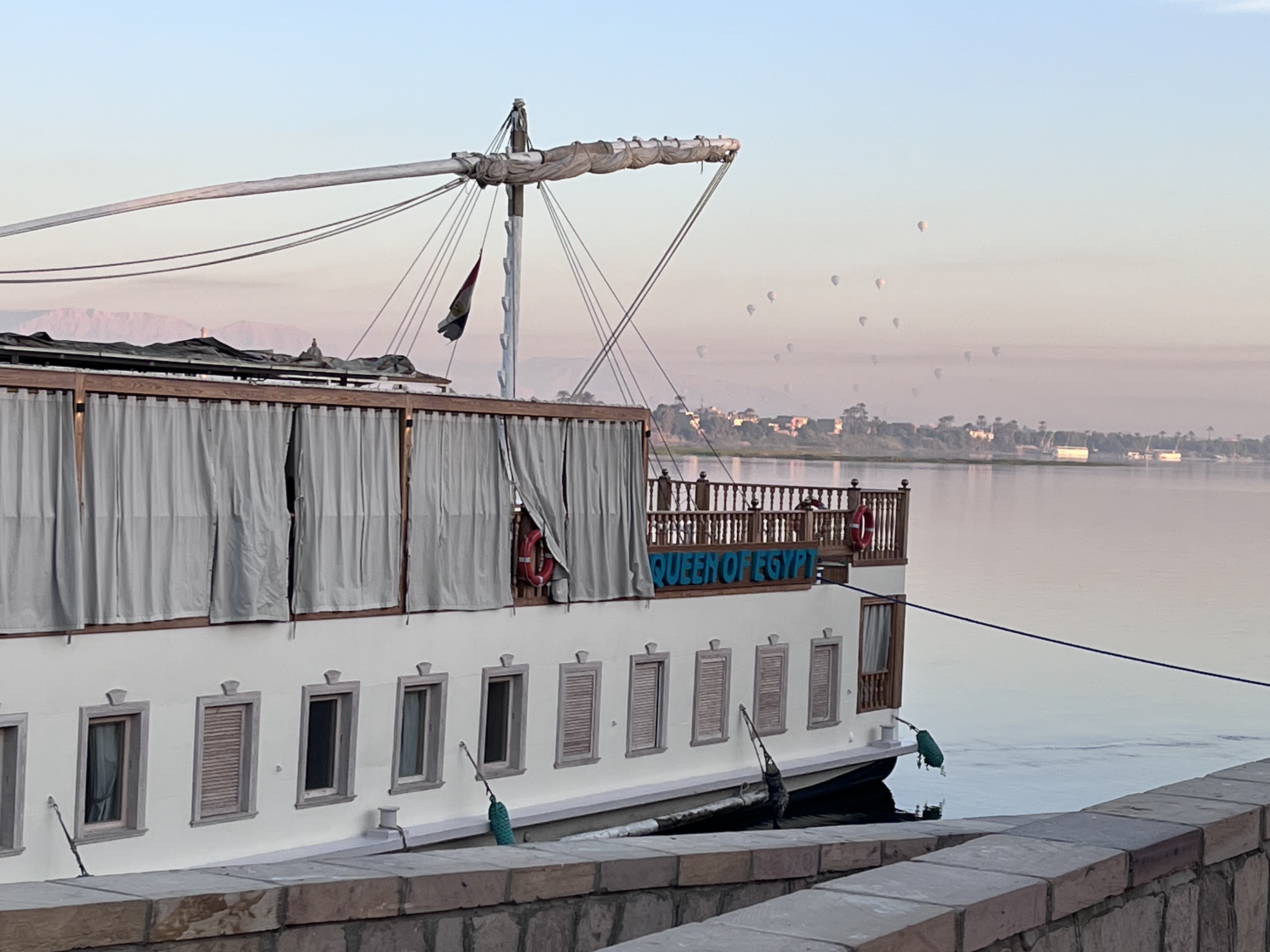
We left Cairo for Luxor, where the Queen of Egypt served as our hotel. It’s a dahabeya, a traditional flat-bottomed boat, which was towed by a tugboat, though one afternoon there was enough wind for us to sail. I spent plenty of time on deck, reading, making notes, but frequently just staring at the scenery on both sides of the Nile. As we passed villages, children gathered on the riverbank, waving and calling “Hello.”

The names of the temples unwind—Karnak, Luxor, Dendera, Esna, Edfu, Kom Ombo, Philae. And El Kab, the location of a cracking good mystery by my blogmate Janis Patterson. The Valley of the Kings, where tomb KV 62 once held the grave goods of Tutankhamun. I was surprised at the small size of the tomb.

Most awe-inspiring? So many wonderful sites, almost overwhelming. The Great Pyramid, the Sphinx, the Step Pyramid, the island temple at Philae. And definitely Abu Simbel.

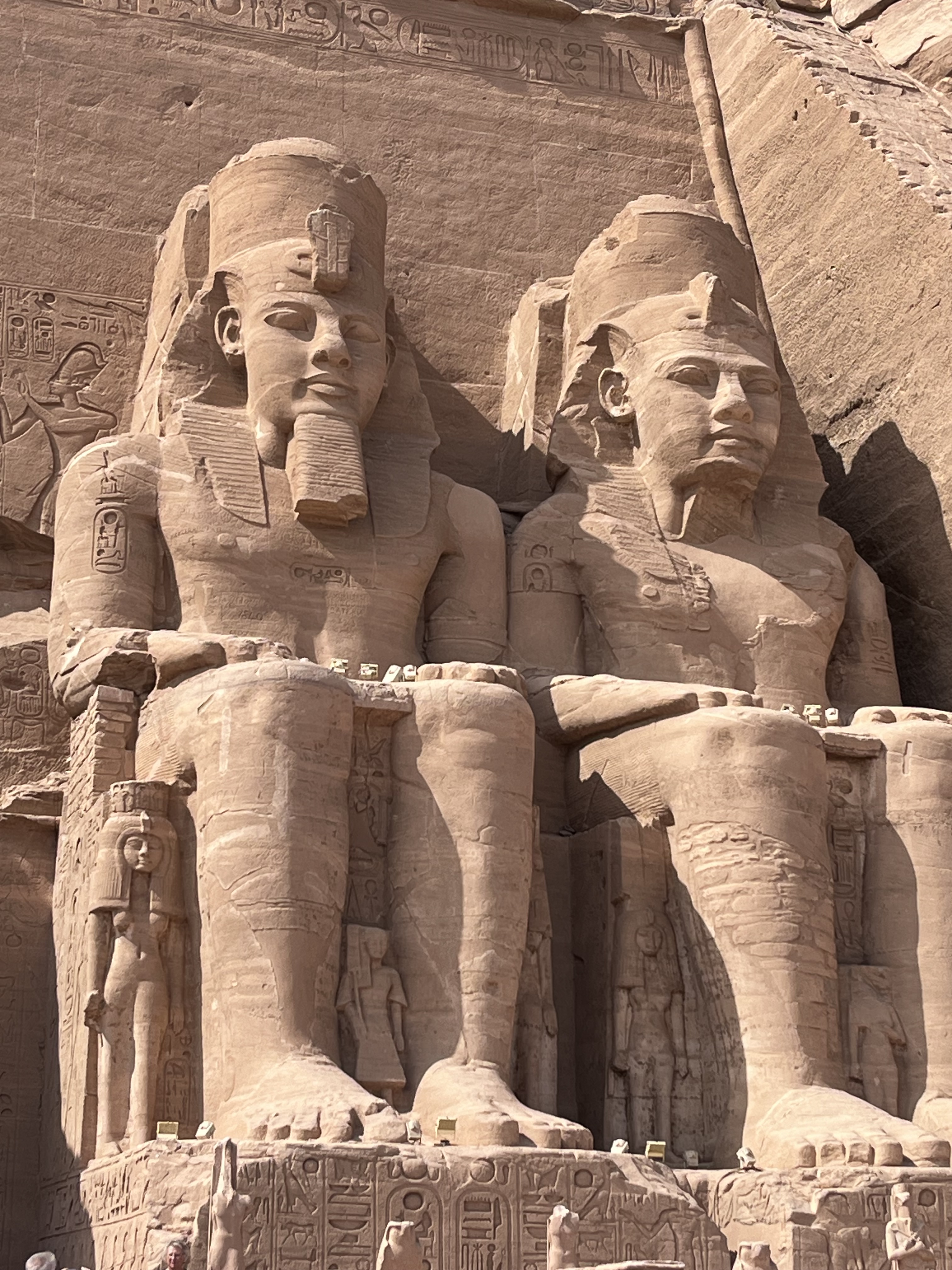
Two enormous rock-cut temples carved out of a mountainside in the 13th century BC, one temple for Rameses II and the second for his wife Nefertari. I am old enough to remember the heroic efforts to move the temple complex to higher ground so it wouldn’t be submerged by the rising waters of Lake Nasser when the Aswan High Dam was built and put into service. The temples were cut into over 1,000 pieces and transported to their new site, above the level of the lake. Being there and seeing the temples makes me realize what a remarkable feat this was.

I’m home now, recuperating from jet lag and getting back to my routine. And thinking about the stories I can tell, with ideas gleaned from my travels. After all, some of Ahmed’s stories about the adventures of a travel guide provided some interesting plots that need to be explored.

Travel is wonderful for a writer. Ideas abound. And one should always ride the camel.