

- To not get wound around my own axles, via the love of research, enthusiasm for the plot, allowing the characters to do the writing, and fingers that won’t stop typing. In the end, all the above result in too much exposition (see #3) and side plots that appear out of nowhere, which need to be wrestled in or out depending on their value to the plot. As for those fingers that just keep typing, I need to keep them curbed, especially on dialogue. Too often, my dialogue requires pruning as though I were nibbling at centuries-old grapevines, hoping to produce an excellent vintage.
Or maybe I should get wound in my axles, maybe the ultimate quality of the story is a composite of all these attributes, and for me, guilty of all three, the editing process results in a more textured tale. Still, I would like to simplify my process. I am eternally jealous of all of you who can write multiple books per year across multiple series, while I untangle the string wound around my bike spokes.

- To add more of the natural world. I always feel like I have too many trees, bushes, clouds, etc., roaming around in my books. But maybe it is not the number but the proclivity I have to write chestnut tree when I should be describing the hand-like leaves through which the sun dapples the ground? What color is the ground? Is it dusty, gravelly, filled with worn footfalls? How does fire dance other than leap, explode, cavort, or crawl? I feel that I need to make the visual world more experiential, especially with those pesky chestnut trees that succumbed to disease after my books take place. But then there is #3 below.

- To watch for telling signs of telling. I worry that, since the Wanee books are told from Cora’s point of view, it is too easy to fall into telling. Should I add another point-of-view? Or is there another, more dynamic way to include action that happens off-stage, without having the observer relate it to the protagonist, and risk descending into telling? And what about setting the stage for a book when a few things need to be “told” to bring the reader up to date? What about that? It can be deucedly hard to avoid telling it. Though, in general, I think I do a pretty good job making it more observational than tell-y.

- To plot more, rewrite less. As if. My brain tumbles out the story in a riot of words, leaving me to fix it all later. Because of this, my current process requires me to edit, edit again, edit some more, then more, possibly even more, then smooth, smooth, smooth. Then recheck every word that looks inappropriate for the period (See #5), even though I know I checked them before. Not to mention, checking and rechecking the dates historical items came into use, like telephones, arc lights, batteries for telegraphing and clothing – OMG. I suspect that if I took laborious notes, indexed them to their locations in the book, and added comments for each, I could save myself considerable editing. Or I can just write with abandon and make myself crazy. Is it too late for me to change? Probably, but I do have more plot notes for my upcoming book than usual. Does that count?

- To figure out how best to use AI. From Grammarly to Autocrit, to well everywhere these days, AI is happy to judge and make suggestions about your plot, characters, and even evaluate your dialogue for appropriateness to the 1870s, as though you hadn’t done the research before using a word, phrase or cadence. Idioms can be weirdly tricky; Shakespeare’s can sound new and something like ‘it takes one to know one’ old, when the reverse is true. One AI critique noted that, on occasion, my characters’ phrasing is too modern. How does it know? Does it know every word and phrase used across the United States in the 1870s? I would say no since each word AI deemed anachronistic was used in the 1870s, but it missed a few that weren’t, which I caught on my gazillionth read. My favorite suggestion to date is an AI-generated list of overused words. So far, these oft-used words have been characters’ names and Mr. and Miss/Mrs. in a time when this was the proper form of address.
Can AI be helpful? Yes. It can, especially regarding grammar and finding pesky misspellings, though AI recently missed a homonym that had it not been caught by a human would have embarrassed me forever. Meaning, AI doesn’t replace edit, edit again, edit some more, then more, possibly even more, then smooth, smooth, smooth, but it does have a place.
Free resolution:
- To write a new standalone thriller, because I miss the thrills. I love writing thrillers with a little romance (Saving Calypso, Booth Island, Perfidia). I do. So why haven’t I written one in over four years? Now isn’t that just a fine and dandy question?
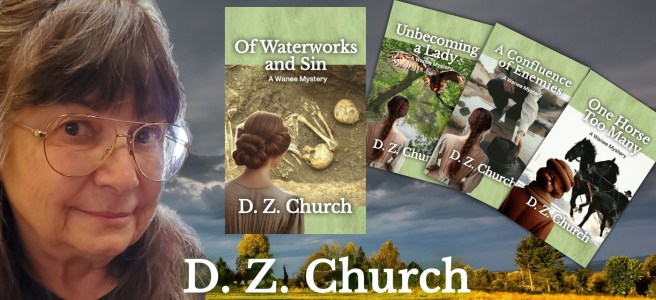
For more about D. Z. Church and her books, check out https://dzchurch.com.

 Ladies of Mystery
This is just my opinion, Dawn, regarding #3, the Wanee Series. Cora is one of the most unique and best character I’ve read in years, as is the series. I would think carefully before adding another POV. But then this is just me having invested my heart into a series that I feel is first-rate in every way. As the creator, you should do what you know to be right. And if you add another POV, it will come from a good place and I will probably love it. After all, I loved the owl, that little thief.
LikeLike
I enjoyed reading about your resolutions and learning more about your writing style. Fun post. Go for the book that is calling to you!
LikeLike
Go for that stand alone. Sometimes they’re even more fun than your familiar genres.
LikeLike