Words, A Garden Of Flowers Or A Patch of Weeds? by Heather Haven

Every time I start a new book, I wonder how my words and ideas will come together. Expressing myself sometimes can be tough. Can I do it? Because, let’s face it, it’s more than stringing a lot of pretty words together. Can I find the right ones to tantalize the reader into staying with me ‘til the end of the book? Or will the words and ideas become a mish-mash?

Remember Snoopy in the Peanuts comics? He used to sit on top of his doghouse and bang on a typewriter, writing the words, “It was a dark and stormy night…” Snoopy stole that line from Edward Bulwer-Lytton’s 1830 novel, Paul Clifford. “It was a dark and stormy night; the rain fell in torrents—except at occasional intervals, when it was checked by a violent gust of wind that swept up the streets (for it is in London that our scene lies), rattling along the housetops, and fiercely agitating the scanty flame of the lamps that struggled against the darkness.” Mr. Bulwer-Lytton himself stole it from the journal of the Doddington shipwreck that was published in 1757. Although Snoopy claims his great, great to the 15th power grandfather, Basil MacDoggal, was the originator of those words, written when he was aboard the Doddington as a mere pup. What it shows is you can’t keep a good sentence down.

What that sentence led to was a worldwide contest, the Bulwer-Lytton Fiction Contest, where writers would write marathon run-on sentences for the pure joy of doing so. And the tradition was carried on until the Bulwer-Lytton Fiction Contest hung up its pen in 2025 after 42 years. Here is just a sampling of the yearly winners:

“On reflection, Angela perceived that her relationship with Tom had always been rocky, not quite a roller-coaster ride but more like when the toilet-paper roll gets a little squashed so it hangs crooked and every time you pull some off you can hear the rest going bumpity-bumpity in its holder until you go nuts and push it back into shape, a degree of annoyance that Angela had now almost attained.” — Rephah Berg, Oakland, CA

“The corpse exuded the irresistible aroma of a piquant, ancho chili glaze enticingly enhanced with a hint of fresh cilantro as it lay before him, coyly garnished by a garland of variegated radicchio and caramelized onions, and impishly drizzled with glistening rivulets of vintage balsamic vinegar and roasted garlic oil; yes, as he surveyed the body of the slain food critic slumped on the floor of the cozy, but nearly empty, bistro, a quick inventory of his senses told corpulent Inspector Moreau that this was, in all likelihood, an inside job.” — Bob Perry, Milton, MA

I’ve read a few books, particularly by novice writers with similar opening sentences, but I suspect they weren’t thinking of the contest when they wrote them. I may have mentioned this before, but one newbie went on about a building for an entire paragraph. This building had nothing to do with the plot and was never mentioned again. A paragraph is a long time to wax poetic about anything non-germane to the story, especially on page 1. However, as it had only been one sentence, he could have submitted it to the B-L contest and just might have won. I like to look on the bright side of bad writing.

Hmmmm. I wonder if I can write one of those danged sentences? How about: “It was a dark and stormy morning with drafts swirling around like clothes in the rinse cycle of a washing machine, white clothes, bleached within an inch of their lives because that’s what you do with white clothes, bleach them, even though it weakens the integrity of the fabric, especially cotton, and cotton-linen blends, and can turn them yellow, not blue the way bluing does.”

What do you think?
The Devil Made Me Do It by Heather Haven

2025 is the 20th anniversary of the Alvarez Family Murder Mysteries. I created the family of detectives living in Palo Alto back in 2005, centered around protagonist Liana Alvarez, better known as Lee. The anniversary made me nostalgic, and I thought back on each story. Dumbfounded, I discovered that Lee was in one dangerous situation after another in every single book.

I had to face it. I like to have Lee in peril. Actually, I love it. And the more challenging the peril, the better. When I come up with a new catastrophe for her to endure in one of the books, I chortle in a way that would make Vincent Price feel right at home. When I think of another calamity, I shamelessly chortle louder.

I’ve stranded Lee at the top of a tree eye-to-eye with a territorial falcon. In another book, she crawls around inside a yucko garbage truck looking for a specific clue, ruining brand-new silk pajamas. In yet another, she’s chased by a woman armed with deadly poison darts, then held captive by said lunatic at her own wedding, a wedding at which nothing goes right. Lee’s been conked on the head, arrested for murder, trapped in an airless mine shaft, and even shot in the arm by a villain on a boat in the middle of the Gulf of Mexico during a hurricane.

What’s the matter with me? Why did I do twenty years of these things to a young(ish), charming woman, whose only fault was being in my books? As I look back on it, I’ve been merciless.

In my latest WIP, Cleopatra Slept Here, Lee reluctantly accompanies her entire family, pets included, on a private plane to Egypt for a working vacation. They are to join an archaeological dig, receiving no pay but having free room and board on a beautiful ship docked on the Nile in Luxor. The goal of the dig is to discover who Cleopatra’s real mother was. Apparently, they didn’t have birth certificates back then.

Once in Egypt, the Alvarez family is followed by unknown persons. Then Lee receives a warning note telling her to go back to where she belongs. But she soldiers on, looking forward to seeing ancient pyramids, temples, and museums, the sights that make Egypt one of the most magical countries in the world.

But I got in there, and in my own nasty way, made sure Lee doesn’t see any of the sights. Instead, she’s in and out of police stations, grappling with felons, crawling around in the ship’s hold seeking a missing youth, and leading a camel chase through the desert.

Wait! Maybe I can be absolved. She does manage to see the Nile River while on the elegant Blue Nile, the ship housing the dig’s personnel. On further thought, no absolution here. Lee sees the Nile a little too “up close and personal” when she has to jump in to save Tugger, her cat, thrown overboard by an unknown bad guy. Right after that, there’s an encounter with a deadly Egyptian Cobra hiding in the wardrobe closet of her cabin. And then there’s the – never mind. Sufficeth it to say, I’ve been coming up with messes for her to get into continually. Why, on why? Well, there’s only one explanation:

The devil made me do it.

The Good Literary Citizen

I’m having an unusually quiet (writing) week, listening to the noise of a hammer and a radio playing on the lawn as workers repair my porch. I could write during the racket, interspersed with the sounds of traffic and occasional voices passing on the sidewalk. But instead I’m marveling at how clear my to-do list is. This summer, instead of planning to get the Crime Spell Books anthology out the door to KDP in September, it’s almost ready to go—in August. I have time to work on a short story and the sixth Anita Ray mystery. How did this happen, I ask?

Over the last several years, I’ve trimmed my volunteer activities, cutting back on responding to last-minute requests for help, or invitations to join another committee. But as I see blocks of time open up and think of things I’ve put off and can now get to, I’m reminded of something else. I didn’t get here on my own. I had help. 

The one key reason I continue to volunteer for various groups devoted to writers and writing, artists and their mediums, is I believe in the importance of sharing what I know with others. When I started out writing, back in the 1980s and even earlier, in college, friends read my work and offered suggestions. That meant they took time for me. I joined a writer’s group, the first of several, and listened carefully to how they commented on each other’s work in a way that was clear and respectful, and vowed to always do the same. I went to classes, asked questions, offered to help organize workshops, and read other writers’ work. As my skills improved, and I began to publish short fiction and then novels, I was invited to participate on conference panels. I read and commented on work by writers I didn’t know, wrote reviews, composed blurbs. I enjoyed it all.

The kind of volunteer work I do with and for other writers has changed over the years. My initial modest reader responses to someone’s new story has now been replaced with a critique of how a panel will work with these writers or those, who brings what to the table and how will the writers complement each other. I refer new writers to agents I think will like their work, I advise writers interested in self-publishing what that will mean (or not mean).

I think it matters that writers share what they have learned on their own or from others, participate in the larger community, and help bring along new writers. We benefit from working with each other. Even during my college years, when I worked on the student humor magazine, I understood that to succeed, we had to work with each other. That has never not been true in all the years since. I’ve enjoyed watching new writers find their voice, an agent, a publisher; established writers try something new; others take a risk and stretch themselves. That “top of the heap” some strive for is not a peak; it’s a mesa. There’s a lot of room at the top, or whatever we call it. Sharing it with others is more fun than standing there alone.

The Truth, The Whole Truth, and Who Am I kidding? by Heather Haven

As of late, I have been MIA from the writing scene. Actually, I’ve been missing from most of life. I’ve been through something that came out of the blue and lasted for 3 months. But I have no intention of writing about it. It involves pneumonia, a blood infection, and a nasty bacterium that landed on the aortic valve of my heart, damaging the valve. All of that led to open-heart surgery. Hmmm. Well, I guess I’ve just written about it.

But that’s about all you’ll read from me. No day-to-day happenings, no long-winded tales about the experience, other than one word: scary, intense, and mind-blowing.. But I have to acknowledge how miraculous it is that open-heart surgery exists, and it can save your life. Hmmm. Well, I guess I’ve just blown the one-word thing, too.

You see, I don’t do non-fiction. Not even my own. I’m not comfortable with it. Fiction is my game, and writing about real life, other than pulling out what I need for my made-up mysteries, is not for me. True crime novels and movies scare me. I really don’t want to think about real things that happen. Nope, give me fiction every time. And if you can make it light-hearted or funny, so much the better.

Now, don’t get me wrong. I follow the news every day, online, in newspapers, “ABC World News with David Muir,” and CNN. Then I gnash my teeth, pull out my hair, and wonder what the world is coming to. When I’ve had enough of that and my blood pressure is at an all-time high, I switch the station to “The Big Bang Theory,” “Mike & Molly,” or “Matlock,” depending on my mood. Here, I know justice will be served and, if I’m lucky, I will have a few laughs.

Every word of my work-in-progress, Cleopatra Slept Here, book 11 of the Alvarez Family Murder Mysteries, is made up. At the moment, it lies fallow, being a scriptus interruptus. But I plan to get back to this pack of lies as soon as possible. My bogus characters and storyline patiently await me. They will do nothing without me because, thankfully, they aren’t real. They exist only in my head. And that’s the truth.

The Joy of Writing a Series

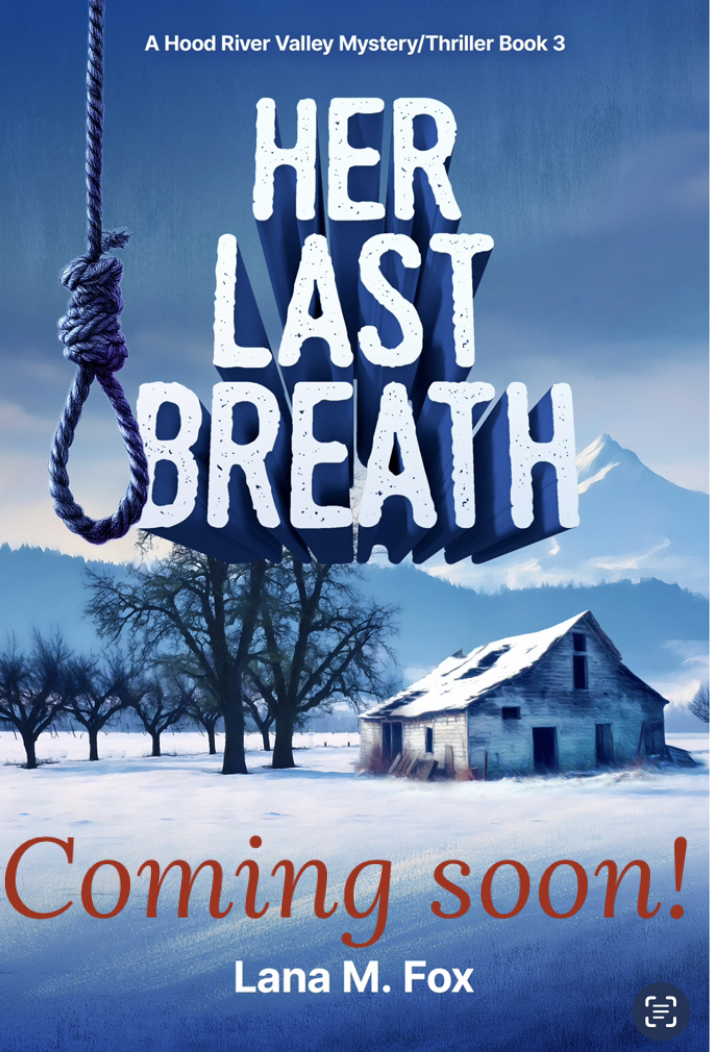
The third book in my Hood River Valley Mystery/Thriller Series is coming out soon. Her Last Breath is about a serial killer who has targeted my detective’s ex-husband, the sheriff. Here is the blurb:

Game on, Sheriff!

Detective Liz Ellisen is ready to walk away. After closing the most grueling case of her career, her resignation letter to Sheriff Mitchell Ellisen—her husband of twenty-five years and soon-to-be-ex—sits unfinished on her desk.

Then the call comes.

A young woman’s body is discovered in an abandoned barn. Staged to look like suicide, but Liz knows better. This is murder—calculated, methodical, and just the beginning.

In the barn’s dusty loft, an old Army trunk holds grim secrets; women’s pelvic bones, yellowed with age. As more young women vanish, taunting messages directed at the Sheriff begin to surface.

While racing to find the missing women, Liz battles demons on all sides—her failed marriage, her birth mother’s sudden reappearance, and the mounting evidence that points to an unthinkable suspect.

The clock is ticking, the body count rising and the killer’s game escalating.

Liz can only wonder why the Sheriff is being targeted by a killer…or is he the killer?

I’m excited to get the reaction to this book from my readers. Will they like the direction I’m taking the series? Will they continue to want more stories about these characters?

With this third book, I’m finding joy in writing a series character. I’ve found that with every book I learn more about my characters. I’ve become more engaged in their lives. I want to know what will happen next. And I hope my readers feel the same way.

My first published book was a standalone. Lots of people asked if I planned to write more books about the characters. Although I was happy that they wanted more, I felt it was one and done. I told the story, and it was finished. In my mind I didn’t need to write another book about these characters.

Then I decided to write a series. I’m finding that along with all of the fun things in doing a series, there are also issues. Keeping true to each character. Keeping them interesting and the story fresh. Remembering names and dates is a challenge and I’ve found myself messing up sometimes.

I took an online class from Deborah Crombie who writes the amazing Duncan Kincaid/Gemma James series. She said that one of the most important things you should do when writing a series is to keep a series bible. List everything about the characters that you can think of because you will need that information at some point.

I don’t know how many times I’ve had to go back to that bible and look for the name of a character who had a small part in the story. Or the name of a street where something happened. I tripped myself up by changing my detective’s parent’s names. Her father started out as Joel Scott, which I changed to George Scott, then discovered while writing the third book that I’d changed his name back to Joel! Needless to say, I had to do ‘search and find’ and change his name to George because that’s what I used in the published books. And I had changed her mother’s name from Melanie to Missy and had to change it back. It’s a very good thing that I caught both name changes and that I had written the correct names in my bible.

While the characters with small parts don’t seem that important, you never know when they will take on a larger role in a story somewhere down the road. So, it’s very important to get their names right. I’ve also had my first readers find eye color changes, and my characters being in a room and a scene or two later coming out of a different room. I’m so thankful for first readers!

I’ve been busy editing the new book, and now that it’s in the hands of my editors, I’m beginning a new standalone. I’m excited to write this book, which is something very different than what I’ve done so far. But I also find that I’m anxious to get back to my series and see what my characters are up to next. I touched on human trafficking in My Sister’s Keeper, the first book in this series, but book four will go deeper into the topic. I’m so excited to start writing it and I hope I do it justice.