
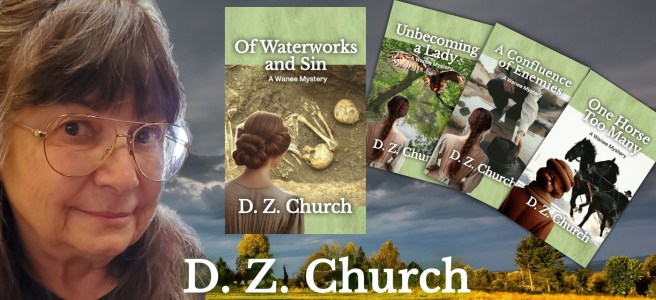
I haven’t posted five things in a while. These five issues (plus the bonus) pertain to the promises I made to myself when I conceived the idea for the Wanee Mysteries. And how that all worked out.
- Main Character. When I think of the detectives (amateur and otherwise) that I love, they all have one thing in common. The detectives are not observers, but are affected and changed by what they see. They grow, they learn, they change. The secret, I think, is to create characters that are true to their own code, their education, and their upbringing, then allow them to grow with each outing, even if that means abandoning their basic precepts while bringing the reader along, knowingly or un. For instance, in “One Horse Too Many”, Doc Shaw, raised by abolitionists, discovers he is prejudiced.
- Aging. One of my pet peeves as a reader is a series where no one ages. Come on! Am I to believe all that death and mystery happened in one place in one year? When I planned the Wanee Mysteries, I intended that the main protagonist, Cora Countryman, would begin as a girl unwilling to lose her short skirt and braid and grow into a fearless woman. I set my sights on each book occurring a minimum of three months after the book before, since one of my other goals was to have my stories unfold in a booming 1870s prairie town. To demonstrate its growth and incorporate the changes, both human and industrial, time could not be static, nor could people’s ages. So far, I’ve stuck to this goal, for why it is so important, read on.
- Daily life. One of my goals was to have those who populate Wanee, Illinois, provide a backdrop, depth and fun to the mysteries. That means the characters, subcharacters, and even the Methodist owl have lives that include romance, marriage, babies, death, and everything in between. As a consequence, Wanee is rich in Cora’s lifelong friends, one pregnant, one attempting to forge a new life, a young doctor challenged daily, a man attempting to redefine himself, and old friends living their lives. Two of the above are suitors, only one of whom can win. Or maybe, none. I pray their lives help define the period, the mores, small town life, and Cora. A reviewer notes: “I love Cora and all the surrounding characters. The voice is so solid, and the details are so vivid that I am transported back to the small, Midwest town circa 1876 every time.”
- The canvas. I set out to build a town grappling with growth and change as the backdrop for my stories. When the mysteries start, Wanee is a pretty sleepy place, or so everyone thinks. Yet the 1870s were anything but. The railroad opened up the country, and towns built water systems, bringing indoor bathrooms and electricity to the bigger cities. Small telephone companies sprang up, coal-fired boiler furnaces appeared, and people roamed, including hobos who stopped long enough to make money before moving on. Politics were raw as people continued to deal with the fallout of the Civil War. One reviewer notes: “Church populates the town with an array of fascinating characters and shows the upheaval of a changing society, as well as the lingering trauma of the Civil War.” So, I guess I can give myself a star for number 4.
- Point of View. I envisioned that Cora Countryman would always tell the tale from her point of view. Frankly, I struggle with maintaining this. The reason is that I created three other characters who could easily carry any story and are often at the heart of big doings, leaving Cora to discover details from them. The decision to begin “A Confluence of Enemies” from Sebastian Kanady’s point of view broke my rule right out of the gate. But it was needed to make the book work. So, I guess the rule is, it’s Cora’s way unless it isn’t. I think in the future there may be more isn’t. But, then, again, it won’t be her story. Darn!
- Bonus: To dangle or not to dangle. Let this bit of wisdom be a warning to us all. A reviewer writes: “This could have been the beginning of a great new series (in my humble opinion) if not for that bomb on the last page. Does it all go down the drain for a few more cents in future sales?” The truly unfortunate part of this is, if the reader had scanned the first pages of the next book, he would have discovered that his presumption was wrong. I guess it is my fault for ending with a joke between friends that was never intended as a dangle. I could always eliminate the offending bits, maybe I should? Accepting all thoughts on this, so feel free to comment.
Read about me, find my books, and sign up for my newsletter at https://dzchurch.com.

 Ladies of Mystery
I like how you stay true to your rules, mostly. 😉 I have my characters age, though it’s hard to do with animals as they don’t have as long a lifespan. Especially dogs. And I have dogs in all of my series. I fudge on the POV too. My Hawke books were supposed to be always in Hawke’s POVB but I’ve needed to use the victims or the villain’s POV at times and some secondary characters to get the ball rolling for the story. Great insight into not only writing a cozy but your series!
LikeLike
Pat Pirard in my PIP Inc. Mysteries series in turning 35 in the first book when she is downsized from her job as Santa Cruz County Law Librarian and printed business cards declaring herself “Private Investigator Pat.” She’s aging slowly because each case follows immediately on the heels of her last one. She will age, though, if slowly in the series.
LikeLike
I really like the depth of thinking with which you approach your series and the major aspects of it, especially the idea of transformative growth in a period like the 1870s. Good post.
LikeLike