
It’s no secret that actors and writers have one big, big thing in common. Well, at least in my book. When faced with a tough scene, actors draw on their own memories and emotions to emote and draw us all in so that we believe in their every breath. There are so many great examples of this, but one that has stuck with me since I first saw To Kill a Mockingbird is the scene where Atticus (Gregory Peck) and Scout (Mary Badham) discuss her mother’s pearls. The emotion was so genuine, the theater so dark, and the patrons next to me so enraptured that I was present in that moment.
Like actors, writers seek the motivation and moment in our past to make what we write as real as the scene in ‘To Kill a Mockingbird’ was to me. We aren’t always successful, nor are actors, but it is in the trying.
One might ask, what could a successful businessperson know about poverty, worry about the next meal, or a place to sleep, well? While waiting to hear if yet another job interview with another ad agency would end in employment, I opened the linen closet in my roommate’s apartment (actually, I bunked on her couch). I spent several sleepless months there, the folks across the hall were the noisiest lovers in the entire frigging world. To this day, I suspect kink, when they stopped, about three, I slept.
On the day in question, I went to the cardboard box where I kept my money and was reminded that I had $79.00 left to my name. I owed my more-than-gracious roommate rent, gas for her car (the one she let me drive to my interview), and money for the phone bill. If I got the job, I had barely enough money left to ride rapid transit until I received my first paycheck. I sat with a plunk on my roommate’s couch and stared at the wall. The ad agency called the next day. I never looked back, but to this day, every time one of my bank accounts ends in $79, I freak out so badly that I sometimes transfer money from account to account just to change the final digits.
And where do I go when I need to describe action? The same place every writer does, the part of our brain where we stow our wild and risky adventures.
When I was eight, my family took a road trip in our massive aqua and white Nash Rambler. The one with the Nash seat, the front seats dropped all the way down, making the inside of the car into a king-size bed. It was a wonderful beast. To this day, I think of it and grin until it hurts. One night, we arrived at the campground on the Suwanee River very late and, rather than pitching the tent, dropped the seats, and the four of us—Mom, Dad, and sister Lynn slept four abreast.
In the morning, the air was so dense with moisture that it formed a haze. A few minutes in it and your clothes felt moist. My sister, a notoriously robust sleeper, was still sleeping, and Mom was wrestling with the coffee pot, when Dad held up the Frisbee and motioned for me to follow him to an open field.
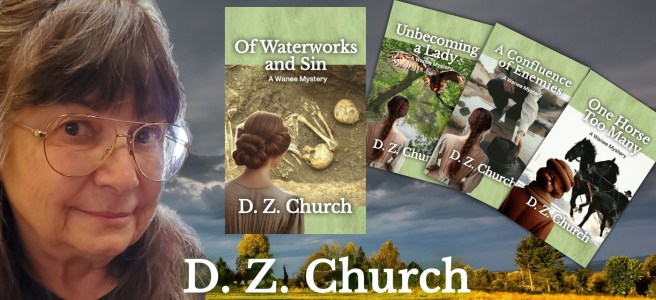
Dad sent soft passes my way, I’d grab them, that is, until a Great Horned Owl swooped out of the early morning mist, grabbed the hair on the top of my head, and tried to fly away with me. Dad threw the Frisbee at the owl and ran toward me, maybe to grab my feet as I was lifted into the air. The owl flapped its wide wings and flew away with a hank of hair in its talons. That memory of how scared, fascinated, and small I felt was available when I needed to describe the owl attacks in “Unbecoming a Lady,” the first book in the Wanee Mystery series.
Writers keep these moments in their back pockets. It is remembering, applying, and interpreting them that results in the descriptive words on the page, just like actors rely on their past to create character. And, like them, we never know what tidbit from the past will meet the need and allow us to leave our readers gasping, or sobbing, or in wonder, as Atticus and Scout do every single time I rewatch ‘To Kill a Mockingbird.’
Find me at https://dzchurch.com, where you can discover all my books and sign up for my newsletter.


An excellent post on how we use the resources embedded in our lives.
LikeLike
Great post! Wow, what an experience! And way to go adding it to your story. I’m sure most writers use something they’ve lived or experienced to make their stories draw the reader in. I know nearly every book I write has something that has happened to me in it.
LikeLike
A great post. I had no idea the owl scene was based on an incident that happened to you as a kid. It’s a wonderful scene, but the way. But the series is one of my favorites.
LikeLike
That’s “by the way.”
LikeLike
I love live theater for just the reasons you described–the moments when we are with story tellers, actors, living the words they’re speaking. When I’m working on a story I’m often surprised at what comes out onto the page, but if it catches me, then I’m pretty sure it will catch the reader. Those lived moments transformed are what make great stories. Great post.
LikeLike