The Creative Juices Of A Writer by Heather Haven

And why I sometimes need basting.

I am always impressed by the creative gifts of many of my fellow authors. Not only are they good writers, but their talents often extend to book covers, ad campaigns, blurbs, banners, and more. And let me add, whatever they touch turns out pretty danged good.

As for me, I’ve spent time and energy doing a lot of my own book covers. Here I let out a deep sigh because the American academic grading system would probably only give my efforts a C+. And I throw myself the extra + because this is my post. It is not something that comes naturally to me. Regardless, I love doing the Persephone Cole covers and some of my other books. But not without tons of feedback from trusted pals. For the record, I am never allowed to touch the Alvarez Family covers. The Powers That Be have mandated.

This brings me back to my fellow mystery writers and why I love ’em. As we go through this crazy journey of being a wordsmith, we regularly ask each other for advice or to look at a WIP with a fresh eye. No one has to say please be candid without being cruel. The last part is a given for my pals. They haven’t got a mean bone in their body. And as we’ve all been taught in our writing classes, “Sweetie, I love your hair, but …”

Last month Janet Dawson, one of our very own, had a new banner for her post on Ladies of Mystery and I was smitten with it (see below). I had to have one, too. Actually, I wanted hers but plagiarism is still nasty-naughty, even though AI does it with aplomb and their masters think it’s not only okay but the wave of the future. Really? Have a REAL plum, honey.

Moving on. After hours of going round-robin, I sent Janet the first version of my banner for feedback. It wasn’t working. As usual, she came up with helpful suggestions. Janet said, in a very supportive way, it was a little busy and dark. Keep the work simpler and lighter, she advised. She even offered to help me do it. I was touched and relieved. Yayyy! A partner. But at 12:45 am, I woke up with another thought: Why not take the cartoon image I’ve been using and add to it? In other words, build on what I’ve got. So I did. Ta-da! My masterpiece, such as it is (see the orange thing at top of page).

I probably would have never arrived at going simpler or using white lettering on a darker background without Janet’s help. That’s why I love round-table endeavors. I love brainstorming. I love it when people put the work first and not their egos. And I try to do the same. Learning by osmosis, don’tchaknow. So, I want to thank all my fellow writers who have offered friendship, support, and words of wisdom.

But I am not surprised. Because that’s what mystery writers do with aplomb.

Hooray For The Sanborn Maps!

Let us now give thanks for the Sanborn maps, a valuable tool for writers.

You’ve never heard of them? I hadn’t either, until I started working at the University of California Berkeley. I was a staffer in a research unit affiliated with the College of Environmental Design, which is where I first heard the term the built environment.

According to Science Direct:

The term built environment refers to the human-made surroundings that provide the setting for human activity, ranging in scale from buildings and parks or green space to neighborhoods and cities that can often include their supporting infrastructure, such as water supply or energy networks.

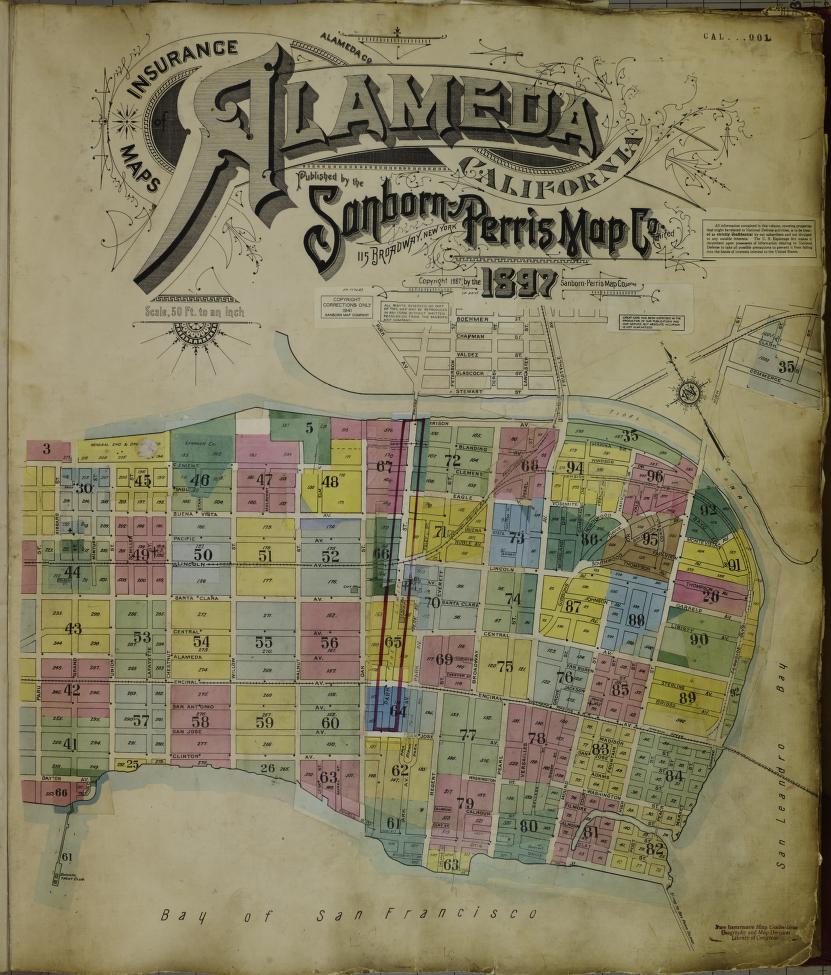
The Sanborn maps show a detailed view of the built environment. Great for writers, because if we’re writing about a particular location, it helps to know what building was on which corner. Fortunately, many of the Sanborn maps have been digitized. Which is great since the bound volumes are quite large and bulky—and not readily available.

Now for some background. The Sanborn Map Company created and published detailed maps of US cities and towns in the 19th and 20th centuries. The earliest published map shows Boston in 1969. The maps were large-scale, lithographed street plans, published in volumes, bound, and updated.

They were created so that fire insurance companies could assess their liability in urbanized areas, utilizing detailed information about properties and individual buildings in approximately 12,000 cities and towns.

The Sanborn maps contain an enormous amount of information. Once you get past the title page and various indexes, the maps themselves show the outlines of each building and outbuilding; the location of windows and doors; street names; street and sidewalk widths; property boundaries; fire walls; natural features such as rivers; railroad corridors; building use (sometimes even particular room uses); house and block number; as well as the composition of building materials including the framing, flooring, and roofing materials; the strength of the local fire department; indications of sprinkler systems; locations of fire hydrants; location of water and gas mains; and even the names of most public buildings, churches and businesses. Even brothels, outhouses and stables! A treasure trove!

You can access the maps through the Library of Congress, though I’m not sure they have the complete collection. What they do have is voluminous. Here’s a link:

https://www.loc.gov/collections/sanborn-maps/about-this-collection/

While writing Death Above the Line, the latest Jill McLeod novel, set in Niles, California in 1953, I consulted a Sanborn map for that small township in Alameda County. I learned that what is now called Niles Boulevard was called Front Street back then. There was a hotel on a corner opposite the train station, which served the purposes of my plot. I also found a large vacant lot farther down the street where I could locate my fictional warehouse-turned-movie-studio.

For my work-in-progress, which takes place in New Mexico territory in the late 1870s and early 1880s, the maps are invaluable. Even now, I’m looking at a digital map of Santa Fe in 1883 that points out the location of the post office, on a corner east of the Plaza, next door to a jewelry shop, an insurance office, and a barber shop—and there was a gambling hall behind that. On another downtown street, I find a bookstore sandwiched between a bank and another building labeled “Gambling Mdse.” I’m intrigued by that one.

Once I figured out that the legend “Dwg.” means dwelling, that gave me an idea of where people lived. Especially useful since my protagonist is renting a room in someone’s home. Now I know where to put that fictional house.

I love looking at maps and I could certainly spend hours with the Sanborn maps. Try them—you’ll get hooked!