Mired? Inundated?? Overwhelmed???

If you are like me, the minute you log onto your email, social sites, or even play games on your phone, you’re swamped by all the little helpers who want to teach you to write, publish, do covers, and do advertising. They’d love you to sell your own books, or not. They want to help you discover the perfect genre to write in to make a bazillion dollars on the first day. They’ll fix your grammatical errors, check your writing against the great masters, tell you how to rewrite it to get closer to whoever you’re mimicking and if that isn’t enough they have AI that will do all of this for you.

Sheesh! How can you write with all this noise? It can make you skeptical of your skills, of your ideas, and well … everything until it mires, weighs, just crunches you into stasis. One of my favorite seminar offers was this … yes, I clicked on it, and, yes, I read it. A workshop that would assist you in toning up your genre, so that your readers wouldn’t be disappointed when they picked up your book. Then it went on to say, if you want to stand out you should change up the tropes. Make your hero a bit dopey, like the dwarf. Make your heroine slightly goofy, like the dog. Do something different. Am I the only one who finds this totally wacko?

Why on this green earth would I take time from writing to attend a seminar that purportedly teaches me about my genre and then promotes breaking form? Isn’t breaking form another word for originality, shouldn’t we all have a uniqueness about our books if we are any good at our trade?

Then there are the software folks who will gladly parse, slice, and dice your text. They will compare you to others in the genre you write. Either inflate or deflate you. Then offer to fix your text right up with their AI system. Am I crazy, is that writing?

I thought writing a book was about plotting, researching, sitting your butt on a chair and pounding on the keys. Reviewing what you wrote the day before, before beginning on the next day’s text. And when you finish, you edit, have it edited, edit again. Then tend to the cover and cover text — maybe not mimicking every darn cover in your genre, but break out there a bit, too. Here’s a random thought. Whatever happened to cover reveals? I admit I did a few. But where have they gone?

Yes, we all hope to sell our books, make some money, and gain some recognition … but when we swim upstream through creepy, sometimes badly written, pushy, flim-flam, how are we supposed to find the wheat in the chaff? Like for instance, those who can truly help us. There are people and sites I trust. And people and sites I use. But it seems like each time I use one of them, I am barraged by hucksters offering software, seminars, and surefire ways to increase my mailing list, outsmart Amazon, and find fame.

It’s enough to make one write a dystopian YA book in which the books in the library begin to randomly fling themselves off the walls, screaming as they fly at you, read me, read me, read me until you’re crushed by the weight of them.

Is that the definition of overwhelmed?

Despite this, the newest book in my Wanee Mystery series, “Of Waterworks and Sin,” will make its debut on April 15. Yes, tax day. And will be available for pre-order on March 15, not tax-day. That is if everyone in the Library of Congress isn’t fired first.
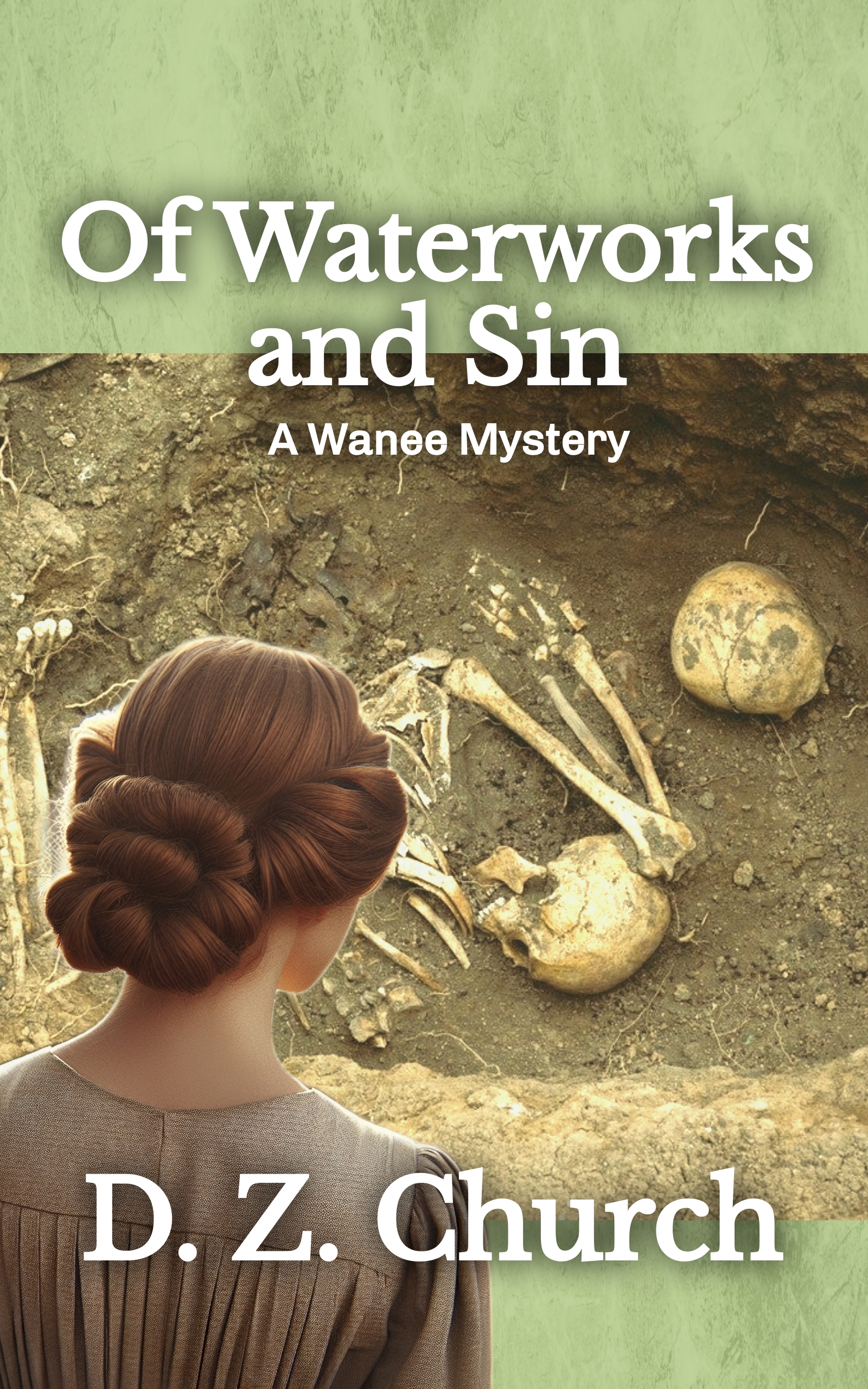
Here’s a brief, brief:

As a favor to the newspaper’s owner, Cora Countryman takes over editing the town newspaper. When two skeletons are found by diggers while trenching the new water main, she can’t resist investigating. As she digs deeper, she becomes fixated on the identity of a mysterious child connected to the victims. With the year 1865 and the memory of a shanty fire looming over her inquiry, Cora suspects a returned Civil War veteran, but which one?

Certifiably not written by AI.

Find me and my books at: https://dzchurch.com.
PAID IN KIND

Yesterday was my first author event of the year. I sold half the books I did at the same event last year, and while I wished I’d had a bigger “payday,” I feel blessed that I was paid in other ways. And remember, you can’t tell my husband, but I’m not driven by money. However, I love hearing from a reader: I loved your book!

I’ve written before about feeling blessed by tips and tidbits from other authors. I also enjoy meeting people, whether they buy my books or not, and brainstorming with someone interested in becoming an author.

This event brought yet another opportunity to see how I continue to be paid in different ways.

When I started my Stoneybrook Mystery Series, which I write to honor my son, Derrick, I had already chosen the name of my fictional Oregon town. To my surprise and joy, I found myself sharing the story behind the name with two couples.

First, the story …

Randy and I attend the Oregon Jamboree in Sweet Home, Oregon, every August. It’s an annual country music festival that has brought such stars to Oregon as Toby Keith and Reba McIntire to the stage. I like to tell people who ask about the festival that we were lucky enough to see Kenny Chesney “before” he became four-time “Entertainer of the Year” winner, Kenny Chesney.

We also love Sweet Home’s small-town charm, even when 45,000 people flood the town during the three-day concert. Since we’ve attended the event over the last twenty years, we’ve secured a premium campsite across the street from the venue entrance.

I’m a people person and am still friends with people I met in the first few years of this fabulous weekend. Three young women were among those friends. The trio adopted us as their Jamboree Parents and spent time at our campsite.

One Saturday night after the concert ended, I was enjoying a nightcap with some of my friends in my RV. There was a knock on the door. It was one of the trio who said she’d been separated from the other two. I invited her in, and she joined us as we had snacks and drinks. Her phone rang, and this was her end of the conversation:

“You guys left me while I was in the port-a-potty.”
“No. I’m not going to walk there by myself; you all need to come here.”
“At the Stoneybrook’s.”

She ended the call, then offered an impish grin when we all stared at her.

“Stoneybrook’s?” I said.
“Well, that’s what we call you guys cause you’re old.” She laughed. “Stoneybrook is the name of the old folks’ home by our house in Corvallis.”
We all had a good laugh, and though my friends and I were far from “old” all those years ago, the moniker stuck!

At my event yesterday, an older couple stopped at my table and asked about “Redneck Ranch,” Book One in the Stoneybrook Mystery Series. I launched into my well-rehearsed spiel, and when I said, “When Harley arrives in Stoneybrook, Oregon—” the man cut in with, “Do you mean the Stoneybrook Senior Living Center in Corvallis?”

I responded with, “Funny, you should ask?” Then, I launched into my story.

About an hour later, a young couple came by and asked about “Redneck Ranch,” and I began my pitch again. This time, the wife told me she works as a Stoneybrook Senior Living Center nurse. We laughed when I told them of my previous visitors, explaining how they’d suggested I ask the center about doing an Author Event for the residents. The wife gave me her phone number and asked me to contact her this coming week because she thought an Author Event was a fabulous idea.

No books were sold to these two couples, but I feel like Derrick sent them my way. Not only did I get to share how Derrick inspired the character of an autistic deputy sheriff who always solves the crimes in my Stoneybrook Mystery Series, but I might now have an opportunity to tell this wonderful story to a room full of Stoneybrook’s.

As amazing as meeting these two couples was, Derrick wasn’t done sending people to my table.

An event like this author fair is designed to attract all types of readers who can peruse various genres. Guests can wander throughout a large room that this year housed 42 authors. We all have the same goal: to attract readers to our tables in hopes that they will buy our books. But now and then, you encounter a reader with whom you share more than an interest in reading.

When Tom and Judy stopped to look at my Mexico Mayhem series, I waited a beat before engaging them in conversation since Judy was reading the back cover blurb for “Peril in Paradise.”

Judy looked at me, tears in her eyes, and said, “How could you write a book about someone losing a child if you’ve never had that experience?”

Tom placed an arm around Judy’s shoulder and drew her close.

“I-I—” a lump clogged my throat, “have lost a child.”

Judy reached out a hand and touched my arm. “We lost our son, Matthew, five years ago.”
“I lost my son, Derrick, eight years ago.”
“Oh,” Judy nodded, “so you do know.”
“Yes.” I squeezed her hand. “How did you lose Matthew?”
“He needed a heart transplant that never happened.” Judy swiped a tear from her cheek. “He left us just after his forty-fourth birthday.”
“Derrick had a sudden heart attack at thirty-six,” I told her.

We talked for a few minutes about our sons, and then I asked Judy if she would mind if I sent her and Tom a pair of White Wings. I explained that I’d been gifting the wings and a poem about grieving parents to people like us.

“That would be so kind of you.” Judy smiled. “And I’d like to buy this book since Clara is a mom like us who also belongs to this sad club.”

I sold Judy “Peril in Paradise,” and she gave me her mailing address. I may never see Tom and Judy again, but I’m comforted that they will have a pair of White Wings to honor their son … and maybe even remind them of me.

My first event wasn’t as lucrative as I’d hoped, but I value the “payments in kind” from the fabulous people who brought me opportunities for the future … and a moment to share my grief with another mother.

If you participate in Author Events this year, I hope you will be richer in more than one way.

Happy Writing, Ladies ~ Kimila

Silk Road Inspiration

Recently a friend told me about a trip her mother wanted to take with her to India, and asked me about some of the sights and events planned for them. I found a description of the trip online and skimmed through it thinking how I would answer her questions when just below was another trip that threw all my travel plans and budget for the year into the trash can.

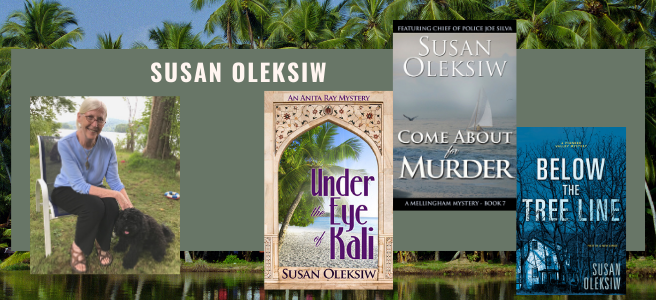
When I was perhaps eleven or twelve years old I came across a book about a trip to Central Asia. After You, Marco Polo by Jean Bowie Shor describes a journey she and her husband made following in the footsteps of the explorer on his travels from Venice to China in the late 13th century. The book was published in 1955, only a few years after their trip in the late 1940s. The author is the definition of the word intrepid, and I don’t believe anyone alive today would even consider taking the same trip so dependent are we on cell phones, public transportation, emergency services, detailed maps, and reliable guides, not to mention translation programs on our cell phones and a general sense of peace and safety (now perhaps ebbing). I reread this book recently and it is still one of the most incredible survival stories of any traveler on the Silk Road in Central Asia I have encountered.

This book sparked my love of Asia, as a result of which I ended up living in India for a year doing research, and then returning for a second year for more of the same. I’ve been back several times to visit friends, and even though I’m no longer any kind of scholar, I’ve maintained my interest in India in the Anita Ray series and several photography projects. The author, Jean Bowie Shor, inspired numerous characters with her impetuous forays into forbidden areas and unbelievable luck in surviving and even thriving, as well as her fortitude in traversing a 20,000 foot mountain pass with her fever-stricken, delirious husband and two guides who were hoping to fleece their dead bodies of more money than the entire community would see in a hundred life times.

I don’t plan to write during the trip, but that’s a plan that can quickly evaporate. I do plan to take a lot of photographs, and as I often do when working on an Anita Ray story, I’ll line up the most interesting along my desk to glance at while I work after I get home. Some people like music in the background, some like a particular bit of clutter, I like photographs.

Now, after many years, I’m finally taking my dream trip—to the Silk Road. I’ve signed on for a tour with about a dozen others to visit three of the Stans—Kazakhstan, Uzbekistan, and Kyrgyzstan—along the Silk Road. After a lapse of many decades, I will be part of the kind of  ensembles of tourists that I find so stimulatingly murderous in my Anita Ray series set in South India. I’m doing a lot of background reading so I’ll be ready for my characters when they show up. The trip is scheduled for the fall, so I have a lot of time to enjoy one of the best parts of travel—anticipation.

I’m not sure what this post is about, but I’m booked for a trip I’ve dreamt about for years and taking it now seems fitting.

Why I Write Thrillers

In less than a month I will be flying to Denver for Left Coast Crime. I’m so excited! I’ve been invited to speak on a panel called Why We Write Thrillers. What a great topic. I had to spend some time thinking about this. I knew I enjoyed reading them, but why write them?

Well, for one thing, I love to read a good thriller. I’ve heard that you should write what you love to read. But why do I love them? Why are they so popular? I think it’s because they grab you and won’t let go until the final twist. And that is what I want my books to do. I love it when readers say they stayed up all night reading my books because they couldn’t put them down.

Reading a thriller is like hurling yourself towards a runaway train. You know it’s coming, you can see it coming, and you want to be like Superman and get in front of it and put your hand out to stop it. To do that, you need to know who started the train barreling down the track, why they started it, and a twisty way of stopping it. Because, unlike Superman, holding out your hand towards it isn’t going to get the job done.

It’s the excitement that’s addictive. That feeling in your gut that the main character just might not pull this off, but she does, and in a way you never expected.

Thrillers allow you to explore dark themes in a way that is safe. I want to know why people join a cult. (Her Sister’s Keeper) Why someone would kill a young homeless girl and leave her body frozen in the snow. (Through Frozen Eyes) And why a serial killer kills women and leaves them as a gift offering for the sheriff. (Her Last Breath, which will be out this spring.)

I’ve heard that people read and write thrillers to bring justice to an unjust world. I love it when the story ends with the killer being caught and sent to prison, or being killed by the main character just before he or she kills said main character or someone they love. And sometimes I love it when at the end of the book the killer is caught, but there may be another killer out there who will continue their killing spree. Suspense is what makes us come back for more.

I’m about three fourths of the way finished writing my fourth book. This will be the third in my Hood River Valley Series. It’s about a killer who is playing cat and mouse with the sheriff. I thought I knew why he was killing women, but while writing this post I realized there is more to his past and his psychological makeup than I knew. It’s the, why did the killer do what they did that makes the story more exciting. What’s in his or her background that would cause them to do something so heinous?

Plot is the structure of the story and characters are the meat. They give the story substance. This is especially true in a thriller. I feel a need to know my characters, to try and feel what they feel. Why are they in this particular place and time? What can they contribute to the story to make it come alive?

And then there’s the twist at the end. It isn’t just about shock; it has to make sense in hindsight. It’s the perfect blend of surprise and credibility. These are the things that make writing thrillers such a joy for me. Or should I say, such a thrill?

Dammit. I’m a suspect.


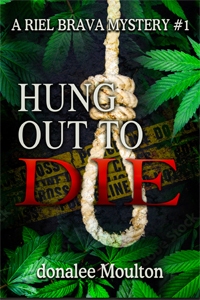
book cover from Hung Out To Die

I’m reaching for the hallway switch when I notice a light three doors down. That’s Norm Bedwell’s office. And that’s unusual. Our comptroller is typically among the last to arrive. Only a fresh honey cruller from Tim Hortons has ever changed his timeline.

I’m running to Norm’s office now, tirade at the ready. The only thing that can prevent the outside security system from working, aside from someone hacking into our server, is if the door doesn’t latch firmly behind the entering employee. A loud audible click lets you know the system is armed, and then you can move forward. Employees are trained to wait for the click; if they don’t, an alarm will sound for two minutes, albeit relatively soft as alarms go. But at this time of day, no one is around to hear it.

It must be Norm’s fault, which may mean the system has only been down for minutes if he just arrived. It’s a question I’m tossing at our comptroller even before I’ve stepped inside his office.

Norm doesn’t answer.

He can’t because he’s swinging from a rope tossed over an open beam (the designer’s brilliant idea), a noose tight around his neck. He’s blue, but not as blue as I believe a dead man should look. This poses a dilemma. I need a few moments to assess my options and identify the safest and most effective course of action. However, I am aware I don’t have the luxury of time. I’ve seen enough Law and Order episodes to know if you don’t call the cops immediately, the delay in time will get noticed, and you’re more likely to find yourself on the suspect list.

Dammit. I’m a suspect.

This realization hits at the same time I’m dialing 911. The perky young woman on the other end asks how she can help.

“I’m in the administrative office of the Canadian Cannabis Corp., and my comptroller appears to have hanged himself. He is dangling from a noose and turning blue.”

“Sir, I have radioed for police; they are on their way,” she says, inhaling to continue with her script.

I cut her off. “Look, I know I shouldn’t disturb anything, but Norm may be alive. I’m going to grab his legs, so the noose doesn’t cut into his windpipe.”

Great, now she knows I understand how hanging kills someone.

Itdoesn’t matter. I’m going to reduce the pressure around Norm’s neck. His feet are tucked into the crease in my left arm, his testicles on par with my bottom lip. I’m not a small man, 6’2”, and I work out regularly, so I can maintain this, albeit a distasteful posture, for quite some time.

I hear sirens, and it hits me. The police won’t gain access to the building without destroying expensive technology. I explain this to the 911 operator. She is not that interested in the cost of our tech.

“I’m going to get someone to open the gate for the police,” I tell her. “That means I’ll have to hang up. I’m on the third floor of the admin building, inside the only office with a light on. My name is Riel Brava. I’m the CEO.”