

Jeri Howard is aging a lot slower than I am. She was in her early thirties when I wrote and published Kindred Crimes, the first book in my long-running series, in 1990. Last year, I published the fourteenth book, The Things We Keep. By now Jeri is in her late thirties.
As for me, well, we won’t talk about how old I am, but it’s been a while since I graduated from college. I admit to the aches and pains of what I prefer to call upper middle age.

Jeri is a private investigator in Oakland, California. Way back when, she used paper maps to find her way from place to place and worked on a dual disk drive computer with floppy disks. Remember those? I do! Jeri was always looking for a pay phone when she needed to make calls.
How things have changed. These days, she relies on her smart phone to make calls and get her where she needs to go. She still gumshoes around and talks to people in person, so she can read facial expressions and body language. The internet has been a great help in her detective work. Using the technology available to her, she researches online. In The Things We Keep, she uses a missing persons database as well as online copies of old newspaper articles to get information about the people who inhabit the book, past and present. And that cell phone comes in handy when she needs to take photos or record an interview with a witness.
I recall Sue Grafton, whose book A is for Alibi was published in 1982. Through 25 books, Grafton made the decision to leave her character Kinsey Milhone fixed in time, in the 1980s. She didn’t have to deal with the world progressing and tech marvels like smart phones and the internet.
I chose to go another way. That means I ignore the fact that the Jeri books are getting a bit long in the tooth. It seems that readers don’t mind. Jeri is as popular as she ever was, discovering new readers via ebooks. I’m happy to report that they want more. Thank goodness for that! Note to readers—the plot for the next Jeri Howard case is currently bubbling in my head, waiting to get out.
My series featuring protagonist Jill McLeod is a different matter. Jill is a young woman in her twenties who works as a Zephyrette, or train hostess, on the streamliner train known as the California Zephyr. I’m talking about the original that ran from 1949 through early 1970, not the Amtrak version of the train. These are historical mysteries, set in a particular time. The first in the series, Death Rides the Zephyr, takes place in December 1952 and by the time Death Above the Line rolls down the tracks, it’s October 1953. So, less than a year has passed in Jill’s life.
There are advantages to a series that’s fixed in time. I don’t have to worry that a reader will notice that the books have aged. They’re supposed to be historical. I concern myself with researching what was going on in a particular month in 1953, so I can drop in details that give the flavor of life in the fifties. That includes the books Jill is reading, the music she listens to, and the movies she sees.
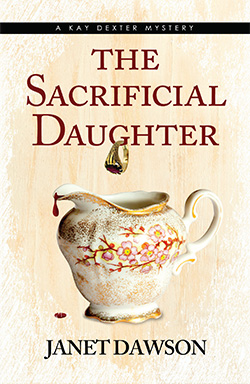
My third series takes place in the present day and it features Kay Dexter. She’s in her fifties and has her own business, working as a geriatric care manager, one who assists families with care of older adults, usually aging parents. Kay puts in her first appearance in The Sacrificial Daughter. I figure Kay is not aging as fast as I am either. Like the Jeri books, Kay operates in the contemporary world, so she’s using the technology that implies.
As always, it will be a challenge to keep writing contemporary stories without letting the ages of characters, and events, get in the way.

 Ladies of Mystery
Your post and what the others have written is interesting to me. I have aged my characters in my series. I ended the Shandra Higheagle mystery when she adopted children because I didn’t want readers to think she was a bad mother by putting herself in danger when she had children to raise. My main character Gabriel Hawke in his series starts out at age 55 and is contemplating retirement. I feel if the book says it’s been a year since something happened in the last book then the characters need to have aged and their life changed in some way. But that’s just me.
LikeLike
I am dealing with something else in the Jeri Howard books. She has a significant other and over the course of several books, they have kinda, sorta, agreed to maybe be engaged. I’m not sure I want her to get married, though.
LikeLiked by 1 person
That’s what kind of happened in my Shandra Higheagle books. I made her in her mid-thirties so when she finally married after a few years she was on the cusp of being too old to have babies but she really wasn’t interested. Then she fell for orphan twins in a book and they adopted. Hawke’s significant other is in her 50s and they are both too independent to get married. I’m trying to decide what to do with Dela in my Spotted Pony Casino mystery. She’s in her mid-thirties but not planning to marry until she understands more about how she came into the world. A subplot that runs through the series.
LikeLike
David Handler, who writes the Stewart “Hoagy” Hoag mysteries, had a great anecdote about this. His editor wanted him to turn his stand-alone into a series, but the protagonist had a basset sidekick, and David asked how he should handle having a dog as a character: “‘She can’t get older over the course of a dozen books. Dogs don’t live as long as people do.’ And with that Kate let out a huge laugh and said to me, ‘David, there are no rules.’” (He’s now written 15 books, the dog is still alive and kicking, and I can guarantee that none of his fans care whether or not that’s plausible.)
LikeLiked by 1 person
You know, I think about that, since Jeri Howard has two cats, Abigail and Black Bart. Abigail is getting old but I think she’ll live forever. Black Bart was adopted as a kitten, so I have lots of leeway.
LikeLike
Great post! I don’t have nearly the career span you do, but I often wonder how realistically to age my characters in my mystery series.
That’s the handy thing about my fantasy series – angels and demons don’t age a day! LOL.
LikeLiked by 1 person
I guess I just ignore it and stick my fingers in my ears and go, la, la, la!
LikeLiked by 1 person
I know what you mean, Janet. All my running characters are locked in time, even the cats. However, time marches on around them. The exception to this in the Alvarez Family Murder Mysteries is little Steffi, now a two-year-old toddler. The protagonist, Lee Alvarez, started out at 34 back in 2005 and is still 34. All the other adults in the series remain the same age. I don’t think readers mind. We all get whammed over the head with advancing age. It’s nice to read about people who are impervious to calendar years. Altho, on Lee’s 60th, I may turn her 35.
LikeLiked by 1 person
Time marches around them, I like that. Some days it’s amazing how whammed I feel by advancing age.
LikeLike
Susan, Thanks. I’m really glad that my readers accept the time issues with the Jeri books. Writing them with a slow progression in Jeri’s life is what works for me.
LikeLike
This is a great post because it points out one of the best features of crime fiction–the writer controls time, and readers adapt and accept. This is an unusual understanding, alliance, whatever you call it, between writer and reader. I let Joe Silva, in the Mellingham series, age according to the needs of the series, so in the end he’s not much older than in the beginning. I love your train series set in the 1950s because, alas, I remember some of those years clearly and I love train rides.
LikeLiked by 1 person