


The QWERTY keyboard? Who in the right mind would organize letters that way? And yet, we all use it. Our fingers know exactly where to find the letters. Well, mostly. If you’re like me and your right index finger occasionally misses the tiny dimple on the j, a trip to Bletchley Hall may be required to decode your deathless prose. So, who put the A there and the M where it is?
In my newest book, One Horse Too Many, Cora’s boarders are gathered for dinner in Countryman House’s dining room where Dr. Shaw speaks of the Centennial Exposition of 1876, where the QWERTY type-writer, the Bell telephone, and giant boilers able to heat whole buildings were introduced. Yet, while people traveled to Philadelphia to see the wonders, General Custer fatefully met the Sioux in Montana, and the James-Dalton Gang robbed the Northfield Minnesota bank. The years 1876-77 were like that, colored by the past and roaring toward the future.
Telegraph operators tapped out the news of the massacre and the robbery on QWERTY keyboards. So, how did the board’s odd array of letters come to be? In October 1867, Christopher Latham Sholes, a newspaper editor and printer who lived in Kenosha, Wisconsin, filed a patent application for an early writing machine developed with the assistance of two friends (Glidden and Soulé).
Sholes worked five more years to perfect his invention, rearranging the alphabetical keys, until 1873, when the QWERTY keyboard came to be. If you spend some time with your keyboard, you will notice that the letters are arranged in diagonally slanting columns. This was done purportedly to accommodate the mechanical linkages, as slanted columns prevented the levers from tangling. Yes, you pushed on a key, and a lever slammed the letter onto a ribbon of ink, leaving an imprint on your actual paper.
Now, researchers into the evolution of the keyboard conclude that the typewriter’s mechanics did not influence keyboard design. Instead, QWERTY resulted from how and by whom typewriters were first used – namely, telegraph operators, whose need to quickly transcribe messages informed the letter arrangement. Also, some cite educator Amos Densmore’s study of bigram (letter-pair) frequency as influential in the design.
In 1873, Sholes & Glidden sold the manufacturing rights to their Type-Writer to E. Remington and Sons. Remington made several adjustments after purchase that resulted in the modern QWERTY layout. These adjustments included moving the R key to the place previously allotted to the period key. With the new arrangement, the last vestiges of the actual alphabet appeared only in the home row sequence DFGHJKL. It makes you want to kiss them, doesn’t it?
And how about this nugget? The QWERTY arrangement allows thousands of English words to be spelled with only the left hand but only a couple hundred with the right hand, even though using alternating hands with the first hand striking as the second readies aids speed and accuracy. Does that make any sense?
Well, this makes sense – business sense. In addition to typewriters, Remington offered training courses (for a small fee), ensuring typists learned on their proprietary system. This forced companies that hired trained typists to buy Remington typewriters. By 1890, more than 100,000 QWERTY-based Remington typewriters were in use nationwide.
When the five largest typewriter manufacturers merged in 1893 to form the Union Typewriter Company, they agreed to adopt QWERTY as the de facto standard, and it still is. Though there have been attempts to make an easier to use keyboard, the QWERTY board is so prevalent that the cost to make a worldwide change is prohibitive.
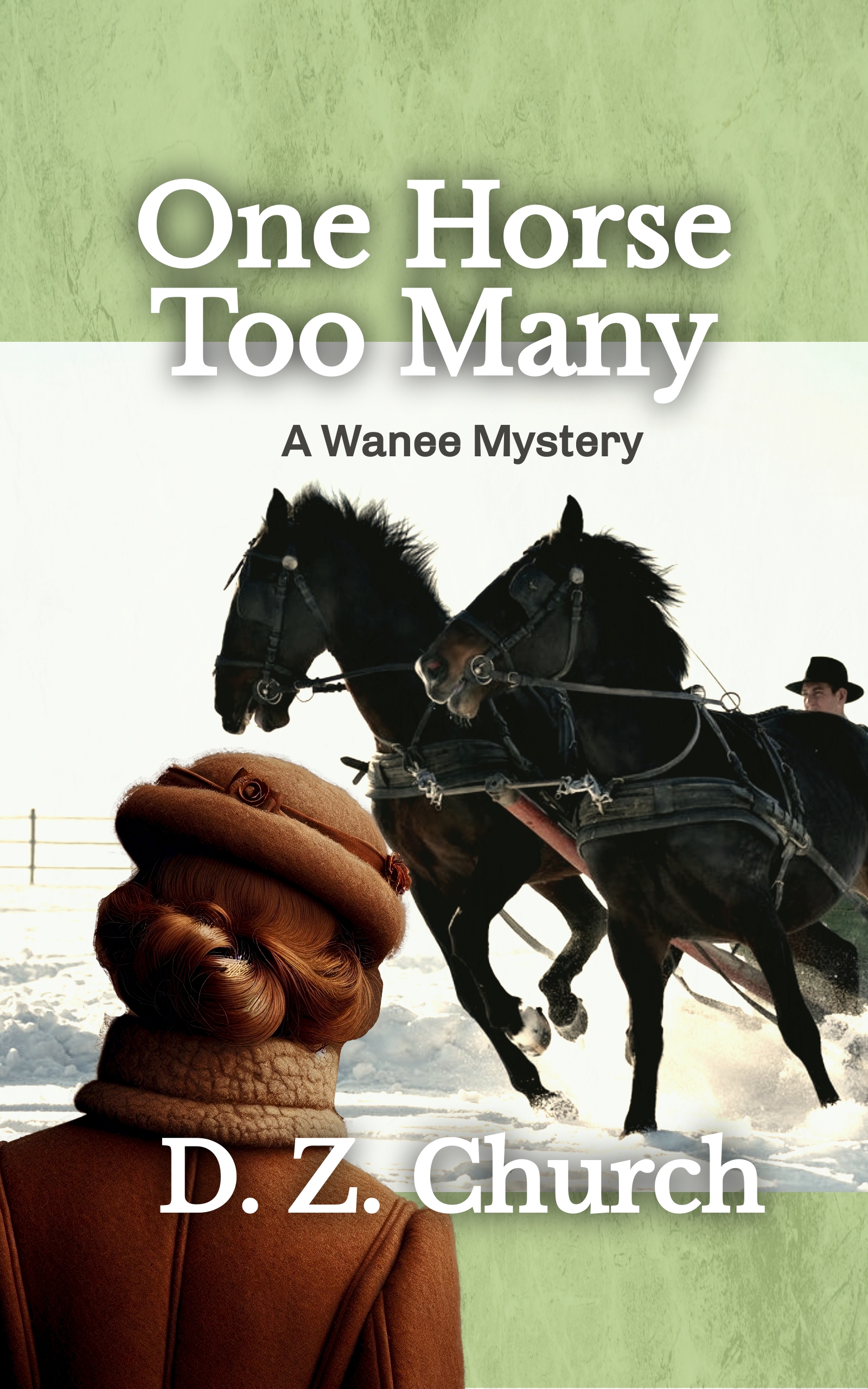
And really, why change something that has produced so many enjoyable books, like One Horse Too Many, available September 15 (pre-order starting September 1)? Here’s a teaser: Sales are up at Cora’s dress shop, and she is making headway on her debt. Her new cook scares everyone and her domestic is a mess. Things have just settled when much-needed drugs are stolen from the hospital, and the newspaper office is tossed. If you like a rip-snorting yarn and appealing, strong-willed characters, you’ll get a kick out of this old-fashioned mystery.
Check out my books at https://dzchurch.com.

 Ladies of Mystery
Let me recommend a delightful documentary about the typewriter–its history, its use in art, its collectors, and the fondness some writers have for it even today. It’s called “California Typewriter” because it features a typewriter repair shop in Berkeley CA.
https://californiatypewritermovie.com/
LikeLike
What an interesting post!
LikeLike
Well, I never! I had no idea. In my heyday, I could type 120+ WPM. Maybe I do 40 now.No matter what brings it on, the human body can be taught to just about anything. Great post, great book.
LikeLike
Excellent post! Not only did we learn about the keyboard and typewriter, we also learned about your new release.
LikeLike
I’ve always wondered how the typewriter got organized as it is. Thanks for the history. Now it has me wondering what kind of brain Sholes had to come up with the idea.
LikeLike
I grew up with an AZERTY keyboard…. that’s the set-up when you use a typewriter in French speaking countries. Confusing? You bet! When I moved to the US, I had to adjust big time. It took a while to get these letters to pop up the way they should 🙂 – I’m glad I never learned to speed type, that would have been time wasted! Instead, I type with two fingers, fast enough to keep track with my creative spurts… and if I have to I can switch between QWERTY and AZERTY… Funny, right?
Martine Proctor
http://www.shawmystery.com
LikeLike