Guest Blogger ~ Elizabeth Crowens

A few years ago, I interviewed the most prolific writer I know, Heather Graham Pozzessere, for Black Gate magazine. https://www.blackgate.com/2018/10/10/the-poison-apple-talking-about-ghosts-an-interview-with-the-queen-of-many-genres-heather-graham/ Writing since 1982, she’s produced over 300 bestselling novels, often mixing romance with suspense and the paranormal, especially in her Krewe of Hunters series. Many people in the mystery/thriller community knew her, but apparently few in the speculative fiction arena were familiar with her work, which was why I wanted to introduce the Black Gate community to her fantastic writing.

Since it’s one thing to knock off a quickie and let your editor polish it and another to have to make it almost perfect before turning it in, I asked her if editing got any easier as more books went down the pipeline. Obviously, she’s built a long-term relationship with her editors, but I also suspected after that many books one got much better at the craft, which also sped the process along.

Although Hounds of the Hollywood Baskervilles is technically my first bona fide mystery novel in print, altogether I have written ten novels which include unfinished works-in-progress, unpublished manuscripts, and published books in other genres. For each of them, I hired freelance editors. For my first novel I hired three, an expensive ordeal, but I was learning the craft of writing as I went along. In a certain way, it was like having a private writing tutor.

By now, I’ve learned a lot from my mistakes. The editing process is a lot faster. For certain elements, I have it down to a science which I’ve nicknamed Search and Destroy. I should probably propose to teach this in a session at a writers’ convention, but this technique helps slash and burn word count and helps eliminate redundancies. The great thing about it is that anyone can do it using Microsoft Word and the Find and Replace function under the Edit dropdown menu.

In a nutshell when we are writing, all of us use certain words far too often. Try doing a word search for common conjunctions such as but and although, adverbs such as maybe (and not only the ones with ly endings) and prepositions such as up and down. See if you can make your sentences more concise. Many times you can also spice up your prose or dialogue with better synonyms. Once you go through your manuscript, it’s amazing how other errors will scream out at you. However, using my Search and Destroy technique still doesn’t eliminate the value of having a second or third set of eyes review your manuscript. – Elizabeth Crowens

Hounds of the Hollywood Baskervilles
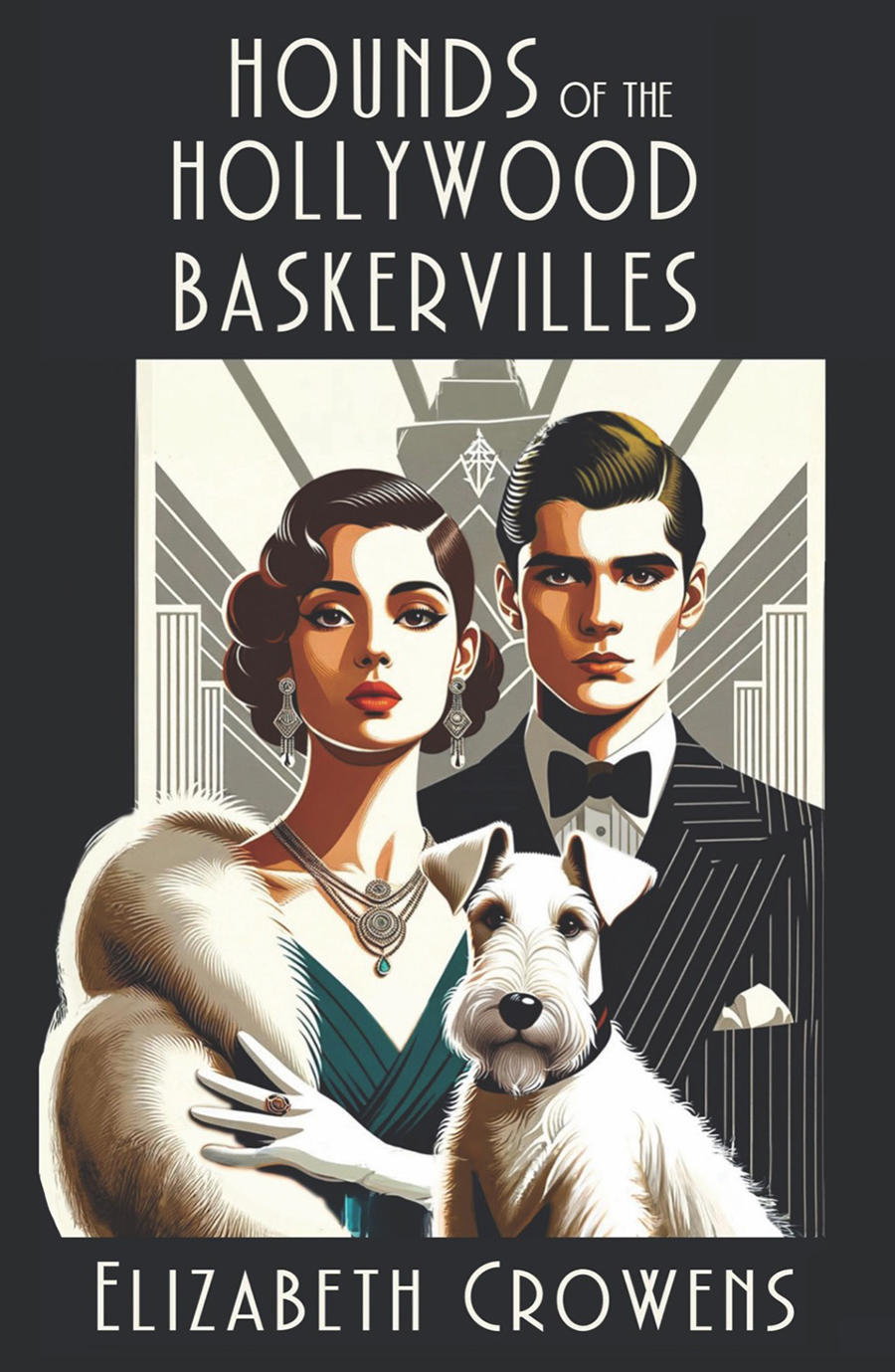
Asta, the dog from the popular Thin Man series, has vanished, and production for his next film is pending. MGM Studios offers a huge reward, and that’s exactly what young private detectives Babs Norman and Guy Brandt need for their struggling business to survive. Celebrity dognapping now a growing trend, when the police and city pound ridicule Basil Rathbone and ask, “Sherlock Holmes has lost his dog?” Basil also hires the B. Norman Agency to find his missing Cocker Spaniel.

The three concoct a plan for Basil to assume his on-screen persona and round up possible suspects, including Myrna Loy and William Powell; Dashiell Hammett, creator of The Thin Man; Nigel Bruce, Basil’s on-screen Doctor Watson; Hollywood-newcomer, German philanthropist and film financier Countess Velma von Rache, and the top animal trainers in Tinseltown. Yet everyone will be in for a shock when the real reason behind the canine disappearances is even more sinister than imagined.

Buy links: Bookshop.org https://bookshop.org/p/books/hounds-of-the-hollywood-baskervilles-a-babs-norman-hollywood-mystery-elizabeth-crowens/21021163

Amazon: https://www.amazon.com/Hounds-Hollywood-Baskervilles-Norman-Mystery/dp/1685125425/ref=sr_1_1

ISBNS:                                    978-1-68512-542-4 (paperback) $16.95

                                                978-1-68512-543-1 (ebook)  $5.99

Elizabeth Crowens has worn many hats in the entertainment industry, contributed stories to Black Belt, Black Gate, Sherlock Holmes Mystery Magazines, Hell’s Heart, and the Bram Stoker-nominated A New York State of Fright, and has a popular Caption Contest on Facebook.

Awards include: Leo B. Burstein Scholarship from the MWA-NY Chapter, NYFA grant to publish New York: Give Me Your Best or Your Worst, Eric Hoffer Award, Glimmer Train Awards Honorable Mention, two Grand prize, and six First prize Chanticleer Awards. Crowens writes multi-genre alternate history and historical Hollywood mystery. Hounds of the Hollywood Baskervilles, which won First Prize in both Chanticleer’s Mark Twain and Murder & Mayhem Awards and placed as a Finalist in Killer Nashville’s Claymore Awards for Best Humorous Mystery, was released in March 2024.

SOCIAL MEDIA HANDLES:

Facebook.com/thereel.elizabeth.crowens

X.com/ECrowens

Instagram.com/ElizabethCrowens

LinkedIn  https://www.linkedin.com/in/elizabeth-crowens-5227804/

Goodreads  https://www.goodreads.com/author/show/15173793.Elizabeth_Crowens

AUTHOR WEBSITE: www.elizbethcrowens.com
Reframing

Reframing is a well-established psychological tool for tackling problems that may seem intractable, and I found myself appreciating it recently.

For the last three years two other writers and I spend much of the spring and summer working on the annual anthology Best New England Crime Stories published by Crime Spell Books. All three of us read and select the stories, and all three of us edit. All the other duties are split. Ang Pompano sends out the acceptance or rejection emails and works on promotion, developing ads and the like. Leslie Wheeler manages the books, and works on sales opportunities. I get to write jacket copy, and lay out the book for POD. We have a great cover designer, and all three of us weigh in on the art and design. We review each other’s work, offer suggestions, and manage to put out a book we’re proud of every year while also having fun at our launch at Crime Bake in November.

Writing jacket copy is perhaps the least onerous job of a writer with a book going to press. My practice has been to look over the list of stories, arrange them in loose groups, and talk about the kinds of crimes they contain. I wrote the copy this month and sent it around to Ang and Leslie. Both liked it but Leslie had a response I hadn’t expected but found provocative. With all the talk of crime in the news today, depressing for everyone, perhaps we could focus on the characters who are fighting back, challenging the criminals or the system. This immediately appealed to me, and I ditched the first draft and reshuffled my note cards.

Looking at these stories from the perspective of the range of characters caught up in circumstance of crime and its consequences changed the way I viewed them and let me see beyond the cleverness of the plot, the range of characters swirling around incidents, the grounding bit of information, the unexpected twist. Most were ordinary people in extraordinary circumstances finding something within they didn’t realize they had. They were sometimes stymied by their situations, tripped up by bad luck or trapped by betrayal, but they were a match to the challenge, though not all succeeded in bringing about justice.

By reframing I also got closer to a different view of the crime. When a crime is committed it is most often by a person shriveled by life and seeking an unimaginative solution. An ordinary scam inspires a docile matron, and a drug addict discovers how far he has gone on the path to a. new life, and what his world is really like, something most readers will never experience. For others, following clues and solving a crime leads to a painful reckoning. Rewriting the jacket copy turned out, also, to be more challenging than cataloging a variety of crimes. As expected, the protagonists in these twenty-four stories were a varied lot.

With every year, we three editors choose stories that we think are well written, well thought out, and interesting as fiction. Because it’s crime fiction there is an understandable emphasis on the structure, the plot with a crime and its solution. But with a change in perspective, a reframing, I find myself appreciating the range of personalities grappling with life’s body blows. There is a richness not as easily appreciated otherwise. I hope our readers will feel the same way when the book is out in November.

Once Upon a Summer Island Thriller

It’s summer, the heart of it; fireworks have filled the sky, and the heat has set in like a hot pad on high. The grass has turned lion’s mane bronze punctuated by the yellow of blossoming mule ears. It all makes me long for a trip to my husband’s family’s cabin on an island in a lake in Ontario, Canada. It is a magical place, saved from dereliction by my husband’s mother. She paid the taxes due in the early days of the prior century.

I once charted 19 species of trees and bushes on the three-acre island a buzz with bees and even the stray firefly. I have long believed it is like no other place on earth. As an island, it is of endless curiosity to those boating on the lake. What, then, does one do to ensure the random visitors who climb the island respect it.

In a stroke of brilliance, the door to the cabin was left open, and a Red Chief pad was set out on the dining room table for those who visited to write their names or leave a note. There have been a few incidents, but very few over the nearly hundred years my husband’s family has shepherded the place.  

And, yes, visitors left notes, years of them, whole histories of those who picnicked with their children, who returned as teens, announced their marriages, and returned to picnic with their children. A history left in pencil on foolscap.

Then there are the Canadians who have property on the same bay. Friends who look out for the place. I’m thinking of one group who, upon availing themselves of the island for a bit of the Canadian pastime of beer drinking, saw that a tree had fallen across the cabin’s roof. They returned, removed the tree, fixed the roof and left a note dubbing themselves The Green Bay Boys. I met them when alone on what appeared to be a deserted island, the guys had taken the boat to go into the nearby town (about 20 miles) for lumber. They trooped up with cases of beer to sit on the deck overlooking the lake. Spying me, they grinned, introduced themselves, and offered me a Labatts, which I did not decline.

The family across the bay, whom my husband knew from childhood, lived in the original stage stop, farmed, and managed a herd of spring kittens. They also allowed our family to dock and keep the boat and the engine in a shed over the winter. They are all gone now, and we truly mourn their passing. Such good friends and times.

And if you aren’t aware, Canadians are lovely, filled with fun, and a bit understated, eh? Our neighbors created a whole mythology about the island added to with wild abandon. A dentist who buried a body on the island. A mobster who flew in on a waterplane and held secret planning meetings. Sprinkled with tales of the horse-eating fishers, just to liven up the lies.

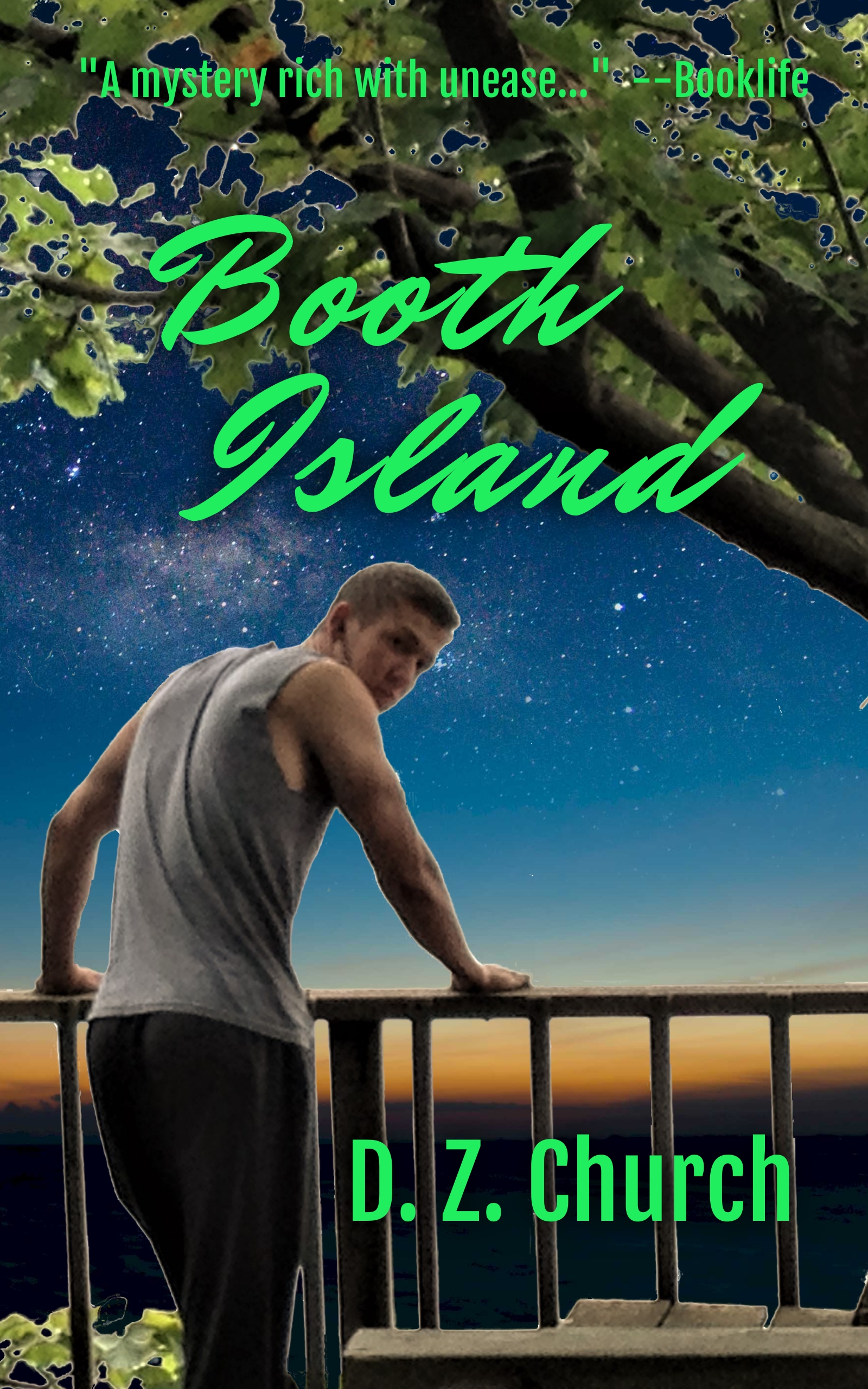
My great-nephew. His
dad’s snap of him on the island’s deck made the perfect cover.

Then it happened. A few years ago, I sat down to write a thriller and out popped a tale of the island. Booth Island was a blast to write, rampaging out of my head chapters at a time. When I was done, it had been nine years since Boothe Treader summered at her family’s island. Twelve since her brother died on its rocky shore. She never forgave him for abandoning her, her parents for divorcing, or the dark-eyed boy who watched him drown.

Then her mother deeded her the island. And old friends lined up to welcome her back —Mike, Meg, and Penny, who all affectionately called Boothe “Boo”— or were they? She sensed she was being watched from the moment she stepped foot on the island, even before the shirt her brother died in appeared on the porch railing.

Or he came — her brother’s killer.

The lake neighbors like it, it’s about them and the lake and the nearby town. They buy copies for the bookshelves in their rentals and, every now and again, replace those taken by visitors. It even got good reviews: Masterful, suspenseful, and engaging; Church crafts a mystery rich with unease and an exhilarating climax while also offering a bold portrait of Canadian lake life; Mystery readers will be hooked by the unresolved death and quiet intrigue of this lakeside thriller.

And it’s about summer — romances, jealousies and lake friends. I’ve had a few. How about you? I suspect that’s why writing about this one magic island in Canada was such a gas. Sometimes, I guess, it is best to just sit down and let the joy flow.

Booth Island is available at https://www.amazon.com/Booth-Island-D-Z-Church-ebook/dp/B08VFCRL16/. For more information on it and my other books, go to my website at https://dzchurch.com

SCRITCH, SCRATCH, FEEDBACK

I’ve always wanted to write a country song. I love country music and how artists tell stories with such few words set to beautiful music. Over the years, I’ve put pen to paper and attempted to write a poem that could possibly morph into a song.

There’s just one little problem … I don’t hear music. Can’t play music. And full disclosure, I can’t sing either!

Not to be deterred, I’ve spent hours researching how to write a song and listened to country music artists describe their process. For instance, Morgan Wallen’s song, “Dying Man,” was originally written for his young son. Morgan said having a child changed him and made him want to be a better person. The song eventually became a love song about a woman saving a man from his destructive behavior.

During my research, I came across a nugget that stuck with me … the definition of the word “scritch” in relation to guitarists plucking the strings of their instruments. I love hearing the string noise while enjoying a song, imagining the musician feeling the notes through his fingers. It surprised me to learn that this sound is also called “feedback.”

Intrigued by the definition, I Googled “scratch.” When I’m writing longhand, the scratching noise my pen makes as it moves across the paper, telling whatever story I’m writing, seems to ignite my creative juices. The simple sound opens the floodgates, and the ideas flow as I work on a novel or blog, smiling as the story unfolds in blue ink.

You guessed it, “scratch” also means feedback. One of the definitions of feedback states: as a reaction to a person’s performance of a task. Of course, there are other types of feedback. The clicking of a laptop’s keys as your fingers bang out a story. The agonizing moan of a writer struggling to craft the perfect sentence. The well-earned sigh of accomplishment when the book is finished, and you’ve typed “The End!”

During my endless hours of listening to country music, I also discovered that the stories the songs tell inspire me. An artist’s ability to describe human emotions and reactions to life in short phrases has given me ideas on how to show the same in my characters.

In “Redneck Ranch,” my hero, Wyatt Stone, is the sheriff. I decided to have Wyatt idolize Eric Church, so Wyatt, his brother, and his high school friends formed a band and sang Eric Church songs in local bars. Eric is known to his fans as Chief, a tribute to his grandfather, who was Chief of Police back in the day. Eric is also a standout singer, songwriter, and performer, but he is also a humble, kind person. I loved the idea that my character Wyatt could mirror these same characteristics. And the nickname has provided an element of humor because Wyatt isn’t crazy about the moniker. He even named his horse Chief, hoping his deputies and the townsfolk would stop using the nickname.

Another Morgan Wallen song, “Cover Me Up,” has this line: A heart on the run keeps a hand on a gun, can’t trust anyone. I used these words as a springboard for my heroine, Harley Harper, to question Wyatt’s love for her in “Willow’s Woods.” She’s had her heart broken more than once, and this line summed up how I wanted her to feel. I loved creating a scenario where Harley doesn’t feel her heart has a home. The song is about learning to trust and love again, and well, you can imagine how her and Wyatt’s journey might end in “Willow’s Woods.” I plan to carry this song into the next Stoneybrook Mystery, “Fatal Falls,” and can’t wait to see what insight it provides for Wyatt and Harley.

Another favorite song, “Oklahoma Smokeshow,” by Zach Bryan, is about a man with a woman out of his league. The word “smokeshow” is a slang term used to describe someone extremely attractive. I used the word as a way for Wyatt’s friend Britt to poke fun at Wyatt about being with someone as lovely as Harley.

All genres of music inspire me except for Rap. Knowing I wanted to weave a Christian theme through my Stoneybrook books, I studied gospel songs, too. I know several worship songs, but was thrilled when I found a lovely song called “Cowboy Church,” which was perfect for the outdoor Cowboy Church scene in “Redneck Ranch.”

In “Vanished in Vallarta,” the third book in my Mexico Mayhem series, I weaved in the lyrics (yes, I Googled and had Paty’s help in knowing exactly how one uses lyrics without going to copyright jail) from Ed Sheeran’s “Perfect,” to create a sexy dance scene between my characters, Jade Mendoza and Amado Pena.

If I controlled the hours of my day, I would spend every spare minute writing. Unfortunately, I still work and have a husband who requires a little attention now and then. Not to mention yard work that never seems to end, I console myself with the knowledge that as I clean the house, file the mounds of paper in my office, or pull endless weeds … I can listen to music and be inspired.

I still yearn to write that country song. But until the lyrics scratch across the pages of a legal pad, or I learn to hear the music in the scritch of my imaginary guitar strings, I’ll keep enjoying the feedback I get from telling my stories and writing my books.

Happy Feedback, Ladies of Mystery!!!

For Heaven’s Sake, Just Take the Photo!

I’ve never been nostalgic. As a child, I often spent weeks away from home at my grandparents’ house or at the home of friends, without a single thought of what I might be missing in my own family. I am very much a creature of the moment.

I’ve also never been photogenic. People rarely believe me when I say this, but then they take a photo of me and remark, “Oh, I see. You’re right.” I’m short, my frame is square, my hair and clothes are inevitably messy, my eyes are squinty in bright light, and if I know someone is taking a picture, my face goes all stiff. I find it impossible to smile on demand. I usually try to avoid being photographed if at all possible. Only a professional photographer who takes hundreds of shots can create a presentable photo of me. Which explains why my author photo is a bit dated.

Selfies are mystifying to me. Who wants yet another photo of herself in front of another landmark? Do all selfie-takers worship themselves? As a child, I had posters of the astronauts and Olympic skiers I adored on my walls, not a single shot of myself. Equally mystifying to me are snapshots of meals or drinks or clothing on Instagram and Facebook. Living animals and plants and landscapes, I can often appreciate.

Put all of these challenges together, and it makes sense that I have very few photographic mementos of my past. In recent years, I’ve realized what a tragedy that is. Late last year, a dear friend of more than 40 years passed away. While searching for a photo to put on his memorial page, I was appalled to discover that couldn’t find any. There were a few action shots taken during backpacking adventures we’d done together, but none of just the two of us, and none of him by himself. I sat down and cried. Why hadn’t I taken more pictures? It simply didn’t seem important at the time, but now it does. I ended up cropping his image out of a photo his friends had sent to me from his solo trip to Egypt. Thank heavens my Pixel phone has a magic erase function to eradicate extraneous people from photos.

For a local adventure magazine, I wanted to write a story about backpacking the West Coast Trail, also called the Lifesaving Trail, on Vancouver Island. Of course it needed photos to illustrate the amazing landscapes and challenging obstacles along the route. I had a handful of old pictures, but none that were good or particularly useful for the article. I remember the trip in vivid detail, but I was building campfires and climbing ladders and ferrying people and gear across rivers in cable cars instead of snapping photos. Honestly, what is wrong with me?

My hiking club likes to post photos of every hike, but I have often thought, why? We have hundreds of photos of the same place. Now I get it. It’s to document the people who were there.

So now, even though it’s not something I naturally do, I try to remember to take photos of my gatherings, whether the events are ordinary or extra-special. You never know when you’ll want to look at that memory again.