Guest Blogger ~ Alice Fitzpatrick

THE MYSTERY IN MY LIFE

            I grew up reading my mother’s Agatha Christie novels, losing myself in idyllic English villages where everyone knows each other, sprawling manor houses with hidden passageways, and luxurious seaside hotels that reminded me of the England I’d left behind when we’d immigrated to Canada.  With each book, I took on the challenge of matching wits with Miss Christie, ever hopeful that this time I would identify the murderer.  However, the real mystery in my life was my own family.

            My Polish relatives lived behind the Iron Curtain which might explain my father’s secretive nature.  He spoke little about his past, but when he did, he told a different tale to each of us.  Once he confessed to me that as White Russians, we’d been forced to flee to Poland during the revolution where we’d adopted a Polish variation of our name.  But even so, he assured me, everyone would recognize our royal connection.  

            For several years, I revelled in the fantasy that I was descended from the House of Romanov.  Once I saw the film Anastasia, it became obvious who my grandmother truly was.  The grainy black and white photograph of the squat Slavic woman my father claimed was his mother was obviously part of the deception my aristocratic relations had been forced to perpetrate in order to remain safe.  Sadly years later, DNA analysis proved this to be false.

The Romanovs
Uncle Terry

            Like my protagonist’s Aunt Emma in Secrets in the Water, people in my British family had a habit of disappearing from my life—my Uncle Terry, my cousin Terry, and my great-aunt Marie.  I was a third of the way through the first draft of the book when I realized I’d unconsciously patterned the death of Emma on that of my uncle.  Only one month after the birth of his son, Terry fell asleep at the wheel, rolled his car down an embankment, and bled to death.  As you’d expect, his death devastated the family. 

            But even a seemingly straightforward car accident was problematic.  The family had always suspected Terry was a hemophiliac since he suffered uncontrollable nose bleeds whenever he became excited.  While it’s highly improbable he had this disease, the story was kept alive.  The family couldn’t accept that their only son, with his whole life ahead of him, could die such a senseless death.  As no one wanted to hold Terry responsible, the hemophilia myth allowed us to blame the disease for killing him, rather than his own carelessness. 

            In my book, with no evidence to the contrary and a suicide note, the coroner ruled that the responsibility for Emma’s death was hers alone, a judgement her family and friends have struggled to accept for fifty years.  Like Terry, Emma was about to start an exciting new phase of her life, having just been accepted into Cambridge University.  Part of what my protagonist Kate is up against as she searches for the truth of her aunt’s death is that over the years, the islanders have idealized Emma, choosing to ignore her weaknesses and failings.  But if Kate is to get to the truth, she must be open to every aspect of her aunt’s character, no matter how unpleasant.  When asked if she would like to know something about Emma, even if it wasn’t nice,  she replies, “It’s not the nice things that get you killed, is it?”            

So why do I write mysteries?  It’s because mystery has dominated my life.  Other authors write crime fiction because it allows them to set the world straight, to bring justice to victims, order to chaos.  But for me it’s the need to understand what happened and why.  It’s like finding the missing piece of a jigsaw puzzle.  Only then is the picture complete.

Emma Galway’s suicide has haunted the Meredith Island for fifty years.

Back on the island to lay her grandmother to rest, Kate can’t avoid reflecting on the death of her aunt.  Learning that her late mother had believed Emma was murdered and had conducted her own investigation, she decides to track down her aunt’s killer. 

With the help of her neighbour, impetuous and hedonistic sculptor Siobhan Fitzgerald, Kate picks up where her mother had left off.  When the two women become the subject of threatening notes and violent incidents, it’s clear that one of their fellow islanders is warning them off. 

As they begin to look into Emma’s connection to the Sutherlands, a prominent Meredith Island family, another islander dies under suspicious circumstances, forcing Kate and Siobhan to confront the likelihood that Emma’s killer is still on the island.

Buy Links- https://www.amazon.com/Secrets-Water-Alice-Fitzpatrick/dp/1988754607/

https://www.indigo.ca/en-ca/secrets-in-the-water/9781988754604.html

Alice Fitzpatrick has contributed short stories to literary magazines and anthologies and has recently retired from teaching in order to devote herself to writing full-time.  She is a fearless champion of singing, cats, all things Welsh, and the Oxford comma.  Her summers spent with her Welsh family in Pembrokeshire inspired the creation of the Meredith Island Mysteries series.  Secrets in the Water is the first book in the series.  Alice lives in Toronto but dreams of a cottage on the Welsh coast. 

www.alicefitzpatrick.com/

https://www.facebook.com/alicefitzp

https://www.instagram.com/alicefitzpatrickauthor

https://twitter.com/alicefitzp

https://www.goodreads.com/user/show/10602521-alice-fitzpatrick
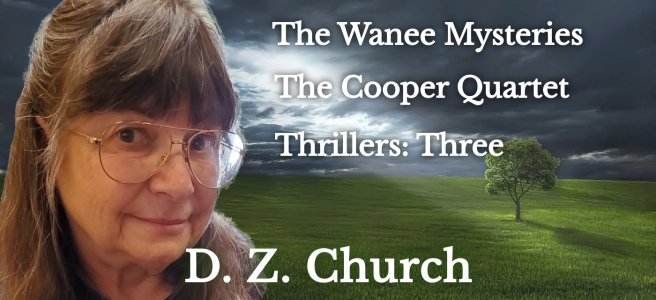
AI Cover Illustrations?

Ever one to try something new, I leaped on the AI-generated illustration wagon. I chose an ethical provider, one who has asked permission from those owning the rights to their photographs and one who pays when those photos are used in a mashup (Note: I licensed all of the pictures used in this blog). As you may or may not know, depending on your relationship with your covers, finding the perfect illustration or photograph can take endless hours of wandering through providers and then sometimes settling or buying rights to multiple photos and cobbling them together to create the cover you envisioned if you can. Sometimes, close is as good as you get.

So why not try AI?

I’m not only a trier; I’m a plunger in that I just plunge in without a thought and see where it takes me. As a consequence, there are now an alarming number of AI-generated illustrations of tipped-over horses and three armed men on the service I used. The provider says that images created will be offered to others. Oh, my!

This is what I learned while plunging — mind your clauses:

  1. Don’t ask this: In 1870s a young woman dressed in men’s clothing galloping a horse with three men through a snowstorm at a distance. What I got was a woman in a skirt galloping a horse followed by three men in a snowstorm. (abandoned)
  2. Or this: Three armed cowboys on horseback side by side in a snowstorm. Some good illustrations, except for those with the three-armed cowboys, you know what I mean. Perhaps one should say armed with rifles or guns. (abandoned)
  3. Or this: A team of four horses hauling a freightwagon at a gallop in a blizzard. What I asked for in the world of AI is a galloping freight wagon hauled by a team of horses hauling four horses in a blizzard. (abandoned – see picture)
  4. Or this: A freight wagon with a broken wheel behind a team of four horses tipped over in an icy snowy stream. What I got, and rightly so, was tipped over horses under a freight wagon in an icy stream. Too gruesome to share. (abandoned)
  5. Close, but no cigar. Learning, I requested:  A 1870s brown-haired, clean-shaven man in a derby hat on a horse with a doctor’s bag in a snowstorm. A wonderful illustration came up. The man even had a distressed look on his face, which was perfect. I thought I had a live one until I realized the doctor’s bag was sitting unattached at the back of the horse.
  6. So, here is the evolution of prompts that led to two illustrations that met my needs. This isn’t to say there weren’t others that were good, just not right. Notice the order and precision of the description that resulted in my final choices (** indicates the two I kept for possible use).
    • An 1870s man reaching for black cowboy hat floating in nearly dry stream
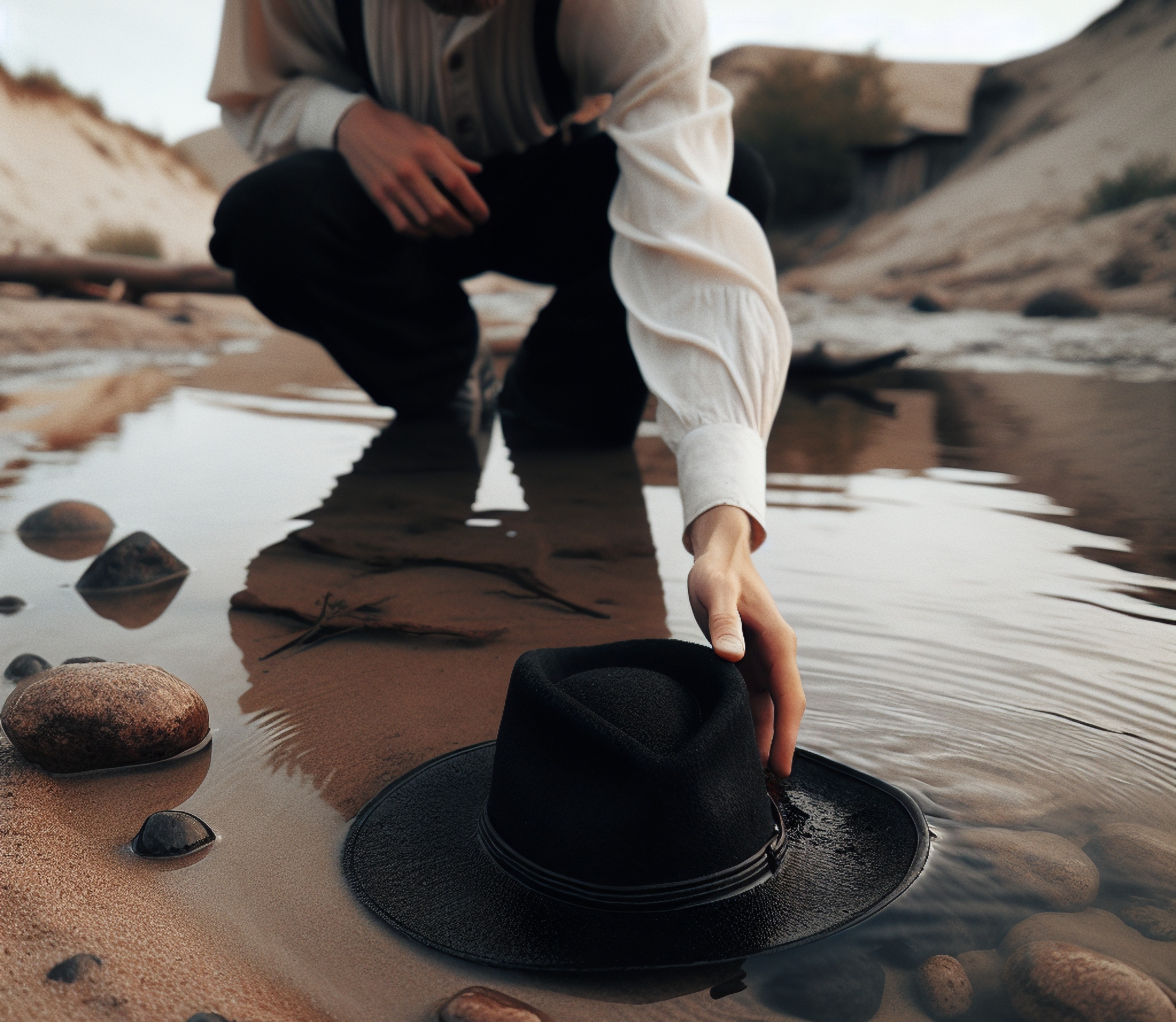
    • An 1870s man in a white shirt reaching for black cowboy hat floating in nearly dry stream (picture 1 **).
    • An 1870s man in a white shirt reaching for black cowboy hat stuck in bushes on the banks of a stream
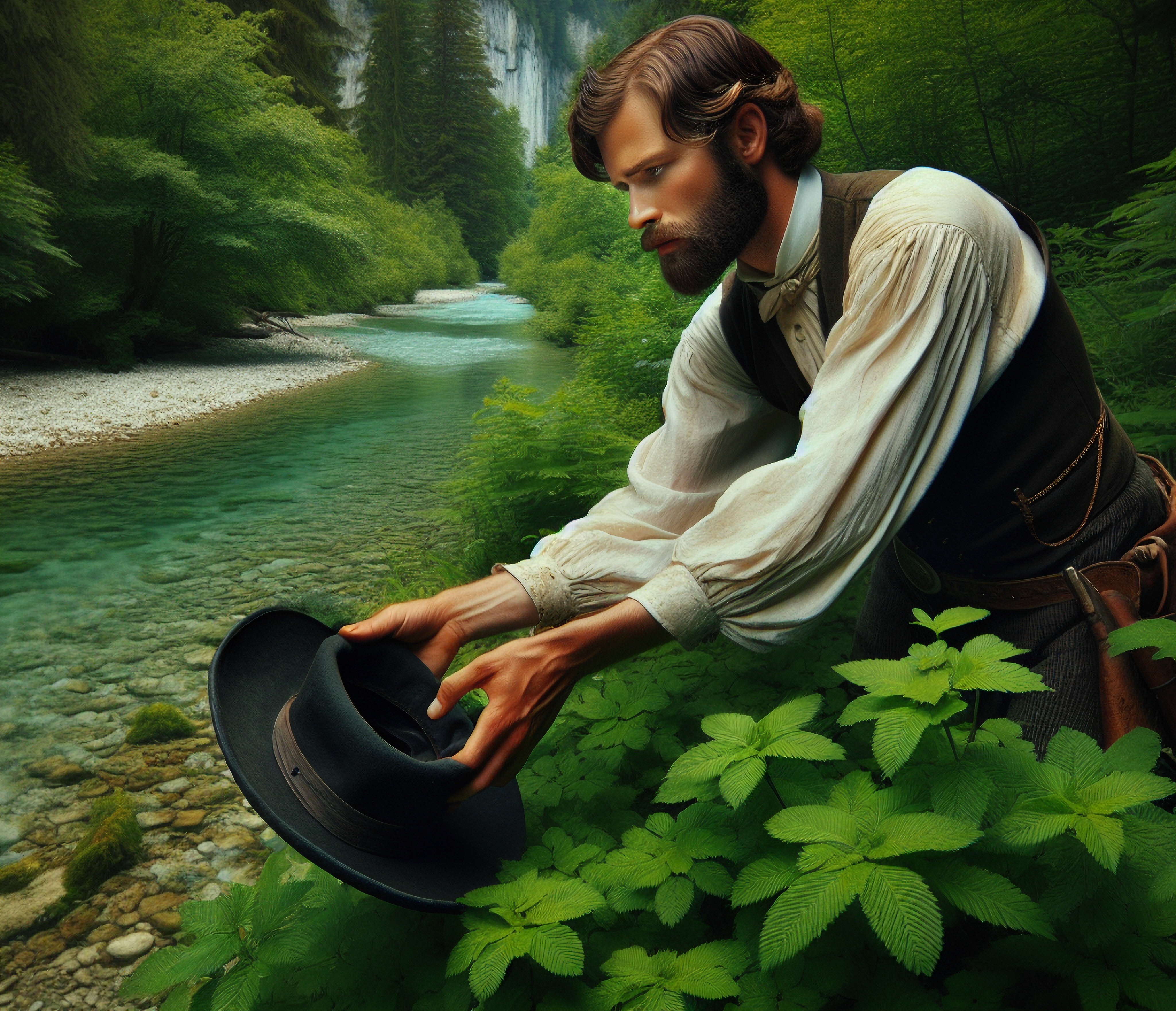
    • An 1870s man in a white shirt pulling a black cowboy hat from bushes on the banks of a stream (picture 2). Note weird dent in the crown of the hat.
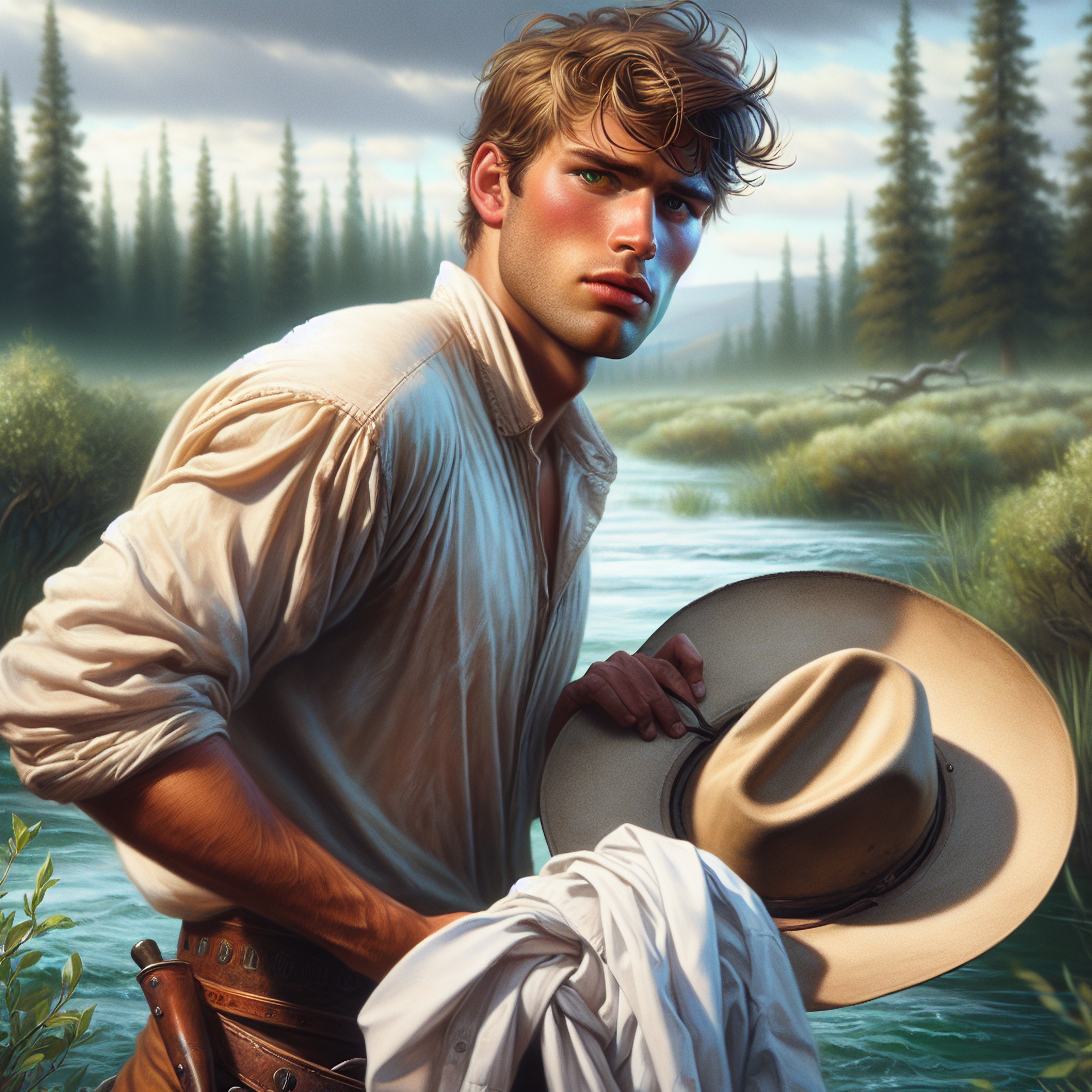
    • A 1870s man in his twenties wearing a cowboy hat and a white shirt with his sleeves rolled up retrieving a Stetson caught in the brush along a slow flowing stream. Serious beefcake. Also, there is no hat on his head, and I’m not sure what he is retrieving. But he sure is pretty! (picture 3)
    • A 1870s man in his twenties wearing a white shirt with rolled up sleeves retrieving a Stetson by the brim caught in the brush along a slow flowing stream (picture 4 **).

Summary

In the final analysis, I was pleased with the results and glad I had chosen an ethical AI service for my plunge. As my character Cora Countryman (Unbecoming a Lady, A Confluence of Enemies, and the upcoming One Horse Too Many) would say, I do not truck with pirating the work of authors and illustrators without their knowledge or reward.

Find my books at https://dzchurch.com or on Amazon.

PERFECT IMPERFECTION

On June 2nd my son Derrick would have turned 44. This year marks the 8th birthday I haven’t been able to celebrate with him. And, as you can imagine, this is a hard day for me. This year a few of my friends bought me a ticket to attend a Beattle’s cover band concert. It was a perfect distraction.

I remember being excited about my second child’s birth, dreaming about what it would be like to have a darling little girl to complete my family. My first born, Norman, was a fifteen month old inquisitive boy who loved motoring around our yard on his souped up tricycle.

When my second child was born, I asked the doctor, “Is she perfect?”

To which he replied, “He has ten fingers and toes.”

“He?” I tried to sit up so I could see. “Are you sure the baby’s not a girl?”

“Pretty sure since he’s peeing on me.”

And so, Brianna Denise became Derrick James, son number two. As a boy mom, I loved the idea that Norman and Derrick would be best friends growing up. When I noticed that Derrick wasn’t hitting the same age related benchmarks that Norman had, I consulted a pediatrician. Within a couple of months, Derrick had his first diagnosis of cerebral palsy. Over the course of the next few years, he would receive five other designations, finally being diagnosed with autism at the age of eight.

As Derrick’s first birthday approached I remember thinking: He was perfect until he was born.

Every year, this sentiment would haunt me right before Derrick’s birthday. Of course, other thoughts piggybacked on this main theme. What would “normal” Derrick have been like? Would he have been smart? Would he have chosen a car or a truck to drive? Would he have gotten married and had kids?

After Derrick died, I thought about my musings and realized that Derrick had been perfect all along. His sense of humor was spot on and always accompanied by a big belly laugh. He couldn’t drive, but his mind had a built in compass and he never hesitated to tell you if you made a wrong turn. And though Derrick couldn’t be a husband or father, he was an excellent Uncle.

Now that I spend my days writing the Stoneybrook Mystery Series, and developing Derrick’s alter ego, Deputy Derrick Stone, I’m once again caught up in delusions of perfection. When I write … anything … I have a deluded expectation that it will be perfect when my fingertips touch the keys and tap out my thoughts. That, unfortunately, is not the case!

I recently discovered that there are still errors in my first novel, “Peril in Paradise”. Seriously? After personally reading the manuscript ten times and listening to the novel five times? I also had four Beta Readers read the book, not to mention paying two editors … and there’s still errors?

My enlightenment came from my investment into Grammarly. The AI editing software had no trouble pointing out all the flaws in my masterpiece. At first, I was extremely annoyed by this revelation.

I shared my experience with one of my Beta readers and she was amazed. “There’s no way all of us combined didn’t catch errors in the book,” she said.

Spurred on by her doubt, and since I hadn’t actually made any of the changes suggested by Grammarly, I decided to take the AI’s recommended corrections one at a time. I discovered that “Alice” (my nickname for the artificial editor) didn’t always get what I was trying to say. Alice did, however, find a few minor things we missed. So, I went through the manuscript and made the necessary changes and corrected things that made sense to my creative brain.

Next, I used Alice while I re-listened to “Redneck Ranch”. I’m double-checking the book for errors or anomalies since I’m having it narrated for an audiobook. Once again Alice couldn’t wait to point out my mistakes. And this time … I found a few storyline problems that Alice wouldn’t catch.

I had another conversation with my Beta Reader friend, and she said, “I know how much of a perfectionist you are, but your stories are fabulous.” She flipped to a part of the book featuring Deputy Derrick Stone putting together clues that would eventually solve the crime. After reading a small snippet, she grinned at me and said, “If there were errors in this section, I didn’t see or hear them.” She hugged me. “For me, and I think all of your readers feel the same, the whole book is perfect.” She grinned. “Just like Derrick.”

When I take a breath and try to look at my work from a non-perfectionist point of view, I’m proud of the seven books I’ve written. My narrator, Dawn, called me a plotting genius and couldn’t stop gushing about how good “Peril in Paradise” is.

Nothing is ever completely perfect. I think when we love something, we massage the person, experience, book, painting, sunset … into perfection. But the true talent is seeing the perfection in the imperfection.

Happy “imperfect” writing, Ladies!!!

Three Hydrangeas

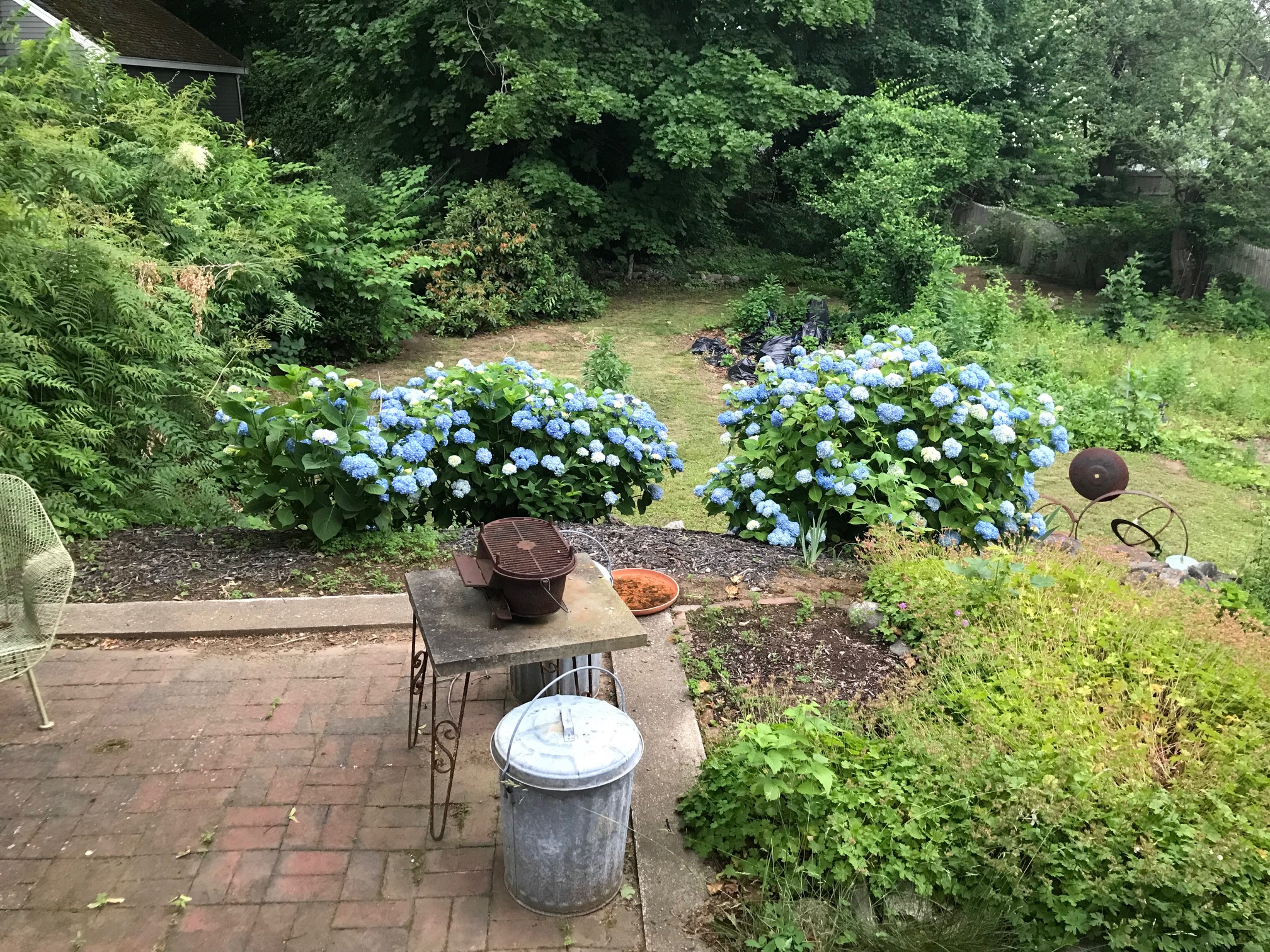
I’ve been reading up on hydrangeas—where to plant, when to bloom, what to feed. I planted three on a gentle slope in the back yard, just off the small patio, several years ago. This area gets lots of morning sun, midday sun, and some afternoon sun. I never feed them, never prune though I do remove old stems that are woody and falling off. And, like many other plants in New England, these three no longer wait for the traditional August blooming. They begin in mid June. 

All three plants have been productive since I planted them perhaps fifteen years ago, and two have reached their full height, over three feet. The third grew more slowly, and two years ago, as I was weeding out whatever had crept up through the mulch, I found an invasive plant had twined itself around the third plant. I rooted it out, and hoped the hydrangea would survive and do better now.

Last year the runt of the trio bloomed nicely, and I congratulated myself for planting it a little higher than the other two, thinking now it gets more sun instead of being somewhat sheltered between two other plants and a fast-growing false spirea, which is another object of my (unfriendly) attentions.

As the spring drifted into June, I admired the first two hydrangeas, which were getting larger and larger, with more and more blooms. I pondered the third plant, which has now arrived at the top of the slope and is only a few inches from the patio. How did it get there? 

It’s been two years since my husband died, and while I thought my life was continuing on its established trajectory, I’m beginning to see that it’s not. A few weeks after Michael died, a mutual friend, also a widow, asked me if I was now reinventing myself. The question surprised me because we’d known each other for years both as writers and as neighbors. My first reaction was, no, of course not. I’m who I have always been. But in the intervening months I have noticed that interests I didn’t pay much attention to are coming to the fore, or I’m taking them more seriously. Some of them involve fixing things myself instead of asking Michael, who loved broken things for the chance to tinker, or hiring someone. 

I’m doing a lot more photography, and looking back on four solo shows and wondering why I didn’t take the work more seriously. My newest project involves lace and exploring experimental photography, which involves poking into analogue work. I don’t feel like I’m reinventing myself so much as sprawling over boundaries established arbitrarily and no longer useful. 

So now when I look at the hydrangea working its way up the slope and getting ready to grow as large as the other two, I don’t wonder how it got here or why. It’s where it needs to be.

Battling with Bots in Phone Mazes

A couple of years ago, I deactivated my Twitter account, right after You Know Who took the company over and decided to allow any wackadoodles to post whatever they wanted, no matter how hateful or delusional. I thought that was the end of it—goodbye, Twitter or X or whatever you want to call yourself next. But somehow, my Twitter account did not go away. As a matter of fact, after two years of absence, the account now lives with someone posting as me nearly every day about magic mushrooms and referencing an account that has been suspended by X for violating its rules. A friend called this disaster to my attention.

I immediately contacted X product support and filled out the form for a compromised (stolen!) account and asked that the account be deleted. In the notes, I pointed out that Twitter no longer recognizes any of my email accounts, so I cannot get into the account, but that the Twitter feed shows the hacker posting as me, using the photo from my Facebook author page as well as my name. I received a form letter telling me to access my account and go through the deactivation process from within. I tried again, even posting my ID and photo. No such luck. Since I can no longer supply the email used for that account, they refuse to believe that it’s mine and it’s been hijacked. I was curious by why they didn’t see that every post by the hacker (probably a bot) references an account that has been suspended. Then it occurs to me: I’m trying to persuade an AI bot that a crime is being committed! As far as I can tell, customer support at X does not include human life forms, so it’s useless to add notes to prove your case; they will not be read.

When I posted on Facebook about the issue, several people referred me to an Instagram account that might be able to resolve the problem. Maybe that would help, and I will probably do it. But does it seem unreasonable that I’m reluctant to run from one social media site to another for help? These days nobody has a clue who is on the other end of any online communication.

Is everyone trapped in this increasingly non-human world every day? I recently dropped an eyecare company because they never offered any way to contact them other than going through their phone maze, and as they have offices all over the state, each time I wanted to call to ask a question, I had to spend twenty minutes wading through that morass. Our biggest healthcare system in my town is the same. You cannot call any office directly. I often hang up before I ever get answers, wondering if some people actually die wandering through the phone maze or waiting on hold nowadays.

Imagine if the 9-1-1 service were converted to AI using one of these phone mazes.

911:      Nine-one-one. What is your emergency?

Caller:  Someone is trying to get into my house! I’m hiding in my closet.

911:      Please choose from the following options: press or say 1 if you need emergency medical service; press or say 2 if you need the fire department; press or say 3 if you want the police department; press or say 4 if this is not an emergency.

Caller:  Three! Crap! The intruder just broke the lock on my front door!

911:      I understand you want the police department. Please choose from the following options: press or say 1 if you are reporting a theft; press or say 2 if you are being threatened by an armed person; press or say 3 for all other reasons.

Caller:  He’s coming up the stairs!

911:      I didn’t understand. Please try again. Please choose from the following options: press or say 1 if you are reporting a theft; press or say 2 if you are being threatened by an armed person; press or say 3 for all other reasons.

Caller:  Oh god, two! Two! Two!

911:      I understand that you are being threatened by an armed person. Is that correct?

Caller:  Yes, yes! He’s trying to open the closet door now.

911:      Press or say one if the person is armed with a gun; press or say two if the person is armed with a knife; press or say three if the person is armed with something else.

Caller:  He has a gun! Help me! Send the police.

911:      I understand that you need help. Is that correct?

BANG! End of call.

Is this the future we have to look forward to? I certainly hope not, but civilization seem to be headed that way. Will we survive the AI-pocalypse?

On the other hand, this 911 scenario would make a great suspense scene in a book. I look forward to publishing my fifteenth novel later this year, and I hope my readers do, too.