

I’m thinking about undergarments.
Lest you think that’s peculiar, I’m a writer, working on a historical novel. And thinking about what my characters wear.

More about the undies later. Let’s talk about what goes over them.
My long-running Jeri Howard series is contemporary, set in the present day. Jeri is a private investigator. I was a woman in my thirties when I began the series, but I’m aging faster than Jeri is. As an investigator, Jeri wears comfortable clothing, usually pants, though in Where the Bodies Are Buried, she dresses up in a business suit and low heels to go undercover as a legal secretary.
Most often she wears comfortable shoes, since she may need to walk distances as she tails a suspect on a city street. She certainly doesn’t want to stand out in a crowd when she has to duck into a doorway or a coffee shop to avoid being seen. In Cold Trail, she hikes over the hills in a regional park, following a lead.
So, Jeri dresses a lot like I do. I favor casual and comfortable. My wardrobe consists of a lot of T-shirts and stretchy pants. As I write this, my feet are ensconced in warm comfy slippers.
I’ve never felt the need to detail Jeri’s undergarments, though I do mention at one point that she sleeps in an oversize T-shirt.
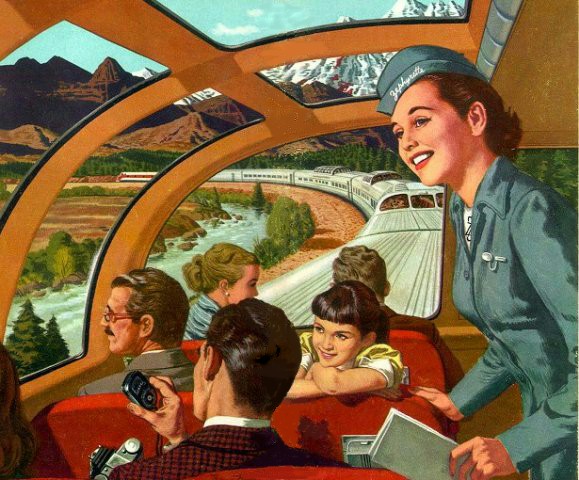
Then I started a new series, set in the early 1950s, featuring Jill McLeod, a Zephyrette on the California Zephyr, the sleek streamliner train that ran between San Francisco and Chicago from 1949-1970. The current Amtrak version is a successor to that passenger train. Jill is a train hostess, the only female crew member. Her job is to walk through the train from time to time, keeping an eye on the passengers and what they need. While she’s on duty, Jill wears a uniform. It’s teal blue, with a skirt and jacket worn over a white shirt, and a military-style cap. When Jill is off-duty, however, she dresses in the styles common at that time. It’s the era of full skirts and dresses with waists, and Jill’s hair is styled in the popular poodle cut.
Speaking of undies, that was the era of girdles and bullet bras. I’ve never written about Jill’s undergarments, but in one book I have her climbing into her berth in a pair of comfortable pajamas.
On to the historical novel—and more about undies. The book I’m working on is set in the late 1870s. I am currently obsessed with researching what people wore. I bought a book called Clothing Through American History: The Civil War through the Gilded Age, 1861-1899. I found a sidebar titled “The Layers of a Proper Lady’s Toilette.” It describes nine layers and 25 pounds of clothing to make up the proper undies for a lady, and goes from stockings to drawers, to chemise, petticoat and corset. We won’t even talk about the damn bustle.
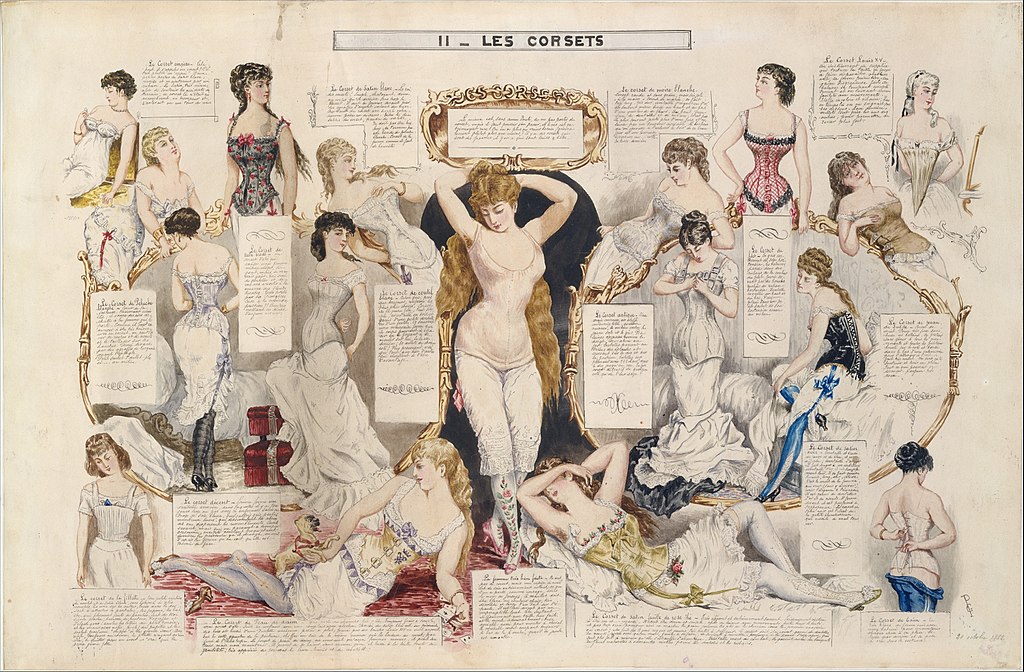
How in the hell did women function when confined in this cage of fabric and metal? I suspect we could have another blog post on how women’s fashions interfered with their lives as well as their movement. And not just in the nineteenth century, and earlier. Remember when it was scandalous for women to wear pants? And when many women, my mother included, strapped themselves into girdles?
We will draw a veil over those bell bottoms I wore, just about the same time I bought those platform heels and fell through a door. Jeri would never do that, at least I don’t think so.
I’m not sure the protagonist in my historical novel wears all that clothing, though. Things were different on the western frontier, where farm wives sewed weights into the hems of their skirts to keep them from blowing up and showing off their undergarments. In the late nineteenth century, women did in fact wear split or divided skirts for riding horses, something I’ve eagerly adopted for my protagonist, since she’s traveling in the first part of the novel, sometimes on a wagon seat and sometimes astride her own horse.
I haven’t decided what to do about her undies. She’s independent enough to push against societal norms. Will that extend to foregoing a corset? I guess I’ll find out.

 Ladies of Mystery
Forgive my lateness in commenting, but I only returned from a short trip. I went to college on a costume scholarship, so clothing and I are old acquaintances. I was never a good seamstress but never met a garment I was afraid of. I know only too well that undergarments have a huge impact on our daily lives, certainly as much, if not more, than the coverings. Sometimes readers comment on how often I mention clothing in my books, but in my opinion what our characters wear affects how they move, think, and feel. Can you imagine wearing a girdle and trying to leap over a fence or climb a tree, as sometimes my protagonist does? And forget about a corset!
Great post.
LikeLike
Heather, my readers often mention how much coffee Jeri Howard drinks! I never had to think much about what Jeri wears in my contemporary mysteries. It’s only when I started setting books in the past that the subject came to the fore.
LikeLike
We men are mostly flabbergasted by this topic in general. But, I have pondered the mysteries in terms of whether the undergarment was intended to accentuate or disguise that which the apparel concealed. I think in general skin was not to be viewed at all, therefore ankles nor wrists were revealed, along with any other extremity. So, in this disguise, what was to be done with the covered up body? Waists cinched, butt expanded with extra rolls, yet crack invisible in the eruption of garments in that locale; bosom magnified; yet nipples invisibly detained. Ahh, what a bunch of craziness our foremothers endured. And what is amazing, as any SIS guy will confess, if that the female form is nothing you really want to miss or mess with, so who wrote all these unwritten rules of bodily subterfuge? My guess is the clergy, evil dudes. While they had to swear off the form, they were not going to let us lay men have any enjoyment.
LikeLike
Fun post! I have several books on the undergarments of the 1800’s. I used them back when I wrote historical western romances. And you are safe to have your heroine, if she is a farmer’s wife, to wear with fewer layers so she can move to do her chores and not overheat. But when she goes to town or church she will put on an extra layer of petticoats and the corset for society’s sake. Or if she is rebellious, she may not. 😉
LikeLike
My protagonist is indeed rebellious, and independent. I think she only wears a corset if she absolutely has to.
LikeLike
So interesting to do research!
LikeLike
It is. One can easily go down the rabbit hole and never come up for air.
LikeLiked by 1 person
Old practices in fashion are fascinating. I winced when I learned that characters on TV shows set in the 19th century had to appear in the apparel worn in that period. Those corsets were something awful. I do know that the lower down the character was on the social/income scale, the fewer undergarments were required. In addition, at the top level, those undergarments were known to distort the shape of organs such as the liver. Hard to believe but true. Good luck with your new book.
LikeLike
Great fun to contemplate all of this. My protagonist is the daughter of an Army officer, moving from fort to fort, so she has a certain amount of independence and rebels against what is expected of her.
LikeLike