
* to misquote Roger Miller’s “England Swings.”
When selecting a year in which to begin my Wanee Mystery Series, I landed on 1876 not by accident but by design. It was the U.S. Centennial year. The Centennial Exhibition in Philadelphia, partially powered by a massive steam engine, showcased Alexander Graham Bell’s telephone, the first typewriter with a QWERTY keyboard (Remington 1), Edison’s automatic telegraph, new products such as popcorn, ketchup and root beer, and mass-produced wares including an improved sewing machine. Attending librarians founded the American Library Association. The women’s pavilion demonstrated women’s influence in philanthropy as well as philosophy, science, medicine, education, and literature, foreshadowing the woman’s movement. All while, Reconstruction was still a thing, Native Americans were battling for their land, the James brothers (and others) were robbing banks, and the country was fraught with the second worst depression in U.S. history, setting men adrift to join those already on the road due to the Civil War.
The War may have been over, but it wasn’t. The tides of belief were changing in the North to be less tolerant of the blacks they had just freed. The Southern Democrats fought a different sort of war using intimidation to ensure victory at the Southern polls. Lynchings were common, murders as well, all over the country, not just in the South. The country felt out of control to most. Yet the depression was easing, opportunities were appearing, and technology was booming. Does any of this sound familiar?
What I didn’t expect was how the next year, 1877, the setting for books four through six, would mirror the present. Newspapers predicted the fall of democracy. Public sentiment turned against “tramps” (homeless to us), immigrants, and Hispanics north and south of the border. Southern Democrats (some of whom, as seditionists, the 14th Amendment denied the right to vote or hold political office) took over statehouses by force and threw out duly elected Republican governors, reclaiming control of the south. The oligarchs of industry ruled the White House and most state houses. Graft was everywhere during President Grant’s just ended presidency, and the election of Rutherford B. Hayes considered fraudulent.
Fear crept through the cracks in doors and across the floor, coloring daily life. Small towns were no exception. Though generally not central to the angst, their newspapers, fed by the larger dailies, amplified the news and worries of the world, breeding distrust of the government and outsiders.
The West was still wild, the East tame (if you call murder, gangs and lynchings tame), and the Midwest a mess of mixed sentiments especially in the border states. Small towns like my fictitious Wanee, Illinois were at the nexus of all this change, rife with the disenfranchised, pressured by growth of outside industry, the railroad, and farmers. Glory be, it is my job to weave the discomfit, prejudice, worry, and change into the warp of each story. What a wonderful and frightening opportunity.
The words of one of my professors accompany me; you cannot truly know the tale Shakespeare tells without first understanding the context of the time in which he wrote. He wasn’t a Shakespearean scholar though he discovered the first draft of one of Shakespeare’s plays. Even so, he taught us far more than Shakespeare. He held our hands through the Elizabethan period, the church, the mores, and Shakespeare’s competitors. He made Shakespeare new to me with one question: what if Hamlet’s father wasn’t dead? I hope I do him honor in providing the context for my tales, these roiling years are the stage upon which Cora and her cohorts play. I ask myself with each page written and each plot devised how this disquiet affects the day-to-day dreams and strivings of Cora Countryman, Dr. Philip Shaw, and Sebastian Kanady, who owns and edits Wanee’s newspaper.
This tumultuous period will provide me with plots for a long time to come as Cora and her supporting cast wend their way through to the new century solving the crimes I present them. Yet, as I work on the fourth book, it feels as though 150 years on, we are fighting the Civil War all over again, while dealing with the same threats to our future, oligarchs, seditionists, and technology included. I for one do not wish another 1877 on this country, nor should you.
But I do love writing about the era and how the changes it forced still define us – for the good or the bad.
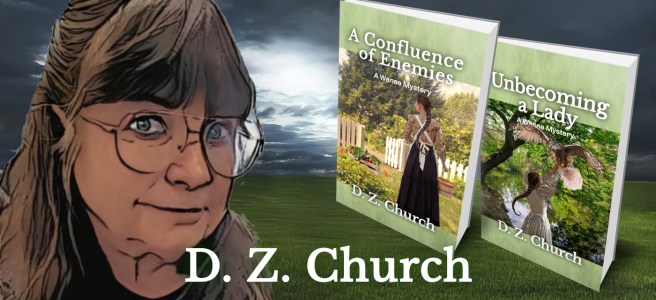
Unbecoming a Lady and A Confluence of Enemies are available from Amazon; https://www.amazon.com/Confluence-Enemies-Wanee-Mystery-Mysteries-ebook/dp/B0CQJ5DW4W. Check my website: https://dzchurch.com for more information on the Wanee Mystery Series and my other books or to sign up for my newsletter.

 Ladies of Mystery
Too true. Everything old is new again. I had the same reaction while researching that time period for my historical novel.
LikeLike
Well written post and I agree with Susan, I’m off to make sure I have the first book.
LikeLike
If your novels are as well written and as riveting as this post, you definitely have a winning series. On my TBR pile now.
LikeLike