A lot has been going on in my life this past month. We have a gigantic fire in the mountains above our foothill home, called the Sequoia Complex Fire, and at this moment we are still on voluntary evacuation alert. The smoke is horrendous.
We had a huge family celebration for my husband’s 90th birthday despite the Covid virus. Nearly 50 relatives attended our four living children, many grands and great grands, and four great-greats, plus in-laws. It was a wonderful party. Some of the relatives came a day early and others stayed a day later. Enough time has gone by that we know no one got sick from attending.
I’ve been working on my next Rocky Bluff P.D. mystery and since it’s set in real time, I didn’t see how I could write this one without including the virus. In some ways it’s been fun because I can use all the different views people have about the Covid 19. I had the opportunity to spend some time talking to my police officer grandson, and he shared some of what he has to do now because of the virus. He was most helpful.
But I really want to share something else. I’m reading a novel, not a mystery, which has more backstory, mostly in narrative, than what is happening “now.” I’ve never read a book quite like this before. What it is doing though is really building each character and showing why each one is like she or she are now.
I don’t think I would ever write like this author has, but for this story it is certainly working. It did make me think though how I could give a little more background to some of my on-going characters for people who haven’t followed my series from the beginning.
Isn’t it amazing how we can find-out new ways of doing things from how other authors? Plus, no matter how old we are, we can always learn something new.
For the last several months I’ve been rewriting a mystery from first person to third. This was more fun and more rewarding than I at first expected and I’m pleased with the results. One of the best parts of the work was rearranging the plot and reworking and developing the subplot. I have a general rule that when this part of writing a mystery gets tedious, then it’s time to start over. That didn’t happen this time, and I enjoyed one of my favorite aspects of crime writing.
Setting up and working out a mystery is for me the same as working out a puzzle, or finding a new tool and learning how it works. I like moving pieces around, setting up clues, keeping track of lines of dialogue that can be used later, reworking a clue, slotting in hints in dialogue to guide or mislead the reader, or lifting and replacing scenes. Dorothy L. Sayers called this process of working out a plot a “tactile” pleasure, and indeed it is. I’m not talking about notecards; I’m talking about the mind’s perception that the hands, fingers, are moving physical items around on a surface.
Some years ago, I signed up for a design course to learn more about how designers work to help me think about book covers. It was a revelation. Never had I more truly understood the difference between a writer’s mind and that of a designer. The first lesson was to use our names in a design as a way to introduce ourselves. I fussed for days over fonts, letter placement (vertical or horizontal), and more unimaginative details.
The student work I remember best was a drawing of the letters of his name tumbling out of a cornucopia in random order. I never produced anything equal to the work of the other students but I learned to release objects as well as ideas from their given, or assumed, boundaries. Which, when you come to think about it, is kin to what’s happening in crime fiction—individuals breaking rules and crossing lines, violating boundaries and challenging others to contain them.
The term “boundaries” has come to mean an emotional guide we use to protect ourselves from others or establish areas where connection is possible. We establish rules of interacting, and talk at length about how to do this. But boundaries are also physical, lines on a map drawn between nations or neighbors. We think of them as fixed, but experience tells us they’re not. Mystery writers have no trouble rearranging the world to suit our purposes. It makes me think of Roosevelt, Stalin, and Churchill at the Yalta Conference in 1945, rearranging the map of Europe before the war was officially over.
Rearranging a plot is rarely so significant as Yalta but slipping the pieces out of logical, rational place can produce the startling results that jiggle the brain out of its comfortable path. Examples abound in the work of Anthony Berkeley, a writer of the Golden Age, in his repeated challenges to the idea of justice and the issue of justified homicide. By seeing an encounter between two people in terms of its individual steps, the writer can pull apart the entire progress and rearrange the steps into a challenge to the standard perceptions of crime and violence. Every time a writer makes a change in the story, no matter how minor, she is turning what is regarded as a straightforward crime into a plot, and leading the reader to break established boundaries and ways of thinking about a particular event. This is a useful skill that might well be applied to all areas of life.
I don’t know about you, but I’m edgy most of the time and worried the rest of it. The Creek Fire is burning a scant few miles away, and we’ve been living under an evacuation warning for weeks now. Of course, there is Covid-19, and now, RBG. Sigh!
At times like this, I find comfort in books. Not any books, but those books, the ones that mark your passages, the ones you’ve never forgotten because at that moment in your life they were perfect.
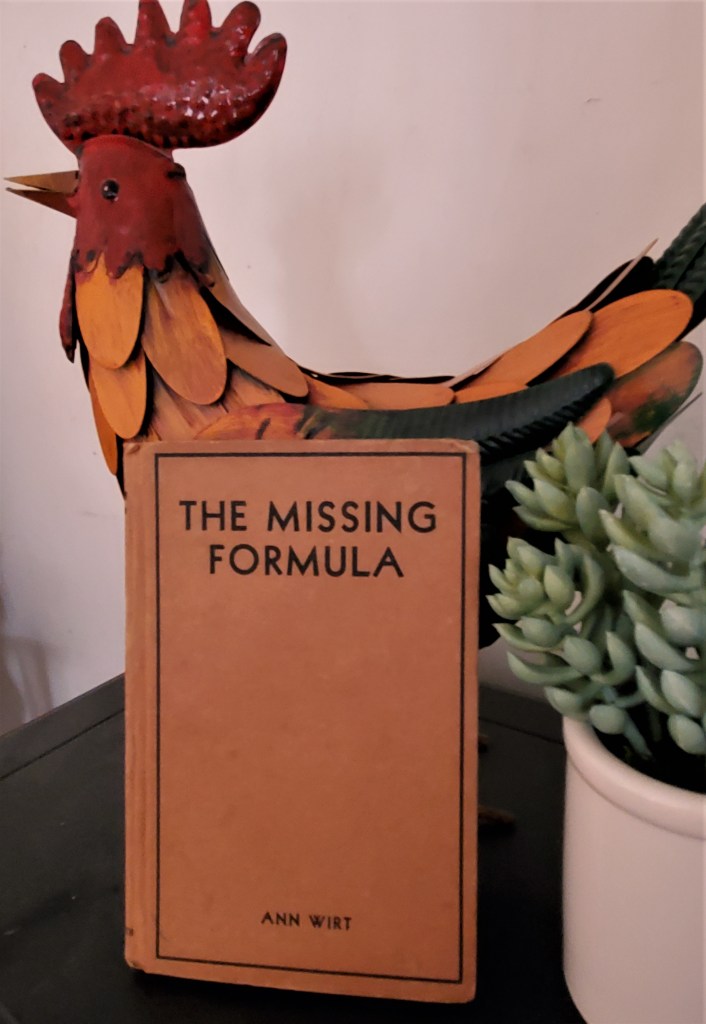
My mother’s copy, published in 1932
Lately, I’ve been thinking about three books that I liberated as a pre-teen from a dusty shelf above the stairs in our house in Michigan. The books were thin volumes, simply bound, in varying colors, with black titles embossed on the cloth bindings—Madge Sterling Mysteries, by Ann Wirt. I remember the feeling of anticipation as I lifted The Missing Formula from the shelf. Next thing I knew, I’d been swept away. I consumed all three of the slight books, one a day for three days, perched on a stair, reading in the stairwell light. They were mysteries—not Nancy Drew, or Hardy Boys—but mysteries with an engaging female alone in the world, armed only with her lively mind.
First Edition- not mine, alas!
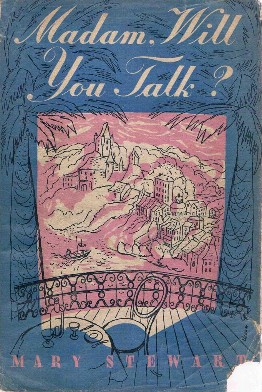
I never forgot Madge, even after I discovered Mary Stewart, who transported me first to the Isle of Skye, then to the South of France, to Crete, to Corfu to the world. And she brought romantic suspense gently into my reading. I have never fully recovered from Richard Byron in Madam, Will You Talk? or Simon Lester in My Brother Michael. Oh, there have been other men, but Richard is waiting for me in a courtyard in Avignon and Simon to drive me to Delphi. I know they are!
Reading Mary Stewart was the first time I experienced world-building, though I never would have used those exact words. Nothing is as soothing as crawling into a carefully constructed world that teaches you, woos you, and entices you to belong. A place you want to stay for a while or maybe forever.
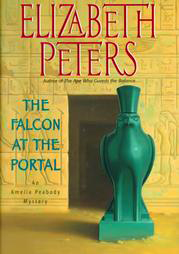
Which brings me to the Amelia Peabody books. Each book should come with a warning that to venture with Amelia into the Valley of the Kings is to slip into a parallel universe from which there is no return. My favorite Amelia Peabody books are the four that take place during World War I. I love them. I read them when I need to return to a time of wry humor, careful history, joyous family, and adventure. Elizabeth Peters, Barbara Mertz to the world, left us real treasures in these books. Start with Crocodile on the Sandbank, but rush to The Falcon at the Portal.
The legacy of all of these ladies accompanies me when I write, though I know full well I’m not in their league. Sure, I have read the gents, lots and lots of mysteries, thrillers, and suspense by men. I adored Travis McGee and Lew Archer, trust me. But these ladies of mystery taught me everything.
First, have fun! Second, build a world that your readers can wander into and not want to leave. Third, make your heroes “all damn and dark your eyes,” even if they are blonds, and your heroines lively and ready to learn more than they ever wanted to know about themselves. As one reader of my first book, Perfidia wrote, “I really enjoyed this book because you can escape from the real world for a time. I loved the characters and did not want the book to end. Can’t miss with Islands, Ocean, Pirates and History.”
Maybe someday her daughter will grab a book from the stairwell and read: “My father, Del Lassiter, is a handsome man in his early fifties. Dark hair shot through with gray, blue eyes coupled with a nice easy smile that makes him the darling of all his female acquaintances whom he dates prodigiously but never marries. My girlfriends all adore him, especially my best friend, Gail. When he pours his honeyed-peanut voice over them, they swoon.”
For many of us this has been a year of uncertainty, a difficult year, and a year we could never have imagined, one that took us completely by surprise and rocked our universe. For my husband and me it has meant almost no in-person contact with our children. Our son and daughter-in-law live on the West Coast, my husband and I live north of the Finger Lakes on Lake Ontario, and although we spent time over the summer with our daughter who lives in New Jersey, she’s started back teaching. We have no idea when we’ll be able to visit with any of them again.
Zoom meetings have become part of our lives. Truth be told, it’s not a great way to mourn the death of a beloved sibling, celebrate several new births, or the milestone of a cousin’s 70th birthday. We do it; we have no choice, but it’s been much harder than giving up dining out at restaurants or attending live cultural performances.
On the professional end, book talks and signings, and a conference for readers of mysteries where I was to be a panelist, were all canceled because of Covid-19, shortly after my second mystery was launched. Appointments for yearly check-ups and screenings have also been canceled and rescheduled, more than once.
But despite the uncertainty and sadness, there have been bright spots: The babies and birthday mentioned above, the support of friends when we were mourning the death of my sibling; the outdoor, safe distancing gatherings of a small group of us who are bonded not by blood but by heart; a cooking video on YouTube with me preparing a recipe from one of my books. And we do get to speak with and see our children on FaceTime and at family Zoom gatherings.
In early April we adopted Nova, a tiny Blue Tick Beagle, who captured our hearts from the moment we saw her photo at the shelter. A gentle, easy going and loving dog, she also is spunky and stubborn, qualities that have stood her in good stead, given the horrible neglect and abuse she suffered before becoming part of our family. Five months have passed, and Nova is a happy, healthy, increasingly confident and secure dog, just as we had hoped. It was the virus that brought us together.
To deal with the anxiety I feel because of these surreal times, I’ve been listening to guided meditation CDs, about 20 minutes daily; it’s helped. As has writing in a journal, giving voice to thoughts and feelings about all the chaos in our world. But I also write down ten things each day for which I’m grateful. Poetry and classical music, always part of my life, have assumed a greater role, calming and centering me.
Most of us have heard the old saw, “this too shall pass,” but sometimes it’s not all that easy to believe. I think it will happen, eventually, but our world, both big and small, will be changed forever. Hopefully, when it does, we’ll find strength to pick up the pieces and move on.
Murder is a shocking and terrifying taboo. The very word sends an icy frisson slithering down one’s spine. And yet, it is an occupational hazard for a crime writer. On a cerebral level, the taking of a human life is fascinating. It is a serious business, requiring cunning and sangfroid mingled with passion, anger or fear. A certain degree of luck is necessary to pull off a murder without getting caught. The faint of heart would be riddled with remorse and horror at this deadly transgression.
Setting aside the moral considerations, I find it deliciously thrilling to plot a murder. The omnipotent power to kill is a dizzying prospect. Murder is an art form, if one thinks about it. The killer must be creative. But how does an author choose from the plethora of methods available? Your character is the key to unlocking this mystery. Therefore, an author must first delve into the murderer’s psyche to thoroughly understand why he or she came to make the fatal decision. Is he or she an assassin, a spurned lover, a business partner who has been swindled, or an average individual pushed to the brink in an extraordinary situation? Once the author has sketched this character profile, the pieces will fall into place and the story will begin to flow. The author must have absolute trust in the murderer. He or she will guide you down the evil path and determine if the victim expires quickly or suffers a slow, lingering death.
In most cases, murder stems from a rupture in an intimate relationship. This personal animus is likely fueled by emotion and an overwhelming thirst for revenge. Consequently, this means inflicting pain. The thrust of a knife into the heart, stomach or between the ribs would do the job nicely. With stabbing, the murderer and victim must be at close range. Generally, stabbing ensures that the killer’s face is the last thing the victim sees in this world, satisfying a desire to mete out punishment. For this reason, the murderer in one of the books in my series featuring journalist Emmeline Kirby and jewel thief/insurance investigator Gregory Longdon slashed the throat of an unscrupulous man, who had derived malicious glee from ruining other people’s lives.
Meanwhile, shooting also would induce pain. With this method, the author has the option of killing someone instantly, forcing the culprit to hastily cover his or her tracks. This provides an opportunity to sprinkle red herrings through the story. Conversely, the dark deed can rattle the murderer to the point that he or she is no longer thinking clearly and makes mistakes. Another possibility is that the gunshot does not kill the victim outright. It may cause a grave wound, presenting the murderer with a chance to finish off the victim another way. Let’s say by poison, for example.
Ah, poison. To me, it’s so sinister and tantalizing. I believe I share this view with my hero Agatha Christie, who masterfully eliminated dozens with a soupçon of poison. Some poisons are tasteless and odorless. Then there is cyanide, which smells like bitter almonds, while arsenic, when heated, gives off an odor resembling garlic. Depending on what your story dictates, poison can work instantaneously or the victim can waste away little by little. Russian spies, and Putin in particular as a former head of the KGB, have a penchant for using poison to dispatch enemies, defectors and anyone who dares to oppose them. As a result, poison was my weapon of choice in another novel. The story dealt with a defector who recklessly pitted Putin against Russian mafia boss Igor Bronowski. At the same time, both had unsavory entanglements with a ruthless British entrepreneur. All were obsessed with a flawless blue diamond. I will confess that two victims succumbed to poison in the book. However, poison is not the exclusive domain of the assassin. An author can wield it perfectly well among those who have a personal score to settle. On this point of the professional versus the amateur (for want of a better word) killer, an assassin can employ stabbing or shooting in a pinch for expediency’s sake.
A lethal arsenal would not be complete without strangulation, drowning and smothering. But all three may prove troublesome because they require a degree of strength and the victim will most certainly put up a struggle. A murderer wants death to come swiftly with a minimum of fuss to have time to disappear before the body is discovered. On the same token, bludgeoning someone to death with a heavy object could prove messy, since several blows would likely be needed thus causing a good deal of blood to be shed. Of course, an author may want to employ bludgeoning for precisely this reason to set the stage for the murderer’s ultimate undoing. For in the haste to flee, he or she may miss a trace of blood.
Allow these diabolical musings to steep in your mind. After a while, you’ll come to realize that it’s criminally good fun to acquire a literary taste for murder.
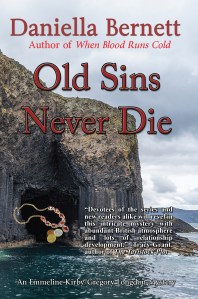
OLD SINS NEVER DIE
Never look back…Treason is deadly
While in the Lake District, journalist Emmeline Kirby and jewel thief/insurance investigator Gregory Longdon overhear a man attempting to hire international assassin Hugh Carstairs, a MI5 agent who went rogue. They race back to London to warn Philip Acheson of the Foreign Office and Superintendent Oliver Burnell. But it’s a devil of problem to prevent a vicious killing, if the target is a mystery.
More trouble brews as Emmeline pursues a story about shipping magnate Noel Rallis, who is on trial for murder. Rallis is desperate to keep the negative publicity from exposing his illicit schemes, especially something sinister called Poseidon. Lord Desmond Starrett, whose dark past made him easy prey for blackmail, is getting cold feet about their dubious partnership. Hovering in the shadows of this ugly secret world is a Russian mole buried inside MI5. Scorned prima ballerina Anastasia Tarasova makes the fatal mistake of threatening to reveal all she knows. The hunt for the answers takes Emmeline and Gregory up to Scotland, where they learn that the truth has lethal consequences.
Daniella Bernett is a member of the Mystery Writers of America NY Chapter and the International Thriller Writers. She graduated summa cum laude with a B.S. in Journalism from St. John’s University. Lead Me Into Danger, Deadly Legacy, From Beyond The Grave, A Checkered Past and When Blood Runs Cold are the books in the Emmeline Kirby-Gregory Longdon mystery series. She also is the author of two poetry collections, Timeless Allure and Silken Reflections. In her professional life, she is the research manager for a nationally prominent engineering, architectural and construction management firm. Daniella is currently working on Emmeline and Gregory’s next adventure. Visit www.daniellabernett.com or follow her on Facebook at https://www.facebook.com/profile.php?id=100008802318282 or on Goodreads https://www.goodreads.com/user/show/40690254-daniella-bernett. Old Sins Never Die, the sixth book in her series, was released today.





 Ladies of Mystery
You must be logged in to post a comment.