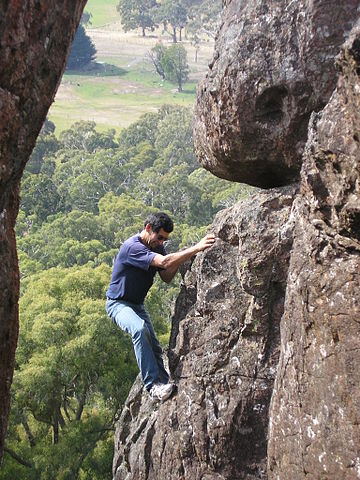
Openings, Closings, Cliff Hangers, Hooks, and Dribbles

In early drafts, I fall into a habit of beginning and ending chapters in similar ways. Because of this, one of the stages I’ve added to my revision routine is the focused examination of chapter-opening and chapter-closing paragraphs to make sure they are not only effective but varied.

Openings

A chapter has to start with a sense of purpose and direction, or a reader will be confused or lose interest, and it’s not just the writer’s goal for the scene that matters—it’s the character’s. Furthermore, it has to be a goal the reader will care about, a goal that arouses empathy, curiosity, suspense, or dread. Although some chapters can begin effectively with an overt statement of a character’s goal, it would be tedious if they all did. How many other ways can I indicate that goal?

  • It can be forced on the protagonist by another’s character’s goal, either in conflict or through teamwork. (But not too often, or the lead character can seem passive and reactive.)
  • Some goals are made so obvious by the action that opens the chapter that they need not be stated directly.
  • Occasionally, a chapter can open with a sequel or reaction scene relating to the previous chapter, a paragraph or two of the character’s inner work which leads to a decision that becomes the goal.
  • Minor goals can set a character in motion only to be swept aside by a more urgent goal.
  • There’s immediate energy in a goal stated in conversation or implied by the subtext of the dialogue.

Though I won’t keep listing them, I’m sure you can think of other variations on this essential feature of the chapter (and scene) openings.

Closings

If a chapter ends with a nice, tight feeling of closure, the reader can easily put down the book. I doubt any of us has ever read a chapter ending like that in a mystery. At least, I hope not. The last lines have to keep the momentum going. I’m not a fan of the “if only she had known what was coming next” sort of hook. It’s possible to use to it sparingly in the first person, or in a truly omniscient point of view where there is a narrator’s voice, but not in close third person, which is the only point of view I use. Sometimes I want to create that portentous feeling, though.

To do so, I can end with a character having a sense of something bad about to happen, and if I do it once or twice in the book—probably once—that’s enough. Another way to get the hint of forthcoming doom or disaster is a chapter with a happy ending to that’s too good to last, or a character turning down a task that he’ll eventually have to face. There’s also the classic cliff-hanger that leaves a character on the precipice of a life-changing decision or a dangerous confrontation, but it can’t be overused without losing its power. Sometimes the hook can be as simple as going through a door, if the reader wants to know what will happen on the other side.

I took a class in which we were cautioned not to let our scenes dribble—not to keep going after they have ended—and it’s good advice, but once in a while I’ve seen some excellent writers do this at the end of a chapter. There is a page-turning plot event at the end, but it’s followed by a few humorous lines of dialogue that add depth to the characters and their relationships without smothering the impact of the “real” ending. It’s a dribble, but it’s a skilled dribble, used judiciously like a dribble of hot sauce that’s only good in small quantities.

For this post, I studied how one of my favorite writers, Tony Hillerman, began and ended chapters, examining his Sacred Clowns. The chapter openings vary from setting a scene and introducing characters along with their goals to dialogue lines that jump into the next stage of the plot, and from inner reflections to moments that progress the romantic subplots. The goals are clear but sometimes implied, not always stated in narration or dialogue. His endings range from surprises to warnings to humorous dialogue following up a more serious event (the well-crafted dribble). One chapter ends with a character’s recognition of an important pattern in the mystery plot, another with an informant’s hint that he can help, and another with a comic setback in a romantic subplot. There are endings where the characters are stumped or struggling, but he never uses an outright cliffhanger in this book. Once in a while, he even ends with character getting what he wants—for the moment.

There’s some wonderful symmetry in Hillerman’s chapter structures. One begins with Joe Leaphorn dealing with paperwork and ends with Jim Chee dealing with paperwork, paperwork to be exchanged with each other. It’s humorous and insightful, tells much about their working relationship, and it moves the plot. Another chapter ends with someone warning Jim Chee that a certain investigation is none of his business, while the following one begins with a different character giving Chee the same caution. The book is a page-turner, without the author doing anything clichéd to make the reader turn the page.

One of my go-to writing books is Jack Bickham’s Scene and Structure, and I expect many of my fellow writers are familiar with it. Bickham’s basic scene structure advice is: goal, conflict, disaster. He gives creative ways to work with that structure, including starting in the middle of the conflict and then revealing the goal later, ending short of a full disaster, and more.

Can you share any other “tricks of the trade” for keeping readers up at night?

Off and Running


Well, maybe not running–but I have certainly begun the promotion for my latest book, A Cold Death, with as much spirit and energy as possible.

Me at Branches and Books

This is my first book signing for the new book at Branches Books and Gifts in Oakhurst. Long  drive but one of my favorite towns. Lots of pluses, got to lunch and visit with an old friend, then after the signing, went to dinner with grandson, his wife and great grandson. Though I didn’t sell a ton of books, did sell some to people who like mystery series.

AColdDeath-lg

I’m also in the middle of a blog tour–it hasn’t gone smoothly, hosts forgot to put my post up–not sure why they wait until the day and don’t schedule it–but I’ve had many great comments and the book is beginning to receive reviews.

My next event is planned at Stafford’s Chocolates, yes, it’s a store that sells handmade delicious chocolates, only 17 miles from home. I’ll let you know how that goes, but if all else fails, I can eat chocolate. The store is excited to be hosting me–so that’s a plus.

Also attending a the Great Valley Bookfest on October 14th in Manteca–also a long drive, but well worth it. The people come to it planning to buy books.

While all this has been going on, I’ve also taken the rights back for some of my books and new editions have appeared on Amazon.

This is a book truly from my heart-not exactly a mystery, though there are some mysterious elements–but it is based on something that happened in our family.

The Astral Gift latest

This one is a mystery–the first one I wrote and published. It has been re-edited–it is about child abuse, astral projection, murder, and a touch of romance.

https://www.amazon.com/Astral-Gift-Marilyn-Meredith-ebook/dp/B075M7B7PW/ref=sr_1_1?s=digital-text&ie=UTF8&qid=1506264448&sr=1-1&keywords=the+astral+gift+by+marilyn+meredith

So you can see, though I’m not really running, I feel like I have been. I’ve also been learning new things along the way.

What new places have any of you tried for book signings? Anyone else experiencing new challenges along the way?

Being an author is certainly not for sissies!

Marilyn

WHODUNIT?

I’ve been reading a lot of mysteries lately, perhaps to unstick myself from where I am stuck in my own book. I read to find the solutions other writers have come up with in their books. When the soluton is revealed and I find out who the murderer is or why the murderer did what he or she did, is it satisfactory? Does it leave me with a feeling that although I was mystified, I am now satisfied by the answer. Those mysteries are a pleasure.

Sometimes, though, I think that the writer doesn’t play fair or comes up with a solution that doesn’t make sense. The solution may be a great surprise, but it leaves the reader feeling cheated.

Sometimes writers do the “Hercule Poirot” ending where the detective or amateur sleuth gathers all the suspects together and accuses each character in turn of committing the murder, lays out the reasons why they did so, and then exonerates each one until he gets to the real murderer. That was good for Agatha Christie, who may have been the first to use it, but it get tedious when it continues to be used. Perhaps everyone has a reason to kill the victim, but not everyone is capable of murder or has a reason serious enough to kill.

That’s an other thing: the reason to kill must be serious. The killer must not only be capable of murder but must also have a really good reason to do so. Revenge for a terrible injury or protecting an important secret or shielding a loved one,. yes. Revenge for a social slight or insult, no. Revenge must be for something really serious.

I like an ending where the sleuth suddenly realizes who the murderer must be and pursues him or her to a satisfying climax, preferably with a chase or confrontation scene. That’s only my preference, of course. Obviously, not all mysteries should be alike. I’ve read many satisfactory mysteries where the murderer is known by the reader from the start, but the story is about the pursuit of the murderer by the sleuth or the sleuth’s realization of who the murderer must be. Or even, although this isn’t my favorite, a story told from the murder’s point of view as he or she escapes from the detective. In that kind of mystery, I find myself rooting for the murderer, and that’s kind of uncomfortable.

Anyway, the sticking point in the novel I am currently writing, the problem which is driving me to read one mystery after another in an attempt to forget my problem or, with luck, solve it, is the discovery early on of a safe deposit full of very expensive jewelry. The novel is the third in my Burgess Beach, Florida, series, featuring detective Andi Battaglia and her partner, Greg Lamont. It’s called REASONS TO DISAPPEAR, and the story concerns their captain, the man who ran the Burgess Beach Police Department, a real stickler for rules and regulations, who has disappeared, taking with him a lot of the city”s money and leaving behind the safety deposit full of jewelry. Is it solen? If so, from whom? By whom? How did the captain get hold of it? Why didn’t he take it with him when he left? What, if anything, does it mean?

I am inclined to trust my writing subconscious, which often causes me to put something in as I’m writing that I’m not sure I know the meaning of. This safe deposit box full of jewelry may be one of those things. Who does it belong to? Was it stolen? How did it get to the Captain’;s safe deposit box? Why is the Las Vegas mob interested in the jewelry? I hope my subconscious knows the answer and will reveal it to me soon.

You’re Not Alone!

thumb_IMG_1225_1024

I had the pleasure this weekend of participating in a mystery celebration at the Tredyffrin library in Strafford, Pennsylvania. The event was in honor of the 30th anniversary of the Sisters in Crime, a fabulous mystery writers and readers group. I spend a lot of time writing, reading, reading about writing, blogging, following blogs… you get the picture. But there is nothing quite like meeting with fellow mystery writers and mystery lovers.

IMG_3459
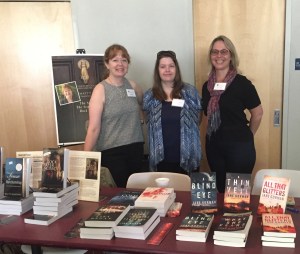
Sharing a table with mystery writers Matty Dalrymple and Lisa Regan

Sisters in Crime was founded by Sara Paretsky and a group of women in 1986. It now has 3600 members in 50 chapters world-wide and offers networking, advice and support to mystery writers. Members are authors, readers, publishers, agents, booksellers and librarians, all bound by an affection for the mystery genre. The mission of the Sisters in Crime is to promote the ongoing advancement, recognition and professional development of women crime writers.

MemberStamp2016-17

If you’re a mystery fan, I can’t recommend the Sisters in Crime enough. I’m a member of two different chapters.

Here in my local area (near Philadelphia), I attend the monthly meetings of the Delaware Valley Chapter. I’ve met some incredible writers through this group as well as some fun mystery fans who I love to share stories with.

_Guppy logo copy

I’m also a member of an online chapter of the Sisters in Crime, the Guppies. Originally created as the “Great Unpublished” (hence, Guppies), the group now includes not only unpublished writers but a few rock star writers as well. It offers a chance to virtually chat with fellow writers, to swap manuscripts, to take online courses, to share information and ideas.

Thanks to my involvement in these groups, I’ve participated in writers conferences, book signings, lectures, and more.

IMG_5466
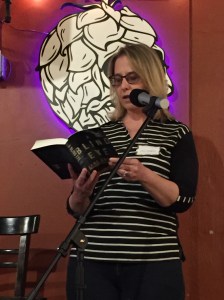
Reading from A Blind Eye

If you are a writer, an aspiring writer, or just a huge fan of mysteries, check out the Sisters in Crime! I’m sure there’s a chapter near you. And if the nearest chapter is farther than you want to drive, boot up the computer and check out the Guppies.

Writing can sometimes seem like a lonely pursuit, or at least something you do alone. But thanks to groups like the Sisters of Crime, I always have someone to support me, to keep me motivated and inspired.

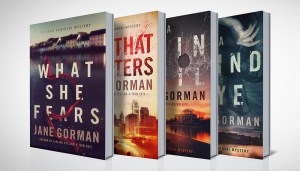
Learn more about Jane Gorman and her books at janegorman.com

Adam-Kaminski-Mystery-Series

Privacy, Responsibility and General Robert E. Lee

by Janis Patterson

On this and other blogs I have always ranted about the necessity of a writer for privacy, of how we shouldn’t have to open ourselves and our personal lives up just because our fans want us to or because we need the publicity. Privacy is very important to me and always has been. Some say that by being too open, or too outspoken on social media we run the risk of losing or even alienating fans, and that is a distinct possibility. No sane person wants to damage their career deliberately. For some reason writers – especially genre fiction writers – are not supposed to be controversial. Mean people who disagree with us, we are warned, will flock to our retailers and give nothing but bad reviews in an attempt to hurt us and complain about our attacking their freedom of speech if we complain.

That sounds more like bullying than freedom of speech.

However, there are things which supercede a career. We have all been counseled to be quiet or at the most neutral about some things, politics and religion primarily. That’s good advice, but I think we are human beings and citizens first, and some things trump both the career and neutrality cards.

I live in Dallas, which is controlled by a very liberal mayor and city council – all of whom are bound and determined to take down a statue of Robert E. Lee that has been standing for over 80 years – all in a rush of indecent and (in my opinion) barely-legal haste. The powers that be had a crane ready to dismantle the statue within minutes of the council’s vote. (After over 80 years in the same place it suddenly had to be removed THAT AFTERNOON? Sounds like something’s fishy to me.) Had not my wonderful husband rushed to file a Temporary Restraining Order we would have lost an incredible work of art. The statue (or as the council member spearheading this idiocy calls it, the ‘statcha’) is one of the finest examples of heroic-sized bronze art in the country. Whoever/whatever the statue (statcha) represents, the fine detail work, the intricate delineations, the entire piece is exquisite and to take such a work of fine art out of the beautiful park setting created for it decades ago and probably out of public view forever is just plain heinous.

But that’s not the worst. Dallas is a perpetually cash-strapped city where (among other things) it can take months to get a pothole repaired, and where over 400 policemen quit the force last year because of the poor pay and a very shaky, poorly managed pension fund. Even with such financial problems the mayor and the city council simply cannot wait to pay over (and maybe a LOT over) $400,000 just to remove the statue. One statue. And that’s when even the liberal media admits that over 80% of Dallas citizens want the statue (and all such monuments) left alone.

How can I as a tax-paying citizen of this city stand still for such deliberate fiscal irresponsibility? How can I remain silent when our tax dollars are being wasted so egregiously? How can I ignore it when the city is always complaining that they don’t have enough money and say our taxes should go up yet again but our services always seem to shrink? When I think of how that almost HALF A MILLION dollars (and probably more before all is said and done) could be spent on paying our police the salaries they should have, or putting after-school enrichment programs in underprivileged schools, or creating some health-care storefronts in the poorest areas of town, or…

There are so many ways that money could be used constructively, and as a citizen I must raise my voice in spite of the wisdom that says writers should not offend anyone, that stating what you feel or believe or espouse can damage your career. I am not so naïve as to believe that there are not people who will judge my stories by my activism, even though those stories have nothing to do with it. Frankly, I don’t care. I was a human being before I was a writer, and I will be a human being after I quit being a writer.

I have a conscience. I have a voice, and I should have a say about what affects me, be it a statue or a tax increase or a mis-managed pension fund or whatever! After all, it is my hard-earned tax money that the powers that be want to squander so idiotically. I love writing, and I love my career, but life is more important than selling books. If we do not stand up for what is right, for the love of fine art and the integrity of history, for freedom of expression, we have no right to complain when things go wrong. That’s why I’ve spent days urging people to telephone or email the mayor and the city council to stop this attack on freedom, fine art, history and the will of the people.

Plus, my most recent exercise in activism is self-serving, and I believe all writers should applaud. Everything offends someone, so if a small minority can dictate – for no real reason other than they don’t like it – the removal of a statue that the majority wants left alone, how long will it be before they start burning the books they don’t like? Or destroying the art?  And after books and art, what next? People?

Remember, those who do not remember history are condemned to repeat it.