
The Other Reason I Write

This is an exciting time. Crime Spell Books has just announced the list of stories and writers that will appear in its first Best New England Crime Stories anthology. This is the nineteenth such anthology after Level Best Books announced it was discontinuing the series last year.

Last fall two of my colleagues and I agreed that the cessation of the annual anthology by Level Best books was a sad end for a publication we all loved and two of us had worked on. Leslie Wheeler and I had been editors and Ang Pompano had published stories in the anthologies. But I had another reason for being disappointed.

I was one of the original founders of Level Best Books, along with Kate Flora and Skye Alexander. There’s something wonderful in creating something that lives after you—and doesn’t need you to prosper. That was the Level Best Books anthology.

In 2003, when we began, print-on-demand hadn’t yet taken hold and become the easy, accessible (and cheap) process that it is today. As the first editors, we chose paper, dealt with printers and shipping, and hand delivered books to bookstores and events. We advertised and promoted. And that came after reading and selecting stories, editing and proofreading. And back then proofreading meant reading the printed text against the paper manuscript, looking for errors in composition and type setting, not in the writing of the story. The process is so much easier today that any writer can put together a collection of stories and publish it digitally and through POD with or without technical help.

Creating this new anthology satisfied something in me that I don’t usually find elsewhere. I love the process of making something. Yes, I write stories and novels, and have a number of both out circulating with editors. I cannot imagine a life without writing, and indeed I’ve never had one without it since I was a teenager. But the finishing process has its own special appeal—there’s a tactile pleasure in putting together the front matter and back matter, arranging the parts felicitously. I get some of the same pleasure from matting and framing a photograph for the few times I’ve done an exhibit of my work. That form of satisfaction is probably why I do needlepoint and embroidery, and used to sew all the time. Sometimes I arrange tools and equipment in the garage or cellar for their appearance rather than practical reasons. I may end up a sculptor making assemblages or found art pieces. I love using my hands. But I’ll still be writing.

The point of all this, I suppose, is to share with all of you those aspects of my writing self that don’t often come out. I talk so much about writing—how to do this or that—that I sometimes forget that each of us who writes has more going on and other ways of being creative and finding a sense of accomplishment than the one part we talk about on line. The beginning of the resurrected anthology is one of them for me. So while all the writers are celebrating having their stories in the new anthology, which I fully understand, I’m celebrating making another object that will satisfy another part of me.

So where do I get my ideas?

One of the questions I have come to almost dread is the standard one about where I get my ideas for a story or a novel. The question is frustrating because no one really knows where an idea of any sort comes from. These things pop into our heads and we either play with them or toss them. But this morning I was trying to recall a thought about a particular memory that had been nagging at me. And that got me thinking about story ideas.

Some of my story ideas are not story ideas at all but arrive first as an experience I’ve heard about or undergone and can’t quite shake. One day, while still employed in social services, I was working quietly in my office when a conversation beyond my door caught my attention. A woman waiting to see her social worker had gotten into a conversation with the volunteer on the desk, and they were exchanging information on what happens after you’ve been convicted, served time, and are released. The man explained that the County House of Correction bus took you back to where you were originally picked up, usually right outside the courthouse. As he pointed out, you were wearing the clothes you had on when you were picked up. In his case, he was wearing shorts and was sentenced to six months. He was released when it was January and snowing. The woman said the situation was different for women. No one provided transportation for women. She got a voucher for a bus or train ticket and had to walk to the station. Two stories grew out of this overheard conversation.

I had seen the navy blue bus before, along with the man checking off names, and never really thought about it. Now I did. In “Kenny Orslow Shows Up on Time” (Mystery Weekly February 2020), a young man is convicted of buying drugs and shows up at the bus stop at the appointed time, but he’s not on the list and the officer won’t let him on. Kenny is now homeless and stranded—and desperate. I had a lot of fun with this story.

The second story grew out of the differences between how the men and women were treated. In “Francetta Repays Her Debt to Society” (AHMM October 2014) a young woman is released from prison but no one is there to meet her. While away, her boyfriend died and she has nowhere to go. She makes her way back to her hometown and arrives at her cousin’s apartment. The cousin is cool and then surprisingly friendly.

The overheard conversation took place in the early 2000s, but it stuck in my imagination for years until I figured out what to do with it. Another odd bit of information came to me more than thirty years ago. A college student drowned in a snow-covered reservoir. The chief of police attributed the accidental death to the student being from the Midwest and not recognizing that the flat expanse was not a field or pasture but a body of water. That comment stuck in my head for years until it emerged in “The Pledge” (AHMM July/August 2020).

Years and years ago I came across a poster of cartoon faces (like the smiley face) showing a range of emotions, with titles underneath—rows of little round faces each with a different expression. This had been developed as an aid for autistic children learning coping skills. This made me wonder how a person otherwise capable could manage in a world where human interaction seemed so opaque. That question lingered in the back of my mind for years (probably decades) until I finally got an idea, which appeared in “Picture This” (Saturday Evening Post, online edition Friday, April 30, 2021).

When one of these factoids, or odd bits of information, comes to me, I don’t think, Oh, there’s a story here. I just remember it because it seems so peculiar, so different from my regular life. Most of my short stories and novels grow out of this kind of tidbit. Right now I have a few of these rattling around in my brain and I’m not sure what to do with them. One involves a man probably in his sixties. He parked his pickup out front of my house and knocked on the door. He wanted to know if I would trade some of the apples in my tree for a bucket of his—he had several buckets in his truck. I agreed because, why not? While he harvested what he wanted (“Please, take more. I can’t use them all.”) he told me about all the fruit trees in Salem that were on public land and therefore whatever they produced was free for the taking. He’d been harvesting, hence the filled buckets in his pickup. I know he’ll end up in a story but I can’t say when.

Meanwhile I’ve been working on a story about an inept hustler who learns damaging information about a friend and tries to use it as leverage with a drug dealer. The idea came from an interview with one of the guards at the Stewart Gardner Museum. A reporter tracked him down in a shabby apartment in a small town and told him some people thought he was in on the robbery. His comeback? “Would I be living here if I had been?” We’ll see where that one goes.

So when someone asks me where my ideas come from, the answer is, Well, it’s complicated. Mostly from life.

Managing the Timeline

One of the features of a mystery that can be hard to pin down is the timeline. Right now I’m reading stories submitted for the first title of the new Best New England Crime Stories series to be published by Crime Spell Books, and one of the stories has a major problem in the timeline. I read through the story enjoying the characters, caught up in the setting, and satisfied with the end—until it dawned on me that the main clue happened after the important incident. The writer had muddled the sequence of events.

Most of us have heard the saying “Time is fluid,” and many of us have experienced the truth of that statement. Add to that the unreliability of memory, and you can see the problem. (This morning I thought it was Sunday and was shocked at how thin the Sunday paper was—a truly tragic shrinking of the Boston Globe.) A good story idea—strong characters, quick pace, good twists—can fall apart if the time line is not carefully worked out. It’s important to track the time.

The best advice may also be the most basic, so basic in fact that we sometimes forget to mention it. Let the reader know at the opening of every chapter and every scene exactly where she is. Does the opening signal a new day? Make it simple but precise: “The following morning, even though it was Saturday, Emily went to work as usual.” Is it a change in time of day? “After four hours at her desk staring at a screen, her eyes tearing up, Emily felt she was entitled to a lunch break—a long one.” Has a week passed? “The following Saturday things were no better, and Emily was still dragging herself into the office to keep up with the piles of busy-work her boss kept dropping on her desk—on his way out for a shortened work day. Emily was beginning to hate even the word golf.” 

Some writers can finesse this level of detail but when I reread their fiction I find they are clear in their own minds where they are and thus it is clear in the reader’s mind how things are progressing. It shows in the story development. You as writer have to know where the characters are or the reader won’t know.

When I’m working on a story long or short I keep track of important details on lined paper (you can use note cards or a spreadsheet or Scrivener—it doesn’t matter) of each chapter and scene. In the left-hand margin I note the time for each chapter or scene; then I note the activity of that scene. I need to know who said what to whom but just as importantly when. Introducing the back story has come to mean for me a new scene or chapter, but the change in time or setting has to be just as clear. “Emily hadn’t expected this level of drudgery when Hank hired her. She remembered that smile, and from the interview she expected a higher-level position. Had it only been three months?”

I may muddle these all together in a draft but as I revise I tease out each time change and make it explicit. When I can see the progression in time and place in my notes I have a better sense of how the story is developing. Do I need to add a twist? “Emily was warned by a co-worker not to complain—the last woman who did so had a terrible car accident and hasn’t worked since.” Have I spent too long on building up the conflict? “Emily remembered the first time Hank asked her to pick up his dry cleaning and the snide glances of the women who worked in the shop.” If the time moves forward in the backstory that needs to be marked also. “But the kicker, the proverbial straw, for Emily was when Hank asked her three weeks ago to pick up a gift at a women’s shop and rewrap it for him. She assumed it was for his wife. But in the box she was startled to find a negligee not in his wife’s size. That did it for Emily. It was time to take action.”

When I’m finished with the first draft I have a clear sense of pacing and direction. I can see easily if I’ve spent too long on moving forward instead of arriving at my destination. Crafting a clear timeline helps with character development (have I spent too much time or not enough on introducing someone?) and pacing (did I put Emily in enough danger, threatening her job security and her own safety before she chooses to act?), as well as keeping me clear on where I’ve been and when. 

A good, clear timeline will ensure I will end up where I want to be. And now, it’s all up to Emily.

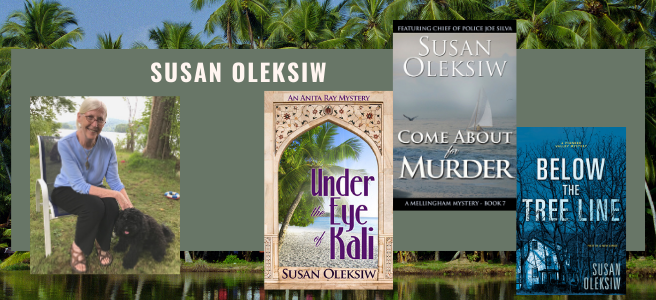
After publishing the first four Anita Ray mysteries, my publisher ended its mystery line. For many writers the transition to being a hybrid author was easy, but for me it was fraught with frustrations. I moved on to writing another series based in the US and not South India, and limited my work on the India series to putting the first three books into trade paperbacks. That’s about to change.

The fifth Anita Ray has been sitting on my desk (almost literally) for over a year while I focus on other stories (short and novel length), but the time has come. In Sita’s Shadow continues the story of Anita and her Auntie Meena and their hotel guests, who arrive as a large tour (large for Hotel Delite) and take over the little converted home.

Anita Ray and her aunt have a small group of devoted followers who occasionally ask me about the next book. I reply as any ambivalent writer might, mentioning a work in progress, other demands, and lots of mumbling. But the time has come and my ambivalence is once again being challenged.

I am not Indian. My love affair with Asia, and India in particular, began when I was young, a preteen, and continued through high school, college, and into graduate school. I was fortunate enough to live there for a year in 1976 and again in 1981-1982, while writing my dissertation and later doing research. With a PhD in Sanskrit and Indian studies, I’m always eager to learn ore. I’ve returned for monthlong visits almost every year since 1999, but that stopped in 2014 for family medical reasons. 

In the advancing twenty-first century, writers are less likely to tell a story through the mind and heart of a character outside their own personal history and ethnic experience. This is unfortunate because the imagination opens doors—it doesn’t close them—to our understanding of the human experience, and the more we stretch ourselves, the more we grow and the more we have to share with others. When I’m reading a well-written and well-thought-out mystery, I never think about who the author is in relation to the cultural identity of the protagonist or any other character in the story. The story is all that matters to me.

By this spring Anita Ray will once again be chasing down a murderer at Hotel Delite (really, it’s a wonder they still have any business at all, considering the body count) and coping with Auntie Meena’s anxieties over her niece’s unmarried state and shameful obsession with murder. 

As the TV announcer used to say, Stay tuned. There’s more to come.

Writing as Discovery

by Janis Patterson

Want to start a lively ‘discussion’ among writers? All you have to do is say something about how ‘plotting’ or ‘pantsing’ is superior. It doesn’t make any difference which; both have their outspoken and extremely vocal adherents. Just make sure you can hold your ground or you have a direct path to an exit. Both sides have passionate adherents.

For those who aren’t familiar with the terms (if there are any of you left out there!) ‘plotting’ is basically an outline, yes, like you used to make in elementary school, but adapted toward a book. Whether it’s the old Roman numeral/Arabic numeral/alphanumeric letter – i.e., bullet point type of outline – or a paragraph style, the outline is a detailed road map of every twist and turn in your story. ‘Pantsing’ is taken from the old phrase ‘seat of your pants,’ meaning you just write and see what happens.

In general, pantsers tend to do more re-writing than plotters, but plotters spend more time on pre-writing work.

I am an avowed pantser. Sort of. My personal system is sort of like a suspension bridge. I know where the story begins. I know where the story will pretty much end – but that has been known to change. I know a couple of plot points in between, though they can be shifted a bit during writing. Then all that’s left is to spin the webwork of the story between them. Does my story change while I’m writing? Yes, it can and has, and I think that’s a good thing, because that means the story is growing organically and being true to itself and – more importantly – to its characters.

Plotters vary from those who put down only a few plot points and notes to those who put in every raise of the hero’s eyebrow and every shrug of the heroine’s shoulders. They also do lots of pre-plotting work, making character sheets, location maps and doing interviews with their characters. I once saw a character worksheet that was at least 5 pages long and included such things as the character’s favorite flavor of JellO and their maternal grandmother’s maiden name. Personally, I’ve had close friends for decades and I don’t know that much about them!

Always willing to improve my craft, I once took a much touted ten-box plotting course that was supposed to be almost magical in creating a book’s structure. A stubborn person, I finished it even though I knew from the second or third lesson that it wasn’t for me. After all, I had paid for it and believe in getting my money’s worth.

Basically you put every turning point and every reaction into one of the ten boxes. An outline, just minus the Roman and Arabic numerals. Using this system I plotted a pretty good romantic suspense novel about Egypt, antiquities smuggling, trust issues, terrorism and a dirty bomb thrown in for good measure.

It will never be written, at least not by me. By the time the last box was filled in I was so bored with the whole idea I never wanted to see it again. Believe me, it shows in the final product when the writer is bored with the project. No matter how good the writer is, the book is lifeless and mechanical.

Don’t think this is a vote either for or against plotting or pantsing. It’s one of those things to which there is no one ‘right’ answer for everyone. The writer has to decide for himself what works for him. And perhaps it is the reader who is the ultimate judge, though most don’t have the slightest idea of the writer’s process. They just know if they like the book or not.

So what do I do? I get an idea for an opening situation, I sit down and I start to write. If the idea is sound, if the story is a good one, the characters just take over and I become more scribe than writer. Do I have to go back and do some re-writing when the plot changes direction? Occasionally, but it only makes the story stronger. Sometimes it surprises me what comes up on the screen as I write, and to my mind that is a good thing. Remember, someone – I don’t remember who – said, “No surprise for the writer, no surprise for the reader.”

Wishing everyone a Merry Christmas, and a wonderful holiday season!