Understanding Your Characters

Part of what makes a great story is great characters. Any reader can tell you that. Writers talk about developing characters, fleshing them out, giving them back story, making them flawed and relatable. These are all vital steps in creating great a character.

But once the character is created, I find I have yet one more hurdle that I have to jump: I have to understand my characters.

A young couple in Galway contemplate the evening

But you created them, you might say with surprise. You wrote their background, you devised their likes and dislikes, fears and dreams. What’s left to understand?

Lots.

Characters run the show. They get away from you, the writer, taking their own story in directions you hadn’t anticipated. Yes, I know that sounds ridiculous. Yet it happens to all writers.

In my current work in progress, I realized after finishing the second draft that I had the wrong killer. A different character was standing in the wings looking guiltily around, trying not to make eye contact with me. Ah-hah, I thought. That’s the real killer!

Trying to pull a fast one on me, I might add.

In several of my books I have another problem of understanding with some of my characters: I write characters who are not native English speakers.

My mother and grandmother in Warsaw

As we all know, language affects not just the way we talk but even the way we think. Writing a foreign character (foreign to me, that is) means not only understanding their native tongue enough to be able to replicate their thoughts, but also understanding the way they frame their thoughts in the first place.

A Pole, an American and an Irishman walk into a bar…. They’re all thinking a little differently and it’s my job to understand those differences.

A woman examines a grave in Warsaw. What might she be thinking?

I’m not complaining. I love that job! I spend time improving my language skills. (By the way, for anyone interested in learning French, I recommend the lessons by Paul Noble. They’re very good!). Extra bonus, it helps when I travel the world and meet new people. So it’s a good problem to have. And one that I hope I have succeeded in overcoming.

But you tell me. If you’ve read any of my books, I’d love to hear your thoughts on my foreign characters and how well I’ve captured their differences.

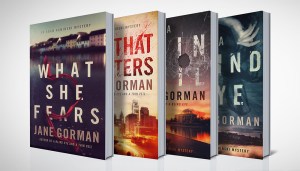
Learn more about Jane Gorman and the Adam Kaminski mystery series at janegorman.com.

Openings, Closings, Cliff Hangers, Hooks, and Dribbles

In early drafts, I fall into a habit of beginning and ending chapters in similar ways. Because of this, one of the stages I’ve added to my revision routine is the focused examination of chapter-opening and chapter-closing paragraphs to make sure they are not only effective but varied.

Openings

A chapter has to start with a sense of purpose and direction, or a reader will be confused or lose interest, and it’s not just the writer’s goal for the scene that matters—it’s the character’s. Furthermore, it has to be a goal the reader will care about, a goal that arouses empathy, curiosity, suspense, or dread. Although some chapters can begin effectively with an overt statement of a character’s goal, it would be tedious if they all did. How many other ways can I indicate that goal?

  • It can be forced on the protagonist by another’s character’s goal, either in conflict or through teamwork. (But not too often, or the lead character can seem passive and reactive.)
  • Some goals are made so obvious by the action that opens the chapter that they need not be stated directly.
  • Occasionally, a chapter can open with a sequel or reaction scene relating to the previous chapter, a paragraph or two of the character’s inner work which leads to a decision that becomes the goal.
  • Minor goals can set a character in motion only to be swept aside by a more urgent goal.
  • There’s immediate energy in a goal stated in conversation or implied by the subtext of the dialogue.

Though I won’t keep listing them, I’m sure you can think of other variations on this essential feature of the chapter (and scene) openings.

Closings

If a chapter ends with a nice, tight feeling of closure, the reader can easily put down the book. I doubt any of us has ever read a chapter ending like that in a mystery. At least, I hope not. The last lines have to keep the momentum going. I’m not a fan of the “if only she had known what was coming next” sort of hook. It’s possible to use to it sparingly in the first person, or in a truly omniscient point of view where there is a narrator’s voice, but not in close third person, which is the only point of view I use. Sometimes I want to create that portentous feeling, though.

To do so, I can end with a character having a sense of something bad about to happen, and if I do it once or twice in the book—probably once—that’s enough. Another way to get the hint of forthcoming doom or disaster is a chapter with a happy ending to that’s too good to last, or a character turning down a task that he’ll eventually have to face. There’s also the classic cliff-hanger that leaves a character on the precipice of a life-changing decision or a dangerous confrontation, but it can’t be overused without losing its power. Sometimes the hook can be as simple as going through a door, if the reader wants to know what will happen on the other side.

I took a class in which we were cautioned not to let our scenes dribble—not to keep going after they have ended—and it’s good advice, but once in a while I’ve seen some excellent writers do this at the end of a chapter. There is a page-turning plot event at the end, but it’s followed by a few humorous lines of dialogue that add depth to the characters and their relationships without smothering the impact of the “real” ending. It’s a dribble, but it’s a skilled dribble, used judiciously like a dribble of hot sauce that’s only good in small quantities.

For this post, I studied how one of my favorite writers, Tony Hillerman, began and ended chapters, examining his Sacred Clowns. The chapter openings vary from setting a scene and introducing characters along with their goals to dialogue lines that jump into the next stage of the plot, and from inner reflections to moments that progress the romantic subplots. The goals are clear but sometimes implied, not always stated in narration or dialogue. His endings range from surprises to warnings to humorous dialogue following up a more serious event (the well-crafted dribble). One chapter ends with a character’s recognition of an important pattern in the mystery plot, another with an informant’s hint that he can help, and another with a comic setback in a romantic subplot. There are endings where the characters are stumped or struggling, but he never uses an outright cliffhanger in this book. Once in a while, he even ends with character getting what he wants—for the moment.

There’s some wonderful symmetry in Hillerman’s chapter structures. One begins with Joe Leaphorn dealing with paperwork and ends with Jim Chee dealing with paperwork, paperwork to be exchanged with each other. It’s humorous and insightful, tells much about their working relationship, and it moves the plot. Another chapter ends with someone warning Jim Chee that a certain investigation is none of his business, while the following one begins with a different character giving Chee the same caution. The book is a page-turner, without the author doing anything clichéd to make the reader turn the page.

One of my go-to writing books is Jack Bickham’s Scene and Structure, and I expect many of my fellow writers are familiar with it. Bickham’s basic scene structure advice is: goal, conflict, disaster. He gives creative ways to work with that structure, including starting in the middle of the conflict and then revealing the goal later, ending short of a full disaster, and more.

Can you share any other “tricks of the trade” for keeping readers up at night?


Reading Aloud

I had no idea how revealing this would be. A lot of authors say they read their works in progress aloud to find typos and missing words, and it does bring those up, but the real discovery for me was the emotional content. That sounds odd, doesn’t it? Wouldn’t I know? I felt it while I was writing, but after a few revisions, I started to doubt the book, to wonder if it was sufficiently compelling even though my critique partners said it was. When I read the dialogue aloud, I discovered the full intensity of the conflicts.

Another revelation was the excess detail in a number of scenes. When I’m revising silently, I tend to debate whether or not a line needs cutting. Does it give depth and flavor, or does it slow things down? When I was reading aloud, there was no question. I did this as if I were the voice actor for an audiobook, and if I couldn’t bring energy into certain material, if I couldn’t act it, it was interrupting the scene, not adding to it. I cut about 900 words that didn’t seem excessive when I did my “cut revision.” From now on, the “audio revision” goes into my writing process toolbox.

The Dunning-Kruger Effect and Writing

You may have heard of this phenomenon, but if you haven’t, here’s the short version: studies by Dunning and Kruger found that competence and confidence don’t always go together. Being a professor, I’ll give an academic example. Students who have the least knowledge of a subject often think they did best on the exam. They lack the foundation from which to question themselves and are amazed when they get Fs. Students who understand more of the material tend to be critical of their performance, in part because they assume others worked as hard as they did. Also, they know enough to know they aren’t perfect. Their sighs of relief when they get As and Bs are sincere. They had doubts. Confidence goes back up when students have real mastery, but not as high as the confidence of the truly ignorant.

What does this have to do with writing? I don’t know about you, but I had no idea how bad the first novel I wrote was at the time I finished it. The theme and the setting still speak to me, and the characters have potential. The writing, however, makes me cringe. I know enough to recognize its faults now and am glad I didn’t inflict it on anyone. Salvaging it would be more work than it’s worth.

Having reached competence but not genius, I’m now in the dip in the confidence curve. I’m stunned that my critique partners haven’t suggested major changes in my work in progress. They noticed places where I could improve it, of course, but I expected they would find problems in the plot, and they didn’t. They said the mystery works. Maybe it flowed well because it started with material I cut from an early draft of the book before it, Ghost Sickness, and because it deals with themes I care about: ethics, spirituality, health and illness, and the exploitation of desperate people.

Nonetheless, before sending it to the next set of readers, I’m going through it to see where it could tighten up further now that I’ve been away from it for a couple of months, drafting the book that follows. So far, I’ve kept myself from acting on the urges of the little demon in my head that’s telling me I should rearrange huge chunks and cut others. I can think of important scenes I almost cut from two other books, scenes which turned out to resonate deeply with readers, so I’m not giving in to the demon, but I wonder if I’ll be relieved or alarmed if the next set of critiques don’t tell me to tear it apart and start over.

Over the Easter weekend, I did my first ever book signing event. After ten years onstage acting and then twenty-odd years as a college professor, I didn’t have jitters about either the reading or the question-and-answer session. It was informal and enjoyable. I sold a few books and got feedback that I should narrate my own audio books, so I trust that my perception of success is not a Dunning-Kruger effect. I plan to try reading the WIP aloud after I complete the current round of revisions and see if it feels alive and ready for an audience. I’ve never done that as part of my self-editing process, but it may be exactly what I need. The actor in me may notice pacing and energy in ways the silent reader doesn’t. If I hear it and cringe as if it were that old first manuscript, I’ll know I have more work to do. If it plays, then it’s ready for the next beta readers, and I’m ready for whatever they tell me. The challenging thing about the Dunning-Kruger effect is that when it applies to us, we can’t tell. One of many reasons I can’t live without my betas.

Perfectionism and the Cut Revision

scissors

Everyone who confesses to this fault, I suspect, is actually bragging. It’s the classic answer in a job interview. “What’s your greatest weakness?” “I’m a perfectionist.” I’m going to be contrary and confess that I’m not one.

My clothes? I have no clue what’s fashionable. If an outfit is clean and has no holes in it, it’s good to go. I don’t wear makeup, and haven’t since I quit acting. If I’m not onstage, the face I woke up with will have to suffice. My apartment and office are neither neat nor chaotic, clean but on the disorderly side. I don’t worry about it other than to move my free weights out of the living room if I’m having guests. Maybe.

So much of my life has been spent in public—acting, dancing, teaching academic classes and yoga and fitness classes—that I have spent many hours being irretrievably imperfect in front of an audience. When responding honestly to a novel situation in a classroom, I’ve sometimes said the wrong thing and couldn’t put it back in my mouth. I could only try to clarify. How many times in teaching yoga have I called right left or called elbows knees? You can’t redo live performance or teaching, only do your best and have a sense of humor.

Of course, I have higher expectations of my language skills when I can revise. While I’m not a full-blown perfectionist, when it comes to word choice and sentence structure, I can get close. One reason I do my plot analysis with a printout is so I won’t be distracted by the changes I would make if I could touch the keyboard. I indicate which sentence I should cut or revise with an orange highlight and a C or an R and keep going. After I make the needed plot changes, I do the “cut revision.” The purpose of this is tightening: consolidating ideas and examining every scene for excess lines, every line for excess words. It may seem perfectionistic to do this before I send it out for the second round of critiquing, but want my critique partners to be able to tell me if the plot is paced well without the distraction of verbal clutter. (I cut four thousand words from my current WIP.)

Another reason I cut so much is because I know my editor will usually ask me to add a few lines to clarify something. We can go back and forth several times over the best way to rephrase a sentence without either of us thinking the other is too picky. I keep double-checking my research, too, finessing tiny details. As long as it makes the book better, I don’t feel pathologically perfectionistic. I know when it’s done, and then I’m ready to let go. No matter how hard we try to make them perfect, no book ever is.Amber in tree final