Silk Road Inspiration

Recently a friend told me about a trip her mother wanted to take with her to India, and asked me about some of the sights and events planned for them. I found a description of the trip online and skimmed through it thinking how I would answer her questions when just below was another trip that threw all my travel plans and budget for the year into the trash can.

When I was perhaps eleven or twelve years old I came across a book about a trip to Central Asia. After You, Marco Polo by Jean Bowie Shor describes a journey she and her husband made following in the footsteps of the explorer on his travels from Venice to China in the late 13th century. The book was published in 1955, only a few years after their trip in the late 1940s. The author is the definition of the word intrepid, and I don’t believe anyone alive today would even consider taking the same trip so dependent are we on cell phones, public transportation, emergency services, detailed maps, and reliable guides, not to mention translation programs on our cell phones and a general sense of peace and safety (now perhaps ebbing). I reread this book recently and it is still one of the most incredible survival stories of any traveler on the Silk Road in Central Asia I have encountered.

This book sparked my love of Asia, as a result of which I ended up living in India for a year doing research, and then returning for a second year for more of the same. I’ve been back several times to visit friends, and even though I’m no longer any kind of scholar, I’ve maintained my interest in India in the Anita Ray series and several photography projects. The author, Jean Bowie Shor, inspired numerous characters with her impetuous forays into forbidden areas and unbelievable luck in surviving and even thriving, as well as her fortitude in traversing a 20,000 foot mountain pass with her fever-stricken, delirious husband and two guides who were hoping to fleece their dead bodies of more money than the entire community would see in a hundred life times.

I don’t plan to write during the trip, but that’s a plan that can quickly evaporate. I do plan to take a lot of photographs, and as I often do when working on an Anita Ray story, I’ll line up the most interesting along my desk to glance at while I work after I get home. Some people like music in the background, some like a particular bit of clutter, I like photographs.

Now, after many years, I’m finally taking my dream trip—to the Silk Road. I’ve signed on for a tour with about a dozen others to visit three of the Stans—Kazakhstan, Uzbekistan, and Kyrgyzstan—along the Silk Road. After a lapse of many decades, I will be part of the kind of  ensembles of tourists that I find so stimulatingly murderous in my Anita Ray series set in South India. I’m doing a lot of background reading so I’ll be ready for my characters when they show up. The trip is scheduled for the fall, so I have a lot of time to enjoy one of the best parts of travel—anticipation.

I’m not sure what this post is about, but I’m booked for a trip I’ve dreamt about for years and taking it now seems fitting.
Three Hydrangeas

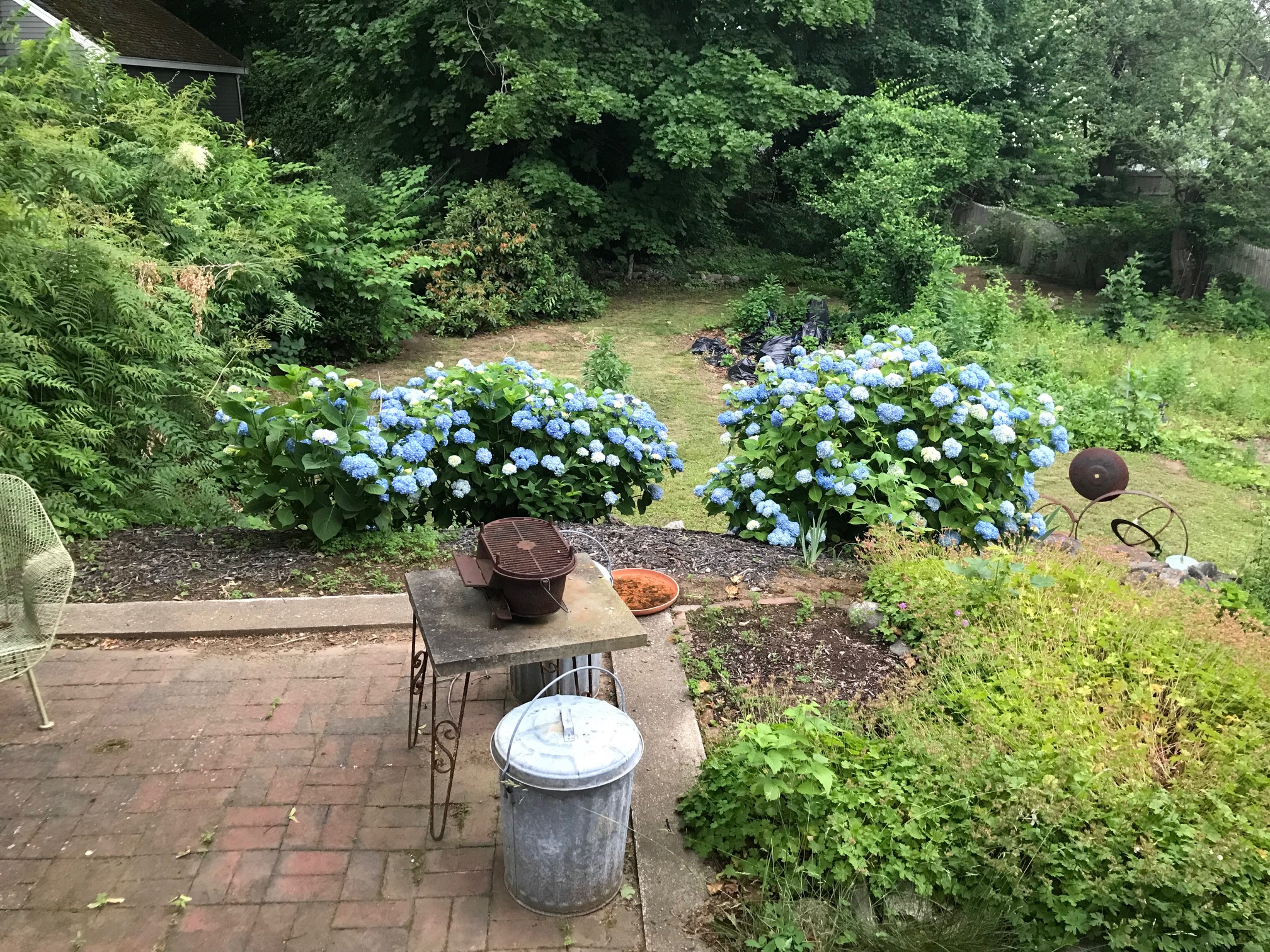
I’ve been reading up on hydrangeas—where to plant, when to bloom, what to feed. I planted three on a gentle slope in the back yard, just off the small patio, several years ago. This area gets lots of morning sun, midday sun, and some afternoon sun. I never feed them, never prune though I do remove old stems that are woody and falling off. And, like many other plants in New England, these three no longer wait for the traditional August blooming. They begin in mid June. 

All three plants have been productive since I planted them perhaps fifteen years ago, and two have reached their full height, over three feet. The third grew more slowly, and two years ago, as I was weeding out whatever had crept up through the mulch, I found an invasive plant had twined itself around the third plant. I rooted it out, and hoped the hydrangea would survive and do better now.

Last year the runt of the trio bloomed nicely, and I congratulated myself for planting it a little higher than the other two, thinking now it gets more sun instead of being somewhat sheltered between two other plants and a fast-growing false spirea, which is another object of my (unfriendly) attentions.

As the spring drifted into June, I admired the first two hydrangeas, which were getting larger and larger, with more and more blooms. I pondered the third plant, which has now arrived at the top of the slope and is only a few inches from the patio. How did it get there? 

It’s been two years since my husband died, and while I thought my life was continuing on its established trajectory, I’m beginning to see that it’s not. A few weeks after Michael died, a mutual friend, also a widow, asked me if I was now reinventing myself. The question surprised me because we’d known each other for years both as writers and as neighbors. My first reaction was, no, of course not. I’m who I have always been. But in the intervening months I have noticed that interests I didn’t pay much attention to are coming to the fore, or I’m taking them more seriously. Some of them involve fixing things myself instead of asking Michael, who loved broken things for the chance to tinker, or hiring someone. 

I’m doing a lot more photography, and looking back on four solo shows and wondering why I didn’t take the work more seriously. My newest project involves lace and exploring experimental photography, which involves poking into analogue work. I don’t feel like I’m reinventing myself so much as sprawling over boundaries established arbitrarily and no longer useful. 

So now when I look at the hydrangea working its way up the slope and getting ready to grow as large as the other two, I don’t wonder how it got here or why. It’s where it needs to be.

Before I Begin Writing

During a recent panel discussion at a nearby bookstore, a member of the audience asked the usual question about how we began our books. The three of us answered in various ways, but all of them were what you might call writerly replies. We began with a character or a scene. I said I began with a situation, a scene that came to me that made me curious about the people in it. My beginning is a little more complicated than that in the case of the Anita Ray mysteries.

I first went to India in 1976, for a year, with thirteen return visits since then, but the last one was in 2014. That seems like a very long time, and it is, even though I stay in touch with friends. Family issues have kept me from returning since then, but I’ve kept writing the Anita Ray series. The fifth in the book has come out in trade paperback and Harlequin will publish the mass market paperback soon. Right now I’m working on the sixth book in the series. So, how do I begin a new mystery set in India after not having visited for so many years? Before I begin with a situation, I look at photographs, to get a feel of the country I love and the area I think I know well. The city of Trivandrum has changed enormously over the years, and I notice large and small changes during every visit. Sitting with images of places I know well—certain shady lanes, small corner temples, old traditional doorways—evoke the ways of living that are so different from how I live here in the States and that may play a role in the story I’m working on.

Many of the photographs suggest story ideas, such as the shop selling as well as exporting homeopathic medicines located on a busy street just at the end of the lane where I lived for a year in the 1980s. Every time I return I walk down Statue Road, and there it is, the homeo shop, near the end, and the elementary school diagonally across the street from it.

One of my favorite photographs is of the laundry hanging among the coconut palms. There is a saying in India. If you’ve only been to a city in North India, you haven’t seen India. If you haven’t been to South India, you haven’t seen India. And if you haven’t been to a village, you haven’t seen India. There is truth in this. The village is the heartbeat of the country, a place encompassing great beauty and unconcealable poverty. Cities of India have on display vast wealth, just like other countries, and unimaginable poverty just around the corner. But in the part of the country I write about, old traditions still live. I learn more about a house and its inhabitants by how the gateway is decorated than I can from any of the nameplates we put on our mailboxes in the States. 

These are some of the details I pull together from some of my photographs to get myself back into the setting of my story. When I write, I want to feel I’m there, and I want the writer to feel she is there with me, so I review my pictures, think about the layout of the city, and imagine my characters walking through a village or resort or the capital of the state. A story I’m working on now is based on a festival held in India in late winter. Pongala has been called the largest gathering of women in the world. Over three million women descend on Trivandrum to make an offering to their deity, to bring good health to the family for the coming year. My photographs of this festival will be on display in the Beverly Public Library in February 2024, while I’m working on the story.

In the fifth book in the series, In Sita’s Shadow, Hotel Delite welcomes a tour from the United States, five guests instead of the six expected. Auntie Meena is soon fussing over them, determined to see them happy while in her hotel though she’s a bit confused by their non-touristy conduct. When the tour leader is found dead in his room, poor Auntie Meena is terrified that his spirit will haunt the hotel, and calls her astrologer at once. Anita calls the police, as is expected, and then begins to worry the death is unnatural. Trying to break the news to the members of the tour proves harder than expected. But one tour member seems uninterested in the death, and rarely uses his room in the hotel. This is not what Auntie Mean expects from a proper guest.

Auntie Meena throws herself into the investigation into the tour leader’s death, to Anita’s dismay, in a determined effort to protect one of her guests from the danger Meena is certain is lurking just around the next corner. Nothing good can come from a young male student sparking a friendship with an older foreign woman. Anita, however, is more concerned about the odd behavior of one of the hotel’s suppliers, a woman who makes airy delicious pastries.

https://www.susanoleksiw.com

My First DSLR

I was returning to India after a seventeen-year hiatus, and my husband suggested I take a digital camera. He gave me his. The first time I returned I took a film camera. The DSLR would be much easier—no film to load and unload throughout the day, not to mention the added cost to develop and weight in my luggage.

One of my favorite side ventures is photography, something that I first tried as an eight-year-old and then again as a college student, but didn’t pick up again until my forties. Since then I’ve had two solo shows, exhibited in juried shows, and sold a few images. But the camera I use has its own story.

Michael began working in photography in college, and immediately showed an aptitude for all things photographic. He began with a Pentax and remained loyal to the brand for practical as well as technical reasons. Every Pentax lens is interchangeable on a Pentax body, and over the years he accumulated lots of lenses. Before my trip he’d been having trouble with his current DSLR, and took it to a specialist, at Hunt’s. The two men along with a technician inspected, tested, retried, retested, opened, fiddled, and couldn’t figure out why it wouldn’t register an image. The camera simply didn’t work. He didn’t buy it from Hunt’s, but the man offered him something reasonable for it. Instead, Michael brought it home and told me of the very disappointing visit. This is where it gets weird.

He came in and told me the whole story of his visit to Hunt’s, and his discussion with the owner, whom he’d worked with before and trusted. I picked up the camera, sighted it, and snapped the shutter. The image appeared and looked fine to me.

“What’s wrong with it?” I asked. “It looks okay.”

Michael looked at the image, at me holding the camera out to him, at the image, at me. He agreed it did look okay. I’ll never forget the look on his face, though I didn’t understand why his expression was so odd.

“Why don’t you take it with you to India, along with the other one.” He was referring to a small pocket digital Pentax I’d given him a few years ago that he didn’t use.

I did, and took tons of photographs. The camera was the most reliable tool I’ve ever worked with. It always worked for me. I never had any trouble with it. It never worked for him again, no matter what he did. I use it still, though I now have access to his other, more advanced cameras and lenses.

At the time I said the problem with the camera was a matter of electricity. I had less in my hands, or body, than he had. My touch didn’t interfere with the operation of the camera. Maybe I have more than he has and that helps the camera work. I have no idea. But it’s one of those odd incidents in life that reminds me of how little we know about how the physical world around us operates. 

And it perhaps explains why some of us love our tools, as though they are a part of our body, an extension of our imaginative selves as we manipulate the physical world to fit our vision. Writers do it with paper and pen, or computer and printer; carpenters with hammers and chisels and wood; photographers with camera and lenses and paper and ink. It doesn’t matter what you use; the result is the same—a world remade according to the singular vision of one particular person, a lens into another mind and its world.

Photography and Plotting

I don’t ever think of myself as having writer’s block but I know that when I’m not sure about what comes next in the novel I’m working on, I tend to turn to photography and play with the camera and old photographs. Aside from my love of photography in general, I find this other art form stimulating in a way different from writing.

lately I’ve been going through old photographs, some dating to the 1930s taken by various relatives and a few dating to just the early 1900s when my grandparents were courting. My grandfather photographed as a sideline and occasionally sold photographs to Look and Life when they were new.  Granddad preferred the modern world—photographing machinery, industrial sites, and 1950s gas stations and fast-food joints lining a highway. My mother preferred landscapes. I like people and color. Granddad was a milk inspector for much of is career.

My family traveled around the United States in the 1940s, 1950s, 1960s, so I have photographs of us visiting various national parks, camping, riding, hiking, and, rarely, looking into shop windows. One summer we rented an RV and traveled up and down the Pacific coast, pulling up next to an RV from California or another western state. My dad often commented, “Too bad we don’t have a license plate from home.” He meant Massachusetts. Any time a park service officer found out where we were from, we were treated like celebrities. This was in 1959, when you could arrive at the Grand Canyon at five o’clock in the afternoon and find a good camping spot still available. 

Most of the photos from this trip are of magnificent canyons, mountains, lakes, and other scenery. We never had trouble getting a good view; there were few crowds and no cell phones—no one taking selfies but lots of people taking pictures of each other on the top of a mountain or paddling a canoe.

It’s an odd habit but photographers often take several pictures of the same person in different positions and poses at the same event, and save all of them, not just the best one. Sometimes the photographer takes three or four of almost identical images. In one instance I came across so many of the same person that it looked like individual cells from an old movie. 

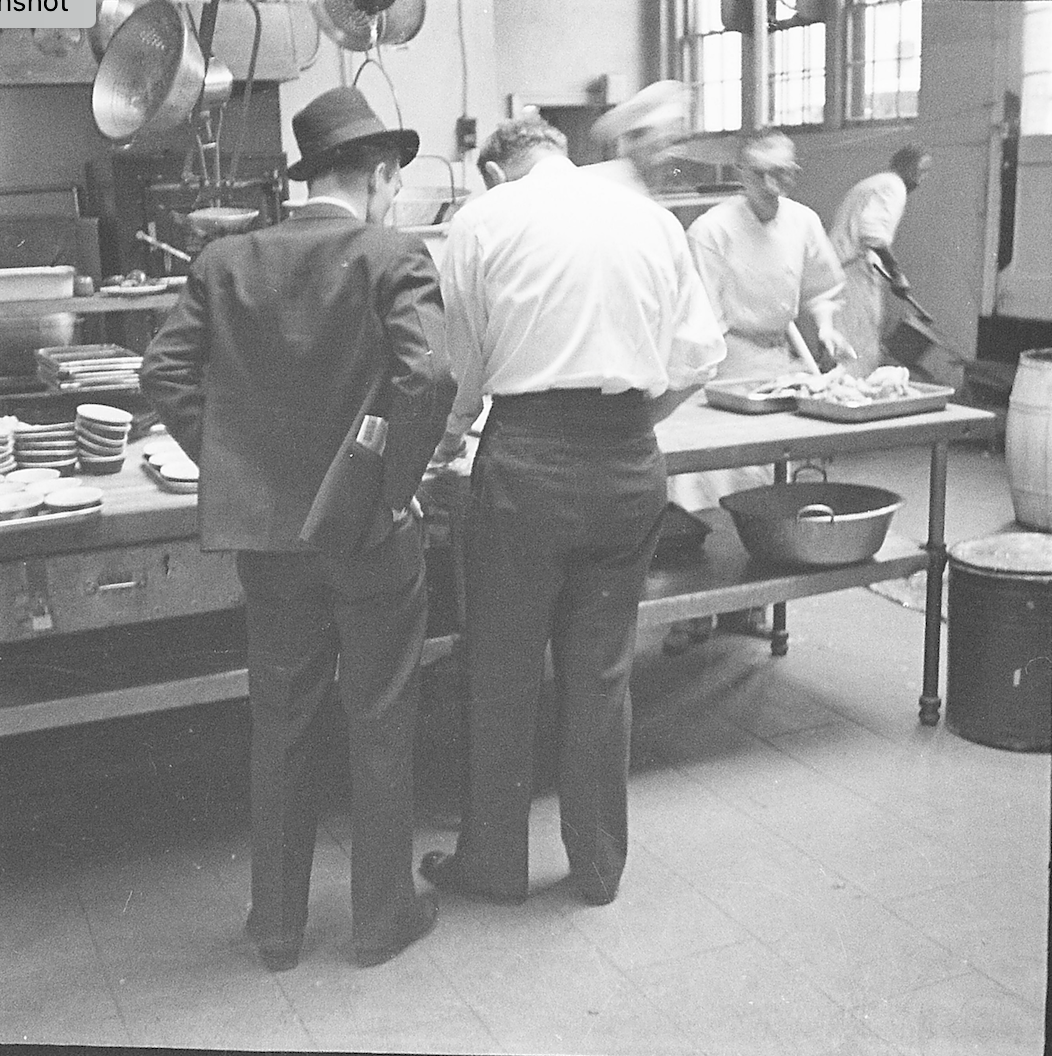
The images from the 1930s and 1940s are of people I didn’t know or know only through family lore, so I’m free to imagine their stories. I rearrange the images in different sequences, much like rearranging scenes in a mystery novel, and a variety of scenarios come up. I especially like the ones of my father chatting with new friends in Sicily in 1936, when my parents took an extended honeymoon to Italy and Greece. That’s Dad on the left.

After a few hours of this ideas for my current project start to bubble up and I quickly turn to taking notes. This afternoon, after feeling stalled about the ending though I was writing scenes that had to be written, I had a slew of ideas coming. I made lists of actions my characters had to take to get to the climax, each a scene by itself leading to the final confrontation. My attention is back on the novel, and I’m putting away the photography for another day. But it will be back.