
Discovering the Setting

I’m in the middle of the sixth book in the Anita Ray series, which is set in a tourist hotel in a South Indian resort. Over the years the area has grown from a tiny fishing village with a few hotels just up the coast to one of the most popular destinations for Westerners eager for the sun and sand, not to mention the sunsets and the fishing boats bobbing on the horizon at night. I know the area well, having visited it for the first time in 1976 and several times in the 2000s. 

The pathways laid out in the early years are now paved walkways through marsh with little pools covered with lily pads. The paths have been widened in some areas to allow shop owners to hang out rows of brightly colored silk saris and blouses. When I think there’s no more room for another restaurant or shop, I turn a corner and spot five square feet turned into an open-air cafe with the owner stirring a pot on a two-burner cooktop, ready to serve the foreigners sitting on stools before a board table. The food is good, the price is right, and the cook’s son works in one of the high-end hotels. Much of Kovalam has spread on what was once paddy fields that came down to a low berm fronting the beach. All those are gone, and only the rare private home remains, hidden away beneath tall palms.

A reader often tells me they know “exactly where I am” in an Anita Ray story, and that’s because I do too. I have a strong sense of direction in India (and elsewhere), a deep understanding of India (after years of graduate school), and a personal love of the region. All of that informs the Anita Ray stories. What I don’t have is a sense of place in any story if I haven’t been there, walked through a public park, found a typical cafe for the area, and visited a municipal building—perhaps a library or town hall. I can make up a lot of it, but I need to experience the “feel” of the place. 

The Joe Silva series, in seven books, takes place in a small coastal New England town. I know these towns well, having grown up in one. The rocky coast speaks of the “flinty” Yankee, and the harsh winds call to mind the ever-present threat of hurricanes and other storms. Winters may be changing because of climate disruptions, but the birds still come, the land demands careful attention, and life for the fisherman is never easy.

One of the reasons I enjoy reading crime fiction is the other landscapes I get to explore. I’ve been through the Southwest and lived for a brief time in Tucson, so I appreciate any writer who can take me into that world of mountains and deserts, long straight roads, and small adobe houses with gravel yards. The openness of Montana and Wyoming brings out the best in some writers, and I look forward to their stories and landscapes.

Regardless of where we grew up or now live, we are creatures of our environment, and the best fiction uses that sense of place, what is distinctive and unique about one location, to propel the characters and their story. This, for me, is the reward of a reading a novel with a rich, fully developed setting. I come to understand both people and place, and know a part of the world I may never visit a little better.

Before I Begin Writing

During a recent panel discussion at a nearby bookstore, a member of the audience asked the usual question about how we began our books. The three of us answered in various ways, but all of them were what you might call writerly replies. We began with a character or a scene. I said I began with a situation, a scene that came to me that made me curious about the people in it. My beginning is a little more complicated than that in the case of the Anita Ray mysteries.

I first went to India in 1976, for a year, with thirteen return visits since then, but the last one was in 2014. That seems like a very long time, and it is, even though I stay in touch with friends. Family issues have kept me from returning since then, but I’ve kept writing the Anita Ray series. The fifth in the book has come out in trade paperback and Harlequin will publish the mass market paperback soon. Right now I’m working on the sixth book in the series. So, how do I begin a new mystery set in India after not having visited for so many years? Before I begin with a situation, I look at photographs, to get a feel of the country I love and the area I think I know well. The city of Trivandrum has changed enormously over the years, and I notice large and small changes during every visit. Sitting with images of places I know well—certain shady lanes, small corner temples, old traditional doorways—evoke the ways of living that are so different from how I live here in the States and that may play a role in the story I’m working on.

Many of the photographs suggest story ideas, such as the shop selling as well as exporting homeopathic medicines located on a busy street just at the end of the lane where I lived for a year in the 1980s. Every time I return I walk down Statue Road, and there it is, the homeo shop, near the end, and the elementary school diagonally across the street from it.

One of my favorite photographs is of the laundry hanging among the coconut palms. There is a saying in India. If you’ve only been to a city in North India, you haven’t seen India. If you haven’t been to South India, you haven’t seen India. And if you haven’t been to a village, you haven’t seen India. There is truth in this. The village is the heartbeat of the country, a place encompassing great beauty and unconcealable poverty. Cities of India have on display vast wealth, just like other countries, and unimaginable poverty just around the corner. But in the part of the country I write about, old traditions still live. I learn more about a house and its inhabitants by how the gateway is decorated than I can from any of the nameplates we put on our mailboxes in the States. 

These are some of the details I pull together from some of my photographs to get myself back into the setting of my story. When I write, I want to feel I’m there, and I want the writer to feel she is there with me, so I review my pictures, think about the layout of the city, and imagine my characters walking through a village or resort or the capital of the state. A story I’m working on now is based on a festival held in India in late winter. Pongala has been called the largest gathering of women in the world. Over three million women descend on Trivandrum to make an offering to their deity, to bring good health to the family for the coming year. My photographs of this festival will be on display in the Beverly Public Library in February 2024, while I’m working on the story.

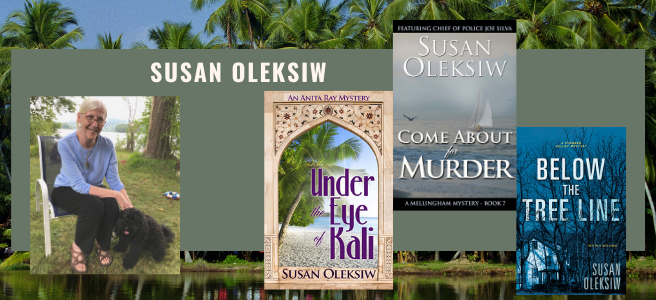
In the fifth book in the series, In Sita’s Shadow, Hotel Delite welcomes a tour from the United States, five guests instead of the six expected. Auntie Meena is soon fussing over them, determined to see them happy while in her hotel though she’s a bit confused by their non-touristy conduct. When the tour leader is found dead in his room, poor Auntie Meena is terrified that his spirit will haunt the hotel, and calls her astrologer at once. Anita calls the police, as is expected, and then begins to worry the death is unnatural. Trying to break the news to the members of the tour proves harder than expected. But one tour member seems uninterested in the death, and rarely uses his room in the hotel. This is not what Auntie Mean expects from a proper guest.

Auntie Meena throws herself into the investigation into the tour leader’s death, to Anita’s dismay, in a determined effort to protect one of her guests from the danger Meena is certain is lurking just around the next corner. Nothing good can come from a young male student sparking a friendship with an older foreign woman. Anita, however, is more concerned about the odd behavior of one of the hotel’s suppliers, a woman who makes airy delicious pastries.

https://www.susanoleksiw.com

My First DSLR

I was returning to India after a seventeen-year hiatus, and my husband suggested I take a digital camera. He gave me his. The first time I returned I took a film camera. The DSLR would be much easier—no film to load and unload throughout the day, not to mention the added cost to develop and weight in my luggage.

One of my favorite side ventures is photography, something that I first tried as an eight-year-old and then again as a college student, but didn’t pick up again until my forties. Since then I’ve had two solo shows, exhibited in juried shows, and sold a few images. But the camera I use has its own story.

Michael began working in photography in college, and immediately showed an aptitude for all things photographic. He began with a Pentax and remained loyal to the brand for practical as well as technical reasons. Every Pentax lens is interchangeable on a Pentax body, and over the years he accumulated lots of lenses. Before my trip he’d been having trouble with his current DSLR, and took it to a specialist, at Hunt’s. The two men along with a technician inspected, tested, retried, retested, opened, fiddled, and couldn’t figure out why it wouldn’t register an image. The camera simply didn’t work. He didn’t buy it from Hunt’s, but the man offered him something reasonable for it. Instead, Michael brought it home and told me of the very disappointing visit. This is where it gets weird.

He came in and told me the whole story of his visit to Hunt’s, and his discussion with the owner, whom he’d worked with before and trusted. I picked up the camera, sighted it, and snapped the shutter. The image appeared and looked fine to me.

“What’s wrong with it?” I asked. “It looks okay.”

Michael looked at the image, at me holding the camera out to him, at the image, at me. He agreed it did look okay. I’ll never forget the look on his face, though I didn’t understand why his expression was so odd.

“Why don’t you take it with you to India, along with the other one.” He was referring to a small pocket digital Pentax I’d given him a few years ago that he didn’t use.

I did, and took tons of photographs. The camera was the most reliable tool I’ve ever worked with. It always worked for me. I never had any trouble with it. It never worked for him again, no matter what he did. I use it still, though I now have access to his other, more advanced cameras and lenses.

At the time I said the problem with the camera was a matter of electricity. I had less in my hands, or body, than he had. My touch didn’t interfere with the operation of the camera. Maybe I have more than he has and that helps the camera work. I have no idea. But it’s one of those odd incidents in life that reminds me of how little we know about how the physical world around us operates. 

And it perhaps explains why some of us love our tools, as though they are a part of our body, an extension of our imaginative selves as we manipulate the physical world to fit our vision. Writers do it with paper and pen, or computer and printer; carpenters with hammers and chisels and wood; photographers with camera and lenses and paper and ink. It doesn’t matter what you use; the result is the same—a world remade according to the singular vision of one particular person, a lens into another mind and its world.