It’s Okay to Not be Productive Right Now

You’re probably thinking, ugh, not another COVID-19 post. 🙂 I wanted to post about something else – I really did. But, nothing came to me and that’s been indicative of writing life during quarantine.

For the first few weeks, I was working constantly. My day job is a communications person for a university and, as you can probably imagine, I was pretty darn busy. The days flew by while I operated in crisis communications mode. I was so anxious and stressed that all I could do was watch true crime shows, watch videos on TikTok (this app has been so helpful during quarantine) and do jigsaw puzzles.

Write? HA! Keep revising my debut cozy that I had planned to launch in the fall? Yeah right. Start drafting something new? Keep dreaming.

You know what? That’s okay.

We don’t need to be productive. We just need to survive a pandemic, you know?

I see so many social media posts about people beating themselves up for not accomplishing a million things during quarantine. But that’s not what we have to do. If that helps you manage your stress and anxiety, awesome! Or if trying to do a 1,000 piece jigsaw puzzle every few days helps? Do that!

Once the crisis slowed down on the work front, I was able to redirect some of my attention. I didn’t choose my books – that still wasn’t there. I’ve been working hard on finishing my master’s thesis (I should be done next month!) so I can cross that off my worry list.

I’m starting to look forward to writing again after 6+ weeks of quarantine. I’m holding off until I finish my thesis so I can pour my whole focus into revisions.

Will I still launch my debut in the fall? That’s doubtful but that’s also okay.

I’ve managed to get through the first couple of months of a global pandemic and that’s freaking awesome.

You have too and that’s freaking awesome. You’re freaking awesome.

How have you been coping with stress? I hope you’re doing well!
More Disappointment

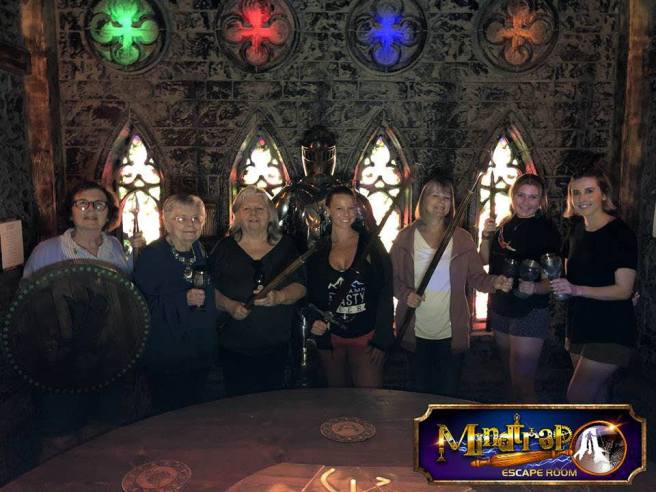
Escape Room 2019

Not to make light of all the horrible things that are happening because of this virus that has changed all of our lives, some in big ways and for others not quite so big, but annoying or disappointing.

So many things have been cancelled including all the wonderful events of the senior year for so many high-schoolers. I have one great granddaughter who is going through this disappointment, though her family has figured out lots of ways to make the passing days fun.

For me, it’s been one writing event after another.  I truly miss my writing friends.

Today, my hubby and I, along with my 2nd daughter who drives for us, had plans to drive to Murrieta to visit our eldest daughter and her husband. We do this once a year.

While we were there, we would have spent time with two of my grandkids’ families, four great-grands including the girl who is missing the fun of the senior year. I was also supposed to go visit her brother’s freshman English class to talk about writing. I went to his 3rd grade class year’s ago.

Our plan was to visit new restaurants and some of our favorites. We always picked a movie to go see in the theater. Another highlight was for all the females in the family to go to an escape room, which we’ve done three previous years. Our choice for this year was a Wizard of Oz themed room. Hopefully, we can get together later on. (In the photo above is all of us who participated last year, 3 daughters, a grand-daughter, and two great-grands and me.)

This is all so minor for what so many are going through. I have one grandson who delivers groceries to the markets and he’s working many long hours. I have two grandsons in law-enforcement, and two granddaughters who are nurses. I’m praying for them to stay safe. Many of my relatives are not working at all because of the crisis.

It is a difficult time for everyone. And a question for you authors who are sheltering in place–are you doing more writing or less? For me, it’s spurts, some days I do a lot, others, not so much.

Marilyn


One Writer’s Thoughts on the Pandemic by Susan Oleksiw

This post was supposed to be about setting, but while I was working on my current project I came to a scene in which the character had undergone a significant change. I wondered how to present this. Should I explain the loss of the job as the result of the Covid-19 lockdown? Or should I just leave it as an ordinary layoff? I posed the question as a general one on my FB page and as of this writing 24 writers have made comments. I’m not the only one thinking about this issue.

One of the strengths of crime fiction, and traditional mysteries in particular, is the precise way authors describe a world. Crime fiction is dependent on an accurate presentation of reality, even when that reality is far-fetched–from the deadly allergy to the fragrance of roses to the importance of the tides. We look for this in our favorite books whatever the subgenre. You may think about the yarn shop where a charming owner gives knitting lessons–to the reader as well as the characters, with knitting instructions at the end. Or perhaps you prefer the cooking mysteries with recipes and menus. I enjoy these too but in this instance I’m thinking about something less obvious but equally significant for the story.

Over fifty-five years, Agatha Christie set many of her mysteries in English villages, so richly described that even now many of us Anglophiles still think of a Christie or Miss Marple village as the definition of English country life. But this would be only half the picture. Christie depicted the world she lived in, and then added a murder and an amateur sleuth. Her sleuths and murders weren’t realistic but her descriptions of the village was. So much so that we can read her mysteries to study the historic changes in English rural life. The tidy village streets with modest homes radiating out from the center are soon dotted with high-rises for low-income and lavish homes for the newly rich after World War Two. The farmers and tradespeople are soon joined by British civil servants and military back from the outer reaches of the Empire and immigrants from the Caribbean, Africa, and South Asia. She would not have set a book in 1943 and failed to mention the war, nor would a story set between the wars have been complete without a Colonel somewhere in the mix. She used technology as do we, relying on one in particular in her most famous novel.

The pandemic of 2020 will fold itself into history, just as 9/11 has, but it would be foolish to think that readers won’t recognize these dates if they show up in a story. If we ignore the changes the disease is making to our daily lives, will our stories be anachronisms? Can you write a mystery today without recognizing the change in the US population? Reading a novel in any genre in which every character is a WASP would be unbelievable today, and a character’s African-American heritage will not necessarily have anything to do with the plot. In some parts of the country you would be hard-pressed to get through the day without hearing at least one foreign language or seeing a few young people walking down the street with their eyes on their cell phones. These are the details that ground a story and make the world believable.

For some readers the current circumstances are too extreme to explore in literature, and they don’t want to read about it. Plenty of writers don’t want to write about it either. It will probably be several months or even a year before we see the first pandemic stories, but until then each one of us has to decide whether or not to use the new ways of managing day to day life as background for a story or as part of the circumstances determining a crime and its solution. I don’t have the answer and probably won’t have one, at least for me, until I reach the end of my current work. I write in uncertainty, just as today we’re living in it.


Neither Holding On nor Pushing Away, by Amber Foxx

A yoga teacher I studied with years ago gave this guidance for how to be with one’s thoughts during meditation: Neither holding on nor pushing away. It helps me now with writing in addition to meditation and life in general—neither holding on to my old normal nor pushing away the present. I’m experiencing writing now as a balancing act, both a remembering practice without holding on and a letting-go practice without pushing away.

My work in progress, book eight in the Mae Martin series, is pre-pandemic. My books are always set several years in the past because I want to get the context right. While I don’t write directly about current events, they exist in the background and have a realistic impact on my characters’ lives. Eventually, maybe in three to five years, I might set a book in the spring of 2020. It’s too soon to write fiction about what’s happening now, and too soon for anyone to want to read it.

I’m keeping notes, though, and making an archive of how we live through this in Truth or Consequences, New Mexico, since my stories take place here. Maybe I’ll never write the book, but preparing as if I’m going to helps me process everything and stay focused. As well as saving copies of statewide public health orders and keeping track of the news, I’m writing down daily observations on life in our community during our present challenges.

I haven’t decided what the mystery in that distant future book will be. My books aren’t about murder, but other types of wrong-doing. I’ll have a better idea by the time I’m ready to write it, in whatever kind of world we live in then. Preparing the background for that book is part of releasing both worry and expectations. I record the full spectrum of events, and then I can let go of them for the day. I can’t plan the plot yet, because I can’t know what the future holds. Meanwhile, I’ve sketched out possible scenes with my characters in a state of not-knowing and uncertainty, of real loss and potential loss, as they struggle with the sudden change. So far, a lot of the dialogue in these quick drafts is humorous, as are many of my conversations—on the phone or six feet away—with my neighbors and friends. Dark humor at times, but it’s part of how we cope.

Meanwhile, my main creative focus is on a book in which people visit each other’s homes, go out dancing, meet for coffee, take aerobics classes and college classes in person, and share hugs. This is my remembering practice. Not clinging to what was normal once, but honoring it.


Family of the Heart by Karen Shughart

At the beginning of each year I create a list of the blogs I intend to write for Ladies of Shughart,Karen-0016_ADJ_5x7 (1).jpgMystery. This month I had planned to write about choosing seasons as setting in a book.
But that’s not going to happen.  As COVID-19 continues to shatter many of our communities and insert itself into our lives regardless of whether we remain healthy or not, I decided that  the topic didn’t feel right. Instead, this blog is called Family of the Heart.

Let me explain: My husband and I live in a small village on Lake Ontario in New York state. Our nearest relatives live in Buffalo, about a two-hour drive away; siblings live in Pennsylvania and Florida and our children in New Jersey and California. Trips we’d planned to visit them were cancelled, and now of course, for several weeks we’ve been sheltering in place. One would assume, then, that we are isolated, but the good news is that we are not.

My next door neighbor, Bonnie, called one morning. She was heading to the grocery store and wanted to know if we needed anything. This week, I’ll call and ask her. On  several occasions we’ve participated in Zoom happy hours with friends who we have not seen for ages even though we live within walking distance, and with friends from far away. One evening several of us texted, it was a venting session to be sure, but it felt good to know we weren’t alone in our fear and apprehension.  There’s also been lots of sharing of funny videos and jokes via email and Facebook, and we’re talking on the phone more frequently with those we love.Nova.jpg

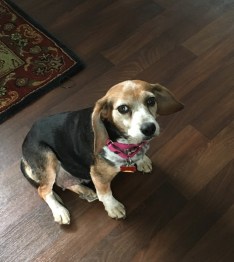
Two of our friends adopted dogs; we did, too.  Nova, a beagle, came to us from a no-kill shelter, and we were advised she had some potentially life-threatening health challenges, the result of being neglected and abused in an earlier life.  We decided to adopt her anyway.  She’s lovely and sweet, but we were anxious to see our vet. When we called, she never hesitated, and we took Nova for an office visit after hours, a necessary precaution these days.The good news is that Nova is far healthier than we believed.  We’ve had so much support through this process. Not only from our vet, but also from friends and neighbors who have provided us with items we needed for her care that we were unable to purchase for a multitude of reasons.

These are indeed difficult and stressful times. But we are not alone. We not only have ties to our biological families who may  living far away, but also to those in our community who are helping us get through this. Both are our families of the heart.