
Writing your way to a college degree

By Sally Carpenter

Whatever I know about writing mysteries, I didn’t learn it in college.

Centuries ago when I was an undergraduate, colleges didn’t offer creative writing majors or even minors. English department classes consisted of solely teaching what I called “stuffy old books,” the kind with tiny print and antiquated prose that made comprehension laborious. I didn’t have the patience to struggle with that kind of literature.

Only one university in my state offered a Masters of Fine Arts in writing. I had my eye on that for a while although I felt I’d never be good enough to get in the program. Then my parents squashed my hopes with “you’ll never get a job with that degree!”

My undergraduate college offered only one or two creative writing classes. The professor “taught” by saying, “write whatever you want.” No instruction on how to craft a short story or a poem or suggested topics to ignite our imaginations. My life experience was limited at that time so I had little to write about.

In grading, the prof disagreed with my opinions and marked my grammatical and spelling errors (plenty of those) in red ink. No helpful critique and encouragement to do better. If her goal was to smash any spark of creative or desire to write in her students, she nearly succeeded.

Flash forward to the late 1990s. I’m back in college for a master’s degree in theater with a focus on playwrighting. Once again, I’m in a class with an incompetent prof (having a PhD must mean Pathetic and Hopelessly Dumb).

While I learned nothing from the teacher, the upside is that the one-act plays I wrote in that class were finalists in a regional college playwrighting competition. I received affirming feedback from the judges and one play became the inspiration for my cozy mystery series.

The English Department of that university had a master’s degree with a concentration in writing. While the department offered a creative writing workshop that students could take, most of the required coursework seemed geared toward rhetoric/composition teachers.

That was then, this is now. In perusing the internet it seems that today nearly every college has a creative writing major or at least a minor. Undergrads can take courses in scriptwriting, short stories, poetry, creative nonfiction and technical writing. My alma mater now has a Bachelor of Fine Arts in creative writing—too late for me, I’m afraid. And in my home state, several universities now grant an MFA in writing.

What happened? How did writing become a popular academic course of study?

I don’t know, but one possibility could be that as professors retired, the new teachers coming in wanted to revise the stale curriculum, expanding the literature options and adding writing classes.

Perhaps students asked for writing classes. Or maybe the writing courses were a way to get students interested in an English major after years of the teachers putting up with “you can’t do anything with that degree.” Technical writing, copy editing and publishing courses expanded the degree’s usefulness.

Some universities even have courses in genre writing, hopefully creating the next generation of mystery authors. A couple of schools have MFA programs for genre writers.

Maybe students want to write because of the internet and self-publishing. Young authors have an instant forum for their work instead of waiting years for publication in an obscure literary journal.

Whatever the reason, I’m happy to see that in spite of the emphasis in elementary and high schools on STEM (science, technology, engineering and math), colleges are affirming students in their writing journeys.


World sleuths on TV

By Sally Carpenter

Why are there so few TV shows about crime writers? Could it be all the action takes place inside the character’s head? Or that watching a person type is boring?

 The most recent TV show featuring a writer was “Castle,” which just ended its eighth and final season. The series began with a clever premise: a playful, best-selling author teams up with a hard-nosed NYPD detective to crack cases.

Detective Kate Beckett calls in Richard Castle when a killer stages crime scenes inspired by the author’s books. Castle, in need of a new series idea, continues to shadow Beckett on other murders for inspiration.

 The cases were often silly and far-fetched, with unrealistic forensics, but viewers loved the characters, the witty banter and the growing romance.

One of the best bits was the weekly poker games with Castle and real-life authors Michael Connelly, Stephen Cannell and James Patterson. When Castle complained about the difficulty of finishing one book a year, Patterson retorted, “Only one, Rick?”

 Then the show became darker and more serious, with story threads that stretched on far past the breaking point and frequent attempts to split up the Caskett romance.

 The show went off the skids when Castle stopped writing and became a PI. When the producers announced the character of Beckett would not return for season nine, fan backlash was so severe the studio wisely put the show out of its misery.

“Castle” is a textbook example of how not to write a series. While readers expect characters to grow, straying too far from what brought fans to the story in the first place can end a series faster than a publisher merger.

 A more successful TV mystery writer was Angela Lansbury as widow and amateur sleuth Jessica Fletcher in “Murder She Wrote,” running a remarkable 12 years. Although the show is off the air, the new cozy mystery books are still being ghostwritten under Fletcher’s name.

The show also gave rise to the expression “Cabot Cove Syndrome,” in that cozy writers must find a way to logically explain the high number of murders in their otherwise charming small towns.

I admit I never watched the show when it aired, but I plan to check out the DVDs soon from my local library and catch up.

The creative team behind “Murder She Wrote”—Richard Levinson and William Link—also produced “Ellery Queen.” Jim Hutton was the pipe-smoking writer who assisted the police. Three/quarters into the show Hutton looked at the audience and asked if they could solve the case with the given clues. The show played fair with the audience but it didn’t last long, probably because viewers don’t want to think when watching the tube.

Another one-season wonder was UPN’s “Legend.” Richard Dean Anderson played Ernest Pratt, a dime novelist in the Old West. He penned an adventure series starring the clean living hero Nicodemus Legend. However, townspeople thought Pratt was really Legend, and regularly called on him to solve mysteries and put away villians. The show also had frequent disagreements with Pratt and his publisher, EC Allen.

 The “Legend” pilot begins with Pratt writing a book. When Legend ends up in a deathtrap with no way out, Pratt whacks his head on the table and says, “I’ve killed my meal ticket!” How often do writers really feel that way when they’re “stuck”?

Do you know of other TV crime writers, and which one is your favorite?


Congratulations, it’s a book!

By Sally Carpenter

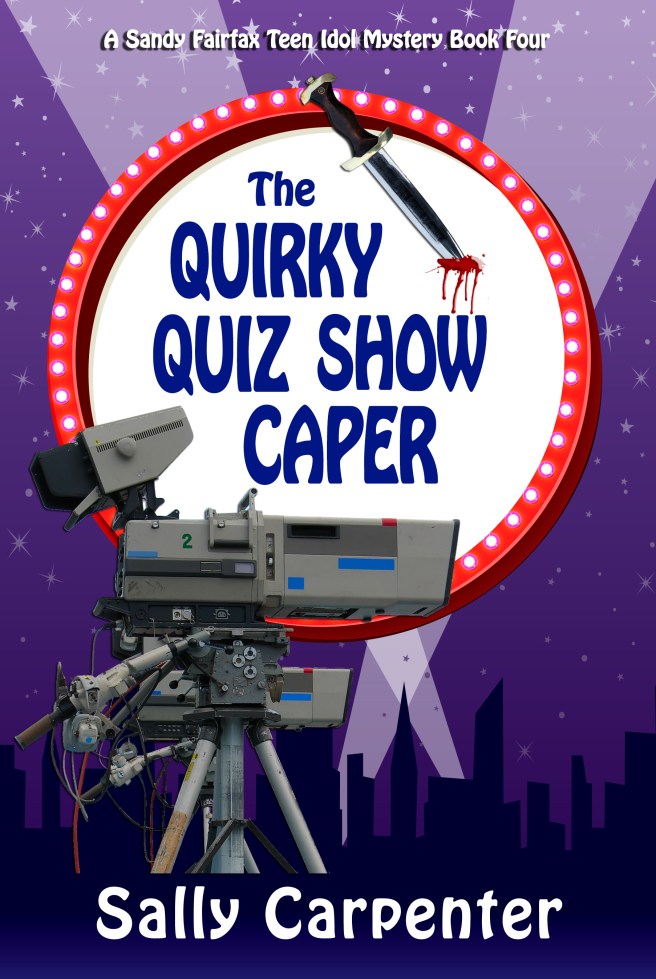
I recently “gave birth” to a beautiful, 15-ounce cozy that I christened “The Quirky Quiz Show Caper.” Gestation was a bit over nine months, as I began in earnest last spring. Labor pains were intense, and the book nearly miscarried.

First thing to change was the title. Following a story arc that began two books ago in the series, the original title was to be “The Bloody Black Tie Benefit Caper.” My protagonist, former teen idol Sandy Fairfax, was to perform at a benefit concert to help fund his father’s orchestra.

However, after considering the sales of the previous books, I needed a “snappier” title to catch readers’ interest. Most cozy fans have never been to an expensive fundraiser (neither have I, even though I live in an area where $150 a plate benefits are common) and might not find it an captivating topic.

Also, a one-night gala event was not enough to sustain a 200-plus-page book. I needed more action to flesh out the story.

So I gave Sandy a show biz job. In each book I put him in a different venue to maintain variety. So far in the series he’d performed at a Beatles fan convention, in a sitcom and on a cruise ship. Since he was singing at the fundraiser, I didn’t want a second concert.

What else do teen idols/actors do? They appear on game shows.

Sandy would be perfect on “Hollywood Squares” where he could crack jokes and express his charming personality. However, to avoid copyright issues I created my own game show, “Raise The Stakes.” That would give Sandy something to do for several days. And when he discovered the murder victim had appeared on the same show . . .

I’m a plotter and I usually have a scene-by-scene outline set before I start writing. This time I just dove in and began writing.

Big mistake. By page 50 I was stuck.

The story began with Sandy going to his father’s office and finding the body. Right away I had problems. How could the killer sneak in and out of an office suite and past the receptionist without being seen? The office was in high-rise so people in the hallways and a lobby desk clerk would have spotted the murderer as well.

My suspect pool was limited to people who worked in the orchestra or were on the board trustees. Try as I might, I just couldn’t picture dedicated musicians as killers.

While writing about a meeting between Sandy and his father, who share a rocky relationship, the scene had zero energy. I knew the story wasn’t working. I found the office setting boring and the plot too shaky.

I told my publisher I wanted to drop this novel and start a new series that I’d been considering. She encouraged me to finish the book (bless you, Patricia).

So I threw out what I had and started over.

I kept the scene that opened chapter two: Sandy is in an old art deco theater, talking with his estranged brother who is the house organist. They are on stage while the brother is playing the organ. Aha! Now that’s interesting. I love old theaters and especially those terrific organs.

I shifted the scene of the crime from the office complex to theater. And Sandy’s brother, not his father, would be framed for the crime. That would force the two feuding brothers to work together.

With this new approach, I finally wrote the plot outline. I won’t give more spoilers, but once I restructured the premise the rest of the story fell in place easily. By the time I wrote “the end,” I was pleased with the result.

QQSC front coverSome books take more nurturing and prenatal care than others.


Where the bodies are buried

By Sally Carpenter

On the day of Nancy Reagan’s funeral at the presidential library in Simi Valley, Calif., I opened a second screen on my computer at work and during the service peeked in from time to time to check out the proceedings.

At the end of the lengthy service, the honor guard carried the casket outside and placed it on a pedestal. In my experience attending funerals in the Midwest, I was expecting the casket to be lowered into the ground next to the president’s resting place. Instead, the broadcast coverage ended with the casket still sitting outside in the rain.

How odd, I thought. Did the network run out of airtime or was the casket going to be buried later? In my research, I found the same situation happened at Ronald Reagan’s service as well—the internment of his casket was not shown to the public.

As a mystery writer, such things intrigue me.

Turns out, showing the actual entombment of Mr. Reagan’s casket would not be practical. First, the casket was placed in a bronze-lined vault inside a crypt. The casket and vault together weighed 4,000 pounds, and heavy machinery was needed to move both. The noise and sight of such a machine would hardly inspire a reverent atmosphere. Then workers replaced the earth over the crypt and installed a concrete walkway, not the stuff most people would care to watch.

 Mr. Reagan’s crypt was sealed at 3 a.m. with only some Secret Service agents along with library and mortuary personnel on hand. The Reagan family had left hours before.

 Mrs. Reagan’s casket, also no doubt placed in a heavy vault, was entombed in the crypt alongside her husband’s. A friend told me that Nancy’s casket was taken back inside the library, placed on an elevator, and transported several levels down to the crypt, which apparently has an underground entrance. That made sense. Lowering in the casket from topside would involve tearing up the concrete flooring on which Mr. Reagan’s headstone sits.

 While this sounds like much ado, vaults and a crypt are good from a security standpoint to protect the bodies from vandals attempting to dig or blow up the gravesite.

 Simi Valley has another interesting burial story. A few years ago the El Rancho Pioneer Cemetery came under fire when a family discovered a loved one had been buried in the wrong grave, and that the site management may have been double- or triple-booking plots to families.

 Other cities have tales of coffins floating away during heavy rains. Or an earthquake uprooting bodies. And I recall reading of a plan in a particular city to move bodies from a cemetery to make way for a development project.

 A mystery writer doesn’t let the dead rest in peace. Interesting burials and missing bodies are the stuff of a good story.


Name that tune

By Sally Carpenter

In my mysteries I use song titles as my chapter headers. The protagonist in my cozies is a former teen idol, so the stories slanty heavy into music. And just saying “chapter one, “chapter two,” etc. is boring.

The chapter title makes some reference to what’s going on in that section so I can keep track of how the action progresses throughout the book. And I like the challenge and fun of finding songs to fit. It amuses me.

And no, quoting song titles in a book does not violate copyright law. If it did, writers would be in trouble every time they used phrases like “she loves you” or “I feel fine” or “I want to know” or even the word “misery.”

 Below are the chapter titles to my upcoming cozy. “The Quirky Quiz Show Caper.” See if you know the artist who recorded the song.

1. Monday, Monday

2. I Want To Know

3. We Just Disagree

4. Carry On Wayward Son

5. Be True to Your School

6. Stiletto

7. (It’s a) Family Affair

8. If You’ve Got Trouble

9. Call Me

10. Games People Play

11. Xanadu

12. Listen to the Band

13. Sometimes She’s a Little Girl

14. Saturday in the Park.

15. Up, Up and Away

16. We Can Work It Out

17. FM (No Static at All)

18. (I Never Promised You a) Rose Garden

19 You Won’t See Me

20. Diary

21. Your Lying Eyes

22. Mr. Success

23. Thanks for the Pepperoni

24. I Can’t Get Her Off My Mind

26. Garden Party

26. Live and Let Die

27. Last Dance

 Answers:

1. The Mamas and The Papas

2. Eric Clapton and The Powerhouse

3. Dave Mason

4. Kansas

5. The Beach Boys

6. Billy Joel

7. Sly and the Family Stone

8. Beatles, but didn’t appear until “Anthology”

9. Blondie

10. The Spinners

11. Olivia Newton-John from the movie soundtrack

12. The Monkees

13. Boyce and Hart

15. Fifth Dimension

16. Beatles again

17. Steely Dan

18. Lynn Anderson

19. Beatles one more time

20. Bread on the original version but Micky Dolenz recorded it years later

21. The Eagles

22. First recorded by Frank Sinatra but I have a version by Bobby Sherman

23. Extra points as this one’s obscure. An instrumental jam on the third disc of George Harrison’s “All Things Must Pass” opus.

24. Monkees once more

25. Ricky Nelson

26. Paul McCartney and Wings

27. Donna Summers

 Cross posted in The Cozy Cat Chronicles