A New (for me) Christmas

Some years ago I listened to an education professional talk about her career, which had been full of surprises, not all of them good. She ended with the comment, “Change is the constant, attitude is the variable.” That’s been true of my life, and with my husband’s death eighteen months ago, I felt challenged to watch the attitude. Christmas now looks different to me, and it’s been full of good surprises.

I think of this holiday as one for children. This is not new to me and certainly not to thousands of other people. But this year I’ve had a chance to focus on how many others are like me, without close family and hoping to tone down the holiday chaos and frenzy and just enjoy our friends. 

My relatives, the few that remain, live a distance away. They don’t want to travel and neither do I. We exchange cards and letters, and wish each other well. I’m not alone. I have more friends without close family with children than with, and we’re all breathing a sigh of relief. We don’t have to go to the mall, wrap gifts, find something special for someone we don’t know well, bake and cook more food than we alone would eat in six months, and drive through weather that we would otherwise ignore from the warmth and comfort of our living rooms. And then drive home.

More than in previous years I’ve noticed that this has become a time to turn people’s attention to those with little or nothing. Several groups in my community, some organized and others informal, are gathering winter clothing, setting up holiday meals, getting homeless into shelters or apartments. Their drives for help and support are gaining traction, and with quiet gratitude they’re satisfying a cruel need and helping the rest of us find greater meaning in the season. This afternoon I’m taking a bag of new winter clothing to a drop-off box at a local temple for distribution on Christmas Eve. From the street this morning, during my early walk, I could see the drop-off box was overflowing. I’ll add to that.

Christmas Day has turned into a day of thanksgiving without the turkey and different decorations. I enjoyed the children’s Christmas when I was a child, and now I enjoy the adult version. With the loss of my husband I found a larger community, its members traversing the same changing seas as I am, all of us at different stages, riding a wave or sliding into a trough, heading to shore or leaving it, but all of us seeing and acknowledging each other. To my delight I prefer this new version of Christmas.

To all our readers on Ladies of Mystery, best wishes for the holiday season, however you celebrate or don’t celebrate.

Motivation

I’ve been working on the sixth Anita Ray mystery since July, and now have 44,000 words. That by itself should tell you that I haven’t been well focused on this one, but I’ve had two epiphanies this month. First, I know what the big crisis will be, and it’s coming up in the next 10,000 words. Second, and much more important, I don’t have to know a character’s motive until I get near the end.

This, the second discovery, surprised me. I’ve struggled with finding motivations for my characters’ behaviors beyond their conduct simply being the result of who they are, their past experiences and hopes for the future. That’s always been true of any character, but when it comes to murder or some other form of violence, I need to see something more in this person I’ve created, something that the reader hasn’t already divined by reading about him or her. 

We stitch together our fictional creations from snippets of real life. Riding on the subway or bus or train brings us into contact briefly with the oddities of our world, the woman who wears orange sandals under a plaid lumber jacket on a sunny day, her jacket covering up fabric of such color we’re dying to get a look at it but she’s buckled up tight. Perhaps the only thing about her buckled up. We overhear snatches of conversation. I still wonder about the meaning behind the casual words of two men in a cafe. She’s always been like this; it was no secret. But he married her anyway? He did. And it isn’t medical? Nope. I really want to know what “it” is. And then there was the package that arrived at a neighbor’s, which she sniffed and shook, and apparently rejected because she left it on the front step. I don’t know what happened to it after that, only that it disappeared.

I’m curious about these people’s lives but if I put them in a story as a killer, I need to know what would make them kill. Being odd or different or cryptic isn’t enough, as every writer knows. We look to the great ones in our genre—Agatha Christie in the traditional mystery, Ray Bradbury in science fiction, or James M. Cain for noir—and think about how they developed their characters’ moves and failures. The motives for crime can be limitless, but perhaps the shortest list comes from Christie: greed, lust, envy. Those cover just about every failing in life.

I’ve been thinking about these for weeks now because even though I have a murder, another crime coming up, a diverse cast of miscreants, and a great deal of stupidity, I still don’t have a motive for the inciting incident. At least, I didn’t. That was part of the second epiphany this month. The characters can have all sorts of immediate short-term motives, but the one that’s driving everything has to be larger, tied deeply and inexorably to the character’s identity. I found it this month, and it has delighted me. It was almost obvious, but not quite. 

The surprising thing to me is that I’ve written half the book without knowing why this is all happening and happening in the way it is. We watch people in life, just as in books, wondering what they’re up to. We’re waiting to cross the street when he see a man on the opposite sidewalk stop and stare in a store window; he peers, he moves closer, he looks around to see who else is nearby, and he stares even harder in the window. When he walks on, looking back once or twice, we cross the street and try to guess what he was looking at. It’s an old-fashioned tailor’s shop with the expected clutter in the undusted window—scraps of fabric, a bolt of cloth, a tape measure, a small cardboard box of pins and other notions. In the unlit interior beyond, we see nothing to catch our interest. So what was he looking at? He wasn’t wearing a fine suit, just a short jacket and slacks; and he wasn’t old enough to have known about regular tailors in this little city. But there is something in that window . . .

I stopped worrying about my characters’ motivations in this particular novel while I wrote, figuring each one would either come to me or it wouldn’t. And I have faith in my unconscious to supply the needful. But I’m also flexible, and if a better one pops into my head, I’ll go with that. This is all part of the path I decided to try with this book. I would write it without guideposts, outlines, clear (or vague) ideas of where I was going. If a character or incident popped into my head, I’d add it. I’d just keep going. It’s very liberating but also a little scary. I’m not sure what I have, if anything, but I do have a sense of things coming together. I’ll let you know in another 20,000 words or so where I am.

Before I Begin Writing

During a recent panel discussion at a nearby bookstore, a member of the audience asked the usual question about how we began our books. The three of us answered in various ways, but all of them were what you might call writerly replies. We began with a character or a scene. I said I began with a situation, a scene that came to me that made me curious about the people in it. My beginning is a little more complicated than that in the case of the Anita Ray mysteries.

I first went to India in 1976, for a year, with thirteen return visits since then, but the last one was in 2014. That seems like a very long time, and it is, even though I stay in touch with friends. Family issues have kept me from returning since then, but I’ve kept writing the Anita Ray series. The fifth in the book has come out in trade paperback and Harlequin will publish the mass market paperback soon. Right now I’m working on the sixth book in the series. So, how do I begin a new mystery set in India after not having visited for so many years? Before I begin with a situation, I look at photographs, to get a feel of the country I love and the area I think I know well. The city of Trivandrum has changed enormously over the years, and I notice large and small changes during every visit. Sitting with images of places I know well—certain shady lanes, small corner temples, old traditional doorways—evoke the ways of living that are so different from how I live here in the States and that may play a role in the story I’m working on.

Many of the photographs suggest story ideas, such as the shop selling as well as exporting homeopathic medicines located on a busy street just at the end of the lane where I lived for a year in the 1980s. Every time I return I walk down Statue Road, and there it is, the homeo shop, near the end, and the elementary school diagonally across the street from it.

One of my favorite photographs is of the laundry hanging among the coconut palms. There is a saying in India. If you’ve only been to a city in North India, you haven’t seen India. If you haven’t been to South India, you haven’t seen India. And if you haven’t been to a village, you haven’t seen India. There is truth in this. The village is the heartbeat of the country, a place encompassing great beauty and unconcealable poverty. Cities of India have on display vast wealth, just like other countries, and unimaginable poverty just around the corner. But in the part of the country I write about, old traditions still live. I learn more about a house and its inhabitants by how the gateway is decorated than I can from any of the nameplates we put on our mailboxes in the States. 

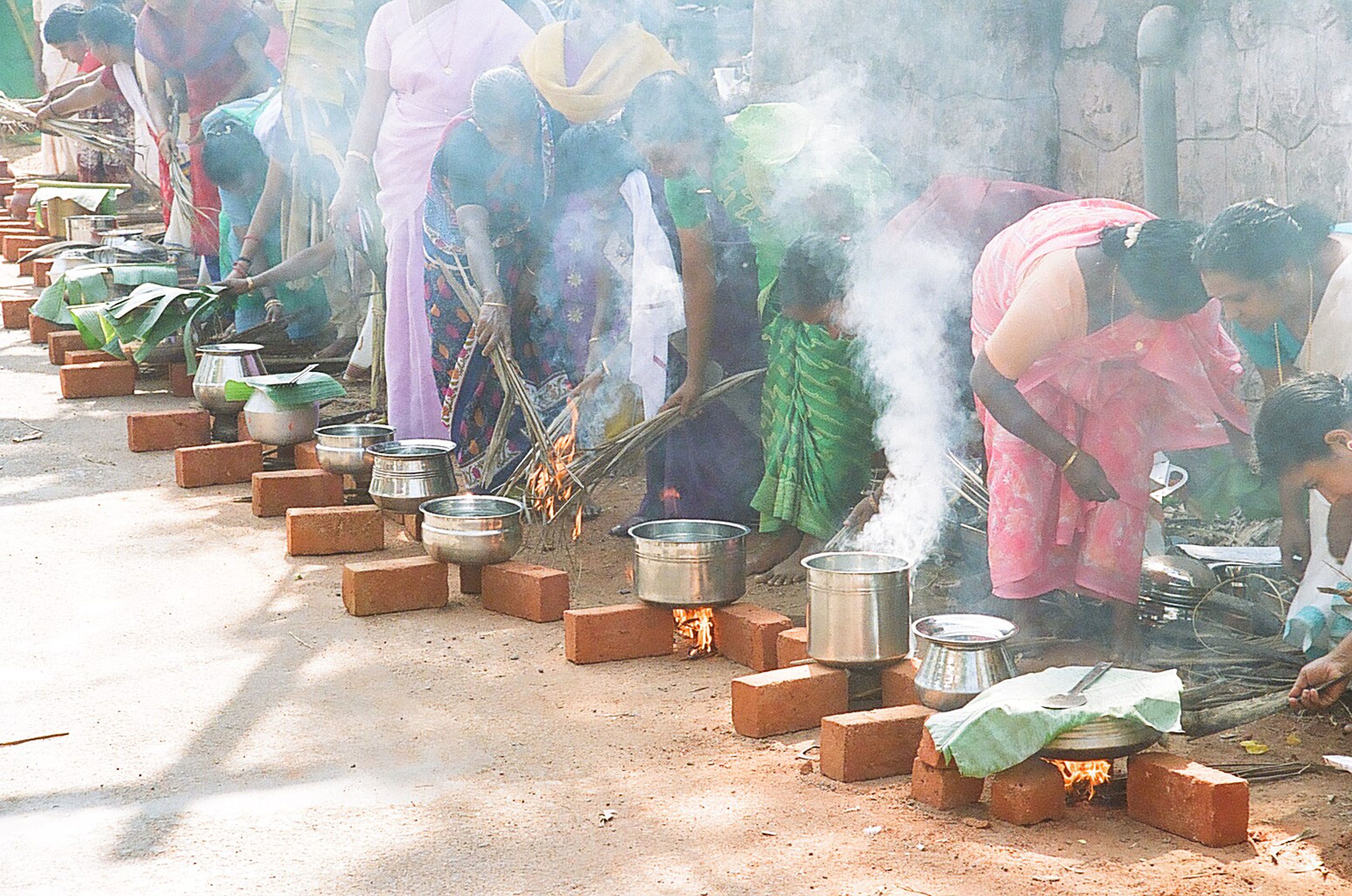
These are some of the details I pull together from some of my photographs to get myself back into the setting of my story. When I write, I want to feel I’m there, and I want the writer to feel she is there with me, so I review my pictures, think about the layout of the city, and imagine my characters walking through a village or resort or the capital of the state. A story I’m working on now is based on a festival held in India in late winter. Pongala has been called the largest gathering of women in the world. Over three million women descend on Trivandrum to make an offering to their deity, to bring good health to the family for the coming year. My photographs of this festival will be on display in the Beverly Public Library in February 2024, while I’m working on the story.

In the fifth book in the series, In Sita’s Shadow, Hotel Delite welcomes a tour from the United States, five guests instead of the six expected. Auntie Meena is soon fussing over them, determined to see them happy while in her hotel though she’s a bit confused by their non-touristy conduct. When the tour leader is found dead in his room, poor Auntie Meena is terrified that his spirit will haunt the hotel, and calls her astrologer at once. Anita calls the police, as is expected, and then begins to worry the death is unnatural. Trying to break the news to the members of the tour proves harder than expected. But one tour member seems uninterested in the death, and rarely uses his room in the hotel. This is not what Auntie Mean expects from a proper guest.

Auntie Meena throws herself into the investigation into the tour leader’s death, to Anita’s dismay, in a determined effort to protect one of her guests from the danger Meena is certain is lurking just around the next corner. Nothing good can come from a young male student sparking a friendship with an older foreign woman. Anita, however, is more concerned about the odd behavior of one of the hotel’s suppliers, a woman who makes airy delicious pastries.

https://www.susanoleksiw.com

The Writer’s Retreat

Last evening I attended a small theater production on the grounds of what had once been a dairy farm and is now a location for modern dance and other events, owned by the late Ida Hahn, an “icon of the modern dance world.” The setting of Windhover, her Performing Arts Center that grew from a summer program for girls in the arts into a well-known center for modern dance and other mediums. After Ida Hahn’s death in 2016, her daughter, Lisa, has carried on the work.

I’m thinking about this now, despite many visits to Windhover over the years, because my companion and I both had the same thought. The scattering of small shingled buildings in a rocky pasture surrounded by woods and only a short walk from the ocean would be the perfect location for a writers’ retreat. The buildings are rustic, but their lights glow through the windows in the late summer evenings as artists and dancers wind down from the day. This is the time for creatives to get together to talk about their work and plans for the day.

The idea found a warm reception in both our minds, since we had both attended writers’ retreats in the past. My friend had experienced more than I have, but our feelings about them are the same. A good retreat lets the writer set aside the usual thoughts about managing life during the day and focus solely on work that too often gets shunted aside for more pressing, usually mundane matters.

In a short memoir about spending a week in a Provincetown dune shake, Thalassa (Haley’s, Athol MA, 2011), the author Allen Young describes his week in an isolated, rustic shack, his preparations and plans for coping and how he spent his days. I’ve long been intrigued by the dune shacks and the idea of spending a week in one, but the National Park Service recently announced that it was no longer going to allow this, and so memoirs like Young’s will be an historical record rather than a call to others for adventure. (The eight historic dune shacks are now being leased for a ten-year period, with the lessee responsible for all care and maintenance. I don’t know if subleasing is allowed; if it is, the dune shack experience may remain an option for others.)

Another writer invited to MacDowell went with his new, incomplete manuscript, eager to work and write what he assumed would be pages and pages every day. Instead, he found the hours alone with his WIP opening up doors he hadn’t expected, doors into rethinking his entire project and its direction. He shuffled pages, rewrote outlines, and although he would have felt this a poor use of his time at home he reported feeling he had come away with something fresh and new. I remember this story so well because he could have ignored the ideas and doubts taking form in the back of his mind and continued on with a perfectly acceptable story for an editor already interested in his work. 

We gain different things from a writer’s retreat. For some it’s the essential time to write. But for others it can be the opportunity to sit quietly with ourselves and listen to inchoate thoughts take form and gain clarity, leading us in a new more fruitful direction. And sometimes, it’s just the experience of being with like-minded people that can give us the energy we need to continue with a novel that is challenging. 

The season is ending in October for Windhover. The buildings lack central heat, so there’s no chance of gathering writers there this year. But I plan to write the director, Lisa, and invite her to consider adding this opportunity for writers to her schedule for the coming year or beyond. And I’ll continue to visit Windhover to enjoy other creative productions.

A summer of surprises

In the summer I’m usually deep into editing an anthology, and this year is no different. I’ve been doing this for most summers since 1989, when a friend and I started The Larcom Review. This summer I’m working on the third anthology from Crime Spell Books, which I co-founded with Leslie Wheeler and Ang Pompano, and have continued with Leslie and Christine Bagley. Our third anthology is Wolfsbane, which comes after Bloodroot and Deadly Nightshade,. in the annual series of Best New England Crime Stories.

This wasn’t going to be my topic for today but I find myself thinking about the sixth Anita Ray mystery I’m working on somewhat desultorily. And this is a surprise because when I sit down to write my thousand words for the day, sometimes after having skipped a few days, the characters keep surprising me. The setting in a resort in South India is the same but nothing else is quite so.

One of my walk-ons got himself killed, though I don’t know why or exactly how; I just know he’s very dead, at the bottom of a cliff in the Kovalam resort. I’ll have to figure that one out. And the expected main character has morphed so many times that he may morph himself right out of the plot, even though that’s not my intent. Meanwhile the counter to Anita Ray has turned out to be more fatuous than anticipated but has thrown one of the best spanners into the plot. And I finally figured out why an elderly woman was able to leave India, without a husband to support her, and move to the States with her young son. None of this is in the synopsis I roughed out several weeks ago, and none of it tickled my brain while I was writing it. It seems to have been hidden in my fingers or the keyboard.

But the most amazing discovery is Anita Ray’s perspective on her own work as a photographer. She has been adopted as a mentor by a young man who is clearly gifted and comes to her for advice. She’s willing to help and enthusiastic about his work, recognizing his distinctive use of color, texture, pattern. He has some gaps in his technical knowledge, and limitations financially; he can’t afford to have every image printed out for examination and critiquing. But he obviously has a bright, perhaps significant future if he can hold on under difficult circumstances. His work and trust in her judgment set Anita thinking, and she enters a phase of an artist’s career that can be deadly or transformative. 

I have no idea what will happen to him. He could be a figure in the mystery itself, dropping clues or finding them, or another victim, or just someone who brings Anita to the fore in a different way, which would make him useful but little more than a background figure. I don’t know now and won’t know until I write again and pose the question.

All this began when I came across a post by Michele Dorsey challenging writers to write one thousand words a day without any plot outline or specific goals. A thousand words is far less than my usual daily goal when I’m working on a novel, so I thought I could fit that in easily while I was working on the anthology. And I did, for a while. Now I write three days in a row, for example, and two days doing something else. And there’s no reason for this except myself-discipling seems to be flagging.

Peter Dickinson, one of my favorite writers, was once asked if his characters took on a life of their own, a fairly standard question for a writer. He replied that there’s little room for surprises in his work once he starts writing because he develops an extremely detailed outline before he begins. I tried that once, and it didn’t work for me, so I admire anyone who can do that. Until that talent comes to me, I’ll continue discovering the world of my characters, and hope it all makes sense. It will be weeks before I know, so I’m learning patience—again.