Three Hydrangeas

I’ve been reading up on hydrangeas—where to plant, when to bloom, what to feed. I planted three on a gentle slope in the back yard, just off the small patio, several years ago. This area gets lots of morning sun, midday sun, and some afternoon sun. I never feed them, never prune though I do remove old stems that are woody and falling off. And, like many other plants in New England, these three no longer wait for the traditional August blooming. They begin in mid June. 

All three plants have been productive since I planted them perhaps fifteen years ago, and two have reached their full height, over three feet. The third grew more slowly, and two years ago, as I was weeding out whatever had crept up through the mulch, I found an invasive plant had twined itself around the third plant. I rooted it out, and hoped the hydrangea would survive and do better now.

Last year the runt of the trio bloomed nicely, and I congratulated myself for planting it a little higher than the other two, thinking now it gets more sun instead of being somewhat sheltered between two other plants and a fast-growing false spirea, which is another object of my (unfriendly) attentions.

As the spring drifted into June, I admired the first two hydrangeas, which were getting larger and larger, with more and more blooms. I pondered the third plant, which has now arrived at the top of the slope and is only a few inches from the patio. How did it get there? 

It’s been two years since my husband died, and while I thought my life was continuing on its established trajectory, I’m beginning to see that it’s not. A few weeks after Michael died, a mutual friend, also a widow, asked me if I was now reinventing myself. The question surprised me because we’d known each other for years both as writers and as neighbors. My first reaction was, no, of course not. I’m who I have always been. But in the intervening months I have noticed that interests I didn’t pay much attention to are coming to the fore, or I’m taking them more seriously. Some of them involve fixing things myself instead of asking Michael, who loved broken things for the chance to tinker, or hiring someone. 

I’m doing a lot more photography, and looking back on four solo shows and wondering why I didn’t take the work more seriously. My newest project involves lace and exploring experimental photography, which involves poking into analogue work. I don’t feel like I’m reinventing myself so much as sprawling over boundaries established arbitrarily and no longer useful. 

So now when I look at the hydrangea working its way up the slope and getting ready to grow as large as the other two, I don’t wonder how it got here or why. It’s where it needs to be.

In Praise of Envelopes

Scattered around the house, until I finally gathered them in one place, were a number of pretty, well-decorated pads of paper in various colors. Some are aqua with little sprigs of white flowers in one corner; others are yellow, or pink, or off white with cute titles such as To Do, or Not To Do, with a row of colorful books at the bottom, below the hand-drawn lines. Some only say Notes in florid fonts. Some have bouquets in the corners and others have snowflakes along the borders. My favorite is the collection of library book cards that used to be found, stamped, in the back of every book. I never use any of these.

I also have a stack of journals I received as gifts. They come with nice covers and silk bookmarks, and beautiful pages, some lined, some not. I don’t use these either. When I travel, I take a plain black Moleskine journal, the small size, and it’s just the right tool for a short vacation, about a month or less.

For taking notes, keeping track of my to-do list, I use envelopes, plain white, usually used envelopes. I can’t break myself of the habit. When I get the mail the first thing I do is examine the envelopes, hoping for one that isn’t stamped or printed on the back, torn or stained. The envelope might end up with coffee spots on it, or smears of butter from a morning pastry break, but I don’t want it to begin that way. I want pristine, a pure white envelope calling me to list all the goals I have for the day, the list of things I believe, in my arrogance or delusion, that I will get done in the next ten hours. I can be very ambitious, and with small handwriting to accommodate the space, I can list a month’s worth of tasks on the back of a No. 10 envelope.

When I think about it, I admire my smarts in choosing this disposable vehicle for my ultimately disposable thoughts. The item is plain, it fits neatly into my hand, and there’s room on the back for additional notes and clarification. Because the No. 10 envelope, a standard size, is 4 1/8 in by 9 1/2 in, it is roomy enough for a clear statement of the task but not so roomy that I’m tempted to get wordy. There’s no point in a to-do list if it reads like a lecture or an essay. In addition, it folds neatly to fit into a pocket, and slides into my purse easily.

This week I cleaned my desk and found no less than seven (that’s seven) envelopes packed with things to do, books to read, household chores to get to, handymen to keep in mind for various repair jobs (I live in an old house), and writing ideas so terse I had no hope of ever figuring out what I had intended. That’s okay. I always tell myself if it’s a good idea, it’ll come back—several times—until I either get to it or discard it. I’d crossed out much of the items on each envelope, and as I read through the remainder I smiled at my plans, and was glad to let them go. I have new ones now.

There’s another reason I like envelopes, one that I rarely admit to myself. You can probably guess what it is, or who I’m going to refer to. In my quiet writerly life, I’ll never rise to the level of him, the great one, nor will I ever write anything so perfect as to be quoted decades or centuries after I wrote it. But here I sit, with my stack of envelopes honored by having its own desk drawer, thinking of what is possible with a simple envelope. The great man’s example is simple and can be summarized by anyone, and is always worth remembering and thinking on. Be direct, be honest, be brief. This is good advice for the writer, no matter what she writes on. Thanks, Abe.

The Blank Page

Like many writers before me, I get a deadline for an assignment and spend the days, weeks, or even months leading up to it thinking about what I’ll write. If I pick something lighthearted, I have to consider just how far to go in the humor direction. If the topic is serious, I worry I’ll sound earnest (Oh, the shame!). Either way, I let my mind wander, make a few notes as I go along (and try to keep them on the same pad of paper), and sit down to write with ample time to revise and edit. And then on the day when I’m supposed to post, I plan to finish the essay with a light and quick rewrite, just to keep it fresh. I open a new page, and there it is. The blank page. I’m catatonic.

What is it about the blank page that makes my brain go blank as well? I look at that white sheet which now has the vastness and strangeness of the Sahara covered with a blanket of snow, and I haven’t a thought in my head. Not even an idea that I’m looking at a blank sheet of paper on a computer screen. Nothing. 

I had so much to write about this morning at 5:30 a.m. I woke up to the morning sun lightening the New England sky, reminding me that today was supposed to be a nice day, upper 50s along the coast, possibly even hitting 60 degrees. A good day to be outside tackling the weeds and cleaning things up for spring planting. I had the luxury of just lying there thinking about all that I could do today after I posted my blog for the fourth Saturday, my regular day for Ladies of Mystery.  But by the time I got to my desk and laptop, something unbeknownst to me was draining my brain of every idea I’ve ever had.

I’ve thought about ways to cheat the blank page of its power to cripple me. It’s possible that pulling up a page from an earlier post will stimulate my tired synapses to get popping, but then I have to make a decision and choose a page. Nope. Still crippled. I could pull up a page from the novel I’m working on (and have been since last summer—what’s with that?) but then I’m liable to fall right into my usual funk of trying to figure out what’s wrong that scene or the other one in the same chapter. Not good for morale, which I need right now.

If you, reading this, are also a writer, you’ve probably already shut your eyes hard against a painful memory of a blank page, the one that just wouldn’t let you get started on what you hoped would be your greatest ever WIP. This experience drives me to question, what is the purpose of the blank page? And I’ve decided it’s the Universe’s way to test us, to make sure we know what we’re doing. If I pulled up a new page and started tapping out advice for ingrown toenails, the Universe would be telling me I’m in the wrong business—I’m not a writer; I’m a frustrated podiatrist. Perhaps I decide to explore the drawing or designing function on my computer. Okay. Problem. No words. 

The blank page is the test for me every time. I don’t know what I’m going to write. Even if I think I do, I don’t know what’s going to come out. No matter how much I plan, no matter how much energy I waste on sample paragraphs or opening lines, the minute I look at that blank page, I go blank, white, empty, nothing. And then something comes up, something not planned, not expected, not even understood sometimes. There it is, and a wonder among wonders, For me writing is like breathing. I don’t really know how it works, but I know that it does and that’s enough for me. I thank the Gods of Desperation and go on typing.

Facing the blank page forces me back on myself every time—challenging me to trust that whatever shows up, making my fingers wiggle and stretch, spreading those black squiggly things across the white space, has to be what matters to me at that moment. On this I have no questions, which is good because I also have no answers. I take it all on faith.

I write because I have to, and I accept what comes also because I have to. It’s me.

Discovering the Setting

I’m in the middle of the sixth book in the Anita Ray series, which is set in a tourist hotel in a South Indian resort. Over the years the area has grown from a tiny fishing village with a few hotels just up the coast to one of the most popular destinations for Westerners eager for the sun and sand, not to mention the sunsets and the fishing boats bobbing on the horizon at night. I know the area well, having visited it for the first time in 1976 and several times in the 2000s. 

The pathways laid out in the early years are now paved walkways through marsh with little pools covered with lily pads. The paths have been widened in some areas to allow shop owners to hang out rows of brightly colored silk saris and blouses. When I think there’s no more room for another restaurant or shop, I turn a corner and spot five square feet turned into an open-air cafe with the owner stirring a pot on a two-burner cooktop, ready to serve the foreigners sitting on stools before a board table. The food is good, the price is right, and the cook’s son works in one of the high-end hotels. Much of Kovalam has spread on what was once paddy fields that came down to a low berm fronting the beach. All those are gone, and only the rare private home remains, hidden away beneath tall palms.

A reader often tells me they know “exactly where I am” in an Anita Ray story, and that’s because I do too. I have a strong sense of direction in India (and elsewhere), a deep understanding of India (after years of graduate school), and a personal love of the region. All of that informs the Anita Ray stories. What I don’t have is a sense of place in any story if I haven’t been there, walked through a public park, found a typical cafe for the area, and visited a municipal building—perhaps a library or town hall. I can make up a lot of it, but I need to experience the “feel” of the place. 

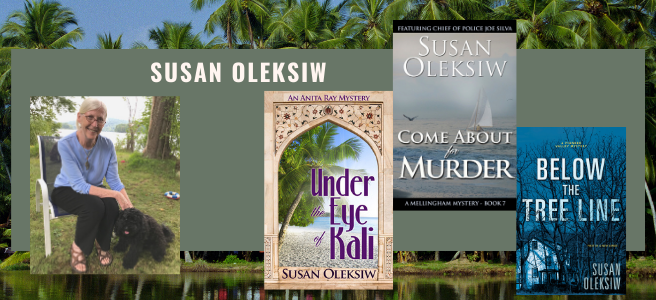
The Joe Silva series, in seven books, takes place in a small coastal New England town. I know these towns well, having grown up in one. The rocky coast speaks of the “flinty” Yankee, and the harsh winds call to mind the ever-present threat of hurricanes and other storms. Winters may be changing because of climate disruptions, but the birds still come, the land demands careful attention, and life for the fisherman is never easy.

One of the reasons I enjoy reading crime fiction is the other landscapes I get to explore. I’ve been through the Southwest and lived for a brief time in Tucson, so I appreciate any writer who can take me into that world of mountains and deserts, long straight roads, and small adobe houses with gravel yards. The openness of Montana and Wyoming brings out the best in some writers, and I look forward to their stories and landscapes.

Regardless of where we grew up or now live, we are creatures of our environment, and the best fiction uses that sense of place, what is distinctive and unique about one location, to propel the characters and their story. This, for me, is the reward of a reading a novel with a rich, fully developed setting. I come to understand both people and place, and know a part of the world I may never visit a little better.

Exploring for Ideas

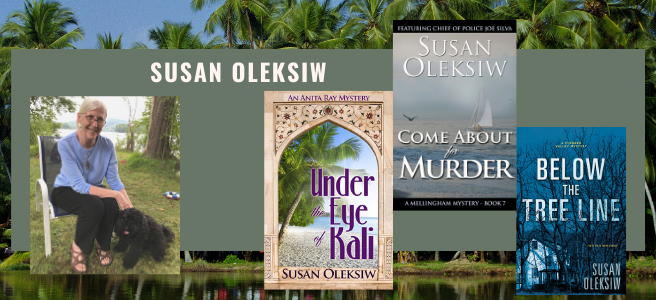
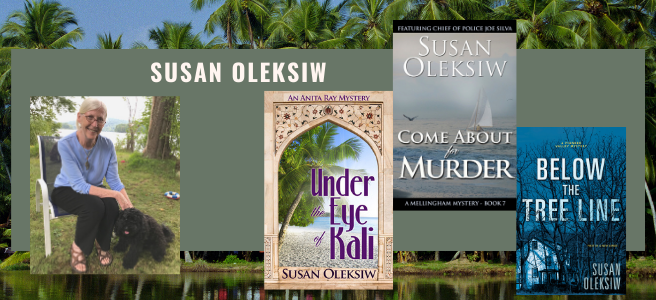
I began the Anita Ray series in 2010 with Under the Eye of Kali. Anita Ray now appears in five books and numerous short stories, and I’m currently working on book number six. In book five, In Sita’s Shadow, Anita is pulled into investigating a group of tourists who don’t seem to care about each other though they are traveling together and know each other from earlier encounters.

After living in India in the 1970s and again in the 1980s, and making numerous short trips since then, I’ve learned that nothing really stays the same in that country. Change is a constant, and at each return I’ve been surprised, intrigued, delighted, and confused by some of the changes. To help me think through the story line in a new short story or novel, I reread notes and spend a lot of time with my photographs. Some of them are leading to a new story that is still in the “idea” stage, based on an annual ritual.

Attukal Pongala, a ten-day religious festival, is held every year in Kerala, South India, drawing up to three million women for the ninth-day Pongala event. This is the largest gathering of women in the world, and they come from all over Kerala (and beyond). The state provides extra trains and busses to bring women devotees to the city. The movie theaters remain open all night, people open their courtyards to visiting devotees, and free tea is available in the morning. 

At a precise time, dictated by the stars, a fire is lit and the flame is passed along to assisting priests who spread throughout the city to start the three million fires. The women cook a porridge of rice, jaggery, coconut, and banana as an offering to the deity of the Attukal Bhagavati Temple throughout the morning. Free lunch buffets of rice and vegetables are set up throughout the city, provided by men, who may be associated with a temple, a place of business, a family, or a fraternal group. 

At the dictated time, in early afternoon, other priests spread throughout the city blessing each cooking pot and its porridge. Once this is done, the ritual is over for that participant, and the women pack up and head for home, hurrying to catch the bus or train. The city cleans up, collecting the bricks used for the hearth, and sweeping up the debris.

One of the features of this event that I only discovered by accident got me thinking about my new story. As a very visible foreigner wandering around the festival taking pictures and occasionally chatting with the women, people were eager to explain things to me or show me something. In one of these encounters a woman who spoke perfect English pointed out a side street with no cooking fires. This was curious, and I walked along with her until we arrived at a small bungalow with a car port. Inside the car port sat perhaps two dozen men and women scowling or looking bored. The woman explained that they were pickpockets and other petty thieves who were corralled for the duration of the festival, so the devotees could cook in peace and safety.

When I reviewed my photographs months later I noticed a couple with a small group of men and women seated in front of a closed shop with no cooking sites in front of them. A few men stood nearby. I’ve wondered if this is another group temporarily detained during the festival. As you can guess, the ideas for a story began to percolate and I’m now at the stage of working out the details before I begin writing. 

The Pongala festival is unique, and open to everyone. When the pot boils over (pongala), it signals abundance in the offering to Bhagavati, and the deity is pleased, suggesting good health and good life for the family in the coming year. This year’s Pongala will be held on February 25, 2024.

For the Anita Ray series, go here: https://www.amazon.com/dp/B09HR76ZKP?binding=paperback&searchxofy=true&ref_=dbs_s_bs_series_rwt_tpbk&qid=1708783919&sr=1-10

To sign up for my quarterly newsletter, go here: https://www.susanoleksiw.com/newsletter.htm

Facebook: https://www.facebook.com/susan.oleksiw.author/

Twitter: @susanoleksiw

https://www.instagram.com/susan_oleksiw

Pinterest: https://www.pinterest.com/susanoleksiw/