It’s Awkward

Once a month I appear on this blog, so I have about four weeks to think of what I want to say. Most of the time I have no problem coming up with an opinion on anything, but shaking loose an idea I want to explore and spend time with that will benefit other writers, even if it’s short, is harder.

My first idea usually gets shelved. This month I considered writing about Beta readers because two experiences from my earlier years came to mind. A friend who wasn’t someone I considered a book person asked about what I was working on. He asked to read it when it was ready. When I had a pretty good draft (perhaps fourth or fifth), I gave it to him. He gave me lots of notes and conversation, and a year later I reworked the story. He again asked about it, so I showed it to him. This time he didn’t like it at all even though it was essentially the same book. He took exception to things he liked the first time around and passed over things that excited him before. Okay. I don’t know what this means except that he changed in the interval, and first impressions are more useful than second impressions. I shelved that blog.

Than I moved on to the idea of reviewing. This is tricky for a writer reviewing in her genre, so after reviewing numerous titles in the 1980s and 1990s for all sorts of journals–The Drood Review of Mystery, Mystery Scene, and Publishers Weekly among them, and later Audible–I gave it up for the simple reason that it became too awkward. After attending a few conferences, including Malice Domestic and Bouchercon, as well as Crime Bake later, I knew too many writers whose books I loved as a reader but could see flaws in as a reviewer. Awkward for sure. End of that topic.

The pandemic is still with us but I’ve already posted about it twice and I’m sick of it. You may be too. I don’t know anyone who isn’t. How is it affecting my work? Hard to say, though I expect we’ll all discover in a year or two that we were in a fog for almost a year and we’ll look back on these months with their fears and restrictions and wonder why we did the things we did. It will be, yes, awkward. Enough of that topic.

And then we come to words. I love words. Nothing new there. I also love my dictionary (Webster’s New World Dictionary of the American Language, second college edition, printed on lovely onion skin paper), which comes with etymologies. The “Guide to the Dictionary” is a six-page explanation of the construction of the entry, all those little bits we lump together as the definition. My favorite line in this guide is “In no case is the first spelling considered ‘more correct’ or the one necessarily to be preferred.” There are also several pages on language, including English, and more on Americanisms. I’m enjoying myself but I’m not sure another reader would be. Time for another topic.

Editing is always a reliable subject because, Lordy knows, we writers do enough of it and we’re always looking for ways to be more efficient. I’d love to be able to write and construct a story well enough not to have to all but rewrite the damn thing during the editing process. I think of the standard advice, When in doubt, throw it out. The trouble with that advice is that it calls to mind a note on an article I sent to a publisher. It “didn’t fit” their journal so they sent it back, but in the notes a reader and editor left was the comment, “This is an excellent sentence.” I found the passage and read it. It read like all my other sentences. What was so special about this one? After turning to it every year or so, I still don’t know. It just looks like all the other passages in that article (still unpublished), so I seem to have not only no advice on editing but also no sense of what to edit. End of topic.

So here I sit at 7:30 on Saturday morning without a topic for my blog post. You’ll just have to tolerate my ineptness today, and I hope to do better next month. Yes, I know, it’s awkward.
Writer’s Block or Writer’s Rest

During the last month or so my mind has been a blank. I haven’t had a single new idea and have plodded forward on the fiction I’ve been working on—editing and proofing—all the while wondering where I would be when this work was finished. This is called writer’s block, but I have learned to call it Writer’s Rest.

At first I called it a drought. I felt dry, used up, empty, as though I had reached the end of the line, the finish line for fiction, the moment when I retire and try something else. Photography? Embroidery? Gardening? Sleeping? I’ve been dabbling in these for years. Was one of them about to take center stage? Unlikely. I began writing as a teenager and knew at once that this was something I had to do. The desire was far stronger than something I wanted to do. It was something I had to do, something I could not not do.

Over the years I’ve become accustomed to my personal quirks and mostly learned to live with them. Inspiration comes in the form of a general idea for a short story or a novel, the vivid image of a person or a situation from which a character emerges. In the AHMM July/August 2020 issue is my story “The Pledge.” The idea came from a news report of a police chief talking about a young man from the Midwest who got himself into trouble in the winter because he couldn’t read the landscape—what looked familiar to his rural eyes was quite different in New England. The police chief’s comments remained with me until the story idea shook them into shape.

In another short story I was struck by the relatives of a foster child who tolerated him but didn’t really want him around. He showed up after school and lingered till he was sent home at dark. This seemed cruel until it occurred to me there might be a reason for their awkwardness. From that came “Just Another Runaway” in AHMM November/December 2019.

These and other story ideas show up on their own, not when I’m rattling around at my desk looking for a good writing prompt and definitely not when I’m trying to force an idea into existence. Since I’m writing every day, you might say I always have a writing prompt in progress so what need do I have for more? Well, how about the moment Writer’s Block hits?

My suggestion in this post is different. It is to think about the purpose of a month or perhaps only a week of writer’s block. While I’m fretting about coming to the end of my career, my unconscious is rearranging the snippets of life I’ve collected and looking for something interesting, intriguing, riveting, revealing. My unconscious is at work creating while I’m fretting consciously about losing my imagination to ageing or boredom or something else.

While I typed the first few words of this blog post I got an idea for a short story and had to stop to write it down. Fifty years ago I met a Catholic priest who had such a clear dislike for secular women (and perhaps women religious as well, though I can’t say) that I had to force myself to keep appointments with him and conduct the business I was required to do. That kind of experience remains with you, and as I began typing this evening, the story revolving around him finally came to me. I’ve waited for a long time for this. After fifty plus years I’m going to get that man out of my head, and in a way that preserves his offensive biases and the damage they can do.

When I’m not obsessed with it, Writer’s Block is nothing more for me than the required rest for my unconscious to work out problems and deliver the results to my conscious mind. Sometimes a number of ideas arrive all at once in an afternoon, so I spend a few days trying them out. Do they resonate with something I learned or experienced recently? Do they give me a new way of looking at someone or a particular problem? Do I feel this will lead to personal discovery and deepen my understanding of a character? By asking these questions I get deeper into the idea and discover if it will sustain attention over several pages or thousands of words. Is there a story here worth the effort? Am I drawn in deeper just by thinking about it? If the idea falls apart on closer inspection, then I’m glad to let it go. But if it rewards me with twists and surprises, then I’m glad to write out a short paragraph about it and think about when I can begin work.

My drought, or Writer’s Rest, has ended. It came to an end while I was preparing this blog post and left me an idea for a short story featuring Ginny Means, a social worker, and a novel featuring a fortuneteller who has more talent than she realizes. I’d say that’s a pretty good ending to what can be a grim time.

The Question of the Victim

One of the first ideas that come to me when I begin a novel or short story is the identity of the villain. As soon as the basic scene takes shape, the victim is the first of the characters to gain a sharp outline in my imagination. The villain, among several possibilities, is the last to be identified.

The selection of both victim and villain allow me to explore various questions, but in the beginning I was mostly interested in mastering the form and telling a particular kind of story.

image

In the cozy mystery, the victim tends to be “the person we love to hate,” the obnoxious neighbor or underhanded business partner, especially the philandering husband or the domineering departmental supervisor. No one misses them, or is sad to see them go. In my first mystery, Murder in Mellingham, Beth O’Donnell made everyone cringe with her sarcastic and cutting remarks, a bully though diminutive in every other way. With the victim neatly dispatched emotionally for the audience, the reader concentrates on those around her. But as the series progressed I wanted the victim to play a more complicated role.

Kali_Front

Setting a murder mystery in an exotic location (to us, the outsiders) offers new possibilities, and I took the opportunity to present a victim who was admired and mourned. Jean is an American nurse traveling through India on her way to Burma, or Myanmar, with a plan to be smuggled in to work in a clandestine clinic in the jungle. This will be her second trip, and she has come prepared with medicine and equipment. Who would want to kill her and thwart her humanitarian work? In Under the Eye of Kali, Jean disappears and is later found dead. Her openness about her plans seems to suggest smugglers or ordinary thieves could be the culprits. We care more about who the villain is because we care more about Jean.

Below the Tree Line

In the first Pioneer Valley entry, Below the Tree Line, Felicity O’Brien finds a young woman she’s only met once dead in her woods. This is the first of two deaths, neither of which fall into the category of expected victims. The reader has no reason to hate either woman, and the convenient category of the cozy victim has no role here. There can be no ambiguity about the death of either woman, and thus no pleasure in the reader at the elimination of an odious character.

The choice of victim tells the reader several things, but mostly what our own values are as we come to know the character and gradually discern the shape of his or her life. We conveniently agree that the obnoxious victim in the cozy got what he or she deserved; we admire the sleuth who tracks down the killer of a virtuous person risking her life for others; and we agree there can be no justification for killing an innocent person.

Crime fiction or mystery fiction opens for discussion and exploration our basic principles and beliefs. In Modus Operandi, Robin Winks, the late reviewer of and writer about this genre, was eloquent on this point. “Ultimately one reads detective fiction because it involves judgments—judgments made, passed upon, tested. In raising questions about purpose, it raises questions about cause and effect. In the end, like history, such fiction appears to, and occasionally does, decode the environment; appears to and occasionally does tell one what to do; appears to and occasionally does set the record straight. Setting the record straight ought to matter.”

One Writer’s Thoughts on the Pandemic by Susan Oleksiw

This post was supposed to be about setting, but while I was working on my current project I came to a scene in which the character had undergone a significant change. I wondered how to present this. Should I explain the loss of the job as the result of the Covid-19 lockdown? Or should I just leave it as an ordinary layoff? I posed the question as a general one on my FB page and as of this writing 24 writers have made comments. I’m not the only one thinking about this issue.

One of the strengths of crime fiction, and traditional mysteries in particular, is the precise way authors describe a world. Crime fiction is dependent on an accurate presentation of reality, even when that reality is far-fetched–from the deadly allergy to the fragrance of roses to the importance of the tides. We look for this in our favorite books whatever the subgenre. You may think about the yarn shop where a charming owner gives knitting lessons–to the reader as well as the characters, with knitting instructions at the end. Or perhaps you prefer the cooking mysteries with recipes and menus. I enjoy these too but in this instance I’m thinking about something less obvious but equally significant for the story.

Over fifty-five years, Agatha Christie set many of her mysteries in English villages, so richly described that even now many of us Anglophiles still think of a Christie or Miss Marple village as the definition of English country life. But this would be only half the picture. Christie depicted the world she lived in, and then added a murder and an amateur sleuth. Her sleuths and murders weren’t realistic but her descriptions of the village was. So much so that we can read her mysteries to study the historic changes in English rural life. The tidy village streets with modest homes radiating out from the center are soon dotted with high-rises for low-income and lavish homes for the newly rich after World War Two. The farmers and tradespeople are soon joined by British civil servants and military back from the outer reaches of the Empire and immigrants from the Caribbean, Africa, and South Asia. She would not have set a book in 1943 and failed to mention the war, nor would a story set between the wars have been complete without a Colonel somewhere in the mix. She used technology as do we, relying on one in particular in her most famous novel.

The pandemic of 2020 will fold itself into history, just as 9/11 has, but it would be foolish to think that readers won’t recognize these dates if they show up in a story. If we ignore the changes the disease is making to our daily lives, will our stories be anachronisms? Can you write a mystery today without recognizing the change in the US population? Reading a novel in any genre in which every character is a WASP would be unbelievable today, and a character’s African-American heritage will not necessarily have anything to do with the plot. In some parts of the country you would be hard-pressed to get through the day without hearing at least one foreign language or seeing a few young people walking down the street with their eyes on their cell phones. These are the details that ground a story and make the world believable.

For some readers the current circumstances are too extreme to explore in literature, and they don’t want to read about it. Plenty of writers don’t want to write about it either. It will probably be several months or even a year before we see the first pandemic stories, but until then each one of us has to decide whether or not to use the new ways of managing day to day life as background for a story or as part of the circumstances determining a crime and its solution. I don’t have the answer and probably won’t have one, at least for me, until I reach the end of my current work. I write in uncertainty, just as today we’re living in it.


The Writer during a Pandemic by Susan Oleksiw

Recently a number of writers chattered on line about writing a story during the coronavirus pandemic. I haven’t considered it yet, but I have noticed the details that signal the changes to my community, and these would probably appear in anything I wrote.

At first I thought the directions to pull back, self-isolate, etc., would lead to obvious changes, that the world would look startlingly different. But that hasn’t been the case. The world closed in gradually. Stay six-feet away from people; close the schools and study on line; work from home if you can. That all made sense. But the changes were more subtle.

Far fewer cars pass our house, and when I walk in the morning I’m struck by how many cars sit in driveways. They were usually gone by eight, and almost always by nine. Now they’re packed in. The streets are nearly empty, and on the rare day when cars are parked on a side street, I know that someone is ignoring the rules to stay inside and has gone visiting.

Most people I encounter seem to be following the rules; a few are nonchalant, letting masks fall, rubbing their eyes; others are defiant or oblivious. In a doctor’s office, twelve patients sat next to each other because there weren’t enough chairs to sit six feet apart. No one smiled, no one read a magazine, and no one escaped into their cell. People sat rigidly in their seats, keeping an eye on each other. No one sneezed, coughed, sniffled.

One morning a young mother parked on a side street, hustled three children out of her car, and followed them down the street to a house around the corner (no parking on that street). A play date? Home schooling?

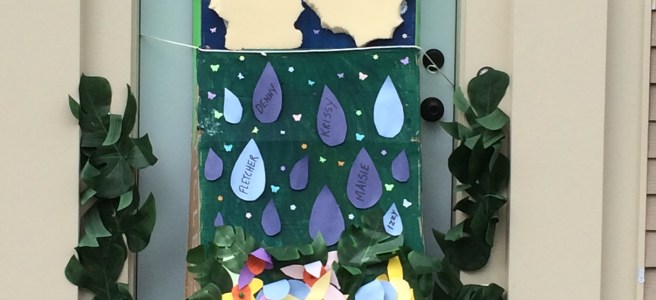
To counteract boredom, neighbors organized an art project, setting children to decorate their front doors. The goal is to give them something to do, and demonstrate that the community is working together even though they can’t play with their friends at this time. The dark side of this is the closing of playgrounds, where caution tape around swings makes the point in a different way.

Before the virus, late at night the bright lights of an alarm-silent police car or fire engine might wake me up. But not now. Far fewer police cars and fire engines fly past the house day or night. Throughout the city sirens are mostly silent. This may not mean less crime; perhaps the police have been hit by the virus and fewer men and women are available to answer the call. A 911 call that once took ten minutes three months ago might now take forty. And no cars have been on the road around five or six in the morning. Most workers have no early shifts to get to.

Our main street is shuttered, restaurants closed, few of them doing take-out. The train doesn’t rumble by in the distance at expected times; the schedule has been changed to a weekend schedule except for an increase in early morning trains to get workers into the city for the early shift change at medical centers.

The newspaper arrives, the trash is picked up, grocery stores are reasonably well stocked. But in all, the salad bar, fruit bar, and soup bar are closed, and in some stores all vegetables are now wrapped. No one gets to choose how many green beans she wants, or how many shallots. The bakery no longer puts out a tray of pieces of a new cake or cookie for customers to try.

These are the obvious changes. The less obvious are the more dangerous, and those arising from people who flout the governor’s directives are even worse. A husband who has threatened his wife before is confined with her in a small home in the woods. Young children in a family with an older brother who bullies them have no way to escape. A landlord who cares little for his tenants’ problems quotes the president announcing the situation is under control; time to go back to work and pay rent. A small business owner dependent on crafts made and supplied by women working at home takes in inventory–and resells it without keeping records. A woman who turns sixty-five in a month can’t reach any of her utilities to fight a shut-off notice.

These are real situations whose danger is amplified by our unusual circumstances in winter 2020. These are the stories we’ll write some day.