A Regional Anthology Continues

Last year, in 2020, Level Best Books announced that it would no longer publish its annual anthology of stories about New England, and would instead focus on its mystery novel line. Everyone who had ever been involved with the anthology was disappointed. The annual Best New England Crime Stories anthology was a much-loved collection, but it had changed over the years. One aspect that remained constant, however, was publication of the winner of the Al Blanchard Award.

The crime fiction world offers lots of anthologies for readers, so the end of one was sad, but the loss of the publication of the Al Award winner seemed a huge loss. Leslie Wheeler, who has been chairing the award committee for years, was especially concerned, and trying to figure out what to do about that drove early discussions among several of us until all of a sudden three of us had signed on to continue the anthology—Ang Pompano, Leslie Wheeler, and myself.

Best New England Crime Stories will be published by our new press, Crime Spell Books, and will include only short fiction by New England authors. 

A little history is in order here. In 1993 Kate Flora, Skye Alexander, and I founded Level Best Books to publish an anthology of crime fiction by New England authors. When Skye moved to Texas, Ruth McCarty took her place. Eventually we passed the LBB on to another group, Mark Ammons, Kat Fast, Barbara Ross, and Leslie Wheeler. After several years they passed LBB on to a group around DC, associated with Malice Domestic. They changed the requirements to stories set in New England by writers living anywhere, not only in the six New England states. 

Crime Spell Books intends to return to the original parameters—stories by writers living primarily in New England (we admit that some of our favorite writers escape New England winters by moving south; we’re jealous but forgive them the error of their ways). Regional anthologies occupy an important place in the world of fiction—opening up one region to readers in another. A good anthology presents a sufficiently varied group of stories to take the reader deep into the territory but also an assemblage of characters closely related enough to give the reader the feel of a novel, an immersion in a way of thinking and living.

We know that many writers who appeared in earlier volumes will be disappointed—unless, of course, they move here. But we are excited to focus on New England authors. Over the years LBB published many first stories by writers now well established and well known. We want to continue that tradition of giving new writers a strong start while also supporting other writers well known and not so well known. Look for our first anthology, Bloodroot, coming in November 2021.

Yes, I forgot . . . by Susan Oleksiw

This post is late because, well, I forgot. But I’m in good company. 

My daily newspaper hasn’t arrived for the last four mornings, though one arrived late in the afternoon. This seems to happen every year, right after I send them a check to thank them for their very reliable delivery the rest of the year.

Every year my husband and I pick out a tree about two weeks before Christmas, but this year all the trees were gone by then. Not even a live tree (in a root ball) could be had. So we bought what was meant to be an urn tree, and so we have the smallest tree we’ve ever had. I rather like it—easy to maneuver, easy to decorate, and easy to move back outdoors for the rest of the winter.

Last year we had dinner at a nice restaurant in Salem, MA, but that wasn’t possible this year. Nevertheless, we received an email confirmation for a reservation for Christmas dinner—one year late! 

On dismal weather days, of which we’ve had several, our dog is slow to get moving, which means he wants his morning walk later in the morning, closer to noon. This means that my husband’s midday walk comes earlier. I consider this another category of lateness but my husband considers it an unnecessary disruption to his schedule. In previous years, with a different dog, I had to drag the animal outside. During a snowstorm he would go no farther than the porch. I no longer do that. If a dog wants to go out in bad weather, he can ask.

Every year I make Christmas cookies. This year I burned several—I was late taking them out of the oven—but my husband is too nice to point that out. Besides, they’re still tasty.

My wishes for a Happy New Year are early, which makes a nice change. In 2021 I hope to get in sync with the rest of the world, or perhaps the rest of the world will sort itself out and we’ll all end up on the same page—emerging from isolation grateful to have survived healthy and ready to meet people without fear of infection.  I look forward to being on time in 2021, along with everyone else.

The Natural World in Crime Fiction

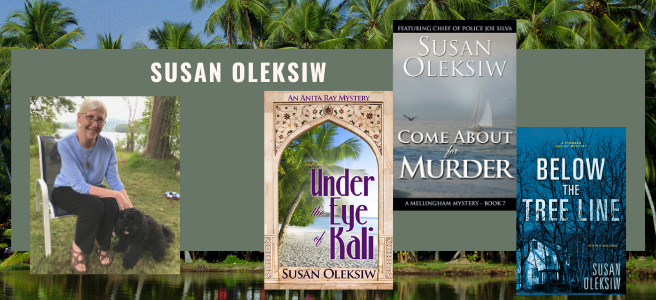
Many of the books I enjoy include some aspect of the natural world. An obvious recent example is The Witch Elm by Tana French, which revolves around an old tree in a yard where the main characters played as children and one returns as an adult to recover from an assault. Then there’s my own Below the Tree Line, which is set on a farm in rural Central Massachusetts. Now that I’m writing about a suburban setting, I’m taking a look at my neighborhood for scenes or aspects of nature to include in a traditional mystery. It’s not going as expected.

My first choice was to talk about apple trees, since we have one. However, it hasn’t produced a real crop in a few years, and right now looks like it’s dying. It might work if the book were entitled “Death of an Apple Orchard,” since the tree looks more like a sculpture than something that might have ever produced fruit. Scratch that idea.

The ornamental trees in this area seem to have developed a disease that kills off their leaves, so for the last two years they have looked like they too are dying. No one seems concerned enough to take them down, so we’ll have to wait and see what the future holds.

To this I can add all the invasive species that have killed off our native species, thereby depriving other plants, birds, and animals of expected sustenance. Our own backyard is being overtaken by bittersweet, bamboo, rose of Sharon, and lots more. I’m not sure it’s even possible to get rid of the invasives now. It may be too late. Nature as evil invader. Not my idea of the setting for a cozy.

The other obvious choice for drawing nature into a tale is birds. I love birds, love watching them flit among the shrubs picking up a meal—bugs or seeds—and jabbering at each other. Cardinals are of course always welcomed, along with goldfinches, northern flickers, and egrets, even crows. But the winged creatures I most often see are not nearly as attractive, or as much of a pleasure to watch. Turkeys.

Turkeys are everywhere now.

Last year a flock made its way slowly down our street, passing from yard to yard in search of edibles. When they encountered a fence they headed out to the street. A driver trying to park made the mistake of honking at one of them. This is received as a direct insult, and the turkeys responded accordingly. Two of them attacked the car, pecking and jabbering at it. Not satisfied with this display of temper, they headed out into the street, bringing two lanes of traffic to a halt. This was so disruptive that a neighbor entered the fray shooing away the turkeys to the other side of the road, allowing traffic to flow again. But the turkeys weren’t done yet. They reentered traffic, once again tying it up, until bored, they wandered away, down the center of the road.

Once when a turkey was behaving appropriately, I snapped a pic of it. The click of my iPhone startled the bird and he looked up, scanning the area for whatever creature had threatened him. I moved on.

These feather characters won’t work as background detail for a story, though they might serve as a motive for murder.

Notice I began looking for an apple tree but mine was not attractive, and then moved on to other aspects of nature that were less than serene or beautiful. The cozy mystery needs the apple tree in blossom, but a thriller or suspense story needs the scaly fruit tree. Nature offers us both (and a lot in between) and as writers we choose aspects of the natural world to signal theme, tone, mood. I plan to get those diseased decorative trees into a story very soon. The turkeys are more likely to find their way into a humorous story, perhaps fleeing a homeowner determined to get rid of them. I’ll enjoy writing that one. And then I’ll talk about the rabbits that are now everywhere.

Tactile Pleasure of Mystery Writing

For the last several months I’ve been rewriting a mystery from first person to third. This was more fun and more rewarding than I at first expected and I’m pleased with the results. One of the best parts of the work was rearranging the plot and reworking and developing the subplot. I have a general rule that when this part of writing a mystery gets tedious, then it’s time to start over. That didn’t happen this time, and I enjoyed one of my favorite aspects of crime writing.

Setting up and working out a mystery is for me the same as working out a puzzle, or finding a new tool and learning how it works. I like moving pieces around, setting up clues, keeping track of lines of dialogue that can be used later, reworking a clue, slotting in hints in dialogue to guide or mislead the reader, or lifting and replacing scenes. Dorothy L. Sayers called this process of working out a plot a “tactile” pleasure, and indeed it is. I’m not talking about notecards; I’m talking about the mind’s perception that the hands, fingers, are moving physical items around on a surface.

Some years ago, I signed up for a design course to learn more about how designers work to help me think about book covers. It was a revelation. Never had I more truly understood the difference between a writer’s mind and that of a designer. The first lesson was to use our names in a design as a way to introduce ourselves. I fussed for days over fonts, letter placement (vertical or horizontal), and more unimaginative details.

The student work I remember best was a drawing of the letters of his name tumbling out of a cornucopia in random order. I never produced anything equal to the work of the other students but I learned to release objects as well as ideas from their given, or assumed, boundaries. Which, when you come to think about it, is kin to what’s happening in crime fiction—individuals breaking rules and crossing lines, violating boundaries and challenging others to contain them.

The term “boundaries” has come to mean an emotional guide we use to protect ourselves from others or establish areas where connection is possible. We establish rules of interacting, and talk at length about how to do this. But boundaries are also physical, lines on a map drawn between nations or neighbors. We think of them as fixed, but experience tells us they’re not. Mystery writers have no trouble rearranging the world to suit our purposes. It makes me think of Roosevelt, Stalin, and Churchill at the Yalta Conference in 1945, rearranging the map of Europe before the war was officially over.

Rearranging a plot is rarely so significant as Yalta but slipping the pieces out of logical, rational place can produce the startling results that jiggle the brain out of its comfortable path. Examples abound in the work of Anthony Berkeley, a writer of the Golden Age, in his repeated challenges to the idea of justice and the issue of justified homicide. By seeing an encounter between two people in terms of its individual steps, the writer can pull apart the entire progress and rearrange the steps into a challenge to the standard perceptions of crime and violence. Every time a writer makes a change in the story, no matter how minor, she is turning what is regarded as a straightforward crime into a plot, and leading the reader to break established boundaries and ways of thinking about a particular event. This is a useful skill that might well be applied to all areas of life.

From First to Third

Since publishing my first mystery in 1993, my preferred point of view has always been third person. In the Mellingham/Chief Joe Silva series I used multiple points of view, and in the Anita Ray series and later the Felicity O’Brien series I used only one. All were third person. But a few years ago I wanted to try first person, and started a stand-alone. After numerous rewrites I had something my agent liked, and out it went to editors, where it has died a pandemic death of neglect.

While I’ve been waiting for responses I’ve had time to think about all the parts of the story I couldn’t tell because I’d committed myself to first person and one main character. I had no interest in adding other points of view in either first or third, but the initially quiet moments of dissatisfaction at what I’d left out grew and I wondered what it would have been like to write the story in third person. Immediately I was reminded of why I liked that particular voice—for the intimacy and also the flexibility it allowed me as the narrator. And that did it. I decided to rewrite the mystery in third person.

Over the years I’ve heard plenty of writers groan about an editor’s or agent’s suggestion that they rewrite the entire book from first to third (or third to first), always with the reminder drumming in their brain that this means more than changing “I” to “she” (or “she” to “I”), along with all the other pronouns as well as correcting the verbs. But the thought of what I could also do prodded me forward and I began. The first discovery was the opening. I needed a different opening, and once I began that I could feel the difference in how the story would unfold.

One of the reasons I’ve avoided first person for so many years comes down to the voice. Too many of the voices in crime fiction seem flip, sarcastic, chip-on-the-shoulder tough, the teenage swagger, a voice that doesn’t sound authentic to me and one I didn’t want to imitate. The strongest people I know are also the gentlest, and that was something I couldn’t seem to capture in first person, at least to my satisfaction. Now that I’ve moved back to third person I feel the other characters opening up, and exploring them more has given the story new dimensions that I’m eager to learn and write about.

In some parts of the novel I’m rewriting an entire chapter—the same plot steps but rewritten line by line. I’ve added new scenes and chapters, but in other instances all I’m doing is changing pronouns and verbs or crossing out entire paragraphs or scenes.

When I began the rewrite I thought about how much work it would be, but still I was curious. I wondered if I’d get bored or frustrated reworking a story whose characters and details I already knew too well. But once I got into a new perspective on the main character, much of the story began to feel new to me (and much of it is new to me). I’m energized every morning as I sit down to work. The characters and plot are the same, but this mystery unfolds like an entirely new experience. For once I’m not cursing the pandemic; it has given me the time to rethink and rewrite a story I care deeply about and want to see succeed. And when this is rewrite is done, I want the pandemic to be over so my new novel can go out into the world and be read by others.