
Photography and Plotting

I don’t ever think of myself as having writer’s block but I know that when I’m not sure about what comes next in the novel I’m working on, I tend to turn to photography and play with the camera and old photographs. Aside from my love of photography in general, I find this other art form stimulating in a way different from writing.

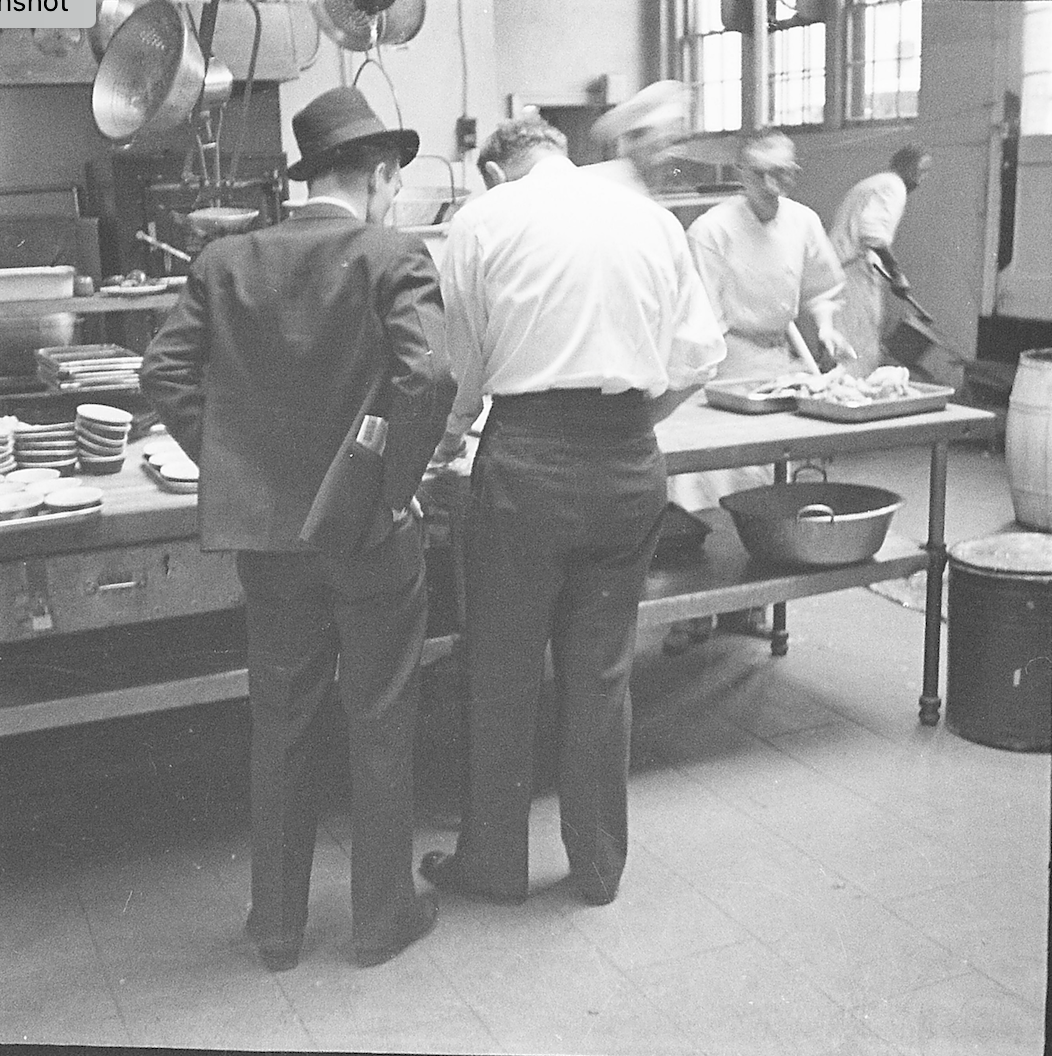
lately I’ve been going through old photographs, some dating to the 1930s taken by various relatives and a few dating to just the early 1900s when my grandparents were courting. My grandfather photographed as a sideline and occasionally sold photographs to Look and Life when they were new.  Granddad preferred the modern world—photographing machinery, industrial sites, and 1950s gas stations and fast-food joints lining a highway. My mother preferred landscapes. I like people and color. Granddad was a milk inspector for much of is career.
My family traveled around the United States in the 1940s, 1950s, 1960s, so I have photographs of us visiting various national parks, camping, riding, hiking, and, rarely, looking into shop windows. One summer we rented an RV and traveled up and down the Pacific coast, pulling up next to an RV from California or another western state. My dad often commented, “Too bad we don’t have a license plate from home.” He meant Massachusetts. Any time a park service officer found out where we were from, we were treated like celebrities. This was in 1959, when you could arrive at the Grand Canyon at five o’clock in the afternoon and find a good camping spot still available. 

Most of the photos from this trip are of magnificent canyons, mountains, lakes, and other scenery. We never had trouble getting a good view; there were few crowds and no cell phones—no one taking selfies but lots of people taking pictures of each other on the top of a mountain or paddling a canoe.

It’s an odd habit but photographers often take several pictures of the same person in different positions and poses at the same event, and save all of them, not just the best one. Sometimes the photographer takes three or four of almost identical images. In one instance I came across so many of the same person that it looked like individual cells from an old movie. 

The images from the 1930s and 1940s are of people I didn’t know or know only through family lore, so I’m free to imagine their stories. I rearrange the images in different sequences, much like rearranging scenes in a mystery novel, and a variety of scenarios come up. I especially like the ones of my father chatting with new friends in Sicily in 1936, when my parents took an extended honeymoon to Italy and Greece. That’s Dad on the left.

After a few hours of this ideas for my current project start to bubble up and I quickly turn to taking notes. This afternoon, after feeling stalled about the ending though I was writing scenes that had to be written, I had a slew of ideas coming. I made lists of actions my characters had to take to get to the climax, each a scene by itself leading to the final confrontation. My attention is back on the novel, and I’m putting away the photography for another day. But it will be back.

The Sounds of Christmas

When I noticed that my post was due on Christmas morning, my first reaction was to cringe and wonder, What on earth could I talk about that wouldn’t seem banal on such a morning? Not sure what to do, I do what I always do. I put the worry aside and took the dog for a walk. 

The various churches in our area often play recorded music. There is little live bell ringing in churches today, which is a loss. As a former bell-ringer, I miss the sound of bell music. When I was barely twelve years old, I was part of a group from my school that performed for the mayor of Boston (in a public concert) during the holiday season as well as for my community. When I hear bell ringing now I actually listen as though I understand what I’m hearing—the different bells, the timing, the way a ringer has to pitch and snap the bell forward, etc. 

On my walk I heard the recorded music from a small nondenominational church nearby, and let my mind drift. In the distance a dog barked and I knew another dog walker was out and about. Briefly a car with the bass ramped up sped by, crushing the bells and the dog. I registered all this and more as I waited for the world to fall quiet so I could enjoy the bells again.

This was one of those moments when a writer recognizes the obvious. In my recent work I’d forgotten the sensation of sound—the music that alters how I feel, the pain of shouting voices, the laughter that starts me smiling and makes me curious, the chorus of dogs barking in response to each other, and the snatch of conversation from two people walking past. The world is one long musical composition of which we hear only bits and pieces. But what if we listen?

The morning of a holy day is a good time to begin to listen well and carefully, to set aside the urge to add a comment or tell a story. Now is the time to listen to the world around us, the sounds we screen out instead of embracing as part of the fullness of life. There is a rhythm to movement and the noise it creates, and if we listen carefully and long enough we’ll see people walking up the steps in time to the beat of a car coming around the corner, or the landing of birds while a tree branch bends. If we listen we can hear the rhythm that holds us in sync with each other, each sound a grace note of life. 

May your holiday be rich in all the best ways.

The Season of Gratitude

This time of year publications on and off line are full of essays on gratitude, each writer searching for a unique expression that would set the writer apart. Having said this, I too am offering one of those essays. 

Some years ago I listened to a speaker on meditation talk about online meditations on various topics including gratitude, and how it changed his thinking. That sounded promising for someone who is often grateful for finding a parking space in Boston or catching the last train out or something else equally pedestrian. I decided to give the meditation on gratitude a try.

The instructions began with a sitting meditation of about ten minutes. After that we were instructed to begin listing the things for which we were grateful, and to keep going for another ten minutes. You might think ten minutes isn’t very long, but it is in fact a very long time, especially when you think you should be able to answer the question and then get on with it. (Obviously I hadn’t yet benefited from the practice of meditation.)

I began the list of gratitudes with the usual–my family, my health, my friends, the colleagues who read the first draft of my first mystery and didn’t tell me to get a day job. Then I scrounged around for things like our garden, the gifts from my family, the quiet streets of my neighborhood, and the like. I kept on going, even though I was feeling a little desperate and telling myself no one would know or care if I quit right then–at the three-minute mark. I passed through gratitudes for having a nice home, enough money to pay the bills, a husband who loved me (he got listed several times in different categories). 

The pressure was mounting. I still had several minutes to go. Without thinking (which is actually the same as thoughtlessly minus the emotional baggage), I began free associating. We had a dog, so I thanked him for bringing me close to broken bones every time he leapt to play with another dog. I thanked the person I offered to help when I saw him struggling with a bureau trying to get it into a truck, and he told me what a handsome dog I had. I was thankful for the mailman who came every day without complaint about our old porch stairs. 

By the end of the ten minutes I was ready to go for another as I thought about all the people I met and spoke with or somehow interacted with, and the feelings they’d left me with. I was grateful for the human qualities that are so often the source of pain and shame and disappointment. And even those qualities and others like them I was grateful for because they reminded me that I was human, and that was glorious.

Recently I read an explanation of why we have fantasies, daydreams, and the rest of it. The reason is, in that particular person’s view, a way to escape ourselves, that we humans will do almost anything to avoid spending time in true communion with our true selves. I don’t know if that’s true or not. But I do know that if you want to really know who you are, try a ten-minute meditation on gratitude. The discoveries are definitely worth the initial discomfort and awkwardness. Skepticism dissolves and something close to identity emerges.

My Take on the Natural World

I’ve been thinking about how I and other writers use the natural world in my stories. It’s a cliche to use a storm to reflect the turmoil within, sunny weather to underscore the openheartedness of a certain character, a snowstorm to emphasize the challenges that someone faces. To give readers a sense of the season, I might talk about the unexpected rain that thwarts a character’s effort to sneak into a home without leaving a trace, or the noisy dry leaves underfoot that give her away as she tries to sneak up to an open window. I’ve been thinking recently about how the literary use of fiction differs from the natural world as I encounter it daily.

My experience of the natural world consists of squirrels eating the pumpkins decoratively arranged on my front porch. And then there are the half-eaten early apples left by the rabbits. The raccoons have moved out of the garage because there’s a hole in the roof that lets in too much light. The skunks moved out ages ago because of the neighbor’s dog always barking at them. The mice have learned to stay out of the kitchen because we have a dog is too interested in them. That said, I have nothing against mice.

In this area, residents who live along the water, in lovely homes with terraces facing the sea, time their evening dog walks to avoid the coyote who has moved in recently. I spotted him trotting down the middle of the street when I was driving home late one night from an event. The wild turkeys seem to have moved on, which is fine with me. During the spring mating season the toms are aggressive. During the summer the birds stop traffic, attack any car that honks at them, and befoul yards and damage feeders. The toads in the garden are welcome but the aphids are not. The worms are also welcome, but I haven’t seen a garter snake in years. I’m very fond of bees, but they’re scarce now, as are the monarch butterflies. 

As writers we get to pick and choose the details we want to work with. If a man is trying to elude a car following him, he might speed up and then skid on wet leaves, which are as dangerous as snow and ice in some parts of the country. An old woman with dementia wants to hide her wealth from a designing nephew and buries it in the garden. We can see the plot twist coming–she never tells anyone and forgets where it is. But what about the squirrels that will dig up and eat anything? Now the squirrel is relevant.

The features of nature that are so prominent in ordinary life have no value if they don’t advance the story. Describing the mice that sneak around the kitchen at night might make the story feel grounded in real life but unless at least one mouse does something to help the story along, he’s clutter. The art of fiction is in transforming the mundane into something that matters, the string of a tea bag twisted around the bag and spoon to squeeze out every drop by a woman who resents her co-workers. The coyote no one has seen except one neighbor, who insists it’s out there, roaming the neighborhood after midnight. I want to know more about these two, that woman and that man.

The ordinary matters only when I as a writer make it matter. As I scratch out sentences and then tap them into the computer, I use what I see or recall to set the stage for a new story, and then I try to twist it into a compelling, haunting moment. Nature is neutral until it takes sides, helping one character or hurting another. One of my goals this year is to use more of the natural world that I experience and avoid cliches.

Writer’s Block

I recently read an article about writer’s block, and nodded as I read through the various suggestions to overcome it. The problem is, I don’t think I’ve ever had real writer’s block as it was described in that and several other articles. I’ve never felt the blank wall closing in on me, the paucity of the well of ideas, the cold empty feeling of not knowing what to do next, the inability to move forward in any way. I do, however, have moments when I don’t like the ideas I’ve come up with, I know they’re not going to work, and I can’t think of something better. I may not call it writer’s block, but I have something in my brain that’s not working.

Carl Jung believed in the all-powerful unconscious to create art in its many forms. 

“The creative process, so far as we are able to follow it at all, consists in the unconscious activation of an archetypal image, and in elaborating and shaping this image into the finished work. By giving it shape, the artist translates it into the language of the present, and so makes it possible for us to find our way back to the deepest springs of life.” (Collected Works 15, paragraph 115) https://jungiancenter.org/speaking-in-primordial-images-part-1-jung-on-creativity-and-the-creative-process/#_ftn2

I don’t think of myself as a Jungian, but I do think that the unconscious plays a role. When the ideas that seem obvious to me also feel unsatisfactory, I set the work aside and do something else, such as write a blog post, outline a different story, read. I let the obvious and unworkable material evaporate and hope something better will come along. And eventually it does.

John Cleese, a man who seems to exude creativity in everything he does once said that he never takes the first idea. If you clap onto the first idea that comes to you, you miss something better. You have to be willing to wait until the dross fades and the pure rises to the surface.

Sometimes I try out the less perfect ideas and use them as a bridge to the next scene or chapter, which I’ve already sensed is a good piece. After a while, the problem with the “bridge” scene becomes obvious and I can rework or remove it. 

One of the best pieces of advice I ever got from another writer was to take my time, don’t rush it, let the story grow organically. If that means setting it aside for a few hours or a few days, do it. The mode of expression is different but the idea lines up with letting the unconscious do its work.

It doesn’t take much to spark a story idea, but it does take more thinking to get the feel of the entire story, who the characters are and how they will interact, the setting and how it affects the characters and the plot, and the tone or mood of the whole thing.

In my experience the writer’s block occurs when I push forward too hard, before I’ve let the story develop. When ideas start popping (yes, like the first signs of popcorn popping), then I settle down to write it out, knowing that I’ll have to stop at a later point and wait for the rest of it to show up. A moment of writer’s block is telling me something, and I’ve learned to listen.