
Where the bodies are buried

By Sally Carpenter

On the day of Nancy Reagan’s funeral at the presidential library in Simi Valley, Calif., I opened a second screen on my computer at work and during the service peeked in from time to time to check out the proceedings.

At the end of the lengthy service, the honor guard carried the casket outside and placed it on a pedestal. In my experience attending funerals in the Midwest, I was expecting the casket to be lowered into the ground next to the president’s resting place. Instead, the broadcast coverage ended with the casket still sitting outside in the rain.

How odd, I thought. Did the network run out of airtime or was the casket going to be buried later? In my research, I found the same situation happened at Ronald Reagan’s service as well—the internment of his casket was not shown to the public.

As a mystery writer, such things intrigue me.

Turns out, showing the actual entombment of Mr. Reagan’s casket would not be practical. First, the casket was placed in a bronze-lined vault inside a crypt. The casket and vault together weighed 4,000 pounds, and heavy machinery was needed to move both. The noise and sight of such a machine would hardly inspire a reverent atmosphere. Then workers replaced the earth over the crypt and installed a concrete walkway, not the stuff most people would care to watch.

 Mr. Reagan’s crypt was sealed at 3 a.m. with only some Secret Service agents along with library and mortuary personnel on hand. The Reagan family had left hours before.

 Mrs. Reagan’s casket, also no doubt placed in a heavy vault, was entombed in the crypt alongside her husband’s. A friend told me that Nancy’s casket was taken back inside the library, placed on an elevator, and transported several levels down to the crypt, which apparently has an underground entrance. That made sense. Lowering in the casket from topside would involve tearing up the concrete flooring on which Mr. Reagan’s headstone sits.

 While this sounds like much ado, vaults and a crypt are good from a security standpoint to protect the bodies from vandals attempting to dig or blow up the gravesite.

 Simi Valley has another interesting burial story. A few years ago the El Rancho Pioneer Cemetery came under fire when a family discovered a loved one had been buried in the wrong grave, and that the site management may have been double- or triple-booking plots to families.

 Other cities have tales of coffins floating away during heavy rains. Or an earthquake uprooting bodies. And I recall reading of a plan in a particular city to move bodies from a cemetery to make way for a development project.

 A mystery writer doesn’t let the dead rest in peace. Interesting burials and missing bodies are the stuff of a good story.


Name that tune

By Sally Carpenter

In my mysteries I use song titles as my chapter headers. The protagonist in my cozies is a former teen idol, so the stories slanty heavy into music. And just saying “chapter one, “chapter two,” etc. is boring.

The chapter title makes some reference to what’s going on in that section so I can keep track of how the action progresses throughout the book. And I like the challenge and fun of finding songs to fit. It amuses me.

And no, quoting song titles in a book does not violate copyright law. If it did, writers would be in trouble every time they used phrases like “she loves you” or “I feel fine” or “I want to know” or even the word “misery.”

 Below are the chapter titles to my upcoming cozy. “The Quirky Quiz Show Caper.” See if you know the artist who recorded the song.

1. Monday, Monday

2. I Want To Know

3. We Just Disagree

4. Carry On Wayward Son

5. Be True to Your School

6. Stiletto

7. (It’s a) Family Affair

8. If You’ve Got Trouble

9. Call Me

10. Games People Play

11. Xanadu

12. Listen to the Band

13. Sometimes She’s a Little Girl

14. Saturday in the Park.

15. Up, Up and Away

16. We Can Work It Out

17. FM (No Static at All)

18. (I Never Promised You a) Rose Garden

19 You Won’t See Me

20. Diary

21. Your Lying Eyes

22. Mr. Success

23. Thanks for the Pepperoni

24. I Can’t Get Her Off My Mind

26. Garden Party

26. Live and Let Die

27. Last Dance

 Answers:

1. The Mamas and The Papas

2. Eric Clapton and The Powerhouse

3. Dave Mason

4. Kansas

5. The Beach Boys

6. Billy Joel

7. Sly and the Family Stone

8. Beatles, but didn’t appear until “Anthology”

9. Blondie

10. The Spinners

11. Olivia Newton-John from the movie soundtrack

12. The Monkees

13. Boyce and Hart

15. Fifth Dimension

16. Beatles again

17. Steely Dan

18. Lynn Anderson

19. Beatles one more time

20. Bread on the original version but Micky Dolenz recorded it years later

21. The Eagles

22. First recorded by Frank Sinatra but I have a version by Bobby Sherman

23. Extra points as this one’s obscure. An instrumental jam on the third disc of George Harrison’s “All Things Must Pass” opus.

24. Monkees once more

25. Ricky Nelson

26. Paul McCartney and Wings

27. Donna Summers

 Cross posted in The Cozy Cat Chronicles


From Smith-Corona to Apple: my love-hate affair with computers

By Sally Carpenter

To a writer, computers are a necessity, our instrument if you will, just as a saxophone is to a blues musician, a brush to a painter or a costume to an actor.

But do we love our computers? In museums one can see the typewriters of famous authors, but has any author put her computer on display? We seldom have a chance to get “attached” to a computer, as we must purchase a new one every few years to keep up with technology.

Few of us want to return to the days of carbon paper and Liquid Paper (except Woody Allen who still writes his screenplays with literal cut and paste) but has all those electronics really us smarter?

Here’s a brief history of my experience with computers.

 In high school I was trained as a touch typist, learning not to look at the keys or the paper in the roller as I typed. So I can’t look at a computer screen when I compose. It slows me down and stops my thoughts.

I earned my bachelor’s degree with a portable manual Smith-Corona. Later I moved up to an electronic typewriter with a memory so I could backspace and make corrections without erasing. Now that was cool.

The first computer I ever saw was in 1976. It was a small grey box that operated by inserting five-inch floppy discs. At the time I didn’t think it was an improvement over the typewriter.

The computer lab in the basement of the college library had big, bulky computers that ran on FORTRAN or some such program. One had to type long, complex commands to make it work. Printouts were barely readable dot matrix on long rolls of green-and-white striped paper with sprocket holes along the sides. One had to tear the pages apart and remove the holes. How cumbersome.

For a while I did temp work in various offices. Computers had not yet been standardized, so every business had its own unique word processing program. I hated having to learn a new system with every assignment. I remember the Wang software. To run spell check, one had to first completely exit out of a document.

On one assignment I became proficient in WordPerfect. I liked it so much that when I bought my first computer–a Brother DOS–I set it up with WP. The commands were made by holding down two keys at once–the alt, shift or control key along with a number or letter key. For a fast touch typist (I can do 75 wpm) I could keep my fingers on the keyboard and not slow down to reach for a mouse. I loved the clickety-clack of the keys. I wrote a slew of fiction as well as graduate school papers on this machine.

I’d still be using that workhorse except for one thing–the Internet. DOS cannot support the web. For a while I used a second computer a laptop with Windows for web surfing and email but I continued writing on the Brother. However, the laptop constantly broke down and when the motherboard gave out after only 2.5 years, I was through with it.

I finally had to give up the Brother about the time I started writing mysteries because many publishers (and now, all) were only taking electronic submissions. A friend gave me his old antiquated iMac when he upgraded. Now I could write, send emails, and use the web on one computer-sort of. The machine is limited in its web capabilities and can be ghastly slow with emails, but it works.

And when I can upgrade to a modern computer, I’ll be going for retro. The QwerkyWriter is a keyboard that hooks up to any tablet or monitor but looks like a manual typewriter keyboard with “clickety clack” and a “return” lever that’s the “enter” key. Everything old is new again.


Resolutions, goals and writing

By Sally Carpenter

Happy New Year! Did you make any resolutions on January 1? How many are you still keeping?

A few years ago I quit making New Year’s resolutions because my good intentions always faded in a few weeks.

Recently I replaced “resolutions” with “goals.” That seemed more manageable. “Resolutions” are too vague: “I will eat better.” “I will exercise.” “I will write more.” I have the personality type that craves closure, so such ongoing aims just wandered around aimlessly.

But goals are result oriented with measurable outcomes. “I will eat two more servings of vegetables each day.” “I will take a 30-minute walk three times a week.” “I will finish writing a novel by Dec. 31.” Now I have targets clearly in view and I can gauge now close or far I am from hitting the bull’s-eye.

I started 2015 with the goal of writing two cozies. As the year started, I became involved in other activities and fell into a writing slump. I’d just released my third book but sales were weak and I couldn’t get motivated to start the new cozy. After 50 pages the story wasn’t working. I wanted to dump the book and quit writing altogether.

My gallant publisher encouraged me to finish the book and told me to take my time (she doesn’t set deadlines for new releases). With no author events scheduled for the year, I had no compelling reason to shoot out another book right away. I could work like a dog and drive myself crazy or relax and enjoy writing. I could relish the Christmas season without the stress of doing promotion for a new book.

So I revised my goal. I’m looking at an early 2016 release for this book. I’m also setting a goal of one book a year and no short stories or other pieces unless someone makes me an offer I can’t refuse. Since I work a full-time day job, this seems a reasonable goal that won’t leave me exhausted and cranky.

I did complete one goal I set in 2015: read the entire Sherlock Holmes canon by Doyle. I did it, but don’t ask me to remember every story. A reading goal for 2016 is to keep chugging through the 15 Nancy Drew and 23 Hardy Boys books I bought some time ago at a library bookstore.

Another goal for 2016 is to start work on a presentation I hope to give in 2017 (more on this as it develops).

Also for this year, my local library asked me to participate in two events-the city’s annual arts festival and the library’s author panel. I said yes, of course. I’ll consider other author events if I feel the exposure and sales will justify the travel and effort.

On top of this, I have three ongoing monthly writing projects: my faith column in a newspaper and two group blogs including Ladies of Mystery. And there’s the cats to feed. This is plenty enough for my plate.

So 2016 looks like a busy year ahead. Let’s get going!

What are your goals/resolutions for the new year?

24 authors but with one single plot

By Sally Carpenter

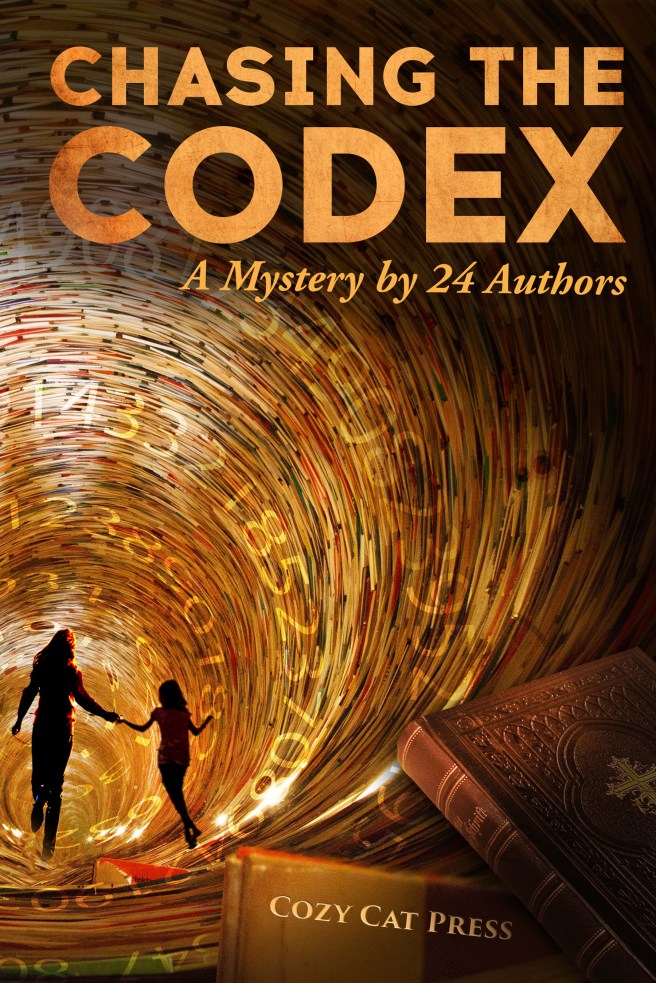
Riddle: How may authors does it take to write a cozy mystery? In the case of “Chasing the Codex,” that would be 24 authors/writing teams.

CHASING-THE-CODEX_fin

That’s right. “Codex” is not a short story anthology but one novel-length story of a bookstore owner and her teen age niece unwittingly pulled into a caper of murder, kidnapping, antique books and hidden treasure.

The idea for the book came from Patricia Rockwell, the founder/publisher/editor of Cozy Cat Press and an author in her own right. She was looking for a way to promote as many CCP authors as possible on a limited budget; hence, a book that would showcase the various talents and writing styles at once.

To get the ball rolling (and the ink flowing), Patricia sent out a request for authors willing to participate. Each author/writing team would write one chapter, carrying the story forward from the previous pages. Authors were assigned chapters in alphabetical order by their last names; I wrote chapter three. Since CCP only publishes cozies, all of the authors were on the same “wavelength.” Attempting to write a group mystery with scribes of various genres (cozy, noir, thriller, true crime) would never work.

Patricia didn’t tell us the story to write. She let the chapter one author create the protagonist, the setting and the beginning action.

In writing my chapter, I re-read the previous chapters to get a feel for the characters and how the plot was moving. I created two new characters; one I liked so much I plan to use him in my next book. I threw in what I thought might be a vital clue. I was pleased to see my characters pop up in later chapters.

As each author turned in a chapter, Patricia emailed that work so everyone could see how the story was progressing. Having many eyes on the project helped, as I spotted a continuity error in a later chapter. A character had locked a door, and a few pages later someone rushed out that same door without taking time to unlock it.

About halfway through writing process, one of the authors made up a list of the characters and summarized the story for the remaining writers. As the story grew, it became difficult to keep track of who’s who and the plot points. With so many cooks in the kitchen, the plot didn’t digress too much off the track.

When the last chapter (which I haven’t read yet) was finished, Patricia hired an editor with fresh eyes to work on the ms., correcting errors and smoothing out any inconsistencies.

For the book cover, Patricia contacted a website that offers design contests. A number of designers submitted their proposals for the cover art and the authors voted on their favorites.

I’m proud I was part of the project. I stretched my writing muscles in that I was working on a story someone else had created. Writing one chapter took far less effort and time than working on an entire book. And hopefully, readers will have as much fun enjoying the book as the writing team and our illustrious publisher had in preparing it.