

The Dilemma of the Little-Known Author

Note: This a pre-Covid memory, so don’t be alarmed at the close proximity of strangers mentioned in this post. Remember those days when we weren’t afraid of breathing the same air?

“Hi, I’m Rae Ellen Lee, an internationally unknown author,” my friend says to the bicycle rider who has stopped to chat with us in a Utah canyon.

Rae Ellen Lee is a fellow author and artist, and she’s more forward and much funnier than I am, and I love this line. It cuts through the embarrassing back-and-forth that, for me, usually goes something like this:

Me: “I’m an author. I write mysteries and romantic suspense.”

Polite Stranger: “That’s great!” Then, peering at me with curiosity, “Would I have heard of you?”

Me (mortified): “Probably not. My publisher never promoted my books.” (Unsaid: And I’m obviously a total nincompoop when it comes to marketing, still true now even after I took back my rights and self-published.) “But here’s a card describing my books.” (Nervous laugh.) “Do me a favor and leave it in a public place.”

Sigh. It’s such a dilemma. How and when does a clueless introvert author make herself known to new readers? Personally, I avoid anyone who constantly hawks herself or her products; why would anyone appreciate that? But I don’t have a big family-and-friends network out there supporting me, and I can’t afford to advertise in expensive venues. I write outdoorsy animal lover mysteries and although many hikers and nature enthusiasts are big readers like me, we outdoorsy animal lover types don’t tend to sit around chatting on social media.

So when I pass up the opportunity to tell a friendly stranger that I’m an author, I never know whether to feel like I’m being just a nice normal person or some sort of expert self-defeating anti-preneur. So I generally say something only half the time and almost always end up feeling like a complete loser.

A couple of days after meeting the bicyclist, as I ride the shuttle from St. George to the Las Vegas airport, I chat with my very nice seatmate. We talk about Utah and other places we have visited, and after a while, she mentions that she reads constantly. Aha-an opening! I tell her I am a voracious reader, too. And then she says she likes mysteries. Feeling like a hunter with a deer in the crosshairs, I tell her I am a mystery author, pull out my card that describes my books, and hand it over. She says she’ll definitely look for my books.

Later, at the airport, I share a restaurant table with an interesting man from Germany who has been visiting all the western parks. I love Germans; they are such adventurers, and like me, many are enthusiastic about the American West, its culture and its beautiful wild places. We talk about places he visited on this trip (he flew to the Cook Islands, too!) and a bit about how Americans and Cook Islanders eat unhealthy diets and will pay for that in the long run, and briefly agree on how politics need to move away from the current all-about-the-profit mode to the work-for-the-common-good mode.

Close-up of magnifying glass focusing on two people

Of course, while we talk, I’m thinking, do I tell him I’m an author and three of my books are published in Germany? Would that be a typical it’s-all-about-me American move? Besides, he’d probably ask me the name of my books there, and my cards are all in English. I can’t even spell the German titles, let alone pronounce them. Nor could I cough up the name of the German publisher. So we part politely without exchanging names and wander off to catch our separate flights back home.

From now on, I’m borrowing Rae Ellen’s line: “Hi, I’m Pamela Beason, an internationally unknown author.”

And I’ll keep using it until a stranger says, “Oh, I know that name! I love your books!”
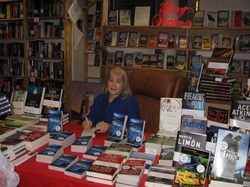
I really am an author! This is me signing books at Seattle Mystery Bookshop
I’m not lying. Really, I am an author. Here I am years ago, signing books at the Seattle Mystery Bookshop, which, sadly, no longer exists. I have 13 novels in print and ebook forms today. Really!

Will We Ever Evolve?

All fiction writers would like our novels to be considered timeless, so when we incorporate historical events or trends into our stories, we often fret that although that makes a story seem more currently relevant, our books could be considered “dated” as the years pass.

However, with my Sam Westin mysteries, I have found that hasn’t been a problem. And that is, frankly, disturbing. My first book, Endangered, was published a decade ago. Its theme of the media and the public inflaming each other to the detriment of truth is still all too relevant, as we have all watched Twitter and Facebook and even television channels spread misinformation to capture the headlines and the public’s attention on a daily basis.

The second book, Bear Bait, originally published in 2012, features armed, racist, anti-government movements intent on perpetrating violent acts against government employees across the nation. Hmmm. Have we seen anything like that lately?

The third book, Undercurrents, includes two parallel stories, one in the Galapagos Islands and the other in Arizona, both with villains fueled by malice toward foreigners coming into their countries. That anti-foreigner attitude clearly hasn’t changed, as our recent leadership seemed hell bent on building a wall on our southern border and tried to prevent travelers from Muslim countries from entering the U.S.

I did manage to more or less escape the political arena for the fourth book, Backcountry, which deals with the effects of the murders of two women hikers. I say “more or less” because the story does include a lot of issues with guns in the wilderness. Sadly, murder is a recurring theme throughout human history.

Then, after a trip to the aforementioned wall along the U.S./Mexico border, I just had to write about the crimes, the environmental destruction, and the ruin of so many lives and livelihoods in that area in Borderland. And all those issues will no doubt affect Americans for decades to come.

I’ve also written the Run for Your Life trilogy (Race with Danger, Race to Truth, Race for Justice), about a champion teenage endurance racer who is living under an assumed identity because of the unsolved murders of her parents, who worked for a pharmaceutical company that supplies vaccines for a continuously evolving virus. Yeesh. I wrote those books between 2015 and 2018.

What does it all mean? That Americans, or maybe even humans, are incapable of evolving? Are we stuck in some sort of endless loop, doomed to forever repeat the cycles of hate and violence? Whether we’re discussing sports or religion or politics or wearing masks in a pandemic, we can’t seem to get beyond some sort of “us against them” attitude. It’s all a bit depressing. But it’s also good fodder for fiction.

And then, just yesterday, I watched a woman become vice president for the first time 100 years after women won the vote in this country. That milestone has been slow in coming, but it offers a spark of hope for the future. Which is also good fodder for fiction.

To Make Things as Awkward as Possible, I Created a Male Protagonist

Let’s face it, nobody can know what it’s like inside another person’s mind or body, so why create protagonists of the opposite gender?

In my Summer “Sam” Westin mysteries, my protagonist is female, and we’re so much alike that many people confuse her with me, which is somewhat understandable because, like Sam, I am a scuba diver/kayaker/hiker, although it amazed me that one reader thought I’d actually barely rescued myself from death at the top of a waterfall. If I was as death-defying as Sam, I’d probably be, well … dead. But Sam and Pam are very similar in many ways, so her character is easy for me to write. Although Sam is often socially awkward, she’s at home in the wilderness setting, and so am I.

On the other hand, when I set out to write my first Neema mystery, The Only Witness, I wanted to set the story of a signing gorilla witnessing a major crime in the most awkward place possible: a conservative, gossipy small town that is not open to the idea that an ape might have something to “say.” I also wanted my detective character to feel awkward in the setting, so I made that character a big-city transplant whose spouse deserted their marriage for a local love shortly after their move. I knew I wanted to include teenage mothers in this story of a missing baby. So, which gender should the detective be?

Husbands leaving their wives for younger models is an all-too-common story in real life. So, I decided that a man would probably be more embarrassed by that happening to him. And it seems to me (rightfully or not) that more women are open to the idea of animal intelligence than men, so I created Matthew Finn, a detective who moved from Chicago to the small hometown of his younger wife because she thought it was a wonderful place to start a family. And then she runs off with her old sweetheart, leaving Matt, who is decidedly not an animal lover (in the beginning), with her two cats and a huge dog. And then, after a teen mom’s baby goes missing, a gorilla unexpectedly enters the scene, and she may be his only witness.

All eyes are on Detective Finn. The town hosts a small college that teaches broadcast communications, and amateur reporters are following him everywhere. Strangers tell him they’re sorry about his wife, and try to set him up with an available woman. To solve the case, he needs to interview a bevy of young teenage girls in this uncomfortable #Me-Too era. And talk to a gorilla? How much more awkward can the situation get?

Yep, the situation definitely called for a man.

What I Do When I Hit the Brick Wall

Once, when I was whining about how difficult it was to be discovered as an author, my mother remarked, “Well, you must like hitting your head against a brick wall.” (Such support, right?) Of course, she meant that I could do much easier things instead of trying to publish novels.

It’s always hard to be an author, and at least for me, with all the Covid restrictions these days, it seems even harder now. Although I long to escape to another world and another life, most days my brain seems incapable of creating that fictional place and story.

When I speak to high school students about the writing life, I ask them to name the most important trait needed to become a successful author. They guess aspects like “good grammar” and “imagination,” which are important, but not the most important. The correct answer is “self-discipline.” Nobody makes a novelist work forty hours a week. There’s usually no guarantee of payoff for all the hours we put into assembling words into stories. We have to make ourselves sit down and write and edit and finish a book. And then most of us have to make ourselves market that book, too. So, as we toil away at our computers and rearrange endless Post-It notes or Scrivener outlines, it’s all too easy to hit the wall and simply not want to continue.

I smash into that dang wall on a pretty regular basis. I get stuck on plots. I decide my writing is total crap. I’m almost always certain I don’t have a clue how to market a book.  Sometimes I don’t even how to finish the freaking story.

But I know I want to try. So, I back up from that wall, bandage my injuries, then take a long solo walk or paddle my kayak around the bay. Some evenings, I’ve been known to have several glasses of wine and feel sorry for myself. But I allow myself only a day to wallow in self-pity. The next day, I suck down several cups of good coffee and get to work on employing these techniques for getting over or around that invisible barricade.

To help with writing:

  • I read a mystery that I love that is similar to what I’m trying to write, and make notes about what happens in each chapter. This must be a book that I’ve read at least once before, because I don’t want to get so involved in the story that I can’t see the structure. I’m not going to copy the plot or characters, but taking notes about the structure allows me to see how the author built the story. Then I can often see where I am going wrong, usually by telling too much too soon, or straying off on some tangent that kills the suspense.
  • I watch a movie in the same genre and take notes of the scenes to accomplish the same goal I described above. Again, this should be a movie I’ve seen before, so I don’t get too wrapped up in what’s going to happen next.
  • I read an instructional book on writing mysteries. Yes, I know all this stuff, but I need to be reminded over and over again.
  • I brainstorm with another writer, asking for criticism of my story and for any and all ideas for improvement, no matter how wacky. It’s easy to lose all objectivity about your own writing, and it’s also easy to fall into a rut, so you need to seek out the ideas and opinions of others. I generally don’t end up using most ideas presented to me, but brainstorming sessions open my brain to new possibilities.
  • I practice writing the short description for the story that will go on Amazon or on the back of the book. This is always an agonizing exercise for me, but it often causes me to focus on what the heck the story is really about.

To help with marketing:

  • I Google other authors who are similar to me and look at what they do on social media and their author websites and such.  Since I am an indie author now, I mostly look at other indie authors, because traditional publishers have larger advertising budgets and more marketing opportunities than most indies do.
  • I ask other mystery authors at my level (or slightly above) and in my genre which marketing techniques and advertising sites have worked for them. I write mysteries, so it won’t help much to ask a nonfiction author or a romance or fantasy author; I’m seeking ideas on what works for marketing mysteries.

The process of writing, editing, and marketing a book takes a long time for most of us. I meet many writers who finished writing a story but did not bother to proofread or polish it, uploaded the rough version to the internet, and then got frustrated and bitter when that effort did not result in massive sales. I call this group “hobby writers.” They aren’t yet professional authors. Professional authors know that writing and marketing books is work, and they are willing to put in the days to push on when they hit the wall. The process doesn’t necessarily get easier with each book, but we know that when that barricade inevitably looms in front of us, we will find a way to get around it.

And now, for a little chaos…

I became a “Lady” (although I’m not sure I’ve ever been called that before) only a few days ago, so I’m going to introduce myself today. My path through life has been a meandering one. I have worked as a translator, a mechanical and architectural drafter, a technical writer and editor, a senior editor of a multimedia department, and a private investigator, and of course an author. I’ve been both traditionally and indie published, with 11 “how-to” books and 13 full-length works of fiction, along with a few advice ebooks, short stories, and two dust-collecting screenplays. I paint, do western line dance, hike, kayak, snowshoe, and sometimes scuba dive. I’m originally from the Kansas hills (yes, there are hills in some parts), but I’ve called the Pacific Northwest home now for decades.

All this chaos might explain how I’ve ended up with four different mystery series. (What was I thinking?) My Sam Westin wilderness mysteries are about crimes on public lands. Wilderness and wild animals are my biggest passions in life, and I spend a lot of time hiking and kayaking in wild places. There are so many ways to get into trouble “out there,” and calling 9-1-1 is not going to bring help any time soon, so suspense is naturally built into the setting.

My Neema series revolves around a gorilla who has been taught sign language. When I worked as a PI, my cases sometimes involved testimony from young children, so I’ve done a lot of thinking about who makes a credible witness. I’ve always been fascinated by animal intelligence, and a gorilla is estimated to have the intelligence of a five-year-old child. My poor human detective soon learns that while Neema knows some sign language, she doesn’t think like a person, and she doesn’t have a large vocabulary. So, when Neema offers clues like “skin bracelet” and “tree candy,” it’s up to the humans to figure out what this gorilla could possibly be trying to say. I didn’t intend for Neema to star in a series, but when readers loved The Only Witness, I had to write two more books.

I wrote the Run for Your Life trilogy for anyone who loves the Hunger Games books. I was inspired by the incredible young female athletes we see today. The protagonist, Tanzania Grey, 17 years old in the first book, is a champion runner who competes in extreme endurance races around the world, while living under a false identity and trying to evade the unidentified killers who murdered her parents.

The Langston Family Stories include Shaken, about a young, dark half-Hispanic woman managing a plant nursery she inherited after her father’s sudden death. The business has been plagued by an earthquake, vandalism, and arson. With so many damage claims, Elisa Langston becomes the target of an insurance investigation. As a PI, I am well aware of how hard it is to defend yourself after you’re accused (or even suspected) of a crime. Again deals with Elisa’s adoptive mother, Gail Langston, who lost three lovers (most recently, Elisa’s father) to violent deaths, so she’s afraid to love again. A handsome EMT, Leon, is pursuing Gail, but another person is shadowing her, too—a psychotic woman who wants Leon for her own. Eventually, I’ll write book #3 about Charlie, Gail’s beautiful blond biological daughter and Elisa’s stepsister.

Feel free to check out my writing on https://pamelabeason.com. I look forward to sharing my fractured imaginings with you all in more coherent future posts.